Showing posts with label Joe Morgan. Show all posts

Friday, June 30, 2023

Ed Romero 1988 Fleer

Sometime in the last two or three months, I received this card from the Baseball Card Bandit (BCB). By the way, this is a great look at the 75th anniversary patch of Fenway Park  that the Sox wore in 1987:


Even when I was a kid, I knew that not everyone on a baseball team was drafted and brought up through the minor leagues by the team that they now played on. There were agencies to improve teams, like free agent signings and trades.


Trades were always the cooler of the two options, any moron could splash a pile of money in front of a guy and say, “Play for us, you disgusting Hessian here’s your filthy lucre.” And nine times out of ten, that player would take the cash. BTW, there is no judgement or shame in the preceding sentences, every single one of us would (and do) the same things every day in our lives.


Who doesn’t want to get paid?


But trades were a gentlemanly pursuit of excellence, a General Manager needed a bit more deft and cunning to outsmart his cohort. The ability to watch a team other than your own and say, “That chap there looks like he can certainly help our outfit!” and then contact his employer with a proposal to bring him to your team—without sacrificing too much—that takes the steady nerve of riverboat gambler.


The ability to really want something, let someone know you really want something and then not give everything you own to have that something—often in a time of extreme need—is a skill that most people don’t possess. If you’ve played cards with me before, you already know that I don’t have it.


This is a long road to saying that former Red Sox infielder Ed Romero was one of the first players that I remember seeing in the day’s current set of baseball cards (not this one) pictured for his old team while watching him on TV with his new team. I was well aware that the Red Sox got Don Baylor from the Yankees for Mike Easler in a seldom-seen swap between the two franchises Also add in that it was one-for-one position-for-position trade and this was a landmark deal that weighed heavily for Boston.


But Ed Romero? When did we get him? (December 11, 1985) Who did we give up to get him? (Workhorse, but oft maligned, reliever Mark “Big Foot” Clear – I have no idea why they called him that) What is he going to do for us, we already have Marty Barrett and Glen Hoffman plus future shortstop Rey Quinones is rocketing through the minors? Why do we need him? (Because Quinones flopped, Hoffman wasn’t much better when he wasn’t hurt and you need backup infielders because players get tired; though Manager John McNamara might not agree with that last statement)


Romero came over to the Sox from the Milwaukee Brewers, the only franchise he had ever known, and was kinda not great for his three-and-a-half years with the team. His totals were .236/.287/.280 with two home runs and two stolen bases (and four caught stealings). For a guy that played 12 years in the bigs (no small feat) but couldn’t really hit (.247/.298/.302) or run, Romero must’ve been a really good glove man.


I have no recollection of that. But I mean, he must’ve been. Why would you keep Ed Romero around for more than a decade if he couldn’t do at least one thing well? So let’s assume that he was a versatile (he played every defensive position—including DH!—except pitcher and catcher, according to Wikipedia) glove first ball player.


He played on two World Series teams, 1982 with the Brewers (he didn’t play in the Series) and 1986 with the Sox, and lost both of them. I wonder if he thinks about that a lot? I mean it’s cool to say that you were in the World Series, and doubly cool to say that you were in two World Series but the next questions are always: how did your teams do? We lost both. How did you do? I got one at bat in one game and didn’t get a hit.


Maybe it’s not something he brings up too often while at dinner parties.


The one thing that I remember most about Romero was the Gatorade bucket incident. I didn’t recall all of the particulars, but the Athletic did. Apparently the Sox were playing the Yanks in June 1989 and were getting beat 7-2. All of a sudden things started clicking for the good guys and the score was tied. Romero came to the dish with the winning run on first, facing Dale Mohorcic.


The right-handed Mohorcic started the right-handed hitter off with three straight balls when Yankees manager Dallas Green felt like he had seen enough. He summoned another right hander, Scott Nielsen, to try and get the dangerous Romero out. At this point Red Sox Manager Joe Morgan decided it was time to put his genius into action and sent up the left-handed Rich Gedman (who was probably hitting as bad or worse than Romero at the time) to win the ball game!


I mean, this is a move straight from Monty Burns. It’s called playing the percentages! It always works—just like telling Daryl Strawberry to hit a homer. Gedman walked, Jody Reed grounded out and the Yankees won after getting a run in the eighth inning.


But the big incident was Romero going insane and throwing a Gatorade bucket on the field. He was incensed that Morgan would show him up like that. I remember columnists lit into him and whenever TV stations ran sports bloopers, that was always on one of the reels. 


From what I've heard Romero, was a pretty mild-mannered guy, so I wonder what his teammates thought? I know that they called him "Gator" for a bit, which must've made Mike Greenwell mad as that was his weirdo nickname. But I think that they had to have sided with him because that was a bullshit move that Morgan pulled. And I bet Morgan would agree. 


Morgan, who was interviewed for the Athletic piece, said that he understood why Romero would react that way but that he (Morgan) “made crazy move (like that) once in a while”, which would’ve have driven today’s baseball fans insane. Morgan said that Romero paid the $50 fine right after the game and they never spoke about the incident again.


I recall that Romero was released like a week later, but it was a little longer than that. His employment with the Red Sox ended on August 5, 1989. From there he played with the Braves, the Brewers (again) and the Tigers. Finally retiring in 1992.


Romero is a baseball lifer and has been bouncing around various leagues with various jobs, I would assume that he’s retired. But you know who’s not? His son, Eddie. Eddie Romero has been in the Red Sox front office since 2006, currently an executive vice president and assistant general manager.


Not a bad deal at all.

Thursday, June 22, 2023

Dana Kiecker 1991 Fleer

Sometime in the last two or three months, I received this card from the Baseball Card Bandit (BCB):


I bet that you don’t think about the 1990 Boston Red Sox all too much.


You're not alone if you don't, they weren't a particularly memorable team. 


I mean, they weren’t a bad team, they won the American League East but got mowed down by the Oakland Athletics in the American League Championship Series 4-0. If you remembered this series or this team at all, this was the one where staff ace Roger Clemens talked shit to home plate umpire Terry Cooney in Game Four in the second inning and got himself tossed. Clemens claimed he was talking to his glove, which what?, and Cooney said he was sure that Clemens was talking to him. Clemens had to be dragged off the field (he went crazy), Manager Joe Morgan was ejected as was second baseman Marty Barrett who was so incensed that he started chucking stuff onto the field.


Clemens was wound up pretty tight for his Game 1 rematch against Dave Stewart (who almost always kicked his ass).To pump himself up for the do-or-die game, Clemens applied thick eye black and tied his shoes with Teenage Mutant Ninja Turtle shoe laces*. It was dumb.

* I’m not sure why this last bit of information is stuck in my head, nor do I understand how cartoon turtle shoe lacers makes a pitcher pitch better, but it didn’t work. Clemens got bombed, like he usually did against the A’s, and the Sox were swept.

That year’s Sox team wasn’t an all-timer. In the late 80s/early 90s, most of the talent was in the American League West—the 1991 AL West is the only division where everyone finished at or above .500 (the last place Angels were 81-81 that year). The American League East was sort of like the AL Central this year, someone has to win. The Blue Jays were a year away from making the trade that would add the heart and soul of their mini dynasty (Joe Carter and Roberto Alomar), the Yankees sucked, the Indians were young and terrible, the Brewers were mediocre, the Tigers were old and the Orioles were flat-out bad. Thus the Red Sox were the sacrificial lambs that were slaughtered by the A’s*.


In the entire series, the Red Sox scored four runs—literally one per game.


* I’ve said it before, but I loved those A’s teams. They had pitching, they had hitting, they had power, they had speed and they had duende. The stars that were on that team were amazing: Canseco, McGwire, Rickey, Hendu, Lansford, Baines, McGee, Eckersley, Stewart, Welch, Steinbach. Thirty-three years later and I’m still shocked that the Cincinnati Reds beat them.


You might not remember that team too much but you know who thinks about that 1990 Boston Red Sox team a lot? Dana Kiecker. Drafted by the Sox in 1983, the Sleepy Eye Minnesota (and how about that name for a hometown) native spent seven years languishing in the Boston farm system until he got his shot in 1990.


And you know what? He wasn’t too bad. He pitched 152 innings, finished 8-9 with a 3.97 ERA and didn’t walk a ton (54) but didn’t strike out a bunch either (93) though he did give up a ton of hits (145). He was a perfectly cromulent fifth starter on a decent team. He wasn’t someone that you’d build your staff around and he wasn’t someone that you could count on for consistently great performances, but it seems that he could play.


Only he really couldn’t. He started for the team in 1991 and was hammered: 18 games, 7.36 ERA, 56 hits in 40 innings with 23 walks and 21 strikeouts. The reason for his awful stats may have been due to a sore elbow, which he spent a majority of the year in Pawtucket rehabbing. His year was dreadful and he was never heard from (Major League wise) again. He signed a minor league deal with Cleveland in 1992 and was invited to spring training with his home state Twins in 1993 before retiring due to elbow soreness.


Not surprisingly Kiecker’s high water mark occurred in 1990 when he had the best game of his life. Down one game to none, he pitched really well against the A’s in Game 2 in Boston: (5.2IP, 6H, 1R) and left the game with the score tied 1-1 against A’s starter Bob Welch who won 27 games and took home the Cy Young Award that year. The Sox would eventually lose, but it wasn’t through any fault of his. Greg Harris took the loss as the A’s didn’t slam the Sox but instead bled the Boston bullpen on bloops and singles. Death by a thousand papercuts.


The one thing that I recalled reading about Kiecker back in the day (and that Wikipedia reminded me) was that he worked for UPS in the offseason while in the minors. After MLB, he went back to UPS and became an Enterprise Accounts Manager and was the pitching coach at Dakota County Technical College.


I wonder how many times he told co-workers that he was a Major Leaguer? Better yet, I wonder how many of those co-workers believed him. Maybe he kept this particular card in his wallet and would show it when that wry smile would show up on that face of someone who didn’t trust his word, “Suuuuuurrree you did Dana. And I used to be a running back for the Minnesota Vikings!”


But Kiecker lived the dream. Even if it was only for a short time. For one year he gave it his all and he was about as close as you could get to playing in the World Series. A year in the Major Leagues. Even if the price was being awful and hurt the following year it’s a trade any baseball fan would make in a second.


How often do you think about that year though? Every minute of every day? What does it feel like to climb that mountain, make it to the top and then have everything come crashing down? I say that I’d make that trade in a second, but the thoughts of that year must be maddening for the rest of your life.


I hope that he found some peace and perspective and is able to say that his job never defined him.


Wednesday, March 01, 2023

Jim Rice 1988 Fleer

 Sometime in January 2023 I received this card from the Baseball Card Bandit (BCB):


Jim Rice was my first favorite baseball player. This is strange mainly because I don't ever recall him doing anything really awesome in my formative years as a baseball fan. I became a huge baseball fan in 1986, mostly because Roger Clemens went super nova that spring and summer and the Boston Red Sox were streaking their way to the pennant. 

Prior to that year, I liked baseball, I just wasn't obsessed with it. I played Little League, I watched the Baseball Bunch, I vaguely remember watching the San Diego Padres/Detroit Tigers World Series at my grandparents' place in 1984 and of course, I'd watch a few innings of the Sox when there weren't any cartoons on. 

When I think back to those years, I remember thinking about Jim Rice and how awesome he was. I just can't tell you why I felt that way. I can tell you how mad I'd get when my father would say that his license plate should be: "6-4-3". I can tell you I'd get even more furious when he had to explain the joke. 

Maybe it was because Rice was the de facto star of those early 80s teams and the club seemed to revolve around him. Though it's more likely that to a ten-year-old, Rice seemed impossobly big--almost like a superhero--but one who could hit home runs over the net in Fenway and onto the street. 

 There are human beings that can hit a ball entirely out of a Major League park? And they play for the team that I root for? I thought that he was awesome. 

By the time that this card was released, Rice wasn't hitting that many home runs any more. And the ones he hit were arching parabolas that landed on Lansdowne Street. His last really good year was the aforementioned magical year of 1986 when he finished second in the league's Most Value Player voting to Roger Clemens. 

In 1987 when he was 34-years-old, he was an average ball player. In 1988, below average and in 1989, even worse than that. Baseball is a game where if you aren't downing or injecting enough drugs to power the 1972 East German weightlifting team, the fall from the cliff is swift and far--especially if you were a star. 

There were a lot of whispers that Rice wasn't really motivated to stay in baseball shape (the dude was always pretty cut, so I'm not sure where that was coming from) and preferred to golf rather than work on his swing. Another rumor was that Rice really, really needed eye glasses to pick up the ball and his ego wouldn't allow him to put them on. 

Whatever the reason was Rice was no longer "the most feared hitter in the American League"--a moniker he had in the late 70s through the 80s. In 1987, that entire Red Sox team got a facelift; veterans like Don Baylor, Bill Buckner and Dave Henderson were either traded for parts or released. Kids like Ellis Burks, John Marzano, Sam Horn and Todd Benzinger took their spots in the lineup. New left fielder Mike Greenwell took Rice's position, exiling the former slugger to part time Designated Hitter, a role he shared that season with Horn.

In 1988 the Sox made a surprise run after manager John McNamara got the gate at the All-Star break. Working-class hero Joe Morgan took over the team on an interim basis and the Sox did so well that they found themselves at the top of the AL East standings and Morgan was named full-time manager of the Sox. 

During this streak, every move Morgan made seemed to turn to gold so when he sent up light-hitting shortstop Spike Owen to hit for Rice during a tight ballgame, Rice was pissed. They got into a shoving match in the tunnel to the clubhouse, which was caught by TV cameras and Morgan is quoted as yelling, "I'M THE MANAGER OF THIS NINE!" which is both kind of a badass thing to say to a guy that is strong enough to rip you apart with his bare hands, but also kinda corny too. 

Since Morgan was winning, a local guy (he drove a snow plow during the winter which made the people around here absolutely love him) and was white, Rice got a lot of shit for not being a "team player", playing the game "gracefully" and not following Morgan's orders. BTW, I can't remember what Owen did in that at bat, that 88 team was bananas, so Owen could have taken the guy deep and the Sox might have won. I have no clue. 

BTW, I'm not saying the Morgan was wrong here. Rice should have handled this much better, but the reaction from the fans was a little insane. 

From that point on, Bostonians were done with Jim Rice. He made too much money, he was too old and he was a bit too mouthy. He hung on for another year and during the last weeks of the 1989 season it was announced that Rice was hanging up his cleats. The Red Sox asked him to share a retirement ceremony with long-time teammate Bob Stanley which made Rice angry. 

 I wrote about this in my last entry on Bob Stanley that that was a shit thing for the Sox to do and if I was Rice, I'd be angry too. Hell, if I was Stanley, I'd be pissed. You can have two retirement ceremonies, no one is going to give a shit. Especially for that dead ass team. 

When he was a player, Rice didn't talk too much. He was described by the almost entirely white Boston press corps as "sullen and rude", the guy didn't make their jobs easier. And why should he? As the star of the club (pre Clemens and Wade Boggs), Rice was a lightning rod. Everything he said became 50-point headlines. The amount of unconscious and conscious racism was huge during that time, dating back to when he and Fred Lynn both made their debuts together as the Gold Dust Twins. He was a quiet kid from South Carolina who was thrown into a racial tempest that was Boston in the 1970s. By the 80s, he probably just got sick of the whole thing and it's hard to blame the guy. 

When he retired Rice became the Sox hitting coach (honestly, he wasn't really great -- I don't recall any hitter saying that Rice helped them) and then in a surprise to many he went to NESN and became a Sox commentator. Before and after games he'd talk about what the Sox did and didn't do and he was actually kind of decent. He spoke with a lot of cliches but he looked like he was having some fun and, hey, I still like the guy a lot; so that was cool by me. 

It took Jim Rice 15 years to finally make it into Cooperstown. And for as much as I love the guy, he probably shouldn't be in there. His numbers are good, but are they really good? Compared to other Hall of Famers--as well as guys on the outside looking in like fellow 1978 MVP Dave Parker--he's on the low end of the HoF spectrum. But I'm okay with that. I'm a big Hall guy to begin with, so you can add another 25 guys to the hallowed halls of Cooperstown and I'd be fine with that. 

For as long as I've been aware of baseball, I've liked Jim Rice a lot. For a guy who was so excellent at baseball, he always seemed to me to be a bit of an underdog. Even when he was the unquestioned star, it seemed that the press and the fans were always looking for someone (usually whiter) else to hang their hat on. And I liked those dudes. As far as I'm concerned Jim Rice fucking ruled.

Tuesday, April 06, 2021

Larry Parrish 1989 Fleer

 On April 2, 2021 I received this card from the Baseball Card Bandit (BCB):


Larry Parrish was one of those guys. You know what I mean, he was the type of guy that was seemingly in every baseball card pack you opened. You looked at the front of his card for a minute, maybe you looked at the back of his card for a half-second and then you shove it back into the pile and keep flipping cards to see whether you got a Wally Joyner or a Bo Jackson or a Roger Clemens.


Unless you were a die-hard Expos or Rangers fan*, chances are you don’t remember Parrish all that much. But he was a beefy dude who played fourteen and a half seasons for Montreal and Texas. When I got around to noticing who he was, he looked like a stereotypical designated hitter; giant, slow, with a bit of a belly. Kind of like a softball player, a person who was seemingly born to DH, but at one point in his life, he had the mobility to be a third baseman and outfielder.


Life is a lot like that, you run into people at certain points in their lives and you think that’s who they’ve always been, but that’s not true. That Mom who’s always making stuff for the school bake sale? She was the bassist in a pretty decent riot grrrl band back in the 90s. The Dad who coaches your kid’s Little League team? He got black out drunk every weekend in college. You’re the guest star in their story, not that other way around. And that’s how it was for me and Larry Parrish. When he played in Boston he looked like a jacked up Alex P. Keaton; neat, short-haired almost like a Republican. But when he was in Montreal, he looked like Bill Lee's running mate, Grizzly Adams-type with a crazy beard and wild eyes. Beards were scary to me in the 1980s, Jeff Reardon (another former Expo to play for the Sox haunted my nightmares). Compare Parrish's card above to an early 80s card while an Expo below.


* As a Massachusetts native, I can’t think of no two more seemingly different, but very similar, outposts in Major League Baseball than Arlington, Texas and Montreal. Both teams were very anonymous, but on the fringes of being pretty good—Montreal was really good but they couldn’t put it together. They both wore powder blue away uniforms and crappy stadiums. Both had terrible weather (too cold in Canada, too hot in Texas) and they just seemed like teams that were around to fill out the league so that the Dodgers didn’t have to play the Cardinals every weekend and the Yankees didn’t have to play the Red Sox all the time--yet they were never on TV's Game of the Week. 


Did you know that Parrish was a two-time All-Star? It’s true, in 1979 and 1987 he made the mid-summer’s classic. The year after he made his second All-Star Game he was released by the Rangers in July and picked up by the Boston Red Sox about a week later. This was around the same time that John McNamara got canned and interim manager Joe Morgan was expected to keep the manager’s office warm until Lou Gorman could find a replacement skipper.


But Morgan kept winning and winning and winning that month, the Red Sox went on a tear and Morgan Magic was born. I remember when the Sox got Parrish he came to town, put on Don Baylor’s old number 25 (which seemed right, he reminded me a lot of a white Don Baylor), stood erect at the plate (he looked like he was seven feet tall and 250 pounds) and just started mashing.


In all, he hit seven home runs for the Sox that season and I bet six of them came within two weeks of his signing. After being discarded by the Rangers, all of a sudden he was as hot as the team he joined. You could tell that the Sox had captured the sports zeitgeist because in September, they made the cover of Sports Illustrated and one of the photos was an action shot of the newly acquired Parrish taking a hellacious cut and destroying a ball.


As the team lost their otherworldly momentum, so did Parrish. He finished a shade under .260, with seven homers, a .298 OBP (yuck) and a .424 slugging percentage. That wasn’t too bad for a 35-year-old, but I think that everyone knew that Larry was done. The good news was 1988 was Parrish’s second foray into the postseason (he was a member of the Blue Monday Expos in 1981), but the Sox were quickly run over by the Oakland A’s juggernaut and Parrish retired from the game after that season.


After he retired, he got back into baseball and was a coach for a few teams. Much like his last skipper, Parrish was named interim manager after his old Ranger pal Buddy Bell got the hook and rode a decent September 1998 (13-12, which was part of their overall 65-97 record) into becoming the new Tigers skipper the following year. The team was abysmal in the year of our Prince, 1999, and finished the season with a slightly better 69-92 record. But it wasn’t enough for the Tiger front office and he was not asked back to manage Detroit into the new Willenium.


As one of those guys, you don’t think of a Larry Parrish very much unless he somehow finds his way to your team. Then you think about him a lot. You can’t remember what life was like when Larry Parrish wasn’t holding down the DH position for the local nine. You see that weird stance every night, you open up Sports Illustrated and there he is the crisp, bright white Red Sox uniforms and you’re like “Damn, Larry Parrish was made to be a Boston Red Sock.”* You get all caught up in his hot streak and the team’s scorching three weeks and start believing that maybe Larry Parrish was the x-factor, the guy who the team needed to push them over the top. This is the year that the Red Sox are going to finally get that stupid monkey off their back. 


* I was so all-in on Larry Parrish that I bought his rookie card that summer. 


But, as they say, water finds its level and Parrish turned back into an old pumpkin. However, you still hold out hope that maybe at the end of September and into October, he has just a little more gas in the tank. Maybe he can put the team on his back and carry them for just a few more games—14 at the absolute most.


He doesn’t. Everyone knows that he’s cooked and he’s gone at the end of the year without much fanfare. After a bunch of years, you almost forget that Larry Parrish ever had a locker in the home clubhouse at Fenway Park, unless you’re tipping back beers with friends and talking about obscure Sox guys.


“How about Larry Parrish!”

“Lance Parrish never played with the Red Sox!”

“I don’t mean the Tigers catcher, I said LARRY Parrish!”

“Oh shit, yeah I remember him. He was pretty good for awhile back in 88, right?”

“Yup. He did some stuff.”


As a guy, it’s always good to be remembered for doing some stuff.


Monday, June 01, 2020

Steve Curry 1989 Fleer


Do you remember a time when we were able to leave our homes without masks? Do you remember a time when we could gather together in public places and shake hands or hug and didn't have to stand six feet from one another? I barely recall these days of long ago--actually it was at the end of February--but it was during this time that the Baseball Card Bandit emailed me (YES! EMAIL!) this card. I'm now only getting to writing about it mainly because I had time remembering Curry and wasn't sure what to say. 

Curry, who looks almost exactly like Deadspin founder Will Leitch, pitched three games in the summer of 1988. Curry pitched three games in his entire pro career, and here is his line: 0-1, 8.18 ERA, 11.0 innings. He gave up 15 hits, 10 runs, walked 14 (!) and struck out four. The only good thing is that he didn't give up a home run during his trio of starts. 

His first MLB appearance was July 10 and his last appearance was July 23. Do you know what this means? Steve Curry lost his first decision and his next two appearances he received no decisions. Let me explain. 

At the beginning of 1988, the Sox were scuffling along. 1986 World Series goat John McNamara was still the manager and it was apparent that he lost control of the club house. So Boston canned him right after the All-Star game. They negotiated to get a few high-profile managers, but in the interim they named Walpole, MA-native Joe Morgan (not that one) manager on July 14. The Sox ripped off a 12-game win streak that the press dubbed "Morgan Magic". 

I remember Morgan Magic and it was insane how the Sox were winning for those two weeks. It seemed as if every game was won in walk-off fashion. One out in the bottom of the tenth and Todd Benzinger hits a game-winning dinger off of Minnesota Twins reliever Keith Atherton*. It was crazy. The Sox would ride this hot streak into the fall before losing to the Oakland Athletics in the American League Championship Series. 

* I could have sworn that Benzinger hit his homer off of seemingly untouchable closer Jeff "The Terminator" Reardon, but apparently it was Atherton, which isn't as good of a story. 

Back to Curry, with his start on July 10, that may have been one of McNamara's final moves as a Red Sox manager. According to RetroSheet.org, Curry didn't pitch too badly in that game, losing 4-1 to the White Sox. He gave up four hits, three runs and walked seven--which sounds to me like the dude was nervous. 

His second start came against the Twins where he had a reverse split of walking only three (good!) but giving up seven hits (bad) in 4.1 innings. Lucky for Boston, they scored 11 runs and that took him off the hook. Though he wouldn't get the win because he didn't pitch five full innings. Just two more batters and you would have got the "W", dude! Damn. 

Curry last start was also against the White Sox and he gave up four hits and four walks but also five runs in a little over two innings. The Red Sox scored 11 and cranked out 20 hits. And that was it for Steve Curry. The bullpen and the offense saved his ass big time in two of his three starts, Morgan and General Manager Lou Gorman had apparently seen enough and he was banished to AAA Pawtucket and was never heard from again, which seems kind of crazy because he was only 22-years-old. 

A couple of things:

1. I have a feeling that Steve Curry was definitely rushed to the Big Leagues and completely spit the bit. He pretty much got his ass kicked, BUT he was in the Show and like I say, that's something that no one can take away from you, no matter how much you stink the place up. I'm really surprised that no one gave him at least one more shot, especially in 1993 when the league expanded and they needed pitchers. A 27-year-old Steve Curry couldn't have been handy to anyone? Really? 

2. It's kind of crazy to me that the 12-game winning streak had two starts by someone who pitched so damn poorly. Like I said above, I was under the impression that these games were mostly close--and according to the game logs they were as 8 of the 12 wins were decided by three runs or less--but they also scored a ton of runs too. I guess I forgot that the pitching staff gave up a bunch of runs too (44 in those 12 games, which isn't great considering that there was a Mike Smithson shutout mixed in there too (exactly who you would have thought). 

3. When I Googled "Steve Curry Boston Red Sox" I got his Wikipedia page and his Baseball-Reference.com page and that's it. The next bunch of links were about how Golden State Warrior future Hall of Famer, Steph Curry is a huge Red Sox fan. I kinda feel bad for the baseball playing Steve Curry, but that's the way it goes, I suppose. 

Hopefully the BCB drops more cards in the mail soon. Not email though. So impersonal. 

Tuesday, November 26, 2019

Joe Hesketh 1992 Fleer


Last week, I received this baseball card from the Baseball Card Bandit (BCB). Included with this card was a note printed on a missed message piece of paper. The note said, “Til we meet again for the first time.” I know that I alluded to this with the Terry Francona card from last week, but it appears to me that the BCB is all done. 

I know that the next question is, why? I think that the reason why is because the identity of the BCB was clumsily revealed to me two years ago at my brother’s wedding. While the name of the person was never verified, I think that he got the message that I know who it is. I’m not trying to be a tease, but I will not reveal the name until he is verified and he wants me to. 

If the game is over, I am legitimately bummed out about this. This has been a fun few years of getting random baseball cards, writing about the players on the front of the cards, exploring how baseball relates to life and how perceptions change over time. How you might look at a player one way in 1988 and then see that person in a completely different light in 2019. 

One of those players is the card that I received today, Joe Hesketh. If you think about Joe Hesketh at all—and aside from a username on SoSH it’s been a while since his name has invaded by cerebral cortex—mostly you might remember him as a fourth starter for some mediocre Red Sox teams. 

And aside from his first full year in Boston, that’s who he was.  

The 1991 season was a bit underrated in terms of interesting Red Sox seasons. They finished in second, behind the division-winning Blue Jays after completely falling apart late in the season. On Sunday, September 22, the Sox had two outs in the ninth against a bad Yankees team. Roberto Kelly was facing Jeff Reardon, who was protecting a one-run lead. Kelly loses the ball over the Wall and the Sox can’t score in the bottom of the ninth. Punching bags Matt Young and Dan Petry come in (there was no one left in the pen, I assume) and gives up two runs to the Bombers. The Sox bat in the 10th and Mo Vaughn rockets a two-out double, Jack Clark strikes out against Steve Farr and the Sox lose. 

This was the turning point of the season as Boston tailspins into a 3-10 record, which costs Joe Morgan his job. The Red Sox were pretty brutal in the next three seasons, finally bouncing back in the strike-shortened 1995 season. 

In 1991, Hesketh was pretty good swingman for the Sox. He appeared in 39 games, started 17 and went a career-high 12-4, with a 3.29 ERA with 104 strikeouts in 153.1 innings pitched. He also led the entire league in winning percentage (.750) that year, which is god damn amazing, if you ask me. If the Braves thought that he’d be this decent, they never would have released him in 1990. 

Confession time: I used to get Hesketh confused with another mediocre lefty National League reject named Joe from around that time, Joe Price.

This was it for the former Montreal Expo (side note: he was 10-5 for the Expos in 1985, which happened to be his rookie year, good for eighth in the ROY award) in terms of being a serviceable pitcher, as his next three years were pretty poor. The good news for Hesketh is that he had his career year at the best time for the perfect GM in the league, as Sox General Manager Lou Gorman felt that he had to sign him and gave him a three-year, $5.1 million-dollar deal. For that scratch, Hesketh rewarded his team with 19 wins and ERAs of 4.36, 5.06 and 4.26. 

I know that I’ve said this before, but it’s not the money that you give to the superstars that gets you fired, it’s the cash you dole out to the Joe Heskeths of the world. Gorman should have known that you can find a Joe Hesketh on every MLB roster and that he’d cost you nothing to aquire him. Also, Hesketh was 32-years-old in 1991, he wasn’t going to get better as he got older. And it was pretty obvious that he was going to get worse. 

I’m not saying that the Hesketh deal was what Gorman axed at the end of the 1994 season, but this—along with the rising star of Jeff Bagwell in Houston—had to be on the list. Joe Hesketh was a one-man heist movie. 

And while he pretty much stole $5 million from the Red Sox, good for him. The Sox should have known what they had in Hesketh, they shouldn’t have given him anything more than a one-year deal. If they wanted to give him a 1992 contract for $1.7 million in recognition of a good 1991 season, so be it. But there’s no need to get attached to a guy like this for real money. 

That’s all on Gorman. 

I think that’s something that fans need to understand.  A player is going to get as much money as they can. Teams need to have some sort of foresight and intelligence when it comes to deals like this. If they can’t help themselves, that’s their problems. I never understood why fans take the teams’ side when the teams gave out the contract. 

Oh well, I guess that’s as good of a rant as anything to go out on.  

In any event, it’s been a fun couple of years and hopefully I’ll get more cards. But if I don’t, I guess I’ll have to come up with a new project for me to write about and for you to read. Talk to you soon!

Friday, February 22, 2019

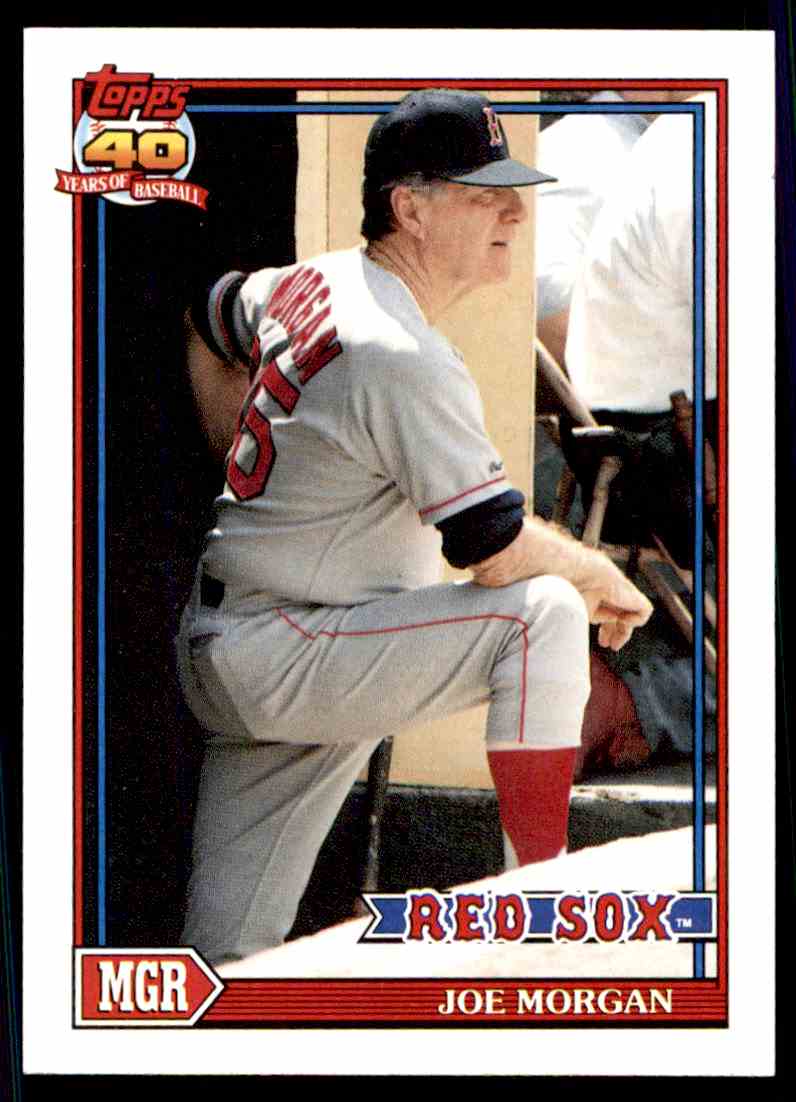
Joe Morgan 1991 Topps

Sometime in the last year or so I received this card but I'm not sure if it was from the Baseball Card Bandit (BCB):


This is a cool card of Morgan. I like the design, I like the shot, everything is just great about it. 

Until Terry Francona showed up, Joe Morgan (not that Joe Morgan) was probably the best Red Sox manager of my life as baseball fan. That lineup includes, chronologically:

1. Ralph Houk -- I don't remember much about him, but from what I've read he was pretty much on autopilot from the moment he showed up in his first spring in Winter Haven. 

2. John McNamara -- seemed like an asshole who got swallowed up in his biggest moment. 

3. Butch Hobson -- so out of his league, that his firing was almost a mercy firing. 

4. Kevin Kennedy -- thought he was the smartest, coolest guy in the room. He was not. 

5. Jimy Williams -- the exact opposite of Kennedy and was incredibly confounding with rules, line-ups and starting pitching. Was pretty good with his bullpen though. 

6. Joe Kerrigan -- lasted about three months and was so over his head as a manager, that it wasn't funny. 

7. Grady Little -- like McNamara, except without being an asshole. 

Morgan was named interim manager after McNamara got the gate in 1988. He was supposed to last a day or two at the most, the Sox were negotiating with Bob "Buck" Rodgers* I believe (for some reason I want to say Whitey Herzog was also in the mix, but that has to be wrong), but Morgan brought a breath of fresh air to the team and they kept winning. And winning. And winning. They ended up winning 12 games in a row and were practically unbeatable at home. Red Sox GM Lou Gorman had no choice but to name Morgan the permanent manager for the rest of the season. 

* Wikipedia said the Sox were looking at Joe Torre and Lou Piniella as their skippers. Which would have changed the course of baseball history.

Morgan's team -- and it was truly Morgan's team that year, he got in Jim Rice's face when he sent Spike Owen to pinch hit for the beleaguered slugger, yelling "I'm the manager of this nine!" -- ended up winning the American League East only to get demolished in the ALCS by the Oakland Athletics 4-0. 

People liked Morgan because he was from the area, he hailed from Walpole drove a snowplow in the offseason, but he also weird things, "Six, two and even" -- which I guess is a sign off from the Dick Tracy radio programs, often managed on hunches and didn't kiss anyone's ass, see the Rice example above. 

He ended up finishing third in 1989, winning the AL East in 1990 (where they were again swept by the A's in the ALCS) and finishing second in 1991. The 1991 season was an underrated heartbreak as Jeff Reardon gave up a late season, game winning homer to New York Yankee Roberto Kelly that sent a previously surging Boston team into a tailspin for the last two weeks of the year. Sox brass had seen enough as he and his career win-loss record of 301-262 were shown the door. In one of his exit interviews, he told reporters that the team wasn't very good and he was right, they finished last in 1992 under new manager Hobson. 

Morgan played with the Kansas City Athletics, Philadelphia Phillies, Pittsburgh Pirates and St. Louis Cardinals where he was a no-hit gloveman who bounced around the field. He was also a member of the Milwaukee Braves and would often come to the Boston Braves Historical Association's (BBHA) annual get togethers. I work with the BBHA and from what I've been told, he was awesome. A lot of times, he acted as the emcee for the dinners and was really cool. He told great stories, was funny and would hang around to talk to the fans. He truly seemed like a good guy.

For most of the 90s and into the 00s, many current Sox managers were compared to Morgan. Fans would call up Sports Radio begging for Morgan to be given his job back. I think that a lot of that had to do with him being a local guy. Even though New England is known as a place where a lot colleges are and has a reputation for being liberal and educated, there are a lot of people who like that blue-collar, no bullshit kind of guy. And Joe Morgan was definitely that. He would very matter-of-fact tell people his assessment of a player or the team and if it wasn't what they wanted to hear, so be it. 

I think that kind of honesty wears on folks you work with after awhile and maybe that's why Morgan got the gate. I know that Gorman said that Hobson was an up-and-coming minor league manager and even invoked the unholy boogey man that the Yankees were thinking of hiring him, but I think that was bullshit. My guess is that the front office just couldn't deal with a manager who didn't give a shit to what they wanted him to do and was incredibly popular with the fans. 

Six, two and even, indeed. 

Thursday, February 14, 2019

Randy Kutcher 1990 Topps

On May 1, 2018 I received this card from the Baseball Card Bandit (BCB):


On Facebook, I wrote: It’s been a little while,but the BCB dropped off another card a few days ago. This time it’s from Hong Kong and it’s for former Red Sox backup backup outfielder Randy Kutcher. 

If you don’t remember Randy Kutcher, I don’t blame you. I’d always confused him with Sox fourth outfielder Kevin Romine. Romine was a bit better though. Kutcher was dreadful. 

2019 Notes: in a few days you'll read a bit about Kevin Romine. For some reason the Sox were really intent on keeping two back-up outfielders in the late 80s. Kutcher played five years and finished with a 228/285/377 slash and 10 homers. Romine played seven years at 251/306/325 and seven dingers. These two players are practically the same, I'm not sure why one of them were on the Red Sox, never mind two. 

For some reason, I want to say that Kutcher was always whispered as the team's third-string catcher. And according to baseball-reference, he did catch! In 1989, Kutcher played one game (2.2 innings) as a catcher in the major leagues. Good for him. 

He didn’t do much for the Sox. He wasn’t fast, he didn’t hit with power—in 1989 he hit more triples (three) than homers (two), which is odd. For some reason he got 160 ABs that year and basically struck out a third of the time. Use that stat the next time someone tells you Joe Morgan was a genius. 

In 1989, that many strikeouts was a big deal. And also he barely walked. All-in-all Randy Kutcher pretty much sucked. However he was:

- traded by the Sox to the San Francisco Giants for Dave Henderson at the 1987 trade deadline, which definitely colored my view of Kutcher. Hendu was my favorite, I was devastated when they let him go. BTW, did you know that Hendu wore a “Fuck Boston” T-shirt under his uniform for the rest of his career? The fuck, Dave?

2019: when I read about Henderson -- and I can't recall exactly where I found this -- it really bugged me. From what I remember, he was beloved in Boston. Even when he sucked in 1987 (and Henderson was not good when he won the starting centerfield job that season) I don't recall anyone booing him. Maybe he was pissed off at Boston management, but then again GM Lou Gorman rescued him from Baseball Siberia, aka the Seattle Mariners. 

- he was born in Alaska. I bet him and Curt Schilling talked a lot about that during spring training before Curt was sent to Baltimore. At least I imagine they did. I sometimes used to make up fake baseball player conversations. 

2019: I can't recall any athlete whose star has fallen faster than Curt Schilling -- non double homicide division. I don't even want to get into his issues, it's just way too depressing. 

- in high school, one of my friends Christopher Graham Baird called him “Crater Faced” Kutcher. That was an appropriate and funny nickname. Kudos to you, Chris! Your nickname is more memorable than the player.

Tuesday, July 18, 2017

Brady Anderson 1988 Topps Traded


On May 23, 2016, I received the above card. Here is what I wrote about it on Facebook:

“After taking the weekend off the Baseball Card Bandit strikes (Ha! Baseball pun!) again. 
Good old Brady Anderson he lasted a little bit with the Red Sox, a little bit on steroids (allegedly) and a lot in our hearts. 
Kudos BCB.”

At the beginning of the 1988 season, the Boston Red Sox were floundering. Most of the rookies that were inserted during the previous season were experiencing sophomore slumps and the leftover veterans weren’t doing much better. For a young squad, they were a dead-ass team and they were going nowhere, fast.

In the middle of the season General Manager Lou Gorman knew a change was needed, so he fired field manager John McNamara and replaced him with Joe Morgan. At the time, the Sox were nine games behind the Detroit Tigers and the Morgan hire was supposed to last long enough for Gorman and Cardinals pitching coach Mike Roarke to work out a deal bringing him to Boston.

The Red Sox won Joe Morgan’s first game as a manager and proceeded to win 12 in a row. They also set a Major League record by winning 24 straight home games in a row too. For a team that was buried at the All-Star break, a month later the Red Sox were sitting on top of the American League East standings. Walpole Joe wasn’t going anywhere and Roarke never got a chance to manage in the bigs.

Now Gorman had to change direction and build for a playoff run. He sent Anderson, who played in 41 uninspiring games with the Sox at the beginning of the season, to the Baltimore Orioles for starting pitcher Mike Boddicker. The Sox sweetened the deal by adding Curt Schilling to the transaction too.

There are times when you’re over a barrel and you have to do something, and for Gorman this was one of those times (though it wouldn’t be the first time he got fleeced by an opposing GM). Boddicker pitched very well for the Red Sox for the next few years and in 1988 he was slotted behind Roger Clemens and Bruce Hurst as Boston’s number three pitcher. The Sox stumbled a bit in September, but held on to get crushed by the Oakland Athletics in four straight games in the American League Championship series.

Brady Anderson started slowly with the Orioles, this was the Orioles team that opened the season with 21 straight losses, so there wasn’t a lot of pressure on anyone to win right now. Anderson played a decent centerfield but didn’t hit over .231 or slug more than four home runs in the ensuing three seasons. In 1992, Anderson turned it on becoming an All-Star for the first time and jacking up his counting stats. He launched homers (21), stole bases (53) and went from being good-field, no-hit to good-field, good-hit. The Orioles found themselves a weapon.

The next two years, his numbers stayed about the same: mid-300s on base and mid-400s for slugging. But in 1996, Anderson went bananas, slamming 50 home runs on the season. It was a magical season for him, but it also brought a lot of eyeballs and suspicion.

His previous nine seasons, Anderson never came close to 30 home runs (21 was his high), never mind 50. Where did this power surge come from? When people talk about the Steroid Era, after you get past the Mark McGwires, Sammy Sosas and Barry Bondses, Brady Anderson’s name is usually the next one to be brought up. And I admit that it does look a little fishy. Brady Anderson was a speedy centerfielder type. He ran well, hit in the mid .260s and showed flashes of power. How did he hit 50 home runs?

I don’t know. All I know is that he did. If he did take steroids why did he only do so for one year? He wasn’t a free agent that season, he couldn’t shop his talent around until after the 1997 season – and he slumped big time then, only hitting 18 homers and seeing his slugging percentage tumble by 150 points. Wouldn’t it make sense to keep the juice going for one more year to quiet the nay-sayers and get an even bigger payday? It’s not like Major League Baseball even tested for steroids or anything, he could cycle whenever he felt like he needed a boost and goose his numbers higher and higher.

I don’t know and I think that’s why I’m not comfortable tossing him on the steroids pyre with the rest of the known steroids guys. Baseball is a funny game, every once in a while, players come along and outperform their career norms and then the next season they turn into a pumpkin. Before he gained fame as the manager who led the Mets to their last World Series victory, Davey Johnson hit 43 Ding Dong Johnsons for the Atlanta Braves in 1973. The following year he hit 15 and the year after that he hit zero. Prior to 1973, the second baseman’s career high was 18.

Things happen, sometimes the lightening you catch in the bottle lasts for the full season. Maybe that’s what happened to Brady Anderson.

The closest Anderson came to matching his career high in bombs was during the 1999 season when he hit 24. He was out of baseball three seasons later.

Did the Sox make the right move trading Anderson (and Schilling) for Boddicker? I say yes. Anderson was never going to be allowed to develop for four seasons in Boston. Fans would have been calling for his head by the end of the 1990 season. Plus, the Red Sox needed Mike Boddicker in 1988 and 1990. The Athletics lost to two huge underdogs the year that they crushed the Sox, so even though they looked infallible, they obviously weren’t unbeatable. Maybe if Clemens got Orel Hershiser or Jose Rijo hot, they could have snuck passed the A’s and played in the Series.

As far as Schilling goes, he got lit up in his stints with the Orioles and later the Astros, before he got his shit together with the Phillies. The Sox share the blame in not recognizing the talent of Schilling with Baltimore and Houston, but a lion’s share falls on Schilling’s shoulders too.

The story is, Schilling was messing around in a Houston gym during the winter when Roger Clemens was working out. Clemens saw what Schilling was doing and reamed him out and said that he was too good to be that bad. Schilling took the advice to heart and began to dedicate himself to pitching and all of the things that go along with it. The following year, he led the Phillies to the 1993 World Series.

Two quick thoughts:

The Red Sox did a pretty good job of scouting in the early 1980s: Mike Greenwell, Ellis Burks, Jody Reed, Todd Benzinger, Sam Horn, John Marzano, Brady Anderson, Jeff Bagwell, two-time All Star Scott Cooper, Tim Naehring, Mo Vaughn, John Valentin, Phil Plantier and John Flaherty all made the bigs and experienced a bunch sort of success. Schilling was about the only pitcher the Sox signed during this time that did anything.

I wonder how that compares to the late 60s/early 70s run of developed players: Jim Rice, Fred Lynn, Dwight Evans, Carlton Fisk, Ben Oglive, Cecil Cooper, Juan Beniquez, Ernie Whitt and Butch Hobson. Again, not a lot of pitchers in the mix here. But man, do the Sox scouts know how to pick hitters or what? Damn.

My parents brought my brother and I to a Sox/Orioles game in September 1988 and both of us were obsessed with getting autographs. We got to the park early and were trying to get someone, anyone to sign. My brother being smaller and more adventurous than me climbed on the Orioles dugout and stuck his head down and gave his and my baseball to someone for an autograph, who passed it along to some other guys before giving it back to my brother. I was excited about one signature: Brady Anderson, nonplussed about another: Joe Orsulak and upset with my brother for the third: Curt Schilling.

“Why did you get Schilling,” I asked. “He sucks. I’m glad you got Anderson because he’s going to the Hall of Fame, but we wasted a good spot on the ball for Schilling.”


Then, as now, I was a bit of a dick AND I act like I do, but I know nothing about baseball.