Showing posts with label Montreal Expos. Show all posts

Monday, October 28, 2024

My favorite stadiums Preamble-26

 Preamble:


Welcome to this year's countdown to The Real National Hot Dog Day. I hope you've been doing your exercises over the last month to stretch out those bellies because game time is almost here.
In counting down to the big day, one of the fun things I like to do get people hyped (do the kids still say "hyped"? I like to think they do) is to rank things from 30-1. Last year it was my favorite baseball teams, the year before it was Red Sox players. This year it's going to be stadiums (stadia?).
 
I've been to 29 different parks and I have thoughts on all of them, but there are 30 days until April 8. So what to do for today? I'm going to use this as a catch-all for the seven parks that I haven't seen and rank them from 7-1 in terms of ones that I want to see next. 
 
7. Tropicana Field. Florida sucks. Tampa sucks. And this stadium looks awful. Plus as we found out last year, the Rays are my least favorite team in MLB. If I wasn't such an OCD completest, I'd skip this one. But since I'm not, I'm going to go and sit with my arms crossed the entire time. That'll show 'em. Fun fact: do you know that NHL Lightning used to play their home games in this mausoleum? It's the house that (Brent) Gretzky built!
 
6. LoanDept Park. Up until 30 seconds ago, I had no idea of the name of the park that the Marlins play in. Now I do and it's as low-rent as the franchise. The two interesting things about the place: the psychedelic statue in center field and the aquariums behind home plate have been ripped out (by former CEO Derek "FUN!" Jeter) and now it's just a boring ass place to watch a game. Great job Jetes, you should be the next commissioner. 
 
5. Guaranteed Rate Field. Or Comiskey II in Chicago. Fun fact, I'm going to this field this year so I'll be able to give a better synopsis of the place. Know this, it opened a year before Camden and the White Sox are trying their damnedest to get out of the place; even threatening to move to Nashville. Do I think that will happen? No. Owner Jerry Reinsdorf tried this bullshit back in the late 80s when he told the world that the Sox were going to play at Tropicana Field (then called the TropicanaDome) only to get the money to build this legacy to boringness. 
 
4. Globe Life Field. It's hot in Texas. Really hot. Especially in July and August, so it finally dawned on the Rangers that the should play in doors after 45 years of playing outside and sweating their mustaches off. I think that this place looks, I don't know, fine? At least there won't be any rainouts or no one will die of heat stroke. Fun fact: the first teams to play in this place weren't the Rangers! When we were in the depths of Covid four years ago, this was one of the spots where MLB held the playoffs. The Ray and Dodgers took the field before the Rangers did. The only other park I can think of where that happened is Wrigley Field, which was built for the Federal League Chicago Whales. When the FL when belly up, the Cubs moved in. 
 
3. Target Field. This looks like a lovely park to spend a Friday or Saturday summer evening. I'm kinda obsessed with the Twin Cities in a weird sort of way, all tucked up in the northern part of the US. It seems quaint. I've never been to Minnesota--I heard the mosquitos are murder--but I'd like to go and where the Twins play is a TARGET destination. Ho, ho! Get ready Minnesotans for that kind of wit when Byron Magrane comes to town(s)!
 
2. Kauffman Stadium. When I was a kid, this was an absolute house of horrors for the Red Sox (sort of like old Arlington Stadium in Texas, though for other reasons). The Royals were the bizarro Red Sox, they were super athletic, barely hit dingers (Medford, MA native Steve Balboni held the club's season record of 35 for many years) and were fast as hell. Kauffman (nee Royal) Stadium was huge and it was covered in astroturf and guys like Willie Wilson or Lonnie Smith or Frank White would slap the ball around and the next thing you know they're standing on third base waiting for George Brett to drive them in and Red Sox fielders are trying to catch their breath. But then the Royals got rid of the turf, tightened the place up a little and it doesn't have quite the same amount of advantages as it used to. They still have the waterfalls though and the team wants to move to a park in down town KC. So I better get my ass to Missouri if I want to see it. 
 
1. Dodger Stadium. God damn, this is the quintessential ball park. I want to go here so much, my feet hurt. Look at the picture attached to this post, it's so perfect. I mean if that doesn't scream baseball, I don't know what does. I have to go to LA really soon and check out a game here, I don't care how much it's going to cost; this is like a pilgrimage to Mecca (not the place the Bucks used to play at). 
 
29.

 
We are 29 days away from The Real National Hot Dog Day and we're counting down the stadiums I've been to in order from worst to best. 
 
Today's park is Olympic Stadium in Montreal, Quebec; home of the Montreal Expos.
 
This was the first park I've ever been to, outside of Fenway Park. The way that I got there was kinda dumb, kinda Amesbury but it worked out. When I was in eighth grade our Spanish class took a four day field trip to Montreal during spring break. Why Spanish speaking kids would go to a French speaking city is beyond me, maybe they wanted to expose (no pun) us to people who spoke something other than a butchered version of the King's English.
 
Anyway, we were supposed to go to a planetarium that night, but I think that the weather was lousy so the surprised us with tickets to the baseball game instead. And I was ecstatic when I heard the news. National League! Expos versus Phillies! A new, modern stadium! Holy shit this was going to be so good.
It was and it wasn't. I mean it was cool as hell going to the game with 40 other kids. There were only like five chaperones, so it was like we were at the game by ourselves; we ran around the stadium, bought souvenirs, ate like assholes ... it was awesome.
 
But the park itself? Ugh. I wasn't impressed. And I was 14-years-old at the time, I was pretty much impressed by everything that wasn't mundane. The place was dirty, cheap looking, not well lit. The turf looked old, the place was cavernous without a lot of people there. It just seemed, I don't know, sad.
Olympic Stadium was built to hold the 1976 Olympics and then was retrofitted for Expos games. Even when I went back in 1988, you could tell that this wasn't a baseball stadium. It no longer had the track running along the field like it once did, but it just was depressing. It was just run down and didn't feel like a major league team should call this place its home.
 
We were told that the roof was able to open and close, but it broke some years prior to when we got to see our game there, so it had to stay closed. I think that the fixed it some years later, but the system they used to bring in the natural daylight didn't work all that great.
 
In 1991-ish, a huge chunk of cement fell off the roof during a time when no one was in the stadium and crashed on one of the concourses. Had there been a game at this time, more than one person would have gotten crushed. The Expos had to go on a 30-day road trip so that architectural engineers could make certain that that wouldn't happen again.
 
Even though the stadium was a drag, for a long time this was my most interesting fact about myself: I saw an Expos game in far-away Montreal. That doesn't say much for me, but I thought that it was cool as hell.
The Expos ended up leaving Montreal in 2004 and relocated to DC the following season. As for the Amesbury Middle School Montreal trip, it ended up going pretty great. We had a lot of fun, I was introduced to a new rock group: Guns N' Roses that everyone seemed to listen to. I went to my first sports bar, which was cool, even though no one drank. We saw anti-English rallies, which made us want to shout things in English (we were assholes!) and kinda terrified us too.
 
I guess sending a bunch of barely Spanish speaking kids to Montreal was a success. Consider our horizons broadened.
 
As for the game, the Expos beat the Phillies 2-1 in extra innings. I'm pretty sure it was Tim Raines (or maybe Graig Nettles) who hit the game winning home run right into the rightfield section we were sitting in. Only we weren't there. Some of the kids were getting bored and wanted to leave, so we took off in the eighth.
 
Knowing my eighth grade self, I was absolutely furious. But que sera sera.
 
Actually it turns out Nettles hit a dinger in the eighth (where we were sitting) to tie the game and the Expos scratched out a run in the tenth. Here is the boxscore: https://www.retrosheet.org/boxesetc/1988/B04160MON1988.htm Two Hall of Famers: Michael Jack Schmidt for the Phillies and Tim Raines for Montreal.

28. 

We are 28 days away from The Real National Hot Dog Day and we're counting down the stadiums I've been to in order from worst to best.
 
Today's stadium is RFK in Washington, DC, home (for a short time) to the Washington Nationals. When last we left the Expos (yesterday), they were wards of the League and were playing in a shitty stadium in Montreal and a stadium in Puerto Rico. The team was sold and moved to Washington, where the national game was given its third chance to take root in the nation's capital.
 
RFK was an old, beat up stadium that was never meant to house the Nats for very long. It began its life as one of the multipurpose stadia that dotted the landscape in the 1960s and 70s. Basically the idea was why have two stadiums in the city for baseball and football, when you can spend less money and have two for the price of one?
 
People in New York (Shea), Pittsburgh (Three Rivers), Philadelphia (Veterans), Cincinnati (Riverfront), Miami (The Orange Bowl), Denver (Mile High), Los Angeles (The Coliseum), Houston (Astrodome) and Washington--and there were other--all agreed. A bunch of these multipurpose stadia didn't have grass, they had astroturf, which was basically green painted concrete. Not RFK though, it was a Cheech and Chong special: pure grass. (Good timely reference? Sure, the kids love the dopey hippie antics of Cheech Marin and Tommy Chong.)
 
While these venues weren't great for the athletes that played there, the folks who ran the city loved them because every one loves a two-for-one deal. After awhile owners started to get pissy because if you didn't own both teams that played in the stadium, there was a good chance that you were a tenant to the guy who did own the stadium. Rich people hate answering to other people so much, so in the 80s and 90s they began vacating these dual purpose places for palaces of their own.
 
Don't worry folks! Those rich people never had to pay for their stadiums and parks, they got us to do it for them. How? Ginned up "research" papers saying that new stadiums bring huge financial windfalls to the areas (they don't). If that didn't work they'd fall back on good old extortion -- "Build my stadium or we're moving to Louisville or Tampa or some other God foresaken burgh filled with rubes who'd kill to build a stadium for me."
 
Anyway, the second iteration of the Senators called RFK their home and when they left for Texas after 12 seasons in DC, the Washington Football Team had the place all to themselves. And RFK was a legendary football field as the WFT was really good in the 80s and 90s (three Super Bowl Champs!) and their fans (the Hawgs) became something of a media sensation too.
 
But as the millennium changed the WFT moved to Maryland into a new (tax payer supported) stadium and RFK was pretty much only home to the MLS DC United. So the Nats were able to move in and play there.
Was it a good stadium? No. It was run down, beat up and seen better days. There was a charm to it, like there is in all those old stadiums, where you know some cool stuff (at least football wise) happened on the same grass that you were looking at.
 
My wife Aly and I went with her friend Amy and sat in seats in the second tier of stands. It was a warm April day and it was just a lovely day. We didn't have any kids to worry about, we just watched a game between two teams we didn't care about (Nats and DBacks), drank some beers and enjoyed ourselves.
Incidentally this was the second or third week that the Nats were new to town and we got seats no problem. I'm not sure what that means/meant but I remember at the time being worried that we wouldn't get seats.
 
The folks at RFK tried really hard to make their stadium presentable and they did fine. It wasn't as depressing as Olympic Stadium or tomorrow's place, but it was an old shithole. And there's only so much paint and elbow grease you can use to spiffy a place like that up.
 
Here is the boxscore of the game we saw: https://www.retrosheet.org/boxesetc/2005/B04170WAS2005.htm No Hall of Famers. Woof of a game.

27. 

We are 27 days away from The Real National Hot Dog Day and we're counting down the stadiums I've been to in order from worst to best.
 
Today's stadium is Oakland Coliseum in Oakland, CA home (for maybe just this last year?) to the Oakland Athletics.
 
This is not a brag or anything, but it's needed to make a larger point: I don't mind going out and doing things by myself. For a lot of people, that's difficult and they don't like it. Not me. I've gone to concerts, comedy shows, movies, dinners and baseball games alone. I would prefer company, but if people can't go, they can't go. It's fine.
 
Most of the things I go to, it's hard to talk to someone while you're doing/watching the thing. Baseball games (and dinners) are different. Live sporting events are designed to be communal and sometimes when you're by yourself, they can kinda drag a bit. It's a good time to meet people and talk to them, which is what I do.
 
All of that being said, the one time that I went to the Oakland Coliseum was one of the most depressing times I've ever spent at any ballpark. I was on a business trip in 2008 and the A's were bad. They were playing the Orioles who were also really bad. I took the BART to the Coliseum (it's gone through so many names, that I'm not sure what it was called) and got out of the train.
 
I walked to the park in this completely chain link fenced-enclosed walkway over the parking lot that seemed like a little bit of overkill. It was ominous, like I was going into a battle. Or a war zone. I bought my ticket from the ticket window and the person there seemed bored and completely uninterested--to be fair, she could have been having a bad day.
 
And then I went into the park. I have always been a big Oakland A's supporter, they're my second favorite AL team. I've always romanticized Oakland as this hip, cool place to live. The little brother of nearby San Francisco. The city with the can-do attitude. I wanted to love the Coliseum.
 
But friends, I did not love the Coliseum. I found my seat and for the entirety of the game, my entire section, not row, was completely empty. I wasn't in the upper bowl either, I was in the second bowl and there was no one remotely close to me.
 
So I got a beer and a dog and watched the A's play seven or eight uninspired innings again the Orioles who did the same thing. After about two innings, I began getting restless and started texting my friends. But it was a 7:00 pm start and most of my friends (except Stephen Brown! Good old Brownie!) were asleep. I stretched my legs, walked around the park a bit. Sat in some other seats.
 
Then I decided to go home. As I walked back on the walkway to the BART and under the enclosed chainlink fence I heard something. It was a white guy (this is an important detail) walking in the middle of the street, next to the BART tracks, screaming at the top of his lungs, "HEY (racial epithet) COME GET ME! COME GET ME!"
 
I jumped on the BART and got the hell out of there, though I often wonder what happened to that guy.
Drunk bigots aside, the Oakland Alameda County Coliseum was once one of the most beautiful stadia in the game. Yes, it was a multipurpose bowl like we talked about yesterday but there were some breath taking views of the surrounding areas. Until Al Davis moved the Raiders back from Los Angeles and demanded that they build more seats.
 
The city of Oakland agreed, built them in center field, destroyed the view, made the place look like shit and the Raiders eventually high tailed it for Las Vegas. This is a city where the Athletics want to go too. Owner Jack Fisher is a real asshole and has salted the grounds in Oakland and is doing a terrible, terrible job of selling the A's to the Vegas community, who wants nothing to do with them.
 
But I guess that's where they're going and it's a shame because Oakland can support the A's. They just took a stand in not supporting a fuckhead like Fisher and now they're getting the shaft.
 
Professional sports kinda sucks, you guys.
 
New thing I'm doing here: if I've seen only one game at the park I'm writing about, I'll link the retrosheet summary here: https://www.retrosheet.org/boxesetc/2008/B05050OAK2008.htm
 
Huh. Looks like Frank Thomas played for the A's. Wild. Aside from the Big Hurt, no one from this game is going to Cooperstown without a ticket.

26.
 
We are 26 days away from The Real National Hot Dog Day and we're counting down the stadiums I've been to in order from worst to best.
 
Today's stadium is Shea Stadium in New York City (where they make all of that cheap ass salsa) the previous home of the New York Mets.
 
In the last three entries, the one thing that ties all of these low-rated ballparks is that they're dumpy. Low rent. Not taken care of. Places that were once grand palaces to sport, now reduced to afterthoughts.
Shea Stadium is no different. I've seen pictures of this place when it first opened up and it looked really bright and vibrant full of electric blues and shocking oranges mixing with the green grass of the playing field. It managed to encapsulate the technicolor vibe of that late 60s era.
 
With their young team on the precipice of a World Series, the Mets played as shiny as that brand new stadium. But like everything else, what once was new is now old. The stadium fell into disrepair. The blues faded. The oranges wilted. Even the green grass wasn't as bright.
 
Shea Stadium needed more than a paint job, it needed a complete resurrection. But Shea Stadium was never YANKEE STADIUM, the House that Ruth Built where a million World Series were won. Shea had the famous 1969 series, the less famous 1973 tilt against the A's, the infamous 1986 bullshit and the cross town series of 2000 that wasn't that exciting.
 
Also, the Jets played there and they were pretty garbage most of the time.
 
When I walked into Shea, I wasn't really blown away. It was like walking into your very elderly aunt's house, where you recognize that this place was once pretty nice but now it's old, musty and probably needs to be fumigated.
 
The Mets did so and now play at CitiField. The lesson today is sometimes just because something is old, doesn't mean it's worth saving.
 
I only went to Shea once and here is the box score: https://www.retrosheet.org/boxesetc/2007/B08240NYN2007.htm
 
The Mets had a pretty good lineup! The Dodgers, not so much. No Hall of Famers, but Carlos Beltran has a shot.


Tuesday, April 06, 2021

Larry Parrish 1989 Fleer

 On April 2, 2021 I received this card from the Baseball Card Bandit (BCB):


Larry Parrish was one of those guys. You know what I mean, he was the type of guy that was seemingly in every baseball card pack you opened. You looked at the front of his card for a minute, maybe you looked at the back of his card for a half-second and then you shove it back into the pile and keep flipping cards to see whether you got a Wally Joyner or a Bo Jackson or a Roger Clemens.


Unless you were a die-hard Expos or Rangers fan*, chances are you don’t remember Parrish all that much. But he was a beefy dude who played fourteen and a half seasons for Montreal and Texas. When I got around to noticing who he was, he looked like a stereotypical designated hitter; giant, slow, with a bit of a belly. Kind of like a softball player, a person who was seemingly born to DH, but at one point in his life, he had the mobility to be a third baseman and outfielder.


Life is a lot like that, you run into people at certain points in their lives and you think that’s who they’ve always been, but that’s not true. That Mom who’s always making stuff for the school bake sale? She was the bassist in a pretty decent riot grrrl band back in the 90s. The Dad who coaches your kid’s Little League team? He got black out drunk every weekend in college. You’re the guest star in their story, not that other way around. And that’s how it was for me and Larry Parrish. When he played in Boston he looked like a jacked up Alex P. Keaton; neat, short-haired almost like a Republican. But when he was in Montreal, he looked like Bill Lee's running mate, Grizzly Adams-type with a crazy beard and wild eyes. Beards were scary to me in the 1980s, Jeff Reardon (another former Expo to play for the Sox haunted my nightmares). Compare Parrish's card above to an early 80s card while an Expo below.


* As a Massachusetts native, I can’t think of no two more seemingly different, but very similar, outposts in Major League Baseball than Arlington, Texas and Montreal. Both teams were very anonymous, but on the fringes of being pretty good—Montreal was really good but they couldn’t put it together. They both wore powder blue away uniforms and crappy stadiums. Both had terrible weather (too cold in Canada, too hot in Texas) and they just seemed like teams that were around to fill out the league so that the Dodgers didn’t have to play the Cardinals every weekend and the Yankees didn’t have to play the Red Sox all the time--yet they were never on TV's Game of the Week. 


Did you know that Parrish was a two-time All-Star? It’s true, in 1979 and 1987 he made the mid-summer’s classic. The year after he made his second All-Star Game he was released by the Rangers in July and picked up by the Boston Red Sox about a week later. This was around the same time that John McNamara got canned and interim manager Joe Morgan was expected to keep the manager’s office warm until Lou Gorman could find a replacement skipper.


But Morgan kept winning and winning and winning that month, the Red Sox went on a tear and Morgan Magic was born. I remember when the Sox got Parrish he came to town, put on Don Baylor’s old number 25 (which seemed right, he reminded me a lot of a white Don Baylor), stood erect at the plate (he looked like he was seven feet tall and 250 pounds) and just started mashing.


In all, he hit seven home runs for the Sox that season and I bet six of them came within two weeks of his signing. After being discarded by the Rangers, all of a sudden he was as hot as the team he joined. You could tell that the Sox had captured the sports zeitgeist because in September, they made the cover of Sports Illustrated and one of the photos was an action shot of the newly acquired Parrish taking a hellacious cut and destroying a ball.


As the team lost their otherworldly momentum, so did Parrish. He finished a shade under .260, with seven homers, a .298 OBP (yuck) and a .424 slugging percentage. That wasn’t too bad for a 35-year-old, but I think that everyone knew that Larry was done. The good news was 1988 was Parrish’s second foray into the postseason (he was a member of the Blue Monday Expos in 1981), but the Sox were quickly run over by the Oakland A’s juggernaut and Parrish retired from the game after that season.


After he retired, he got back into baseball and was a coach for a few teams. Much like his last skipper, Parrish was named interim manager after his old Ranger pal Buddy Bell got the hook and rode a decent September 1998 (13-12, which was part of their overall 65-97 record) into becoming the new Tigers skipper the following year. The team was abysmal in the year of our Prince, 1999, and finished the season with a slightly better 69-92 record. But it wasn’t enough for the Tiger front office and he was not asked back to manage Detroit into the new Willenium.


As one of those guys, you don’t think of a Larry Parrish very much unless he somehow finds his way to your team. Then you think about him a lot. You can’t remember what life was like when Larry Parrish wasn’t holding down the DH position for the local nine. You see that weird stance every night, you open up Sports Illustrated and there he is the crisp, bright white Red Sox uniforms and you’re like “Damn, Larry Parrish was made to be a Boston Red Sock.”* You get all caught up in his hot streak and the team’s scorching three weeks and start believing that maybe Larry Parrish was the x-factor, the guy who the team needed to push them over the top. This is the year that the Red Sox are going to finally get that stupid monkey off their back. 


* I was so all-in on Larry Parrish that I bought his rookie card that summer. 


But, as they say, water finds its level and Parrish turned back into an old pumpkin. However, you still hold out hope that maybe at the end of September and into October, he has just a little more gas in the tank. Maybe he can put the team on his back and carry them for just a few more games—14 at the absolute most.


He doesn’t. Everyone knows that he’s cooked and he’s gone at the end of the year without much fanfare. After a bunch of years, you almost forget that Larry Parrish ever had a locker in the home clubhouse at Fenway Park, unless you’re tipping back beers with friends and talking about obscure Sox guys.


“How about Larry Parrish!”

“Lance Parrish never played with the Red Sox!”

“I don’t mean the Tigers catcher, I said LARRY Parrish!”

“Oh shit, yeah I remember him. He was pretty good for awhile back in 88, right?”

“Yup. He did some stuff.”


As a guy, it’s always good to be remembered for doing some stuff.


Tuesday, November 26, 2019

Joe Hesketh 1992 Fleer


Last week, I received this baseball card from the Baseball Card Bandit (BCB). Included with this card was a note printed on a missed message piece of paper. The note said, “Til we meet again for the first time.” I know that I alluded to this with the Terry Francona card from last week, but it appears to me that the BCB is all done. 

I know that the next question is, why? I think that the reason why is because the identity of the BCB was clumsily revealed to me two years ago at my brother’s wedding. While the name of the person was never verified, I think that he got the message that I know who it is. I’m not trying to be a tease, but I will not reveal the name until he is verified and he wants me to. 

If the game is over, I am legitimately bummed out about this. This has been a fun few years of getting random baseball cards, writing about the players on the front of the cards, exploring how baseball relates to life and how perceptions change over time. How you might look at a player one way in 1988 and then see that person in a completely different light in 2019. 

One of those players is the card that I received today, Joe Hesketh. If you think about Joe Hesketh at all—and aside from a username on SoSH it’s been a while since his name has invaded by cerebral cortex—mostly you might remember him as a fourth starter for some mediocre Red Sox teams. 

And aside from his first full year in Boston, that’s who he was.  

The 1991 season was a bit underrated in terms of interesting Red Sox seasons. They finished in second, behind the division-winning Blue Jays after completely falling apart late in the season. On Sunday, September 22, the Sox had two outs in the ninth against a bad Yankees team. Roberto Kelly was facing Jeff Reardon, who was protecting a one-run lead. Kelly loses the ball over the Wall and the Sox can’t score in the bottom of the ninth. Punching bags Matt Young and Dan Petry come in (there was no one left in the pen, I assume) and gives up two runs to the Bombers. The Sox bat in the 10th and Mo Vaughn rockets a two-out double, Jack Clark strikes out against Steve Farr and the Sox lose. 

This was the turning point of the season as Boston tailspins into a 3-10 record, which costs Joe Morgan his job. The Red Sox were pretty brutal in the next three seasons, finally bouncing back in the strike-shortened 1995 season. 

In 1991, Hesketh was pretty good swingman for the Sox. He appeared in 39 games, started 17 and went a career-high 12-4, with a 3.29 ERA with 104 strikeouts in 153.1 innings pitched. He also led the entire league in winning percentage (.750) that year, which is god damn amazing, if you ask me. If the Braves thought that he’d be this decent, they never would have released him in 1990. 

Confession time: I used to get Hesketh confused with another mediocre lefty National League reject named Joe from around that time, Joe Price.

This was it for the former Montreal Expo (side note: he was 10-5 for the Expos in 1985, which happened to be his rookie year, good for eighth in the ROY award) in terms of being a serviceable pitcher, as his next three years were pretty poor. The good news for Hesketh is that he had his career year at the best time for the perfect GM in the league, as Sox General Manager Lou Gorman felt that he had to sign him and gave him a three-year, $5.1 million-dollar deal. For that scratch, Hesketh rewarded his team with 19 wins and ERAs of 4.36, 5.06 and 4.26. 

I know that I’ve said this before, but it’s not the money that you give to the superstars that gets you fired, it’s the cash you dole out to the Joe Heskeths of the world. Gorman should have known that you can find a Joe Hesketh on every MLB roster and that he’d cost you nothing to aquire him. Also, Hesketh was 32-years-old in 1991, he wasn’t going to get better as he got older. And it was pretty obvious that he was going to get worse. 

I’m not saying that the Hesketh deal was what Gorman axed at the end of the 1994 season, but this—along with the rising star of Jeff Bagwell in Houston—had to be on the list. Joe Hesketh was a one-man heist movie. 

And while he pretty much stole $5 million from the Red Sox, good for him. The Sox should have known what they had in Hesketh, they shouldn’t have given him anything more than a one-year deal. If they wanted to give him a 1992 contract for $1.7 million in recognition of a good 1991 season, so be it. But there’s no need to get attached to a guy like this for real money. 

That’s all on Gorman. 

I think that’s something that fans need to understand.  A player is going to get as much money as they can. Teams need to have some sort of foresight and intelligence when it comes to deals like this. If they can’t help themselves, that’s their problems. I never understood why fans take the teams’ side when the teams gave out the contract. 

Oh well, I guess that’s as good of a rant as anything to go out on.  

In any event, it’s been a fun couple of years and hopefully I’ll get more cards. But if I don’t, I guess I’ll have to come up with a new project for me to write about and for you to read. Talk to you soon!

Tuesday, November 19, 2019

Terry Francona 1990 Upper Deck


Before Terry Francona was the most beloved Red Sox manager of all time (he led them to the 2004 and 2007 World Series Championship, if you forgot and was a whisker from going back to the Fall Classic in 2008), he was a major league baseball player. 

I know it’s difficult to think of Francona as anything but the guy who sat at the end of the dugout in a Red Sox sweatshirt, but he was a well-regarded college player. He won the Golden Spikes in 1980 (which is the college version of MVP), won the MVP of the 1980 College World Series (that his University of Arizona team won) and was a first-round pick of the Montreal Expos. Add in that his father Tito (this is where he got that nickname, if you didn’t know) played in the Major Leagues for 15 years, and it appeared that Francona the younger was poised to be a star. 

Terry rocketed through the Montreal minor leagues and made his debut the year after he was drafted. He played in 34 games and started the season in the minors again, before coming up to stay in the second half of 1982.  

Francona didn’t have much of a position, he played a little outfield but in Montreal, they had two young, Hall of Famers in Andre Dawson and Tim Raines along with a bunch of other guys in rightfield. At first base was Al Oliver and in 1984 Francona got the opportunity to start, but he didn’t do much to establish himself as a star. The following year, he moved around a bit more and after the 1986 season, he was granted his release. 

From there he bounced around like a baseball vagabond: with stops in the North Side of Chicago in 1986, Cincinnati the following year, Cleveland the year after before winding up his career in Suds City in 1989. 

One of the things that people often say about baseball is that it’s a humbling game, and they’re right. If, at the beginning of the 1980s, you were to tell Francona that he’d end up bouncing around the Midwest hoping to latch onto a job; he’d have said you were nuts. He had the pedigree and not only that, but at every level he played at, not only was he successful; but he was among the most successful. 

I’m not sure how rapid failure, or in Francona’s case, rapid mediocrity can screw with your brain, but it must make you crazy. How can you hit like Ted Williams at multiple levels, but be stuck behind Warren fucking Cromartie at the ultimate level? Was Warren Cromartie that much better than you? Did he work harder than you? What was his secret?

I once read an interview with an athlete (I can’t recall who, and honestly it doesn’t matter) where the interviewer talked about how great it must be to a professional athlete. “You play a kid’s game and you get showered with money and praise and adulation! It must be wonderful!” And the athlete said that for stars, that kind of life is wonderful; but the majority of professional athletes aren’t stars. They’re constantly stressed out of their minds that someone is going to take their job or that their manager has a bug up their ass about them or that they’re going to lose their athleticism. Not only that but their General Manager is always looking to replace them with someone younger and cheaper. And the media is highlighting their latest screw up and that asshole in the stands is yelling at them. They live in constant fear and doubt.

It sounds like an incredibly stressful situation and I’m kinda shocked that an athlete hasn’t broken and pulled a “Last Boy Scout” yet. 

For Francona he had to live with this paranoia just like everyone else, but he also had to live with the stain of being a disappointment. That’s a lot of baggage to foist on to one person. And I think that’s why he was such a good manager. He understood what it was like to be a star and he understood what it was like to be a scrub. He got that the fear of losing this professional life, this money, this lottery ticket all of this weighed heavily on 99% of his players. He was able to coax greatness out of them because he understood them in a way that few had. 

Ted Williams was an incredible baseball player, but he was a shitty manager. In the late 60s, he managed the Washington Senators and when they moved west to Dallas, he managed the Texas Rangers for a little bit too. The one thing that Williams could never understand is why his players couldn't hit like him.

Ted Williams was probably the greatest pure hitter that ever lived. And while he studied the hell out of hitting, he had a truly unique innate ability to marry the transfer of his weight and otherworldly hand-eye-coordination to smash a spherical object thrown at great speed with another rounded object, hitting that first object very, very far. It's not easy. Every hit is a complex calculation that your brain conducts where it determines the speed of what's being thrown at you with the ability to guess where this thing is going to be in .004 seconds. Even for major league hitters, hitting isn't easy. Shit, in his greatest season ever, Williams failed 59.4% of the time.

But his inability to understand that his charges are doing their best routinely flummoxed him. 

Not so for Francona. He understood that the game of baseball is hard, that hitting a baseball is even harder still. Not only that, but he was able to express this understanding of the game's frustration. And I think that’s also why he was Michael Jordan’s first manager when MJ rode the busses in the mid 90s and called Birmingham home for a summer. Francona sorta understood what it was like to be a star (maybe not a Michael Jordan star) and he grew up in major league locker rooms, so he also wasn’t star struck either. 

Was Terry Francona perfect? No. Probably not. But for a sport like baseball with its litany of imperfect people, he does just fine. 

Tuesday, February 05, 2019

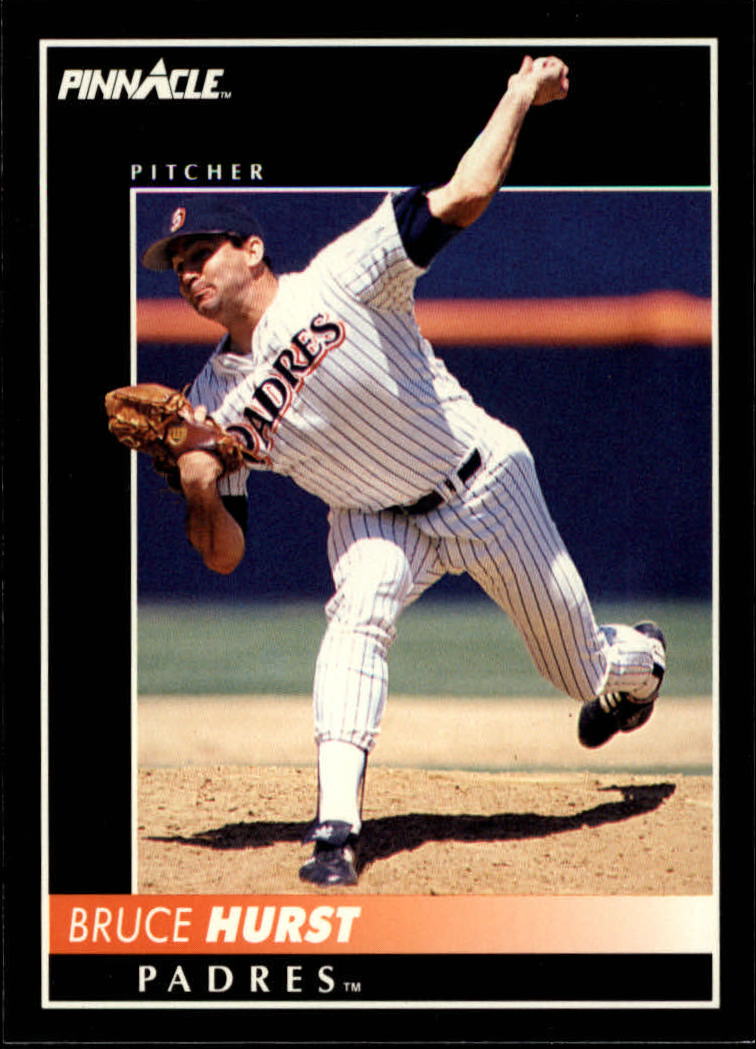
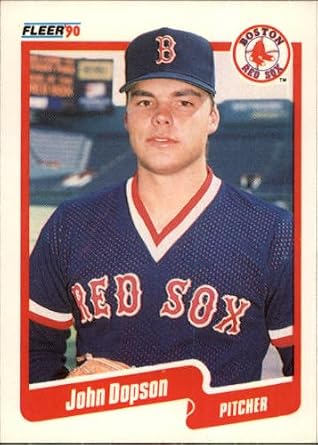
John Dopson 1990 Fleer and Bruce Hurst 1992 Pinnacle

On August 15, 2017 I received these cards from the Baseball Card Bandit (BCB):


On Facebook, I wrote: I've been very behind with my BCB cards. Here are two from a couple of weeks ago. 

I wrote a long piece about BruceHurst recently, this is the second Hurst card I've received from the BCB, which you can find it here.

2019 Notes: There isn't a lot more to say about Bruce Hurst than what I said about him in the last entry. I've never seen Pinnacle cards though. They seem like a nice enough card. 

The second card is John Dopson. He came over from the Expos along with Luis Rivera for Spike Owen and a minor leaguer. Dopson wasn't very good. All he needed to be was a cromulent third or fourth starter but he was unable to do so. That's John Dopson in a nutshell, good enough to be in the majors but not good enough to be counted on.

2019: The above is an unfair portrayal of Dopson. 

I don't recall much about John Dopson and the way he pitched, I only remember the name. There isn't much to go on in terms of information online about Dopson, but judging from his baseball-reference page, he might have been on the road to being a decent major league starter. The year before he was traded to the Sox, he had an ERA+ of 118, which is good. And while his K/9 ratio wasn't great, he looked okay. I'm sure people freaked at his won-loss record of 3-11, but who gives a shit about that. 

After he came over to Boston, a lot of his peripherals dipped a bit (ERA+ and K/9 especially) but his won-loss record improved to 12-8, which again, who gives a shit. However, at age 25, maybe this was the type of pitcher John Dopson was going to become: a nice, middle of the rotation innings eater. Every staff could use one of those. 

In the next two seasons, Dopson pitched a total of five games (four in 1990 and one in 1991) which leads me to believe that he was seriously injured. With what, I'm not sure, it's not on his Wikipedia page but he came back in 1992 and had a bad year. In 1993 he had a worse year and the Sox let him go. He was a California Angel for the 1994 and then retired.  

You try to look at a bunch of numbers and see if you can figure out what kind of person a ballplayer is and it's hard to do so. You try to remember what he was like when you watched him pitch and it's difficult to do so. Dopson seems like one of those players where things were going to start going his way and then he got injured. And the wasted potential of the 1990 and 1991 seasons probably never go away from his mind, even though we've long forgotten about it. 

Yes, I'm sure that there are a lot of advantages to being a pro ballplayer. But for the vast majority many never reach their fullest potential and I bet having to walk around with that notion in rattling around in your brain for the rest of your life has to be maddening. 

Tuesday, January 29, 2019

Otis Nixon 1990 Fleer

On April 17, 2017 I received this card from the Baseball Card Bandit (BCB):


On Facebook, I wrote: The BCB takes no holidays! I came home from my parents' house yesterday and found this waiting in my doorstop. And the BCB is so current too. 

You may remember that Otis Nixon was in the news last week because he went missing from his Atlanta home. He was found safe and sound a few days later. 

Home is an interesting concept to Nixon as he bounced around to nine different organizations in his 18-year career, including one year in Boston. It was the strike-shortened season of 1994 and he swiped 42 bags and was caught ten times. 

The Sox had no idea what to do with him (they batted him lead off because he was fast but his OBP was atrocious: .360) and was shipped to Texas as part of the Jose Canseco deal. 
Canseco was a dude the Sox knew and loved. A tall right handed power guy well past his prime. 

Nixon never won a World Series but played in three Fall Classics (all with Atlanta). He also made north of $19M in his career, though if he stayed away from the Bolivian marching powder he would have made more. But he was better than his brother Donnell and that's what matters.

2019 Notes: Despite playing for the Red Sox, Nixon was the type of player who didn't play for Boston a lot. Like I said above, he was fast, good defensively, no power and no arm. You can look through the years and the Red Sox don't have a lot of players like that. 

The thing about Nixon is that he looked older than he was. How old do you think he is in that baseball card above? Assuming that that photo was taken in 1989, he's 30-years-old. In any event, he played 17 seasons in the bigs, which is pretty impressive considering he made his money with his legs. And the legs are usually the first to go, see Ellsbury, Jacoby.  

I would've bet that he was an All-Star at least once, but he didn't. I realize that I'm hung up on who was and who wasn't an All-Star. I'm not sure why, but I am. 


Friday, January 18, 2019

Tim Nahering 1990 Upper Deck and Spike Owen 1990 Upper Deck

On February 23, 2017 I received these cards from the Baseball Card Bandit (BCB):


2019 Notes: TWO cards! Unprecedented. Cool action shot of Naehring. Owen looks a lot thicker than I remember.

On Facebook, I wrote: A few days ago, I received TWO more cards from the BCB. The Tim Naehring card is postmarked from Iceland while the Spike Owen card hails from Denver. 

If you were a Red Sox fan in the early 90s, all you heard about was the potential of Tim Naehring. He could play anywhere in the infield, he could hit, had a bit of power and could run a little too. Unfortunately Tim Naehring couldn't stay healthy, so he was the ultimate tease. 

I remember thinking, "Okay, we have Mo at first, Valentin at short and Cooper at third. All we need is Naehring the play second and our infield is set for the decade." It never happened. Naehring would inevitably go down with an injury sometime in April, return in a June, get hurt in July and that would be it. A lot of ink was spilled over the never-was career of Tim Naehring. 

2019: Like I alluded to in the last paragraph, through no fault of his own, Tim Naehring is the worst kind of prospect. He's the one who has a ton of potential but can't reach it because he's always injured. That's worse than simply being not good because if you're not good, things happen and you try your best but you can't just cut the mustard. It happens. But when you're always injured, it's a bit of a tease. You perform well when you're healthy and then the inevitable injury occurs. Then you come back, do well, get everyone's (including yours) hopes up and then you tweak something. You're back on the shelf. 

After a while people lose patience with you and you're discarded as an oft-injured has been who can't be counted on. Some people will go even so far as to say you're not "tough enough", which is crap. If you're a professional athlete you put your body through a grinder every day, sometimes it just won't respond. But the nagging little voice in the back of your brain, the one that keeps saying, "You could have been something if you were a little healthier" must be maddening. To be betrayed by your own body and have to think about that for the rest of your life is simply unfair. 

Nahering is a respected talent evaluator in the Yankees organization now. I bet that it's easier to deal with his frustrating pro career easier there than if he drove a tow truck or was a CPA after baseball. 

---

Another Red Sox shortstop, Spike Owen was a part of the late 1986 trade that brought the AL Championship to Boston. Along with Dave Henderson, Owen was acquired for a handful of players who never amounted to much. He settled down the Boston infield that year and was--to a 10-year-old--a pretty decent player.

Owen played in those University of Texas super teams back in the early 80s with Roger Clemens and Greg Swindell. I always wondered whether Clemens and Owen would tell UT stories on bus rides to the park. If so, I bet their teammates wanted to murder them. 

Owen was eventually sent to the Expos for a package that brought the Sox John Dopson and Luis "Funky Cold" Riviera. I made up that last nickname.

2019: Spike Owen played 13 seasons in the big leagues. And for an undersized (5'9") guy who didn't hit a ton and played good defense, carved out a nice career for himself.  Aside from the 1986 Red Sox, he played on some mediocre teams: Mariners, Expos, Yankees and Angels. Here's something that I didn't know, in 1986 he was named team captain of the Mariners (they were terrible, but they could have been one of my favorite non-Red Sox teams ever -- I should write a blog on that some day) and then was shipped out of town by August. 

He also signed a pretty hefty deal with the Yankees in 1993 with the idea that he could provide veteran leadership. He didn't have an awesome year and the Yankees dealt him to the Angels after one season. Sorry Jetes. 

His older brother Dave also played in the bigs for two seasons. I wonder how Dave felt about his kid brother Spike being more successful than him? I bet that it eats at him.