Showing posts with label Boston Braves. Show all posts

Thursday, February 15, 2024

Sherry Magee 1992 Sporting News

Last week the Baseball Card Bandit (BCB) threw me a changeup and sent me this card:


If baseball--and all sports--are to continue into the future, there is going to come a time when all of the sports heroes that we loved and worshiped are going to be nothing but a collection of random letters that mean nothing to futuristic people. It's weird but it happens now. 

As I've said dozens of times, one of the best things about baseball is that games are played every single day. You don't have to wait until Saturday like in football, Sunday like in other football, or get a few games a week like in hockey or hoops. Day-in, day-out with baseball you're probably getting a game--maybe two if you're lucky. 

In that way, you start to "know" the players. For some guys if you passed them on the street you'd be able to recognize their faces but at the very least you know their names. Like if I said "Trevor Story" you'd say, "Oh yeah, he's the guy who plays shortstop for the Sox when he isn't hurt."

The point is, you know their names, they take up space in your brain. But brains are funny things, once you don't see someone every day you might forget who they are--no matter if you saw them every day for three seasons. This blog is littered with guys that fit that description. The one exception are our stars, you might not have thought about Wade Boggs in a long time, but you know who he is. You know what he looks like. You probably even know most of his statistics--even in a vague sort of way. Stars never dim.

But they do. At some point in the future, there's going to be a person who loves baseball but isn't familar with Boggs. Or Jim Rice. Or Roger Clemens. Or Pedro Martinez. Or David Ortiz. Or Manny Ramirez. Those are going to be funny sounding names from long ago. Their stars are going to take precedent in their skies. 

That's the way life goes. 

Which brings us to today's card of Sherry Magee. I'm a member of the Boston Braves Historical Association and I'm embarrassed to say that while I've heard of Magee's name (it's hard to forget a dude named "Sherry"), I don't know much about him. According to the biography on the back of this card, Magee was the Philadelphia Phillies leftfielder for 11 seasons, before coming to the Braves in 1915*, played two-and-a-half seasons before finishing his career in Cincinnati in 1919.    

* I was going to say that it sucks for Magee that he came to the Braves a year too late to be on the 1914 Miracle Braves squad. But he made up for it by playing two games in the 1919 World Series and winning a ring with the Reds in his last year. If the 1919 World Series is familiar to you, that's because that was the Black Sox Series. I guess Magee was happy that these rubes sold out to gamblers to fuck owner Charlie Comiskey over. He should send a cigar to the Old Roman--though maybe Magee and Commie aren't in the same place now. 

Anyway once he was done with playing baseball he became a big league umpire in 1928. According to this card*, Magee could have had a long career in blue but he died of pneumonia the next season. 

* Look at this card, he was in his early 30s when this picture was taken. That face looks like it's seen some shit, doesn't it? Why does every old picture seem that way. No one looks rested or relaxed or healthy. They look like they all came out of a mine somewhere and are seeing daylight for the first time since they were nine. Are we going to look like that to future generations? I bet the answer is yes. 

The question on the card says, "Why Not in the Hall of Fame?" and I can't tell you why. He lead the league in a bunch of hitting categories but not a ton. He looks like one of those Hall of Really Good dudes that you read about. My guess is that once the Hall got up and running, Magee was just one of those players who got lost in the shuffle. Maybe if he started his playing career ten years later and lasted a little longer as an umpire, he'd have gotten the call. But he didn't and he's forgotten to history. 

Well at least until weirdos find his card and send them to unsuspecting, good looking people like me. Pour one out tonight for Sherry Magee, his name might suck (it's short for Sherwood, I think that I'd rather be called that) but his career was decent. And like I said, that's about all you can hope for when you shuffle off this mortal coil. 

Friday, May 24, 2019

Now Taking the Field: a Review


It's not as if I didn't enjoy "Now Taking the Field" by Tom Stone, I just thought that I'd enjoy the book a lot more.

That's a dubious opening sentence, but it doesn't exactly encapsulate what I'm trying to say. The elevator pitch of "Now Take the Field" (NTTF) is this: every Major League franchise has its stars. But what if all of those stars were able to come together--regardless of era--and fill out a roster. What would that roster look like? Stone answers that question in this book.

In his forward, Stone said that he had spent about 20 years researching and perfecting the idea of this book. And that shows. There aren't a lot of books (baseball or otherwise) which are as doggedly researched as NTTF. When reading this, it's abundantly clear that Stone did his homework and didn't cheap out by just grabbing the most recognizable name and throwing them in a position. Nor does he move player around too much so that the best team could be assembled.

For example, if a team had two great first basemen and a handful of average third basemen, Stone didn't simply transfer one of the great first sackers across the diamond to make the best team. He stuck to his rules and had two great first basemen and a few mediocre guys at the hot corner.

Unfortunately, what's great about his book is also where it starts to bog down. There was a lot of information and statistics in this book--there had to be--but after awhile all of the numbers, all of the names, all of the teams started to run into each other. Stone kept the same dry format over and over and over, for over 600 pages.

It got to be a little too much.

Not only that but in every chapter were lists from the past of how other publications viewed each franchises' all-time teams. This was a good idea, in theory, it's interesting to see what people in 1950 thought that the Red Sox all-time team looked like. But there were so many examples, and so many of those lists were virtually the same, that it almost became in exercise in typesetting.

There were not a lot of real insights or interesting stories about the players that he selected. Most paragraphs would start out with the player's name, a rehashing of his statistics (which were printed above the paragraph) followed by a line or two of what the player did best. These are the best-of-the-best, so I knew about 95% of the players and while I may not have known every number, I had a pretty good idea of why they would be chosen.

For example, former Boston Braves infielder and Hall of Famer Rabbit Maranville was chosen as one of the backup second basemen for the Braves. Stone said he chose him because while he couldn't hit, he was fast and played good defense. That was pretty much it. These few lines were sort of flat and lacked a bit of life.

I know that it's sacrilege (and almost unfair) to compare a modern baseball write to Bill James, but when Bill James released his Baseball Almanac almost 20 years, he had a top-100 player list at every position. James would cite some stats, but then wouldn't just regurgitate the stats in the paragraph; he'd write something that you may not have known about the player.

For example, when discussing Rickey Henderson, James mentioned that if you took away his stolen bases, Henderson was still a Hall of Famer thanks to his other numbers. If you grew up in the 80s or 90s, there was a school of thought that Rickey was mainly a speed guy. He had some power too, but he was kind of pigeon-holed into a stolen base threat. James changed some of that perception by pointing out that his other numbers were incredible too.

I don't think that Stone really did that. He took a very straight path in explaining why a player deserved to be on the team. Baseball is a game of circuitous routes and rabbit holes, Stone didn't explore those holes. And that's a shame because I think that would have made this a better book. Instead of relying on what the 1959 readers of Sport Magazine thought about who the best all-time White Sox were, it might have been better to explore other areas.

I think that Stone had a great idea for a book, Rob Neyer (a Bill James acolyte) wrote a similar book 15 years ago called the "Big Book of Baseball Lineups" and Stone would quote his all-time teams as comparison to what he thought. Neyer's book was just as regimented, but shorter and filled with more interesting tidbits.

I don't want to dump on this book a lot, because it was a decent read and I was really excited at the premise of the tome because I really do love baseball history. And maybe I should review the book that I read rather than the book that I wished it could be. It's more than apparent that Stone is a huge baseball fan and obviously did a ton of work on his research and he has a gift for turning a phrase. It may not be ideal to read this book from cover to cover, it's probably best to bounce around from team-to-team like I did. To be honest, I found the strongest part of Stone's work is when he was able to use his voice more and pick the rosters of the newer teams like the Mariners or Rockies or Diamondbacks. There he was writing without the net of past all-time teams and he was a little more free with his prose. I likes that a lot.

For a first book, I thought that this was a really good effort. If you're on the beach this summer and need something to peruse, you could do much worse.

I was sent Now Take the Field free to review and comment on. This did not have any effect on my review. 

Friday, February 22, 2019

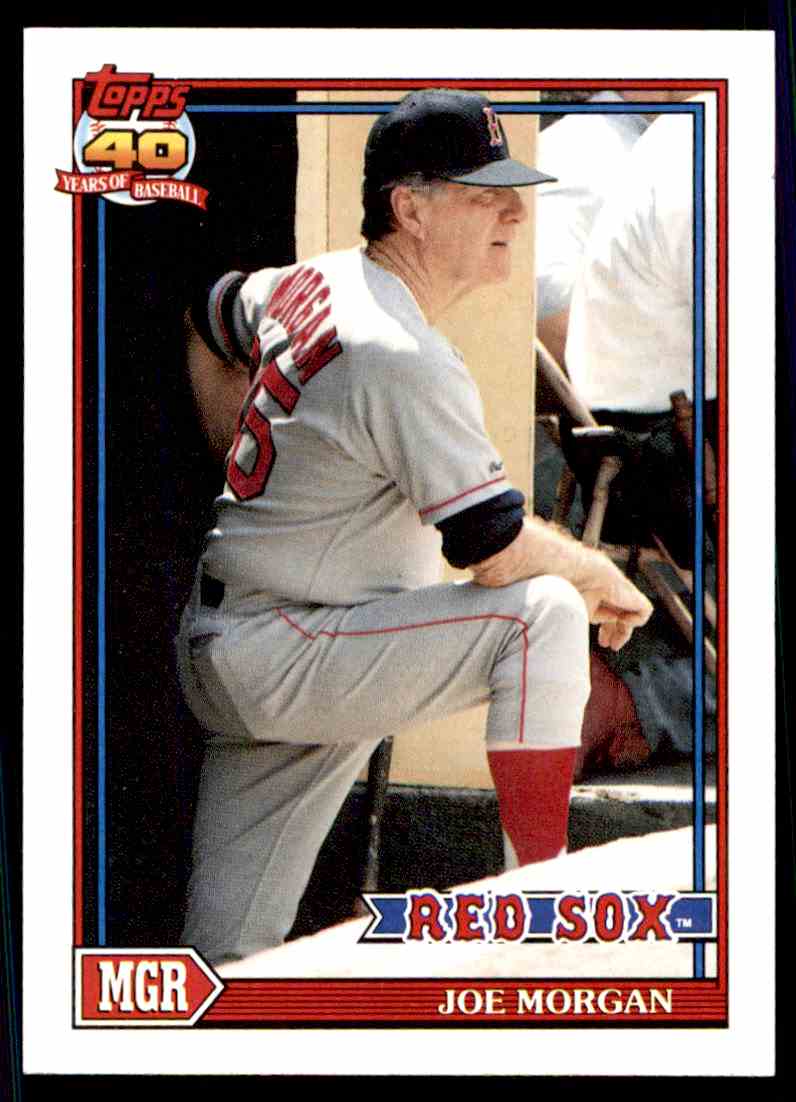
Joe Morgan 1991 Topps

Sometime in the last year or so I received this card but I'm not sure if it was from the Baseball Card Bandit (BCB):


This is a cool card of Morgan. I like the design, I like the shot, everything is just great about it. 

Until Terry Francona showed up, Joe Morgan (not that Joe Morgan) was probably the best Red Sox manager of my life as baseball fan. That lineup includes, chronologically:

1. Ralph Houk -- I don't remember much about him, but from what I've read he was pretty much on autopilot from the moment he showed up in his first spring in Winter Haven. 

2. John McNamara -- seemed like an asshole who got swallowed up in his biggest moment. 

3. Butch Hobson -- so out of his league, that his firing was almost a mercy firing. 

4. Kevin Kennedy -- thought he was the smartest, coolest guy in the room. He was not. 

5. Jimy Williams -- the exact opposite of Kennedy and was incredibly confounding with rules, line-ups and starting pitching. Was pretty good with his bullpen though. 

6. Joe Kerrigan -- lasted about three months and was so over his head as a manager, that it wasn't funny. 

7. Grady Little -- like McNamara, except without being an asshole. 

Morgan was named interim manager after McNamara got the gate in 1988. He was supposed to last a day or two at the most, the Sox were negotiating with Bob "Buck" Rodgers* I believe (for some reason I want to say Whitey Herzog was also in the mix, but that has to be wrong), but Morgan brought a breath of fresh air to the team and they kept winning. And winning. And winning. They ended up winning 12 games in a row and were practically unbeatable at home. Red Sox GM Lou Gorman had no choice but to name Morgan the permanent manager for the rest of the season. 

* Wikipedia said the Sox were looking at Joe Torre and Lou Piniella as their skippers. Which would have changed the course of baseball history.

Morgan's team -- and it was truly Morgan's team that year, he got in Jim Rice's face when he sent Spike Owen to pinch hit for the beleaguered slugger, yelling "I'm the manager of this nine!" -- ended up winning the American League East only to get demolished in the ALCS by the Oakland Athletics 4-0. 

People liked Morgan because he was from the area, he hailed from Walpole drove a snowplow in the offseason, but he also weird things, "Six, two and even" -- which I guess is a sign off from the Dick Tracy radio programs, often managed on hunches and didn't kiss anyone's ass, see the Rice example above. 

He ended up finishing third in 1989, winning the AL East in 1990 (where they were again swept by the A's in the ALCS) and finishing second in 1991. The 1991 season was an underrated heartbreak as Jeff Reardon gave up a late season, game winning homer to New York Yankee Roberto Kelly that sent a previously surging Boston team into a tailspin for the last two weeks of the year. Sox brass had seen enough as he and his career win-loss record of 301-262 were shown the door. In one of his exit interviews, he told reporters that the team wasn't very good and he was right, they finished last in 1992 under new manager Hobson. 

Morgan played with the Kansas City Athletics, Philadelphia Phillies, Pittsburgh Pirates and St. Louis Cardinals where he was a no-hit gloveman who bounced around the field. He was also a member of the Milwaukee Braves and would often come to the Boston Braves Historical Association's (BBHA) annual get togethers. I work with the BBHA and from what I've been told, he was awesome. A lot of times, he acted as the emcee for the dinners and was really cool. He told great stories, was funny and would hang around to talk to the fans. He truly seemed like a good guy.

For most of the 90s and into the 00s, many current Sox managers were compared to Morgan. Fans would call up Sports Radio begging for Morgan to be given his job back. I think that a lot of that had to do with him being a local guy. Even though New England is known as a place where a lot colleges are and has a reputation for being liberal and educated, there are a lot of people who like that blue-collar, no bullshit kind of guy. And Joe Morgan was definitely that. He would very matter-of-fact tell people his assessment of a player or the team and if it wasn't what they wanted to hear, so be it. 

I think that kind of honesty wears on folks you work with after awhile and maybe that's why Morgan got the gate. I know that Gorman said that Hobson was an up-and-coming minor league manager and even invoked the unholy boogey man that the Yankees were thinking of hiring him, but I think that was bullshit. My guess is that the front office just couldn't deal with a manager who didn't give a shit to what they wanted him to do and was incredibly popular with the fans. 

Six, two and even, indeed. 

Monday, October 24, 2011

The Big Show


There is probably no other sport more photographed than baseball. There are myriad reasons for that, the chief being that baseball was the nation’s game at the turn of last century when the art of photography was just taking shape. Also the pace of baseball lends it to being photographed more than hockey, football and basketball.*

* During Joe DiMaggio’s record 56-game hit streak in 1941, there is a picture of DiMaggio ripping a hit. Most of the time this picture is cropped, but in the uncropped version there are three or four photographers five or six feet away from the batter’s box. I’m not sure when this practice fell out of vogue, but it’s startling to see people without protection so close to the action.

One of the better photographers of this early era of baseball was Charles M. Conlon. In a new book called “The Big Show” Neal and Constance McCabe gathered some of Conlon’s best work and preserved it in an exquisitely done coffee table book featuring a few hundred of Conlon’s 30,000 shots. There is also a remarkable foreword written by “Boys of Summer” author Roger Kahn.

There are plenty of stars littered through out this book: the aforementioned DiMaggio, Walter Johnson and Tris Speaker to name a few, but the main characters in this book are, to use baseball card parlance, the “common players”. Ballplayers that had solid careers, but weren’t household names. The McCabes did a fantastic job of choosing terrific shots and incorporating vivid stories to go with the pictures. And in a way, it underlines what baseball can be about.

In the annals of baseball, for every Babe Ruth or Ty Cobb story there’s a cool story about a guy like Fred Snodgrass, a player who had an auspicious past. He was a slick-fielding centerfield who dropped an easy pop fly for the New York Giants against the Boston Red Sox in the 1912 World Series. This is one of baseball’s biggest and most famous gaffes and the authors mention it in his write up in a roundabout way. Instead they focus on an incident in 1914 when he was almost plunked by a Boston Braves pitcher Lefty Tyler. Snodgrass took exception said some words and Tyler responded by throwing a ball in the air and dropping it, mimicking his mistake in the ‘12 Fall Classic. Snodgrass went back to the batter’s box, was promptly plugged and started a brawl.

After the brawl, Snodgrass went to first base and he thumbed his nose at the Braves fans who went bananas throwing bottles, cushions and anything else they could at him. The Boston mayor tried to have him ejected from the game from starting a riot and harbored a resentment towards him until the following year when he was dealt to the Braves. *

* A few things: one if this happened today both Tyler and Snodgrass would be internet sensations and talk radio would have a field day with this story. “Tyler did what?”, “What was Snodgrass thinking egging the crowd on like that?” And when Snodgrass died, his New York Times obituary headline read, “Fred Snodgrass, 86, Dead; Ball Player Muffed 1912 Fly.” That just sucks.

And there are literally hundreds of players like this in the book all with thoroughly interesting stories.

But the real star of the book are the photos. When I was a kid, black and white pictures from around this time scared the crap out of me. I don’t know why, it probably had something to do with the fact that these guys don’t look like anyone that I was used to seeing. And it’s still true, these players all look like hardscrabble men who came to the wilds of the country to play ball in the big city. Their complexions and eyes are pointed and dark, their faces ragged with deep lines, their smiles crooked and wherever they’re standing, it looks cold and dank.

Most of these people were younger than me, yet they looked more world-weary than I will ever be. These athletes should be in the prime of their lives, but they don’t look it. And that’s what’s so interesting about them. They look tired, weary and like they have a million things on their mind other than baseball. The youthful exuberance that we associate with today’s game is nowhere to be found back then. But that’s the expression that all working men had back then and the baseball players found in this book are a reflection of that.

One hundred years ago, life wasn’t fun. If you lived in the city it was cesspool of crime and filth, if you lived in the country you were cut off from modern life and grew up backwards and (probably) illiterate. There wasn’t much to be happy about. Some time after World War II this all changed and Americans became a more “happy” people. Life simply wasn’t as hard and this continues today. Things are getting easier, but it’s important to remember where we came from and recognize the folks who pioneered for our way of life.

“The Big Show” brings those people to life.