Showing posts with label Baseball Card Bandit. Show all posts

Thursday, August 31, 2017

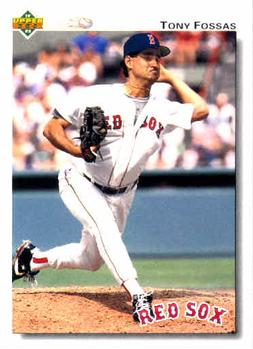
Tony Fossas 1991 Upper Deck


On July 30, 2016, the Baseball Card bandit sent me the above baseball card. I took to Facebook to write this:

The domestic BCB has been caught and sent to the baseball gulag (Minneapolis) but there seems to be a national copycat in the mix. 
I received this pristine Tony Fossas card in the mail (think El Guapo 1.0) and the only return address is DFW. Dallas Fort Worth? Down For Whatever? (Gross) Don't Forget Willis?
What does it all mean?”

What does it all mean, indeed? The meaning of life is this: throw lefthanded. When Tony Fossas last threw a baseball, he was 41-years-old and his ERA was 36.00 over five games. It was 1999 and he was a member of the New York Yankees. If you remember your baseball history, 1999 was a year that the Yankees won the World Series.

Somewhere in his home, despite not actually pitching a single inning in October, Tony Fossas has a World Series ring. Ted Williams doesn’t have a World Series ring. Ernie Banks doesn’t either. Neither does Ty Cobb or Barry Bonds or Tony Gwynn or Carl Yastrzemski or Rod Carew or Willie McCovey or Robin Yount. All of these guys are Hall of Famers. Despite not being in the Hall of Fame, as a player, Don Mattingly doesn’t have a Yankee World Series ring. That probably has to sting a bit. 

Tony Fossas does. No matter how many games you play in a championship season, if you're on the team; you get a ring. 

Fossas is also a left-handed specialist who looks like everyone's dad and played 12 years in the major leagues without really doing anything excellent. He always got work despite giving up a bunch of hits, walking a bunch of guys and not striking anyone out. He never pitched more than 51.2 innings in one season, made zero starts and accumulated seven saves. For that, he made over $4.1 million in his career.

Again, Tony Fossas is lefthanded. I can not stress the importance of this fact. 

When he was with the Red Sox, I remember him being pretty good and his numbers show that: in 1991 he appeared in 64 games and had a 3.47 ERA. In 1992, he was even better: 60 games, 2.43. But the wheels started coming off in 1993 when Sox manager Butch Hobson began to trust him a little more and brought him into 71 games. Fossas returned that trust with a 5.18 ERA. It seemed like he was a shade better in 1994 with a 4.76 ERA, but not really.

Then the Sox released him and he bounced around the Bigs. First to St. Louis for a few years, then in 1998 he went to Seattle for a third of a season, then to the Cubs for eight games, then back to Texas (before he was in Boston he plied his trade for the Rangers and Brewers) for ten games before finishing his career with the aforementioned five games with the Yankees in 1999.

Fossas was in the minors for ten years before he made his major league debut in 1988 and he was thoroughly mediocre there too. But again, he was a lefty. And when you’re left-handed and don’t strike out a lot of guys, you get stuck with the adjective: “crafty”.

Tony Fossas was a crafty southpaw who wrung every drop of talent from his left arm. He stuck with the game for ten years, desite traveling by bus from one shithole town to the next, playing in front of dozens of uncaring fans. One day he wins the lottery, is brought up to the majors and he holds that ticket for 12 years. Even when it was evident to everyone that Tony Fossas wasn’t a major league pitcher, he stuck with it.

At the end of the day he has $4 million in the bank and a World Series ring. Baseball is a crazy game, a pitcher like former Yankees and Red Sox reliever Ramiro Mendoza can somehow accumulate five World Series champions and Ted Williams can have none, despite being a much better ball player. Every once in awhile you hear someone hold that fact against a guy like Fossas or Mendoza. Don't. Life is not fair, kids. Sometimes it’s not what you can do, but where you can do it.

Speaking of where you can do it, either this card or the Jeff Reardon card was the first card that I got from the second Baseball Card Bandit. This one was sending me cards from around the country. As I alluded to in the Facebook post, this one was postmarked in Anchorage, Alaska. I still don’t know who sends them to me, but I like their style. 

Wednesday, August 16, 2017

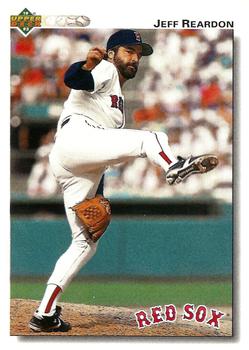
Jeff Reardon 1992 Upper Deck


On July 1, 2016, the Baseball Card Bandit sent the above card. I took to Facebook that day to write this:

“The BCB is at it again but this time there's a wrinkle in his (I assume it's a man) game. Look at the postmark! This card, of Terminator Jeff Reardon, was sent from New York City where Reardon spent the last 11 games oh his career sans trademark beard. 
Reardon was needed when he was with the Sox (Boston had potential HoFer Lee Smith) but for some reason GM Lou Gorman picked him up. Maybe that's what led him to real world troubles he had in Florida after he retired. 
Or maybe it was just Florida. Man, that state just sucks.”

I was never a big Jeff Reardon guy. I just didn't think that he fit a need for the Red Sox and wondered why they were spending money on him. It was a needles bauble, as far as I was concerned. Sign a starting pitcher, an outfielder with pop, anything but another lights-out closer. We already had one. And he was good.  

When the Red Sox picked him up as a free agent after the 1989 season, I was a little shocked. Boston still had Lee Smith*, who had a really good previous year. Smith was 6-1 with a 3.57 ERA (which is unfair metric to judge for closers) and had 25 saves and a 12.2 strikeout over nine innings ratio. Reardon had a 5-4 record, a 4.07 ERA, saved 31 games and 5.7 SO/9. Plus, Reardon was two years older and cost more money. 

*The Lee Smith deal was probably Lou Gorman's best deal ever. He traded Calvin Schiraldi and Al Nipper to the Cubs for Smith. Gorman should have been arrested for larceny. It was that good of a deal. 

Why would you sign a closer when you already had a really good one in the back of your bullpen. I wasn’t sure what Red Sox General Manager Lou Gorman was thinking. But I assumed that since Reardon was signed in December 1989, Smith would be gone by Spring Training. Again, not true. When the Sox reported to Winter Haven, Florida both Reardon and Smith were there too. They spent a lot of time talking about who was the closer and they gave similar pat instances about how “these things have a way of working out” and “whoever had the hot hand”. Crap like that.

If there was ever a manager who could make this work, it was Sox skipper Joe Morgan. He said the same thing. When camp broke that April, both Reardon and Smith were on the roster. This lasted about a month before Gorman traded Smith to the St. Louis Cardinals for Reardon’s former Twin teammate Tom Brunansky.

Brunansky was slotted in right field and was the Red Sox only power threat in some very lean years. He did make a pretty awesome catch off of Chicago White Sox shortstop Ozzie Guillen to clinch the 1990 American League East. Other than that, he was completely adequate.

I often wondered why Reardon chose the Red Sox that off season. He knew about Lee Smith and he understood that the Sox really didn’t need a closer. Reardon grew up in Dalton, MA, so maybe he wanted to come home. Gorman gave him a crap-load of money to pitch here. Maybe Gorman told him that the team didn’t like Smith anymore and that he would be traded soon and that there was nothing to worry about.

I’m not sure. But he came in and pitched well. In two plus seasons, he had 88 saves for the Red Sox and made the All-Star team in 1991. That was also the year where he gagged the American League East flag. The Sox were making a pretty hard run late in the season when the Sox were on the verge of beating the New York Yankees to get closer to the league-leading Toronto Blue Jays.

With two outs in the top of the ninth and the Red Sox leading 5-4, Reardon gave up a game tying shot to Roberto Kelly. The next inning, Matt Young and Dan Petry couldn’t get out of their own ways and gave two runs to Bombers who won the game 7-5. From that game forward, the Sox lost 10 of their next 13 and finished in second behind the Blue Jays.

The Sox were never a serious contender until 1995 when another Massachusetts boy, Dan Duquette took the reigns as Boston General Manager and remade the Sox on the fly following the strike-shortened 1994 season. Duquette was Reardon’s catcher at UMass-Amherst.

Late in the 1992 season, Reardon was traded to the Braves for a minor leaguer. From there he bounced to Cincinnati and the Yankees—two teams that had strict rules of facial hair. If Reardon wanted to continue pitching, he had to shave off the beard that made him famous and intimidating. He retired after the abbreviated 1994 season.

Jeff Reardon was an interesting character. He looked like James Brolin from the original “Amityville Horror” movie. He was a Met for a while, but was traded to the Montreal Expos where he began his career as the unstoppable stopper. That’s also where he got his nickname “The Terminator”. He’d come in, throw gas by everyone, save the day and walk off the mound. He never showed a lot of emotion and when you mix his beard plus playing in the “wilds of Canada” he seemed scary as hell.

After the 1986 season, he signed with the Minnesota Twins and was dominant that year. He was probably their Most Valuable Player that year as he brought a ton of stability to the bullpen. The Twins believed that the game was over once Reardon was on the mound. Twins manager Tom Kelly used him brilliantly and was the best weapon in the American League that year riding him all the way to Minnesota’s first world championship in any sport.

The years after his retirement were not kind to Reardon. This is from Wikipedia (and references what I wrote about him in the original Facebook post):

On December 26, 2005, Reardon was taken into custody and charged by the Palm Beach Gardens, Florida Police Department for allegedly committing armed robbery at a Hamilton Jewelers store at the Gardens Mall. Reardon attributed his actions to the influence of the medications that he had been taking since his son died in 2004. Soon after the episode at the mall and his release from an overnight stay in jail, Reardon returned to a psychiatric facility, and was an inpatient for nearly two months. His doctors drastically reduced his medications and began to administer electroshock treatments. However, Reardon still had to stand trial.
Reardon was eventually found not guilty of the charges by reason of drug-induced insanity. The judge ruled that because Reardon had been taking anti-depressants and mood stabilizers, and was distraught over his son's death, there was no reasonable explanation for the robbery. In addition, Reardon was not required to be committed after the ruling.”

I haven’t read much about Reardon since then, so I assume he’s doing okay. At least that’s what I want to believe. Because even dominant relievers need some relief.


Tuesday, August 15, 2017

Bruce Hurst 1989 Topps Traded


On June 25, 2016, I received the above card, I took to Facebook and wrote the following:

“Once again back is the incredible, baseball card animal, the unhittable BCB. 
Dropping off Bruce Hurst as a Padre! The former Sox lefty was nails in 86 Postseason and was a solid number two behind Clemens. No thanks to all time jackass who almost ran the Morman lefty out of Spring Training back when Hurst was a rookie. 
Zimmer was a nincompoop who never understood pitching (only that he couldn't hit it).”

I’m not sure why I started this post with a Public Enemy quote because if there was one person in all of Major League Baseball who was un-PElike, it would be Bruce Hurst.

Bruce Vee (that is his real middle name and I swear to Joseph Smith I did not look this up) Hurst was a Mormon left handed pitcher out of St. George, Utah. He kinda looked like a gym teacher or a banker or a dude that spent every weekend in his backyard barbecuing. He just seemed to be a really nice guy.

Too bad that Don Zimmer, who was his manager his rookie year, hated him. According to Peter Gammons’ phenomenal book, “Beyond the Sixth Game” (if you haven’t read it, you should) Zimmer used to give Hurst a lot of crap because he wasn’t a “real ballplayer”. Because he was a Mormon, Hurst didn’t drink, smoke or cuss; so Zimmer thought that he was a pussy. Zimmer used to give Hurst so much crap, that Hurst almost quit baseball.

Don Zimmer seems like a hell of a guy. Fuck him.

In any event, Zimmer was canned by the end of the 1980 season and Bruce Hurst worked his way to a stable major league career. In 1983, I bought a scorecard magazine at the first Red Sox game that I went to and there was an article titled, “The Sox Southpaws are HOT!” It was about the trio of young Sox lefties: Hurst, (Bob) Ojeda and (John) Tudor. The article was correct, because during the next five or so years, this trio would be amongst the best pitchers in the league.

In fact, of the eight teams that played in the World Series from 1985 through 1988, these players pitched on five of them. Of course, Hurst with the Sox in 1986, Ojeda with the Mets in 1986 and the Peabody, MA-native Tudor with the Cardinals in 1985, 1987 and the Dodgers in 1988. The strange thing about Tudor is that the team that he contributed the least to, the 1988 Dodgers, is the one team that he won the Series with. Of the three, only Hurst was picked for an All-Star team (1987), though I thought for sure that Tudor would have been a lock in 1985 when he was 21-8 and Ojeda in 1986 when he was 18-5. But they weren’t.

Tudor was traded from Boston to Pittsburgh for Mike Easler. Easler spent a season in Boston (Tudor spent a year as a Pirate) before being flipped to the Yankees for Don Baylor. Ojeda was sent to the Mets in 1985 for a package of prospects that included Calvin Schiraldi, Wes Gardner and Laschelle Tarver. 

Hurst was a vital cog in the Red Sox rotation and was the perfect number two guy behind Roger Clemens. He never struck out a ton of batters, but he had this big looping curveball that he could get over for a strike anytime he wanted to. It must have been something for a batter to see Clemens pumping fastballs by you one night and then facing this crafty lefty and his weirdo curveball the next. And on the follow through after one of those curves, Hurst always had his right leg up in a weird angle. He was a real joy to watch.

While you could argue that either 1987 or 1988 was his best year, his absolute peak performance came in the 1986 World Series. Hurst absolutely stymied the Mets for two games and was cruising along in the seventh until he just ran out of gas. Had Boston got that final out in Game 6, it was Hurst who would have been the Series MVP.

The Sox had a pretty good front three in 1988 with Clemens, Hurst and new pitcher Mike Boddicker. They just got overwhelmed by an awesome Oakland Athletics team. If they could have kept that front three together for a couple of more years, I think that they would have made some noise in the American League. 

People really liked Bruce Hurst and when he left, I don’t recall too many fans being pissed off that he took a lot of money and moved to San Diego. Everyone said that he wanted to be closer to his family in Utah, that he had a West Coast mentality and that the money that Padres were offering was too good to turn down.

Funny enough, the only person that people seemed to be pissed off at after Hurst bolted was Roger Clemens. I think. I did very minimal research on this, but I could have sworn that Clemens’ “Luggage Interview” occurred immediately after Hurst left. Clemens went on TV with Channel 5’s Mike Dowling and started jabbering on and on about why players leave Boston. He mentioned something about how the team does nothing for them and that “they have to carry their own luggage” when they go on the road.

People flipped out. Seriously. People lost their god damn minds about this. If you look at it, all Clemens is saying is that other teams do things for their players; get their luggage to and from the airport, sets their family up when they get to town, things like that. Things, that teams do now. But New Englanders went into hissy fit mode and accused Clemens of being a prima donna baby whose too good to carry his own bags. Clemens didn’t mean that, only he’s too damn inarticulate to say what he meant.

Anyway, according to the site I just checked, this interview was given on August 12, 1988. Maybe he was responding to a “what if” question from Dowling. Like, “If Hurst leaves, what would be the reason?” or something like that.

In any event, Hurst went to the West Coast and teamed up with slugger Jack Clark (another prized free agent that the Padres signed that winter) and Tony Gwynn and proceeded to lead the Padres to an 89-73 record which was good for second place behind the Giants. He pitched well for the Pads (55-38) record, but wasn’t ever outstanding. Kind of like how he was in Boston. All of his pitching stats (aside from strikeouts) were a tick or two better in San Diego than when he was a Red Sox, though I bet that had more to do with playing half of your games in Jack Murphy Stadium rather than Fenway Park.

He finished his career with stints with the Colorado Rockies (he was an original Rocky) and the Texas Rangers where he finished his career at 36-years-old.


All-in-all, not a bad career for a guy who almost quit the sport because Don Zimmer wasn’t able to size him up right. I bet no one cheered louder than Hurst when Pedro Martinez put that douchebag on his ass—though I bet he cheered in the most polite, Mormonly way possible.