Showing posts with label Jeff Reardon. Show all posts

Thursday, July 06, 2023

Daryl Irvine 1992 Fleer

Sometime in the last two or three months, I received this card from the Baseball Card Bandit (BCB):


I don’t recall anything about Daryl Irvine’s days in Boston. According to the back of this card, Daryl was “one of the top closers in the minor leagues [and] will try to graduate to the big leagues in 1992.” He played three years in the Bigs (1990, 1991 and 1992) and was the exact opposite of what you want in a closer.


In 63.1 career innings, Irvine gave up 71 hits, 33 walks and only struck out 27 batters. Not surprisingly, his ERA was astronomical: 5.68; so not only did he put runners on base, but he let them score too. No matter how good he was in the minors—not good, actually he pretty much had the same kind of issues down there—he wasn’t going to close for anyone unless he missed some bats.


When I wrote about Dana Kiecker a few weeks back, we talked about that 1990 team and Irvine was a part of that team, he pitched in 11 games. But the other two years he pitched, the Red Sox weren’t great. They had their moments in 1991, but in 92 the Red Sox were so bad. Tom Brunansky led the team with 15 home runs. Bob Zupcic led the team in batting average: .276, over Wade Boggs who managed to hit .259!


The team finished with 73 wins, but if you look at their roster, they should have been able to put something together: Boggs, Mo Vaughn, JodyReed, Tony Pena, John Valentin, Ellis Burks, Mike Greenwell (the latter two were apparently hurt) plus Brunansky. Add in older dudes like Billy Hatcher, Jack Clark plus young kids like Phil Plantier, Scott Cooper and Tim Naehring and I mean, they could have been league average or better, if they hit.


The pitching was kind of a mess with solid years from RogerClemens and Frank Viola heading the rotation and Jeff Reardon closing, but everything after that was a complete disaster. Plus they had Butch Hobson managing, who was clearly way, way over his head.


Fun fact: 1992 was the only year since 1986 that I haven’t seen a game live at Fenway. I’m not sure why, but I decided to sit this year out; which is odd because I’ve seen some really shitty Red Sox teams play baseball. I wish that I saw the Sox play at least one game that season because it’s easier to say, “I’ve been to Fenway for 37 straight years” instead of “I’ve been to Fenway for 37 straight years, except for 1992. So I guess I’ve only been to the park for 30 straight years.”


That’s right, if I had a time machine, I wouldn’t go back and kill baby Hitler; I’d go back and watch the 1992 Red Sox in Fenway Park so that uninteresting personal anecdotes would be easier for me to relay.


Anyway Boston was apparently unimpressed with righthander and Irvine was sent to the Pittsburgh Pirates after the 1992 season. This was year one of the Pirates annual depths-of-the-division league tour that they’ve been perpetually on since Barry Bonds took his talents to San Francisco. Andy Van Slyke was still there, as was Jay Bell and Jeff King but other than future Red Sox Tim Wakefield and Stan Belinda, the staff was a complete and total disaster. Irvine should have been used to the chaos.


Ultimately it didn’t matter as Irvine was never able to put his chaotic team experience to good use as he never got a call up to Pittsburgh. Through the very perfunctory research that I’ve done, I can’t tell when he retired, but I bet it was pretty soon after that. According to Wikipedia, he lives in Harrisonburg, VA.


What does Daryl Irvine do all day? I’m not sure, but the way that his baseball career went, I’d be surprised if he thought about his days in the Major Leagues. I prefer to think about how he was drafted by the Red Sox three times over a couple of drafts—I guess the Sox liked him very much at one point. He probably thinks of his dominance in high school and college and how at one point everyone he knew wanted to be Daryl Irvine.


I think that’s what I’d think about as I’m relaxing on my porch in Harrisonburg, VA. I wouldn’t be thinking about the boring-ass drive from Pawtucket to Boston, sitting around in a cramped, sweaty bullpen waiting to get my brains beat in. That’s for god damn sure.


Maybe I’d show some neighborhood kids my baseball card if they asked, but I’d say, “that was a long time ago” and dramatically stare off into the distance. That wistful drama is almost cooler than having a lot of success at the Major League level. 


Almost. 

Tuesday, April 06, 2021

Larry Parrish 1989 Fleer

 On April 2, 2021 I received this card from the Baseball Card Bandit (BCB):


Larry Parrish was one of those guys. You know what I mean, he was the type of guy that was seemingly in every baseball card pack you opened. You looked at the front of his card for a minute, maybe you looked at the back of his card for a half-second and then you shove it back into the pile and keep flipping cards to see whether you got a Wally Joyner or a Bo Jackson or a Roger Clemens.


Unless you were a die-hard Expos or Rangers fan*, chances are you don’t remember Parrish all that much. But he was a beefy dude who played fourteen and a half seasons for Montreal and Texas. When I got around to noticing who he was, he looked like a stereotypical designated hitter; giant, slow, with a bit of a belly. Kind of like a softball player, a person who was seemingly born to DH, but at one point in his life, he had the mobility to be a third baseman and outfielder.


Life is a lot like that, you run into people at certain points in their lives and you think that’s who they’ve always been, but that’s not true. That Mom who’s always making stuff for the school bake sale? She was the bassist in a pretty decent riot grrrl band back in the 90s. The Dad who coaches your kid’s Little League team? He got black out drunk every weekend in college. You’re the guest star in their story, not that other way around. And that’s how it was for me and Larry Parrish. When he played in Boston he looked like a jacked up Alex P. Keaton; neat, short-haired almost like a Republican. But when he was in Montreal, he looked like Bill Lee's running mate, Grizzly Adams-type with a crazy beard and wild eyes. Beards were scary to me in the 1980s, Jeff Reardon (another former Expo to play for the Sox haunted my nightmares). Compare Parrish's card above to an early 80s card while an Expo below.


* As a Massachusetts native, I can’t think of no two more seemingly different, but very similar, outposts in Major League Baseball than Arlington, Texas and Montreal. Both teams were very anonymous, but on the fringes of being pretty good—Montreal was really good but they couldn’t put it together. They both wore powder blue away uniforms and crappy stadiums. Both had terrible weather (too cold in Canada, too hot in Texas) and they just seemed like teams that were around to fill out the league so that the Dodgers didn’t have to play the Cardinals every weekend and the Yankees didn’t have to play the Red Sox all the time--yet they were never on TV's Game of the Week. 


Did you know that Parrish was a two-time All-Star? It’s true, in 1979 and 1987 he made the mid-summer’s classic. The year after he made his second All-Star Game he was released by the Rangers in July and picked up by the Boston Red Sox about a week later. This was around the same time that John McNamara got canned and interim manager Joe Morgan was expected to keep the manager’s office warm until Lou Gorman could find a replacement skipper.


But Morgan kept winning and winning and winning that month, the Red Sox went on a tear and Morgan Magic was born. I remember when the Sox got Parrish he came to town, put on Don Baylor’s old number 25 (which seemed right, he reminded me a lot of a white Don Baylor), stood erect at the plate (he looked like he was seven feet tall and 250 pounds) and just started mashing.


In all, he hit seven home runs for the Sox that season and I bet six of them came within two weeks of his signing. After being discarded by the Rangers, all of a sudden he was as hot as the team he joined. You could tell that the Sox had captured the sports zeitgeist because in September, they made the cover of Sports Illustrated and one of the photos was an action shot of the newly acquired Parrish taking a hellacious cut and destroying a ball.


As the team lost their otherworldly momentum, so did Parrish. He finished a shade under .260, with seven homers, a .298 OBP (yuck) and a .424 slugging percentage. That wasn’t too bad for a 35-year-old, but I think that everyone knew that Larry was done. The good news was 1988 was Parrish’s second foray into the postseason (he was a member of the Blue Monday Expos in 1981), but the Sox were quickly run over by the Oakland A’s juggernaut and Parrish retired from the game after that season.


After he retired, he got back into baseball and was a coach for a few teams. Much like his last skipper, Parrish was named interim manager after his old Ranger pal Buddy Bell got the hook and rode a decent September 1998 (13-12, which was part of their overall 65-97 record) into becoming the new Tigers skipper the following year. The team was abysmal in the year of our Prince, 1999, and finished the season with a slightly better 69-92 record. But it wasn’t enough for the Tiger front office and he was not asked back to manage Detroit into the new Willenium.


As one of those guys, you don’t think of a Larry Parrish very much unless he somehow finds his way to your team. Then you think about him a lot. You can’t remember what life was like when Larry Parrish wasn’t holding down the DH position for the local nine. You see that weird stance every night, you open up Sports Illustrated and there he is the crisp, bright white Red Sox uniforms and you’re like “Damn, Larry Parrish was made to be a Boston Red Sock.”* You get all caught up in his hot streak and the team’s scorching three weeks and start believing that maybe Larry Parrish was the x-factor, the guy who the team needed to push them over the top. This is the year that the Red Sox are going to finally get that stupid monkey off their back. 


* I was so all-in on Larry Parrish that I bought his rookie card that summer. 


But, as they say, water finds its level and Parrish turned back into an old pumpkin. However, you still hold out hope that maybe at the end of September and into October, he has just a little more gas in the tank. Maybe he can put the team on his back and carry them for just a few more games—14 at the absolute most.


He doesn’t. Everyone knows that he’s cooked and he’s gone at the end of the year without much fanfare. After a bunch of years, you almost forget that Larry Parrish ever had a locker in the home clubhouse at Fenway Park, unless you’re tipping back beers with friends and talking about obscure Sox guys.


“How about Larry Parrish!”

“Lance Parrish never played with the Red Sox!”

“I don’t mean the Tigers catcher, I said LARRY Parrish!”

“Oh shit, yeah I remember him. He was pretty good for awhile back in 88, right?”

“Yup. He did some stuff.”


As a guy, it’s always good to be remembered for doing some stuff.


Tuesday, November 26, 2019

Joe Hesketh 1992 Fleer


Last week, I received this baseball card from the Baseball Card Bandit (BCB). Included with this card was a note printed on a missed message piece of paper. The note said, “Til we meet again for the first time.” I know that I alluded to this with the Terry Francona card from last week, but it appears to me that the BCB is all done. 

I know that the next question is, why? I think that the reason why is because the identity of the BCB was clumsily revealed to me two years ago at my brother’s wedding. While the name of the person was never verified, I think that he got the message that I know who it is. I’m not trying to be a tease, but I will not reveal the name until he is verified and he wants me to. 

If the game is over, I am legitimately bummed out about this. This has been a fun few years of getting random baseball cards, writing about the players on the front of the cards, exploring how baseball relates to life and how perceptions change over time. How you might look at a player one way in 1988 and then see that person in a completely different light in 2019. 

One of those players is the card that I received today, Joe Hesketh. If you think about Joe Hesketh at all—and aside from a username on SoSH it’s been a while since his name has invaded by cerebral cortex—mostly you might remember him as a fourth starter for some mediocre Red Sox teams. 

And aside from his first full year in Boston, that’s who he was.  

The 1991 season was a bit underrated in terms of interesting Red Sox seasons. They finished in second, behind the division-winning Blue Jays after completely falling apart late in the season. On Sunday, September 22, the Sox had two outs in the ninth against a bad Yankees team. Roberto Kelly was facing Jeff Reardon, who was protecting a one-run lead. Kelly loses the ball over the Wall and the Sox can’t score in the bottom of the ninth. Punching bags Matt Young and Dan Petry come in (there was no one left in the pen, I assume) and gives up two runs to the Bombers. The Sox bat in the 10th and Mo Vaughn rockets a two-out double, Jack Clark strikes out against Steve Farr and the Sox lose. 

This was the turning point of the season as Boston tailspins into a 3-10 record, which costs Joe Morgan his job. The Red Sox were pretty brutal in the next three seasons, finally bouncing back in the strike-shortened 1995 season. 

In 1991, Hesketh was pretty good swingman for the Sox. He appeared in 39 games, started 17 and went a career-high 12-4, with a 3.29 ERA with 104 strikeouts in 153.1 innings pitched. He also led the entire league in winning percentage (.750) that year, which is god damn amazing, if you ask me. If the Braves thought that he’d be this decent, they never would have released him in 1990. 

Confession time: I used to get Hesketh confused with another mediocre lefty National League reject named Joe from around that time, Joe Price.

This was it for the former Montreal Expo (side note: he was 10-5 for the Expos in 1985, which happened to be his rookie year, good for eighth in the ROY award) in terms of being a serviceable pitcher, as his next three years were pretty poor. The good news for Hesketh is that he had his career year at the best time for the perfect GM in the league, as Sox General Manager Lou Gorman felt that he had to sign him and gave him a three-year, $5.1 million-dollar deal. For that scratch, Hesketh rewarded his team with 19 wins and ERAs of 4.36, 5.06 and 4.26. 

I know that I’ve said this before, but it’s not the money that you give to the superstars that gets you fired, it’s the cash you dole out to the Joe Heskeths of the world. Gorman should have known that you can find a Joe Hesketh on every MLB roster and that he’d cost you nothing to aquire him. Also, Hesketh was 32-years-old in 1991, he wasn’t going to get better as he got older. And it was pretty obvious that he was going to get worse. 

I’m not saying that the Hesketh deal was what Gorman axed at the end of the 1994 season, but this—along with the rising star of Jeff Bagwell in Houston—had to be on the list. Joe Hesketh was a one-man heist movie. 

And while he pretty much stole $5 million from the Red Sox, good for him. The Sox should have known what they had in Hesketh, they shouldn’t have given him anything more than a one-year deal. If they wanted to give him a 1992 contract for $1.7 million in recognition of a good 1991 season, so be it. But there’s no need to get attached to a guy like this for real money. 

That’s all on Gorman. 

I think that’s something that fans need to understand.  A player is going to get as much money as they can. Teams need to have some sort of foresight and intelligence when it comes to deals like this. If they can’t help themselves, that’s their problems. I never understood why fans take the teams’ side when the teams gave out the contract. 

Oh well, I guess that’s as good of a rant as anything to go out on.  

In any event, it’s been a fun couple of years and hopefully I’ll get more cards. But if I don’t, I guess I’ll have to come up with a new project for me to write about and for you to read. Talk to you soon!

Friday, November 08, 2019

Tom Brunansky 1990 Score

In mid-September 2019 I received this card from the Baseball Card Bandit (BCB):


The first year I really started to obsessively follow baseball was 1986. Watching the Red Sox that year was total exhilaration, until it came to the second-to-last and last games of the season. Then it sucked. Hard. But you already know that story and I’m not going to talk about it because it doesn’t matter in the greater context of this blog entry. 

The thing that no one really warns you about, is that once the season ends; baseball pretty much disappears. When you follow the game every single day for eight months, this is god damn jarring. No longer is the sports page abuzz with team notebooks and game summaries and box scores. Maybe once or twice a week, you’ll get a few inches on what the Sox are thinking about and every Sunday Peter Gammons or Larry Whiteside filled a broadsheet of rumors, but that was it. You were supposed to go cold turkey on baseball. 

But eventually, things heat up a little bit at the beginning of December where all 26 teams (there was only 26 teams back then) came together in some hotel in a warm part of the country and they’d sit around and make deals and sign free agents and new uniforms would be announced. It was like a baseball Hanukah, because it happened over a week, and every day there were gifts as players were changing teams at a rapid pace. Anyway, during the Winter Meetings of 1986, it seemed that just about every team—except for the two teams* in the World Series—made moves. When they showed up to Spring Training in 1987, mostly everything was the same. 

* The Mets made one memorable move, sending a bunch of players (including Kevin Mitchell) to San Diego for Kevin McReynolds. The only thing that the Sox did was alienate Roger Clemens and colluded against catcher Rich Gedman.  

Using this first offseason as my template, I thought that was how champions and runners-up behaved. Don’t fix what isn’t broken. Of course, the Sox and Mets stumbled a bit in 1987 and didn’t make the postseason. So, I should have learned a lesson. 

What does this lengthy preamble have to do with Tom Brunansky? In 1987, Tom Brunansky was a key member of the World Champion Minnesota Twins. He was their rightfielder and was a key bat in the middle of their lineup. About a month into the 1988 season, the Twins sent him to the Cardinals (the team that they just beat the previous October!) for second baseman Tommy Herr. 

I had questions.

Tommy Herr? Why would the Twins make that deal? They had veteran Steve Lombardozzi, a Massachusetts native to boot, manning second base. They won a World Series with that guy, why would they trade for someone to replace him? Especially from a team whose ass they just kicked? And why would they trade a power bat like Brunansky? Who was going to play rightfield and hit 30+ home runs?  

Here’s the thing that I didn’t really get about baseball back then. The clichés are usually true. Especially the two that fit here: to get something good, you have to give up something good and the proverbial trade that helps both teams. 

In the late 80s, the Cards needed power, badly. All they had was Jack Clark hitting dingers and he took his bat to San Diego (along with former Sox lefty Bruce Hurst). The only power threat they had was former Brave Bob Horner, who was returning from a year in Japan. He was no Cecil Fielder and was pretty much running on fumes by this point in his career. With this trade, the Cards got their middle-of-the-order bat in Brunansky. However, even with Brunansky and his 22 homers in 1988, St. Louis managed 71 homeruns all year. I know that they were still in the midst of Whitey Ball, but that’s less homers than Barry Bonds hit by himself in 2001. Consequently, they finished behind the Mets for the National League East title. 

The Twins were looking for someone that could play second base and hit. Despite being born in Malden, Massachusetts, and starting for a championship team (I was obsessed with this for some reason, like I thought because you started and your team won, that automatically meant you were really good) Lombardozzi was a terrible batter. That World Series cornerstone slashed 238/298/352 in 1987, and those were some of his better numbers. They needed a second baseman who could hit and run a little. They had power with first baseman Kent Hrbek, third baseman Gary Gaetti and centerfielder Kirby Puckett. Therefore, Brunansky was the odd man out. So Herr, who was a few years away from finishing in the top five in the 1985 NL MVP race behind teammate Willie McGee, was slotted in at second and Lombardozzi roamed around the infield, not hitting but being a pretty good gloveman (I assume, I don’t have his defensive numbers in front of me). 

Even with Herr, the Twins finished second to the budding dynasty that was beginning in Oakland. Herr stuck around for less than a year and joined up with the Phillies in 1989 before ending his career with the Mets and Giants two years later. 

Brunansky was a Cardinal for about two seasons before he was sent to the Red Sox in exchange for Hall of Fame (that’s still really weird to write) reliever Lee Smith in 1990. Brunansky reunited with former Twin Jeff Reardon and made a spectacular catch in the corner of rightfield in Fenway Park off the bat of Chicago White Sox shortstop Ozzie Guillen that clinched the 1990 AL East flag for Boston. It was probably the highlight of his Red Sox run. 

I’ve talked about this before, but I never understood why Boston GM Lou Gorman signed Reardon in the first place when he had Smith in the backend of his bullpen. And I was really angry when they shipped Smith to St. Louis for a fading power hitter in Brunansky. I talked about it here and here

For some really awful Red Sox teams in 1991 and 1992, Brunansky was the only one who supplied any sort of power with 16 and 15 round-trippers. That second number led the entire team. Fifteen home runs was the best that a Red Sox player could do in 1992, despite playing half of their games in Fenway Park. It was abysmal. Brunansky played with the Brewers in 1993 before coming back with to the Sox in 1994, where he hit his last 10 dingers. 

For a guy from West Covina, California (I wonder if he knows Josh Chan? Shout out to “Crazy Ex Girlfriend”) with mediocre power and a mustache, Tom Brunansky not only brought a lot of questions, but he also ended up teaching me a lot about baseball – mostly that nothing should stay the same. You have to keep moving, getting better and improving. And if that means trading your fourth-best power hitter. 


Tuesday, January 08, 2019

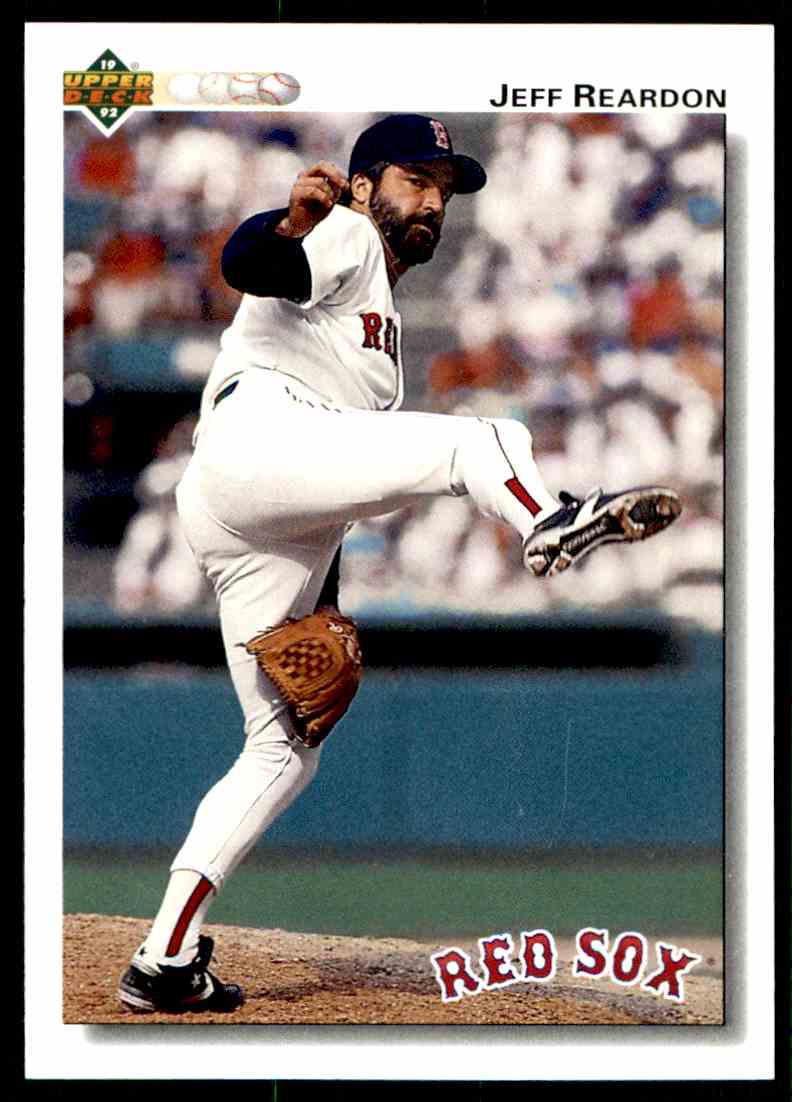
Jeff Reardon 1992 Upper Deck

EDIT: Looks like I already wrote about this card a few years back. Oh well, here's another version.

On July 1, 2016 I received this card from the Baseball Card Bandit (BCB):


I'm back writing a bit about the BCB after a very long absence. I am not going to write really long entries on the blog, but I will write what I wrote on Facebook at the time and probably add a bit here and there. 

Here's what I wrote on July 1:

The BCB is at it again but this time there's a wrinkle in his (I assume it's a man) game. Look at the postmark! This card, of Terminator Jeff Reardon, was sent from New York City where Reardon spent the last 11 games of his career sans trademark beard. 

2019 Note: For some reason, I forgot about the three seasons he spent with the other New York team (the Mets) early on in his career. When I think of Jeff Reardon I think Expos or Twins first, Red Sox second and then Mets, Braves, Reds and Yankees in that order. 

Reardon was not needed when he was with the Sox (Boston had potential HoFer Lee Smith) but for some reason GM Lou Gorman picked him up. Maybe that's what led him to real world troubles he had in Florida after he retired. 

2019: Since I posted this three years ago, Lee Smith went from potential Hall of Famer, to actual Hall of Famer. I still don't understand why Lou Gorman added Reardon to the Red Sox in 1990. Lee Smith was still at the top of his game, he had struck out 12.2 SO/9, which dwarfed Reardon's 5.9 mark. And plus his ERA was a full run plus better than the Terminator. The only thing Reardon had on him was he had six more saves. The back end of the bullpen wasn't a problem at all. And to top it off you trade him for Tom Brunansky? Ugh. I hated that trade then and dislike it now. 

It was supposed to be a homecoming of sorts for Reardon, who was born in Dalton, MA. He did make the All-Star game the following year but the Sox stunk. I don't know, on paper, the Jeff Reardon signing is something that I should have loved when I was a kid: local boy comes back to his team, former World Series winner, proven major leaguer with a tough pitch. But even I knew the Sox could have spent their money differently. 

Or maybe it was just Florida. Man, that state just sucks.

2019: It wasn't "just Florida" and I can't believe I was so glib writing that. I can be a real prick sometimes. Since he retired, Reardon has had some major issues. They're a bit heavy and I don't want to really get into it, because he does seem like a nice guy. If you want to read more, click here.

Wednesday, August 16, 2017

Jeff Reardon 1992 Upper Deck


On July 1, 2016, the Baseball Card Bandit sent the above card. I took to Facebook that day to write this:

“The BCB is at it again but this time there's a wrinkle in his (I assume it's a man) game. Look at the postmark! This card, of Terminator Jeff Reardon, was sent from New York City where Reardon spent the last 11 games oh his career sans trademark beard. 
Reardon was needed when he was with the Sox (Boston had potential HoFer Lee Smith) but for some reason GM Lou Gorman picked him up. Maybe that's what led him to real world troubles he had in Florida after he retired. 
Or maybe it was just Florida. Man, that state just sucks.”

I was never a big Jeff Reardon guy. I just didn't think that he fit a need for the Red Sox and wondered why they were spending money on him. It was a needles bauble, as far as I was concerned. Sign a starting pitcher, an outfielder with pop, anything but another lights-out closer. We already had one. And he was good.  

When the Red Sox picked him up as a free agent after the 1989 season, I was a little shocked. Boston still had Lee Smith*, who had a really good previous year. Smith was 6-1 with a 3.57 ERA (which is unfair metric to judge for closers) and had 25 saves and a 12.2 strikeout over nine innings ratio. Reardon had a 5-4 record, a 4.07 ERA, saved 31 games and 5.7 SO/9. Plus, Reardon was two years older and cost more money. 

*The Lee Smith deal was probably Lou Gorman's best deal ever. He traded Calvin Schiraldi and Al Nipper to the Cubs for Smith. Gorman should have been arrested for larceny. It was that good of a deal. 

Why would you sign a closer when you already had a really good one in the back of your bullpen. I wasn’t sure what Red Sox General Manager Lou Gorman was thinking. But I assumed that since Reardon was signed in December 1989, Smith would be gone by Spring Training. Again, not true. When the Sox reported to Winter Haven, Florida both Reardon and Smith were there too. They spent a lot of time talking about who was the closer and they gave similar pat instances about how “these things have a way of working out” and “whoever had the hot hand”. Crap like that.

If there was ever a manager who could make this work, it was Sox skipper Joe Morgan. He said the same thing. When camp broke that April, both Reardon and Smith were on the roster. This lasted about a month before Gorman traded Smith to the St. Louis Cardinals for Reardon’s former Twin teammate Tom Brunansky.

Brunansky was slotted in right field and was the Red Sox only power threat in some very lean years. He did make a pretty awesome catch off of Chicago White Sox shortstop Ozzie Guillen to clinch the 1990 American League East. Other than that, he was completely adequate.

I often wondered why Reardon chose the Red Sox that off season. He knew about Lee Smith and he understood that the Sox really didn’t need a closer. Reardon grew up in Dalton, MA, so maybe he wanted to come home. Gorman gave him a crap-load of money to pitch here. Maybe Gorman told him that the team didn’t like Smith anymore and that he would be traded soon and that there was nothing to worry about.

I’m not sure. But he came in and pitched well. In two plus seasons, he had 88 saves for the Red Sox and made the All-Star team in 1991. That was also the year where he gagged the American League East flag. The Sox were making a pretty hard run late in the season when the Sox were on the verge of beating the New York Yankees to get closer to the league-leading Toronto Blue Jays.

With two outs in the top of the ninth and the Red Sox leading 5-4, Reardon gave up a game tying shot to Roberto Kelly. The next inning, Matt Young and Dan Petry couldn’t get out of their own ways and gave two runs to Bombers who won the game 7-5. From that game forward, the Sox lost 10 of their next 13 and finished in second behind the Blue Jays.

The Sox were never a serious contender until 1995 when another Massachusetts boy, Dan Duquette took the reigns as Boston General Manager and remade the Sox on the fly following the strike-shortened 1994 season. Duquette was Reardon’s catcher at UMass-Amherst.

Late in the 1992 season, Reardon was traded to the Braves for a minor leaguer. From there he bounced to Cincinnati and the Yankees—two teams that had strict rules of facial hair. If Reardon wanted to continue pitching, he had to shave off the beard that made him famous and intimidating. He retired after the abbreviated 1994 season.

Jeff Reardon was an interesting character. He looked like James Brolin from the original “Amityville Horror” movie. He was a Met for a while, but was traded to the Montreal Expos where he began his career as the unstoppable stopper. That’s also where he got his nickname “The Terminator”. He’d come in, throw gas by everyone, save the day and walk off the mound. He never showed a lot of emotion and when you mix his beard plus playing in the “wilds of Canada” he seemed scary as hell.

After the 1986 season, he signed with the Minnesota Twins and was dominant that year. He was probably their Most Valuable Player that year as he brought a ton of stability to the bullpen. The Twins believed that the game was over once Reardon was on the mound. Twins manager Tom Kelly used him brilliantly and was the best weapon in the American League that year riding him all the way to Minnesota’s first world championship in any sport.

The years after his retirement were not kind to Reardon. This is from Wikipedia (and references what I wrote about him in the original Facebook post):

On December 26, 2005, Reardon was taken into custody and charged by the Palm Beach Gardens, Florida Police Department for allegedly committing armed robbery at a Hamilton Jewelers store at the Gardens Mall. Reardon attributed his actions to the influence of the medications that he had been taking since his son died in 2004. Soon after the episode at the mall and his release from an overnight stay in jail, Reardon returned to a psychiatric facility, and was an inpatient for nearly two months. His doctors drastically reduced his medications and began to administer electroshock treatments. However, Reardon still had to stand trial.
Reardon was eventually found not guilty of the charges by reason of drug-induced insanity. The judge ruled that because Reardon had been taking anti-depressants and mood stabilizers, and was distraught over his son's death, there was no reasonable explanation for the robbery. In addition, Reardon was not required to be committed after the ruling.”

I haven’t read much about Reardon since then, so I assume he’s doing okay. At least that’s what I want to believe. Because even dominant relievers need some relief.


Wednesday, February 27, 2013

A Fruitless Obsession

I haven’t read Malcolm Gladwell’s “The Tipping Point” and if this entry has any similarities to that the book, it is purely coincidental. What won’t be coincidental is that Gladwell has probably written about the topic much better than me.

I’ve been thinking about an issue a lot lately, so much that it’s become a quiet obsession, but ultimately it’s going to be an obsession in which will prove to be fruitless because it’s not quantifiable. What I’m trying to define is the exact moment when something (whether it’s a pop culture event like a television show or movie or song or a living organism such as an athlete or an actor or a writer or a ham-and-egger) goes from ordinary to extraordinary.

That seems like a very generic introduction, but I will explain it further using the professional athlete as a cypher. I began collecting baseball cards in 1986 and when I first opened my wax packs, I was excited to gaze upon any Jim Rice, Pete Rose, Steve Garvey, Ricky Henderson cards. These were super stars and more importantly they were older stars, stars with a track record, stars that had an impressive resume, stars that did stuff and that were slam-dunk Hall of Famers. In my mind these cards were surely the ones that were worth more than the pieces of cardboard that simply had a mishmash of minor league numbers on the back. The were the cards of prospects who had little more than a promise of greatness and an avalanche of hype.

Why would you value a picture of a guy who COULD something over the card of a man who DID do something? To me, this was logical.

After visiting a few baseball card shops and baseball card shows, it became apparent to me that my thinking was backwards. The thing that drove this hobby isn’t finding someone who already did do something, the trick is to find someone that is about to do something. That’s the hardest nut to crack. Because for every Bo Jackson Future Stars, there are a 1,000 Pat Dodsons from the same sub set of player. It occurred to me that baseball card people were interested in the blind prospect, the gold around the corner, the two in the bush versus the one in the hand. And for awhile, even though these players did absolutely nothing, these cards were valuable until one day they were proved that they weren’t.

At some point, most collectors turned into prospectors: betting a few bucks on Gregg Jefferies or Steve Avery or Cory Snyder. Kids bought magazines like Beckett Baseball Cards to find out who are the “no doubt” Hall of Famers who were destroying the minor leagues and were just waiting for a chance to dominate the Major Leagues. And while there are ball players that flame out and prove that they aren’t stars, there are a handful of players who did become great. Players who eventually become starting ball players, consistent All Stars, perennial MVPs and Cy Young winners and ultimately Hall of Famers.

After some time these players become the men who everyone talk about as the upper echelon of the game. What I want to know is the day, the specific game, the specific at-bat where they turn from prospect to star. When they realize their potential. And it’s also interesting to determine the opposite, the instant where everything goes to shit, when a player goes from prospect to suspect to an after thought. There has to be a moment. But where is that moment?

Finding this moment is difficult to pin down because a transformation is usually made over time: from fan (cult) favorite to city favorite to national favorite to a transcendent star. The latter is someone like Derek Jeter or Tom Brady; a player whom someone who doesn’t follow sports would now. Perhaps this is difficult to pinpoint because there are four different stops along this line, but these points are there. And it usually springs from an event: a big hit, a winning drive, etc. That event usually gets people talking and if he does it again, more people talk. The more that player’s greatest becomes ordinary, the more people talk about it and the more his stature grows. Though that greatness genesis begins somewhere.

It might be difficult to pinpoint an athlete’s greatness on a grand scale because it’s difficult to get a group of people looking at the same sky to agree on the color of said sky. So an argument ensues on the first “great” thing that a player has done.

One might think that a game-winning sacrifice fly in the eighth inning might be the start and shows the onlooker that the player can deliver when the game is late. Another person may say that a sacrifice fly is an out that virtually 99% of all major leaguers can do, but a game-winning hit is where the legend begins. Another may counter that there have been plenty of regular-season heroes, a true great makes his bones in the playoffs. And so on.

Perhaps it’s easier to determine your personal appreciation for how an athlete excels at his craft. Going back to 1986 and finding out that Roger Clemens struck out 20 Seattle Mariners certainly put him on my radar. As a relatively new baseball fan, I knew that this was a big deal (though I wasn’t sure exactly how big of a deal it was) but I started intently following him: watching his games, reading the press clippings the next day, making sure I watched the local sports report for tidbits on him. As his record grew to 8-0, 10-0, 12-0 and finally 14-0 to begin the season I had gone from a Roger Clemens fan to a Roger Clemens fanatic.

I wanted to read everything about him, his posters adorned my wall, I feverishly opened packs of cards to find his cardboard likeness. I talked about him non-stop that summer. Over the years that fanaticism never maintained the frenzy (it couldn’t) Roger Clemens was always my favorite player. I made excuses for why he pitched poorly in the post season, why Oakland Athletic Dave Stewart always seemed to have his number, why it was okay to ignore new manager Butch Hobson. Major League Baseball was Roger Clemens’ world and I was happy to observe it.*

* Of course then he pulled the ultimate villain move when he packed up his gear went north, never really acknowledging the Boston fans on his way out the door, holding some sort of vendetta against the Red Sox, ramping up his training and winning two Cy Young awards as a Blue Jay. Then he complained about the lack of winning Blue Jay players until he forced his way to the Yankees, retired, unretired, got embroiled in PED allegation, sold his wife and his colleagues out in a trial and behaved like a miserable self-absorbed person. Beginning with his defection to New York, Roger Clemens has been Public Enemy Number One.

Clemens is an easy example because his rise to popularity came at around the same time I began my obsession with baseball. Therefore it’s easy to chart my Clemens fandom with my love of baseball. But there are countless of other players that have come and gone that I have really enjoyed watching play. And while the game has stayed constant, the players have not and I’d like to be able to find out when I began liking them.

And while it may be simpler to pinpoint the greatness of athletes, you can do the same—albeit it’s tougher—with actors and actresses, musicians, writers or pretty much anyone. With an actor there is a certain scene in a movie where you realize, “Yes! This person is good at his craft and I like what they are doing. I want to see more of their work.” The same thing is true with music, you can listen to a CD once or twice or ten times and it finally clicks*. For a writer, it’s a book. And if you drill down even more, maybe it’s a particularly poignant page or paragraph.

* For me, music is a bit tougher because I always tie music to memories. One of the reasons why I like Pearl Jam, especially albums such as “Ten” or “Vs” is for the songs themselves, yes, but it also reminds me of college and my 20s. These CDs and others like it (Smashing Pumpkins “Siamese Dream”, Beastie Boys “Check Your Head” to name a few) remind me of friends I haven’t seen in awhile, meandering drunken conversations that went nowhere and everywhere, dancing with girls whose name I have long forgotten. It reminds me of a time when my life was laid out before me and the possibilities seemed endless. There have been other CDs and songs that I’ve loved since the 1990s, but they’re tethered to memories too. I remember devouring Cake’s oeuvre around the time my first daughter was born and I can’t hear “Italian Leather Sofa” or “Alpha Beta Parking Lot” without thinking of her.

The bottom line is that this is a very tough exercise whether you choose an athlete or an entertainer because you’re never going to know that you’re in that moment. For every Manny Ramirez cracking three homers against the Yankees as a Cleveland Indian rookie, there is a Todd Benzinger launching a late-inning home run off the seemingly untouchable Minnesota Twins reliever Jeff Reardon to prolong 1988’s Boston Red Sox Morgan Magic.

The ability of hindsight is absolutely key when figuring out when your favorite player truly becomes a favorite player and not a, to borrow baseball card parlance, a common with a great moment.