Today I am completely exhausted for some reason, but I am still going to deliver to my readers my 2008 American League baseball preview. Next week, I'll bust out the National League preview and the week after I will go ahead with a more in-depth Boston Red Sox preview.
I was trying pretty hard to think of a gimmick for this entry, but those have been sort of played out in the last few years, right? I mean, if I have to see one more person use quotes from “One Crazy Summer” or the names of 19th Century German philosophers as reasons for where teams are going to end up, I'm probably going to puke. So, we're going old school and just listing the teams in the order where I think that they'll end up ... which is sort of a gimmick in itself.
American League East:
1. Boston Red Sox
The Sox freak me out a bit, I think that they're going to win, but it's not going to be easy. Josh Beckett's back scares me. Curt Schilling's injury scares me. Tim Wakefield scares me some times, but is oddly comforting other times. The experience of the two kids (Jon Lester and Clay Buchholz) scare me. Bartolo Colon would scare me if I saw him coming at me with a fork and knife. About the only starting pitcher that doesn't scare me is Daisuke Matsuzaka. I think that he's going to have a monster year in 2008.
I think that the bullpen is going to be great, as long as Papelbon is handled with care and Peter Gammons has been absolutely raving about Manny Delcarmen. Mike Timlin and Hideki Okajima are going to be solid and the team has a few other live arms as well. I just want to ask, what the hell ever happened to Craig Hansen? Wasn't he supposed to have the closer's role by now?
Dougie Parmesan is gone, which means that backup catching goes to Kevin Cash. That totally sucks, but it doesn't matter, because Jason Varitek is going to do most of the catching. And maybe the front office will get off its collective ass and get a catching prospect to intern under Varitek.
Aside from Coco Crisp, the same group of infielders and outfielders are back for another year. Is Jacoby Ellsbury for real? The front office certainly thinks so. Will Mike Lowell have a 2008 that was anything like 2007? Probably not, but JD Drew and Julio Lugo should be better, so that will even out. Manny Ramirez, David Ortiz, Dustin Pedroia and Kevin Youkilis are four guys who you shouldn't spend a lot of time worrying about. They're going to be fine.
2. New York Yankees
I don't know what to tell you about the 2008 Yanks. Do I think that they're going to be bad? Probably not. Do I think that they're going to be good? Yes, I do, but not as good as they were last year. But I'm not ready to count them out yet. Mainly because I've been kicking dirt of the Yankees' grave since 2002 and they always come back to haunt you.
The things I'd be worried about if I was a Yankee fan are: starting troika of Ian Kennedy/Phil Hughes and Joba Chamberlain—and this doesn't include their asinine plan to start Chamberlain in the bullpen for two months, send him to the minors to stretch his arm for two months and then bring him back as a starter for the stretch run. Can these three rookies handle the pressure? Can Andy Pettitte handle the season after what happened to him in January and February? Is Mike Mussina going to continue to be the best .500 pitcher masquerading as an ace ever? Mariano Rivera is 36-years-old, he has to slip eventually, right?
And what about the offense? ARod is going to rake, no doubt. Derek Jeter and Robinson Cano will do the things they do. But Jorge Posada won't have the year that he did last year. Johnny Damon is left, Melky Cabrera is in center and Bob Abreau is in right. Is that a good outfield? And Jason Giambi is playing first, while porn meister Hideki Matsui DHs. Is that a good idea?
Plus, Captain Spaz (Joe Girardi) himself is the new manager in the Bronx. This is not Joe Torre and with Hank Steinbrenner shooting off his mouth every two weeks, I can easily a Bronx Zoo situation blowing up in the summer. I think that this team is closer to fourth place than first.
BTW, Billy Crystal will not help this team. Though if he did get a fastball in his ear, that would've helped me out immensely. I hate that smug prick.
3.Toronto Blue Jays
They've got good pitching and solid hitting. They can definitely go places. Of course, I've been saying that for a few years and each year, someone on the Blue Jays gets hurt and it completely submarines their season. Who will it be this year? I am going to go on a limb and say Alex Rios or AJ Burnett.
4.Tampa Bay Rays
These aren't your daddy's Devil Rays. They changed their uniforms, their colors, their name and maybe their luck. These Rays are going to be a solid team, no doubt about it. I wouldn't be surprised if they finished ahead of the Blue Jays for third place, but fourth is where they'll likely end up. They have solid starters (Scott Kazmir, Matt Garza and James Shield) and have a solid, young lineup especially if Evan Longoria is ready to take over the hot corner. The one thing that's going to kill them is their bullpen, especially if they're going to rely on Troy Percival, who didn't even pitch last year. Put it this way, if this young and exciting team doesn't draw anyone to the Trop this year ... end the charade and move them to a city that appreciates Major Leauge Baseball.
5.Baltimore Orioles
Give this front office credit; it took them 10 seasons but they finally realized that they have to blow the entire thing up and rebuild. And it's not going to be pretty. This team may lose 110 games this year and will be a punching bag for every team in the division. If you're an O's fan, at least you'll get to watch Adam Jones and whatever they get from the Cubs for Brian Roberts. That should be fun.
American League Central:
1.Cleveland Indians
I like what the Detroit Tigers have done this off season, but I like the Indians a little better. Fausto Carmona and CC Sabathia are miles ahead of what Detroit has. Also, their every day talent is a bit younger and I expect Travis Haffner to have a more more Pronk-like season this year. Also, and this is a scary thought, I think that their bullpen is going to be better, especially when Joe Borowski is not the closer any more. This Indians team reminds me of the Indians team of the mid 90s in that there may be a flaw or two, but otherwise its a solid group of players that should do some damage during the season and post season.
2.Detroit Tigers
Just four years ago, Detroit were the worst team in the majors and you couldn't find a Tigers fan if you offered free Red Wings tickets. Now, they're arguably the strongest offensive team and the pick du jour for World Series Champions. That happens when you acquire Dontrelle Willis, Miguel Cabrera and Edgar Renteria. No doubt, they're stacked, but there are a bunch of questions. Will Willis make the transition to the American League (especially after getting lit up in the NL last year)? Is Gary Sheffield healthy? Will Maglio Ordonez have the same output this year as he did last year? Is Renteria an AL player?
3.Kansas City Royals
Maybe it's because I read three Royals Blogs a day, but I am convinced that Kansas City is going to do very well this year, or at least better than expected. Gil Meche and Brian Bannister lead off their rotation and those two guys aren't too bad. If Alex Gordon matures and Billy Butler hits like he's supposed to (draft him in the late round of your fantasy league, trust me) they could be a decent team. I like what new manager Trey Hillman is doing and if they play with some passion, third place is a good landing spot for them.
4.Chicago White Sox
Mark this down, Ozzie Guillen will be the first manager fired in 2008. However, GM Kenny Williams should be the one to get the blame. He signed a ton of mediocre bullpen guys to long term contracts over the winter. He traded starting pitcher Jon Garland for shortstop Orlando Cabrera. He did manage to get Nick Swisher, but he's playing him in centerfield. I'm not predicting a lot of South Side wins this year and they're going to fight with the next team on the list to stay out of the basement.
5.Minnesota Twins
They have Joe Mauer, Justin Morneau, Joe Nathan and a healthy (?) Francisco Liriano. That doesn't add up to a lot of wins, but will that allow them to escape the cellar? I don't know. They lost a lot: Torii Hunter, Carlos Silva, Matt Garza and most of all, Johan Santana. The one really good player they got back from all that was Delmon Young. They're building for their new building in 2010, so I think that they expect to get their butts handed to them—especially with the worst hitter in the majors as their starting short stop, Adam Everett. It just sucks for Twins fans because owner Carl Pohlad has the money, he's just too cheap to spend it.
American League West:
1.Los Angeles Angels
They're the class of the division. They have the most balanced starting rotation, a terrific bullpen and every day lineup, as well as a pretty decent manager. They've been like this for most of this century, so why do they only have one World Series title to show for it? I don't know, maybe Vlad Guerrero has something to do with it. They were able to sign Torii Hunter and while he was able to be a star in Minnesota, I don't think that it will translate to the left coast. I expect them to take the American League West title again and suck in the playoffs.
2.Seattle Mariners
Last year the M's won 88 games. Stat heads will tell you it was mostly luck and that they should have won closer to 83 games. Apparently the front office doesn't believe in statistics as they went out and traded their entire minor league system to the Orioles for Erik Bedard. With Bedard and King Felix Hernandez, does Seattle have what it takes to win the AL West or at least get the Wild Card? I don't think so, but if you like strong starting pitching and a great closer with a funny name (JJ Putz) look to the Pacific Northwest.
3.Texas Rangers
They aren't going to be a very good team, but they will be better than the Athletics. Seriously, the Orioles, Rangers and Athletics could be some of the worst baseball teams the American League has seen in some time. I know that Ron Washington manages them, Hank Blalock, Ian Kinsler and Michael Young make up a decent infield and catcher Jarrod Saltalamaccia has the longest last name in MLB history and is a stud, but this team is damn terrible.
4.Oakland Athletics
Every few years Billy Beane is lauded as the example of a model franchise and then does the model thing—purge. Edit: Ugh, what a crappy juxtaposition ... I'm going to leave it in there as a testament to just how bad I can write some times. Christ. Huston Street will probably be gone by July 31 as will Joe Blanton and if anyone wants Bobby Crosby or Eric Chavez, they'll be out of town too. That leaves a bunch of kids and Jack Cust. The A's are building for their move to Freemont, which like Minnesota will also be in 2010. Manager Bob Gerren has his hands full, but the good news is that he shouldn't have any expectations to win. Hooray for him.
Friday, March 14, 2008


Wednesday, March 12, 2008
38. 24

I really do like this show a lot, but there are two reasons why this show is not higher on this list: a) I find repeated viewings of this program virtually unwatchable and b) last season was so bad, that the only reason why I continued watching it was out of consolation and to make fun of it.
Let me explain the second reason first: it probably wasn't totally the writers' fault why the fifth season was just so poor. For starters “24” is a hit show because of one reason, each week and each season the show has to be more exciting and more action-packed than the last. The American people always want more, they want their heroes to be bigger, stronger, faster and after a while a tipping point is reached where action-packed turns into sheer idiocy. Unfortunately, that tipping point was reached last year.
I would guess that each season's first writer's meeting begins with the following question “How do we top the previous season?” For the sixth season, the writers thought that a nuclear bomb exploding in a town just outside of Los Angeles would be the best thing to do to grab their audiences' attention. And that worked, however they had the bomb explode a little too early in the day thus rendering the rest of the day's action completely implausible.
Yes, I understand that when viewing “24” and thrilling to the heroics of Jack Bauer (Kiefer Sutherland) believability is usually suspended. It has to be so that the “real time” formula of the show can work correctly—Bauer is never in traffic (unless as a plot point), he never eats, sleeps or goes to the bathroom during this entire day, people eventually bend to his every whim and for the most part people do what he says. Fine. I can deal with all of that, this isn't a documentary.
But, here's what happens during Season Six' day: Bauer is released from 20 months in a Chinese torture prison, immediately he is put to work to help find five suitcase bombs, he finds four and the fifth one explodes in Valencia, CA, the President and the leader of a anti-American group (who is now working with the Americans) both are caught in a bombing that was set up by a secret cabal that includes the Vice President, he wants to turn the Middle East into a parking lot and hopes that the American people will buy that an Arab faction were the ones that wounded the President, also the Chinese and a renegade group of Russians come back into the picture with war on their mind and it's about to happen until Jack Bauer stops it.
BIGGEST. NEWS. DAY. EVER.
What would be on the front page of the following day's newspaper: War with China and Russia Averted? President in Coma? Coup D'etat Squashed? Nuclear Bomb Explodes Near LA? For example, when the bomb explodes, every one is in a panic for about 10 minutes. The rest of the day happens like there was no bomb. The President is in a coma and everyone is ok with that too and he comes out of it for a few minutes to stop the Vice President's “retaliatory” strike on an innocent Middle Eastern country. Oh yeah, the US government was rounding up Middle Easterners and throwing them in internment camps. Aside from a few people, no one really seemed to care.
See, there is just way too much going on and after awhile it was just silly. The best part of “24” was that there was a little bit of realism that went along with the show. In Season Six, the writers took all of that and threw it out the window. Jack Bauer could've been in outer space fighting dragons with a Wookie sidekick and I'd probably have taken it more seriously.
As far as the first reason, that's more on me than anything. “24” is syndicated on a couple of channels and I've tried to watch it, but when I know what's coming, the show just isn't as good. I know that a cougar is going to attack Kim Bauer in the first season. I know that President Palmer—who, BTW is the best fictional President ever, though his brother sort of sucked—is going to get some sort of virus from an unsavory character. Nina is going to turn on Jack and shoot his wife. Audrey is going to get amnesia. The kid from “Harold and Kumar Go to White Castle” is really a terrorist. Edgar may be a creep at first, but he's really a nice guy and is going to die from poison gas that wipes out most of CTU. These things just don't pack the same punch when seen a second time as they do when they are first viewed.
BTW, there were spoilers in that last paragraph.
And that's what I love most about this show: it's unpredictability. It's awesome that main characters get killed all the time, it's cool that Jack Bauer is as close to a super hero as we have on television, it's great that there are bad guys who are just evil. I love it, the whole black and white of all the situations are great. You don't have to think or feel conflicted, like you do in the real world. Bad guys are bad. Good guys are good. It's almost like I'm eight-years-old again.
And I think that the whole serialization of the show is brilliant. From January through mid-May you get a new episode or two every single week. No reruns, no waiting three weeks for a new episode. It's gratifying to know that next week, Jack is going to wiggle his way out his next dangerous encounter and kick some bad guy ass. I imagine this is what older generations loved about the “Superman” or “Tarzan” serials that were run before the main feature of a movie every Saturday. Watching a show unfold, as if it was a chapter in a book is terrific fun.
I know that I usually go on and on and on about characters, but this show is much more different than any show that I watch—as the plot is what I like most. The plots are involved, though not the most difficult thing to understand (“The Wire” is far more complicated as was “Rome”) and there are a few red herrings here and there, but for the most part they keep the viewer interested and engaged. The writers do cop out every now and again—how many moles could CTU hire in five years? It seems like 90% of the people that work there have other, more sinister obligations—but I can understand that and I give them a pass. I would bet that writing “24” is not a typical gig for a writer.
The characters are usually right out of central casting, but that allows the viewer to concentrate on the plot. Yes, nerdy computer girl (Chloe, played by “Mr. Show” alum Mary Lynn Rajskub) may look like she won't help Jack, but in the end she will. And the hard ass CTU boss (there are a million of them) may not like the way Bauer does business, but damn it, he gets results!
The one character that is a bit different is Jack Bauer, of course. Yes, he is a machine who will stop at nothing to get the job done, but he also has a conscious which sets him apart from the drug lords, mercenaries, war lords and terrorists that he faces every day. And while that can be a little hacky, the writers at least allow him to lose something tangible (his wife in the first season, his partner and daughter in the third, his girlfriend and all of his friends in the fifth) so that it's not just lip service. This makes him a hero with flaws, which is something that we don't see too much—even in this age of anti-heroes.
My hope is that with the writers' strike cancelling this season of “24” it will allow the writers to look back and study what made older seasons of the show so great. Then they will go forward with better ideas and realize that bigger is not always better. The one thing that I am nervous about is that one of the series creator, Joel Surnow, has left the show. In my view “24” seems to have a liberal bent (most of the “evil” politicians are conservative) but what I find interesting is that Surnow is about as right wing as one can get. He ultra conservative and favors isolationism, but his writing doesn't seem to follow his ideas. I think that this is really cool for some reason.
Are there better written dramas out there? Of course. But is there a more fun drama? I doubt it. Another thing that I really like is that each episode is like a mini movie, with explosions and fire fights that rival big screen action movies. The producers and the tech guys spend a lot of time and money on this show and the viewers can tell.
Having said that, will this be a show that goes down in the annals of television history? Probably not. I suspect that in 10 or 15 years, people will look at “24” the way that we look at “The A-Team” or “Knight Rider” now; innocent fun that seemed far more serious at the time. Especially since there is going to be a whole group of people that will parody the way that the show is shot, will have the digital clock countdown and other aspects from the show. The same thing happened to "The Matrix" when everyone copied the slow motion fighting. It took away from the original project and made it a cliche. If imitation is the sincerest form of flattery, I guess that will be just fine.
Monday, March 10, 2008
39. Car 54, Where are You?
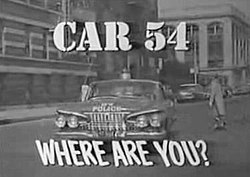

I'm not here to write an exquisite prose about the cultural merits of “Car 54, Where are You”. I'm not going to say that it was a wonderfully sublime show that worked on eight different philosophical levels. Nor am I going to say that the show reinvented the sitcom, and forced us to look at ourselves and our lives differently. I'm not going to say this because it's not true. I am going to paraphrase a certain NFL head coach and say, “Car 54 was what it was.” And what the show was was a screw-ball comedy about two oddly coupled Bronx cops and the people they helped and worked with every day.
Quick aside, everyone has met that guy; the one who always has to bring the must mundane, mindless pleasures up to a certain level so that he can explain why he enjoys them. Usually the medium involved is either music or books, especially comic books (“I read the Amazing Spider-man because of the subtle and sophisticated commentary on social mores that I can't find anywhere else.”). Every once in awhile he'll turn his attention to a television show that's “beneath him” and find some sort of crazy high-brow justification for why he watches it. I've never found anything wrong with this reason: I like it because I like it.
And that's the reason why I enjoy “Car 54”, the show does what it sets out to do: make me laugh. Each episode's plot was pretty much the same: something out of the ordinary happens to Gunther Toody (played by Joe E. Ross) or his partner Francis Muldoon (Fred Gwynne). And it's the typical sitcom faire: they have to take care of a baby or a dog, Gunther has problems with his wife, Muldoon can't find a date, etc. During the next 30 minutes, there's a few misunderstandings, some shenanigans ensue and the duo return to the status quo. To make things even better (Or worse depending on your point of view) neither of them ever bring up any of the previous episodes' “major” calamity.
If you've been reading some of my other entries, you'll notice that I harp on one thing: it's not the plot, it's the characters. And that runs true here: Muldoon is the typical straight man who is both sharp and level headed. Toody is the buffoon, whose responsible for most of the laughs. They bicker like a married couple, but they genuinely have a strong affection for each other, which is something that the audience can tell.
As actors, the two couldn't have been more different. Up until his role on the Phil Sivers' show “Sgt. Bilko”, Ross cut his teeth as a comedian who was the first act at a lot of strip clubs and bars. Gwynne was a Harvard-educated ad man who, like previous entry and Harvard alum Conan O'Brien, was the president of the Harvard Lampoon. He loved performing but found it tough getting a steady job (which is why he worked at an advertising agency) until “Car 54” came along. Of course, Gwynne was to become most famous for his turn as Herman Munster in “The Munsters” which aired a year after “Car 54” was cancelled. Joining him on “The Munsters” was Al Lewis who played his father-in-law Grandpa. In “Car 54” Lewis played fellow officer Leo Schnauser.
It is these differences that helped make the show shine. Officer Toody looked like a guy that would be a hacky comedian working at a strip club while Officer Muldoon looked like a guy that would've gone to Harvard. The writers were smart not to go against type and let these two guys play to their strengths. And like future sitcoms like “Seinfeld” there was never a “learning or hugging” moment in the program—though, I doubt that was an official edict as it was on the Seinfeld set. Gunther and Toody were two Bronx cops who happened to be involved in funny situations and for the most part, the producers left it like that.
When I started this entry, I promised that there wouldn't be any other reason for liking this program other than “because I like it”. However there was another interesting dynamic to the show that wasn't prevalent in the era: and that was the “dignified” appearance of black people on a TV show. I put dignified in quotes because of a few reasons, but the biggest one is that television in the 1950s and 1960s was typically a white world, when a black person was on TV usually he or she was in a role as servant or in some other menial job. On “Car 54” there were a few black cops, most notably Nipsey Russell who took on the role of Officer Anderson. They were treated the same as the white cops and as actors, Russell in particular, had some great lines.
Was “Car 54” the Rosa Parks of the sitcom world? No. But showing black people and white people equally working together was a step in the right direction.
Another reason why I liked this show was sort of the reason why I liked "The Andy Griffith Show" and that's there is no way that this program could ever be on TV now. America is too different of a place than it was in the early 1960s. Like Andy Griffith what made this show funny is that there was a certain respect that cops had that they don't have now. The neighborhood policeman was a pillar of the community and the jokes about them were seen as good natured fun. The modern day lampooning of police officers is a little more edgy, a little more mean and that's because of the way that cops are seen. Whether or not we're better off, I'm not sure, but while I can't see Jimmy McNulty and Bunk Moreland joining the 53rd Precinct, I couldn't see Toody and Muldoon signing up for a tour on "The Wire" either.
Perhaps the lasting memory of “Car 54, Where are You?” is the opening theme song:
“There's a holdup in the Bronx!
Brooklyn's broken out in fights!
There's a traffic jam in Harlem
That's backed up to Jackson Heights!
There's a scout troop short a child!
Khrushchev's due at Idlewild!
Car 54, where are you?!”
Of course, I know that Idlewild is the old name for the current John F. Kennedy International Airport, but when I was a kid I thought that the line was “Krushchev is doing Ida Wild”. It sounded dirty, which didn't make sense in the context of the show, but I had no idea who Ida Wild was. I think I may have even asked my parents, who also had no clue what the hell I was talking about.
“Car 54” ran for two seasons before it was cancelled. According to Fred Gwynne biography I watched over the weekend—yes, I am that much of a dork—the show was still popular when it ended, but the biography didn't give a reason why it was cancelled.* And after that it spent some time in syndication reruns before landing at Nick at Nite during the late 80s, which is where I found it.
* The same thing happened to “The Munsters” as it was a ratings bonanza when it debuted in 1964—which coincidentally was also the year that “The Addams Family” and “Bewitched” debuted, which says a lot about the copy-cat industry that is television even in those days. However, it fizzled once “Batman” came on the air the following year in the opposite time slot. Gwynne didn't care that his show was on the way out because by that time he was pretty sick of playing Herman Munster. From the hours it took to get him into makeup to the ridiculous Munster plots, Gwynne didn't go on a full-fledged Robert Reed rant, but he did make it known that he wasn't thrilled playing the role that would make him so famous.
In 1994, someone got the idea of revising the “Car 54, Where are You?” franchise for a full-length movie starring John C. McGinley as Muldoon (you may know him better as Dr. Cox on Scrubs) and David Johansen as Toody (you may know him as Buster Pointdexter who sang that insufferable “Hot, Hot, Hot” song that's played at every single wedding and the guy who lead the cross-dressing pre-punk New York Dolls). Adding to the cast were Fran Drescher, Rosie O'Donnell, Jeremy Pivin and Daniel Baldwin. There were also cameos by Russel and Lewis.
It was one of the biggest bombs of the year and given the cast, who could blame them from staying away from the theater. I have no idea why the producers used the “Car 54” name for the project as it really had nothing to do with the original show. McGinley and Johansen are just playing mismatched cops, like Eddie Murphy and Nick Nolte did in “48 Hours”. Why go with the “Car 54” name? Call it something else, especially considering that this wasn't a time piece it was updated for the 1990s. I don't think that a name change could have saved the movie, but at least the show wouldn't have been connected to this stink bomb—which IMDB.com readers listed as the 28th worst movie of all time.
Watch the original TV show, but avoid this movie at all costs.
Tuesday, March 04, 2008
40. Late Night with Conan O'Brien

To be totally honest, I haven't seen much of “Late Night with Conan O'Brien” since I started working full-time—the show starts at 12:30 am EST and I'm usually asleep much earlier than that. Because of this, maybe the show should be a bit lower in the standings, though when I was a die-hard viewer (college and the first few years out of school) there was no funnier hour on TV.
O'Brien first came to the public's conscious (or at least the comedy nerd's conscious) in the late 80s as a writer and bit performer on “Saturday Night Live” before moving on to a writer/producer role at “The Simpsons”. There was no doubt that he was a hilarious writer—some of his episodes on “The Simpsons” are the classics that most refer to when speaking about the “good old days” of the show—but people had no idea who this extremely tall, extremely Irish looking guy welcomed them to David Letterman's old show in September 1993. The only thing that they knew was that O'Brien was no Letterman.
And that was ok. Despite attempts by NBC to hire Garry Shandling, Dana Carvey, Jon Stewart or Drew Carey for the job, O'Brien won out. O'Brien's old boss at SNL (Lorne Michaels) was producing the show and felt that the upstart had something that people would like. Having an established house would have been the safe play, but the show after “The Tonight Show” is supposed to be hosted by an anonymous person. Letterman did it that way and he was hugely successful. And when Conan leaves to host “The Tonight Show” in 2009, it should be the same way.
Unfortunately, for the first few years, it didn't look as if O'Brien would be so lucky. NBC had the brilliant idea of just signing him to 13-week contracts, which probably made his confidence soar, and were close to firing him—only they couldn't find a replacement. Like many things in life, luck and the ability to work cheaply (and on a ridiculously short contract) were the saving graces of a now successful man.
Somewhere after the awkwardness of hosting his show dissipated, O'Brien found his confidence and started doing comedy his way. And that's when he started to shine. He was one of the first mainstream comedians to bring “nerd humor” into American living rooms. And while that's not on par with Richard Pryor, Lenny Bruce or George Carlin bringing their edgy brand of funny to the masses, it was an important step to where we are today in terms of what our nation finds funny. Quick aside, when I say “Nerd Humor” it's a catch-all reference to jokes about “Star Wars” or “Star Trek”, general awkwardness or any self-deprecating jokes.
For the first seven years of the program, O'Brien had his own Ed McMahon in the form of Andy Richter. We've spoken a bit about the genius that is Richter in a previous entry, but he really made his bones on this show. Whether it was a weekly staring contest bit with O'Brien, except for Richter's last episode Conan always won because there would be something strange or disgusting occurring behind O'Brien that would break Richter's concentration, or going for a desk ride, this is where Andy and Conan would pretend to drive around while a green screen behind them showed the audience where they were heading, Richter always brought the funny.
And that was important for the first couple of seasons because while an unknown himself, Richter was a crutch that O'Brien could lean on when the show was going off the tracks.
In addition to Richter, O'Brien also played off his band leader and former member of Bruce Springsteen's E-Street Band, Max Weinberg. Weinberg was always at his best when O'Brien would make him out to be an arrogant, sleazy character who would do anything at any time to get ahead at work or with the ladies. With his sly smirks and man-of-few-words demeanor, Weinberg quickly became an audience favorite, who were in on the obvious joke.
Ultimately what saved O'Brien was the comedy, it was terrific stuff that hadn't really been done before and just needed a chance to find an audience. And it did, after three year O'Brien began to get more recognition from the mainstream press who hailed him a favorite of Generation-X and especially college students. When the mainstream recognizes hidden genius this is normally this is the kiss of death for hipsters and young people who hopscotch to the next fad, but O'Brien persevered and both the underground and the “normal” public both enjoyed him.
Though O'Brien, Richter and Weinberg were funny on their own, there were a large cast of characters who'd visit the set nightly. Some real (Tony Randal, Abe Vigoda) some fictional (Pimpbot 2000, a stereotypical 1950s looking robot that was programmed by a stereotypical 1970s pimp and Triumph the Insult Comic Dog) but always killer. The one classic bit that stands out in my mind was during the winter of 1996: O'Brien was on a quest to find Grady character (Whitman Mayo) from “Sanford and Son”. A few times a week he'd play an old clip or two of Grady from “Sanford and Son” and then show a map of the United States and fake callers would phone in with recent “spottings”.
As the months passed, the bit grew more and more popular and finally the show had to find the real Grady and began promoting that he'd be on that Thursday night's show. Up until this point, I doubt that anyone had thought of Whitman Mayo in 20 years, but the crowd was going crazy for this guy when he showed up. A gigantic flashing, neon sign that said “Grady” dropped from the ceiling, confetti flew everywhere and the band played the theme to “Sanford and Son”. The crowd reacted as if Mayo was the first man to land on the moon, come back to Earth and hit a walk-off grandslam in Game Seven of the World Series.
The genius behind this bit was that O'Brien and his writers took a character that we all knew, that was buried deep in our collective memories and brought him back. I've said it before, you can not go wrong with nostalgia. But it was more than that, the two-month build up that slowly started gaining steam was tremendously well-done. Normally, my roommates and I went out to a bar every Thursday night to try and pick up chicks, there was no way in hell any of us were going out that night. Any time you can stop a few college guys from trying to drink beer and find girls, you know you have something special.
As the show and the host matured, certain things got better: O'Brien's opening monologue went from brutal to well done and his interviewing skills got remarkably better as well. The one thing that O'Brien was terrible at was interviewing guests. He would ask a question and as the guest was answering, O'Brien would start interjecting pointless stories which would infuriate the tale's teller. This wasn't done with any malice, like Ali G or Tom Green, I think it was done out of general nervousness and the fear that if O'Brien wasn't talking, people would forget whose show it was.
It was always my opinion that if the show was cancelled in its early years, that would have been the reason. To their credit, NBC stuck with the show and it prospered. This should be a lesson to all TV executives who want to cut down an interesting, new show. Give it time and it will work, the American people don't like crap, but if that's all you give them, that's all they'll watch.
Friday, February 29, 2008
41. WKRP in Cincinnati

Comedic law #1: Ensemble casts usually make the best comedies. I'm not sure why this is true, though it probably has something to do with the fact that if you don't like one character, if you wait a few minutes he'll be off the screen and another one will come along. Sort of the Chinese Buffet way of thinking: I don't like egg rolls, but I like the General Gau's chicken. And one of the best orders of General Gaus—I mean ensemble casts—was featured on the great “WKRP in Cincinnati”.
To my knowledge, none of the cast members were big stars before the show took CBS' airwaves in the late 1970s. Most played bit roles in television or movies and were known as character actors. That's why the show was so great, it wasn't built around a star or was a vehicle for one particular person—an aside: the show “Friends” was initial a vehicle for Courtney Cox and that's why a majority of the first season revolves around her character Monica, who may be the least interesting character of the six. If “Friends” stayed in this format, who knows if it would have been a monster hit in the ratings.
With “WKRP” the stories and the plots were the stars, and they were mostly character driven. Much like another MTM ensemble show (“The White Shadow”), to enjoy “WKRP” was to enjoy the characters. In other words, the hook of the show, a group of radio workers, isn't what made it beloved. It was the heart within these people. Yes, Dr. Johnny Fever (Howard Hessman) was a burn out who had nothing in common with slick sales man Herb Tarlek (Frank Bonner) or Les Nessman (Richard Sanders), but it was apparent that the cast cared for each other and that showed on the screen.
Every member of the cast worked very well with all of the other members, but there were certain pairings that were terrific and the writers often went to the well with these duos: Fever and Venus Flytrap (Tim Reid), Mr. Carlson (Gordon Jump) and Andy Travis (Gary Sandy), Tarlek and Nessman. Even the woman, who seemed as if they had nothing in common; smarter-than-she-appears secretary Jennifer Marlowe (Loni Anderson) and industry new comer Bailey Quarters (Jan Smithers) had a great deal of chemistry. In each pairing, the latter was usually the straight guy, while the other character played off of him/her. This wasn't gospel and sometimes it changed up, however.
The Jennifer/Bailey debate among young men who grew up watching the show in syndication is that generation's version of the Ginger/Mary Ann debate from “Gilligan's Island”. While Jennifer was a knockout in every sense, there was something “sneaky hot” about Bailey that a lot of guys found intriguing. It was almost if Jennifer was the sure thing (good looking, brains, rich) but Bailey had something under the surface that could be better than Jennifer. The girl you picked probably had more to say about picker, than anything: did you lean towards the favorite or were you a champion of the under dog?
As stated before, while the acting was top notch, the plots were the engine that made this show run. Perhaps one of the greatest episodes in television history is when the station came up with the idea of a Thanksgiving turkey giveaway. Instead of simply going to a store or food shelter and handing out turkeys, the group decided to have station manager Mr. Carlson go up into a helicopter and drop turkeys to the people on the ground. The thought was that when the birds were released, the turkeys would fly down and land softly in the arms of the people. One problem: turkeys can't fly.
Instead of seeing the turkeys fall to earth, we are then shown program director Travis sitting in Carlson's office listening to the radio as the promotion that will put them on the map is underway. As he is listening to Nessman's description of the events (reminiscent of Herbert Morrison's description of the Hindenburg disaster), Travis realizes (too late) that turkeys can't fly. This led to one of the great lines in television history from Carlson, “As God as my witness, I thought turkeys could fly!”
And the fact that the director left the scene of turkeys bombing down on Cincinnatians to the imagination of the audience makes the scene that much more funny.
Not all episodes were that slapstick-y, there was another episode when the gang had to play a softball game against their rival station and the only one who was excited about it was baseball fan, Nessman. The problem was he stunk at the game partly due to his mother's constant harping of him having to practice the violin while the other kids played ball. With the station clinging to a one-run lead, the bases loaded and two out in the bottom of the ninth, Nessman is stuck in deep right field. Suddenly the viewer hears the crack of the bat and it's obvious that the ball is coming his way. As the ball is coming, Nessman is day dreaming of his mother's shrill tone imploring him to practice. Suddenly he notices the ball, puts his glove up and ... the show ends.
While the nerdy guy making the decisive play in a baseball game isn't new territory, the juxtaposition of Nessman's enthusiasm coupled with the reason for him being so bad was a different way of telling the story. That is another reason why the show worked well. It never really broke a lot of new ground in the way it was filmed and most of the plots and characters could be consider either cliché or done already, but the writers often took different routes to those “places”.
And no show about a radio station would be complete without some music, and “WKRP” had a fine lineup of the day's biggest artists. The problem is, due to licensing money, you can't hear them any more. According to Wikipedia, when the show went into syndication the original music from artists like the Rolling Stones, KISS and the Doors were too expensive to pay, so they would have a band record generic rock and replace the well-known songs. These generic replacements followed the episodes to DVD and while there may be some loss, it is mostly incidental.
While not the first ensemble comedy, “WKRP in Cincinnati” showed that America can support a show with a lot of characters and smart plots. A direct influence on another off-beat, ensemble comedy about the radio business, “Newsradio”, “WKRP” was also responsible for a number of unique characters bringing the biggest laughs.
Tuesday, February 26, 2008
42. The White Shadow

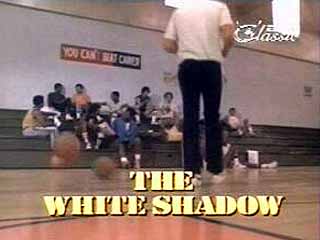
It's sounds like a corny premise for a show: former NBA player forced to retire because of bad knees comes back to his old high school and finds that everything has changed since he left. The principal of the school happens to be his former roommate at Boston College and talks him into taking the job of basketball coach at the alma mater. One problem, the principal says, the kids are tough and times (and kids) are different.
It's a story that has been told a million times, “Welcome Back Kotter” is one example, but “The White Shadow” was so much more than a Kotter copy. Produced by Bruce Paltrow (Gwyneth's father) and MTM productions (the same folks who brought you “Mary Tyler Moore” and “Rhoda”), this wasn't the basketball version of the insanely popular WBK. It was something much different, much more serious. For the first time a prime time, network show was centered around teenagers (black and Hispanic teens to me more precise) that didn't reduce the characters into caricatures. Each character was fleshed out and was given a true personality, one that didn't just see in strict black and whites—they understood that there were gray areas in life too.
Ken Howard plays the Shadow, Coach Ken Reeves, who uses a lot of old-school logic and toughness to whip the Carver High School basketball team into city champions. Set in South Central Los Angeles, it would have been easy for the writers to go the Kotter route and make the kids lovable goofballs who might be tough on the outside, but are really nice and sweet on the inside. Quick aside: for all of the Sweathogs' tough talk, when did the audience ever see these guys get into a fight? Are we to believe that the toughest kids in a Brooklyn school all worshipped at the altar of their teacher—himself a second-rate Groucho Marx? There have been a lot of stupid things foisted on the American public, but “Welcome Back Kotter” has to be one of the dumbest.
Instead of goony antics, over-the-top camera mugging and worn-out catchphrases, “The White Shadow” brought a gritty realness to prime time television and showed the viewers that a. modern teenagers don't live carefree lives and b. kids living in the ghetto are constantly bombarded with negative influences. From gangs to point shavings to drugs to high school prostitutes to even a member of the team getting gunned down in a liquor store before the city championship, if you were a Carver High graduate, you've pretty much seen the entire gambit of human misery. And it would've been easy for the writers to go the complete opposite way of the Kotter kids and make each episode a weekly “After School Special” about the danger du jour. They didn't do that either.
What made “The White Shadow” so perfect was that there was a nice combination between the serious and the funny. The team members constantly busted each others' balls, got together after games to party and had traverse the troubles of the classroom. In other words, it was about as close to real life as you were going to get in the late 1970s. And another important thing: the kids at Carver High actually looked like they could play basketball. Nothing takes a viewer out of a TV show than an actor trying to do something that he simply can't do. One of the worst parts of “Teen Wolf” was watching Michael J. Fox try and dribble a basketball without watching what he was doing. I could buy the lycanthropy, I can buy car surfing, I can even buy the whole town rallying around a werewolf, but I can't buy Fox playing hoop.
For former “high school heroes” or if you played sports at any level, one of the reasons why this show worked is because you might be able to see your team or members of your team in the Carver High bunch. Like I said before, nostalgia sells. But this wasn't to say that the squad was a big happy family, like most teams there were disagreements and some people didn't like other people for a variety of reason. Abner Goldstein, who was the only Jewish guy who played hoop and often felt ostracized from his teammates who were mostly black. The issue was eventually cleared up and most of the guys treated him as a teammate, but it wasn't a one and done event. I believe that his awkwardness around the team lasted most of the first season. There were a lot of racial aspects explored in the show, but mostly the racial stuff was either not talked about or was dealt with separate from the team—in one episode three players were held in suspicion of mugging an old lady, simply because they were black.
The one goofy portion of the show were the shower scenes. I'm not sure why the producers did this, but they decided to focus on the singing ability of the team. Worse than that, the “Shower of Power” (what the group was called) would often sing rock and R&B songs from the 1950s and early 60s. For a program that was built on the cornerstone of being “real” this was a transcendence into absurdity which never worked because of two reasons. One, most high school basketball players aren't singers and if they are, they aren't doing it in the shower. Two, if we buy the premise that these kids love to sing, they aren't going to sing a bunch of tunes that even the nerdiest of them would consider lame.
As the show progressed cast members left and were added, as the mainstays of Thorpe, Coolidge and Salami stayed constant. By far the team's best player, Coolidge was also the player Reeves was most close to and was seen to be the one where basketball was not just a game, but a life's occupation. However, in a brilliant piece of casting, Coolidge ends up on another MTM show—“St. Elsewhere” as an orderly.
Despite some players leaving for graduation, often times they would return to visit their coach and update him on what they were doing: Haywood worked for a law firm, Goldstein joined the Marines and Reese drove a cab while simultaneously pursuing his dream of becoming a singer. These little vignettes allowed the viewer to catch up cast members who left, which is something that most shows don't do. Once you leave the set, the character is usually forgotten for good. This was proof that the writers cared about their characters.
The show did well, but never caught fire like CBS intended it to and was cancelled after three seasons. For awhile it reran on Nick At Nite and ESPN Classic, but has since left the airwaves, which is a shame because while the basketball shorts are really short and no one posts up in Chuck Taylors anymore, well-crafted stories never go out of style.
Friday, February 22, 2008
Spring Training Thoughts
Here's a couple of thoughts that I've had during the only time that I wish I was in Florida:
+ Coco vs. Jacoby, who do you choose? Last year Jacoby Ellsbury came up to the bigs and made the most of his time. He hit for average (though no power), ran like crazy (though the Sox don't like to do that too much) and played a pretty good centerfield (thouhg not better than Coco Crisp). He played in 33 games, had 114 plate appearances (not including the playoffs) and posted these numbers: .353/.394/.509. Make no mistake about it, those are some terrific statistics, but he amassed them in essentially a month's worth of work. One has to wonder, was this just a fluky streak?
On the other hand, Crisp has posted back to back years of .264/.317/.385 in 105 games and .268/.330/.382 in 145 games, which are numbers much lower than anything he did in Cleveland. Though he does have sensational defense and probably should have won the Gold Glove this year. The numbers are pedestrian, but Crisp has maintained that he's been injured for the last two years. One has to wonder, is he serious?
If you're Red Sox GM Theo Epstein, what do you do? Do you trade the veteran and cross your fingers that the rookie does well? Do you keep the veteran and send the rookie back to AAA for more seasoning? Here's what we do know, Ellsbury isn't going to hit .350 for the entire year and he is going to go through a slump. But where is he going to level off at? .310? .290? .270? He's probably not going to hit for much power, but how many homeruns will he have? 10? 15? 20?
While he hasn't been the answer to Johnny Damon, Crisp has been consistent in Boston and you know what you have in him. Ellsbury is the wild card, he could be terrific, he could be Crisp, he could be worse. Depending on whether you're an optimist or a pessimist depends on who you keep. If you trade Crisp now, you're getting 50 cents on the dollar. Trading Ellsbury at his peek value, you're getting $1.50 on a dollar.
One thing not to consider is the fans' love of Ellsbury. There are some people who wouldn't trade him straight up for former Twin Johan Santana. These are the same fans who will boo the crap out of him if he's batting .197 for April.
+ Curt Schilling dishes it out, but he can't seem to take it. I am a media yenta; I care about the feuds between the press and the players. I find the behind-the-scenes dealings between the two factions fascinating, especially considering each camp (for the most part) can't stand one another. That's why the little slap fight between Schilling and Boston Globe columnist Dan Shaughnessy cracks me up.
On Sunday, Shaughnessy wrote a scathing column pretty much calling Schilling a lying fat ass when it came to his injury. Up until Monday, Schilling hasn't said anything about the injury to the press, but decides to give an impromptu press conference that morning, only he didn't invite anyone from the Globe. This is a complete BS move.
Shaughnessy probably wasn't going to cover the press conference, he's notorious for his hit-and-run style of writing a hatchet job and not showing his face in the clubhouse/locker room for weeks. The people which were going to be hurt by this snub are Sox beat writers Gordon Edes and Amelie Benjamin. I have no idea whether Benjamin or Edes have done anything to piss Schilling off other than have the gall to work at the same paper that Shaughnessy works at. Anyway, Edes was forced to write the story while watching the live feed from NESN.
Schilling routinely calls Shaughnessy CHB (which stands for Curly Haired Boyfriend, which is a nickname the great Carl Everett gave to him when he was flipping out on Edes one day) and has not hid his intense dislike for the writer. In his blogs and on message boards he's given Shaughnessy a tough time, and that's fine. I'm not defending Shank (another nickname), but if Schilling is going to rip Shaughnessy, he has to expect to get ripped back.
And taking his revenge out on his innocent colleagues isn't the way to settle the score. Schilling is one of the first people to admonish someone for painting all ballplayers with the same brush. He should listen to himself.
+ Pedro Martinez showed up at Mets camp with a gigantic smile and told everyone that he has been clean, steroid free and essentially that proves he's been the best pitcher of the generation.
I have to agree.
From 1997 through 2003, his highest ERA was 2.82. The league's minimum ERA was in the mid 4's. Take a peek at his numbers, they are eye-popping:
Pedro's Stats
Add in the fact that he's had to deal with Bunyon-esque sluggers, a tighter baseball and smaller ball parks and it can be argued that these seven seasons are the greatest seasons ever.
There was a lot of off-field baggage that came with Pedro Martinez, he was petulant and often felt that he was the target of an imagined snub or turned small differences into bigger molehills, but the Red Sox and Major League Baseball will never see a pitcher like Pedro Martinez ever again. His 1999 17 strikeout, one-hit (a homer by the immortal Chili Davis) game against the New York Yankees was the best and most dominant game that I've ever seen pitched.
As we get further and further from the steroid era, Pedro Martinez will get the proper accolades that he deserves and will one day be seen as the right-handed Dominican Sandy Kofax.
He was that good.
+ Andy Pettitte cheated, sort of came clean, then came “all the way” clean and is now a paragon of integrity. Roger Clemens cheated and lied about it and he's (to quote another infamous HGH abuser Debbie Clemens) “been treated worse than Hitler.”
What does that say about America? We're suckers for apologies and Roger Clemens is an idiot for not realizing this. I pretty much feel the same way that most of America feels, Clemens is a dirt bag who tried to throw everyone in the world (his wife, his mother, his best friend and his agents) under the bus in order to make himself look innocent. It's not working and if it wasn't such a disgusting act of cowardice, I'd almost feel sorry for the dumb Texan.
Aside from that, my take on this entire mess is that it sucks for baseball that the best hitter (Barry Bonds) and one of the best pitchers (Roger Clemens) were doped up. And it sucks more for baseball that their plan for fighting this was a two-pronged attack of ignoring the problem and then denying the problem existed. Once again, the fans (the real guardians of the game) are the ones who end up getting screwed in the end all in the name of greed.
The good news is that Bud Selig has recently signed a contract that will allow him to stay the commissioner of baseball through 2011. This is after he renegged on his promise that he was going to step down after his contract finishes up at the end of the 2008 season. Once a car salesman, always a car salesman.
Thursday, February 21, 2008
43. Action
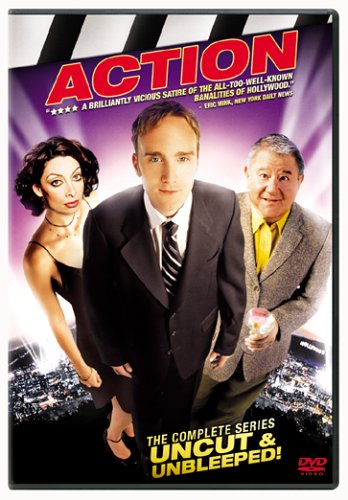
This is going to be the shortest entry on a show that I'll be doing. The reason is not because I don't like the show “Action” because I do, it's because I don't remember much about the particulars of each episode. In fact, I was toying with taking it off the list but as I was researching the program yesterday, I started to remember that there were a lot of things that I liked about the show and how it has a strong influence on shows that I love now.
To begin with, this was another one of those “risky” FOX shows that makes FOX look awesome to TV geeks like me when they send out press releases about the new “daring” show that takes “a lot of risks” and is “edgy”. The ultimate problem with these types of shows is that FOX usually doesn't have the balls to stand behind it and face the inevitable low ratings or backlash from the flyover state viewers that don't particularly like or understand the program. And before I'm besieged with emails and comments telling me that I don't get the TV business, I do. Shows are only on television to get ratings which in turn make money for the network. Basically, they're the filler around all of the advertisements.
If a show flounders, you're finished. I understand that. It's just that FOX had to know that most of America wouldn't take to Peter Dragon at all. Dragon is the main character of “Action”, played by Jay Mohr who did his best job of acting for his whole career with this role. He's a slimy, douchey producer that got his start writing scripts for gay porn movies and may or may not be a homosexual himself. The second lead is a former child star who ends up with a major coke problem and is a high-class bisexual hooker—though she does have that heart of gold. By the way, Illeana Douglas is fantastic in this role too.
Forget the gay stuff, most Americans don't like to watch a show where the main character is a jerk and the other main character is a hooker with a drug problem.
Look at a show like “Big Brother”, know why it's not a gigantic hit here in the United States (unlike in Europe)? Because when it comes time to vote the cast members out, Americans always knock out the biggest asshole in the house. These people are usually the ones that you want to see on television, they're the ones who make the show interesting. The good people are the ones who make the show boring and flavorless. I firmly believe that if “The Sopranos” were on network TV, it wouldn't have lasted a season for this one reason.
But it's been ingrained in our heads since we able to watch television, you can not root for the bad guy. When Henry Hill introduces Jimmy to the audience in “Goodfellas” he said that “Jimmy is the type of guy who wants the bad guys to win in the movies.” For most, that's a gigantic character flaw.
So the main character is a jerk. That's one strike. The show is about the inner workings and the gross underbelly of Hollywood—a lot of the plots were taken almost verbatim from stories told to creator Chris Thompson and producer Joel Silver. Like I wrote about in my entry on “Grosse Pointe” many people don't care about the goings-on behind the Hollywood sign. They are simply not interested in seeing how the sausage is made. The show has to have some other kind of dynamic to hook the audience in, otherwise it's finished. “Action” didn't have another dynamic. That's strike two.
Strike three was its time slot: it was on Thursday nights after “Family Guy” at 9:30. Since the mid-80s, NBC has pretty much owned Thursday nights, so the audience that FOX was looking for: young, urban, up on pop culture was probably watching “Friends”, “Frasier”, “ER” and whatever garbage that NBC threw in between the three shows. Furthermore the lead-in to “Action” was “Family Guy”. Which is a decent show, but the same audience that watches “Family Guy” isn't going to appreciate “Action”. They are simply too different and appeal to vastly different audiences. And “Family Guy” wasn't the hit for FOX that it is now. It bounced all over the place and never won a strong audience until it was rerun on Cartoon Network's Adult Swim. Then it was brought back to FOX and turned into ratings gold. In 1999, it was just another “Simpsons” clone that never caught on.
After eight episodes shown over four months (FOX does another stupid thing by premiering their shows in September and then having an October hiatus for the World Series, it's a gigantic momentum killer) the show was out and “Action” bid adieu.
Here's the thing though, I think that “Action” had a bigger impact than most people give it credit for. Without this show, HBO's hit “Entourage” doesn't exist. Jeremy Piven's Ari Gold is essentially the agent's version of Peter Dragon only without the sexual confusion. He's loud, abrasive, obnoxious—he's a dick. But the good thing for Piven (and the crappy thing for Mohr) is that Piven is on HBO where they have a string of shows where the main character is a jerk. From “The Sopranos” (the aforementioned Tony Soprano) to “Curb Your Enthusiasm” (Larry David) to “The Wire” (Jimmy McNulty), none of these people are men that you'd like to see your daughter date. But, they are among the best created characters of the last 15 years.
The show also set the scene for some of “Arrested Developments” funniest gags as “Action” was among the first to have the characters curse, but the offensive word is bleeped out, though the audience understands the message being conveyed. And it was among the pioneers of uncomfortable humor that makes shows like “The Office” or “Ali G” work so well.
All 13 episodes of the show are available on a DVD set, and most times it can be found pretty cheaply. Do yourself a favor and watch one of the shows responsible for the genesis of the more edgy and uncomfortable brand of humor that shows up from time to time on network and cable TV. It's well worth your time.
Tuesday, February 19, 2008
44.Buffy the Vampire Slayer

For a movie that was essentially done to capitalize on the popularity of Luke Perry, the television version of “Buffy the Vampire Slayer” did pretty well for itself both ratings-wise and artistically. I'm not going to delve into the mythology of the show nor the debates about creator Joss Whedon being a genius because frankly, the people who endlessly debate those topics scare me more than any vampire ever did.
Here's what I liked about the show: the season story arcs were intricately done and were well-plotted out. Much like a show that aired on the UPN/CW after “Buffy” was gone (“Veronica Mars”), Whedon was able to keep a nine-month story going without getting bogged down in the episode-to-episode adventures. The main villain of the season (called the “Big Bad” by fans) was usually established in the first or second episode. During this time, Buffy or her buddies would also begin going through an adolescent upheaval that had nothing to do with the Big Bad, with both plots would closely mirroring each other.
At about the season's one-quarter post, the Big Bad would make him/herself known and the Buffy gang would have to begin coming up with a solution for getting Sunnydale back to “normal”. At midseason, the first solution wouldn't pan out, and they were back to square one often licking their wounds. By the final few weeks, the Big Bad would plan something drastic causing Buffy and her friends to get back on the horse and go hell-bent-for-leather (what a set of weird clichés I decided to use, by the way) to finally get rid of the Big Bad.
The trick for Whedon and his writers wasn't the overall story arc—if I had to guess that was probably the easiest part of the job—but how to keep the arc fresh in the minds of the viewers while it lurked in the background of the “day-to-day” events. I may be wrong, but I can't seem to remember many action shows doing that before Buffy, and if they did so, it was done poorly.
Another thing that Whedon did well is present his view that traversing through the high school years, and adolescence in general, can be pure hell for everyone. In this case he skipped the metaphor entirely and went for the subtle approach of putting the gates to hell on the grounds of the local high school. Despite every thing you may have seen up until the late 1990s, for many people high school sucked and the disenfranchised were finally getting their say with shows like this and “Freaks and Geeks”. Buffy wasn't particularly popular and aside from Cordelia (Charisma Carpenter) none of her friends were either.
Speaking of which, from Carpenter to Alyson Hannigan (Willow) to Eliza Dushku (Faith) to Buffy herself (Sarah Michelle Gellar) the girls of Sunnydale High School were knockouts. In fact, despite the daily threats of vampires, werewolves or other supernatural entities; Sunnydale High School is the one place that I'd like to matriculate if given the choice. The WB knew what they were doing when they casted this crew. Though I have to admit that there is a lot of things that I bought on this show (vampires, witches, etc.) but Hanngian being cast as the “ugly” chick? I'm not so sure about that.
Like I said, I never immersed myself in the whole Buffy mythology, but for the most part, I felt that this was a tremendously fun show and a decent way to escape the real world every hour. Like most shows set in high school, it began to lose some steam once the gang graduated and they all attended college together (which was conveniently located in the same town) and the whole Buffy/Angel angle was played to death and then there were the few seasons where Buffy had a sister.
Seriously, that was pretty much the final straw for me.
There's a lot of things that I can deal with on a TV show (Phil Hartman being replaced by Jon Lovitz on “Newsradio” for one thing), but Cousin Olivering a show that really didn't need it, is not one of them. It seems as if the character of Dawn, the name of Buffy's sister, was added because they wanted to put a little spice back into the characters' lives. Which is fine, I can deal with that. But after the season where she was integral to the defeat of the Big Bad, Dawn became more of a nuisance to both the characters and the writers themselves. Unlike the other characters, she wasn't allowed to grow, she sort of hung around and tagged along—mostly because Buffy would remember that she had to care for her younger sister. When this happened the normal cliches occurred, “The vampire kidnapped Dawn, what do we do?” or “Everyone made it out of the volcano alive, we're so lucky! Wait a minute, where's Dawn? She's still back in there!” That's hacky, boring stuff.
But what made Dawn so bad is what made the rest of the show so good. All of the characters seemed to grow and mature at a normal rate. The only “regular” guy Xander went from uber-geek to a confident dude, who was dating Cordelia. Willow went from a timid nerd to a legit hottie witch. Even Buffy grew and changed through out the series run. Yes, change is a normal aspect of a character's growth, but the care that Whedon had while making his changes never felt forced or rushed. Anything that happened to one of them usually had a lasting consequence that weren't usually belabored, but often remembered and felt later.
Aside from some worn-out fashions, “Buffy the Vampire Slayer” will probably still feel fresh when viewed in 10, 20 or even 30 years from now. High school is still going to suck, vampires are still going to scare and well-written stories with snappy dialogue will always have their place.
Friday, February 15, 2008
45.Magnum P.I.

Why “Magnum P.I.”? When a show can force you to blow off a half day of work in the “Biggest Little City in the World”, you know it's a good one.
This is how much interest I had in one of my previous jobs; I was at a convention in Reno, NV when I woke up in a hotel room and struggled to start the day. Whenever I'm on the road, I usually flip on the tube and keep it going for background noise. Normally I don't pay much attention to what's going on as it's usually the local news or SportsCenter, but for some reason the channel was tuned to A&E. As I was getting into the shower, I heard the familiar guitar strum of the “Magnum PI” opening theme. I jumped out of the bathroom, got back into bed, ordered some room service and watched two hours of “Magnum P.I.” while the conference went on without me.
In the 70s and 80s there were a lot of detective shows and most of them had some sort of twist: old lady solves crimes (“Murder She Wrote”), married couple solves crimes (“Hart to Hart”), homeless guy solves crimes (“Columbo”). But there was always the tried and true genre of: handsome-guy-solves-crimes. To the uninitiated, “Magnum P.I.” would seem to fall into that category, however that wouldn't be giving the show the credit that it so richly deserves.
For obvious reasons, this show was popular with women and it was popular with men with not so obvious reasons. Thomas Magnum (played by Tom Selleck) lived in Hawai'i on a unseen millionaire author's estate (the mysterious Robin Masters). Magnum had the life: he resided in paradise, only drove a Ferrari, hung around and worked with his buddies, drank a ton of beer, watched sports all day and bedded beautiful women. For most men, this would be heaven. The only drawback was the person he had to share the house with Higgins—but he was only a minor hindrance as Higgins was more bark than bite. The most compelling subplots of the show's run was whether Higgins was Robin Masters, and though hinted that this may be true it was never confirmed. *
* I love when television shows and movies do stuff like this. It's so much better to end a show with a couple of unanswered questions hanging over the audience's head. BTW, doesn't Higgins look like an absolute jerk in the above picture? Man, I could see why he drove Magnum nuts.
Each show was usually a self-containing adventure as Magnum would either be hired by a damsel in distress or stumble into a mystery. Like many detective shows, there would be the obvious red herring thrown into the first few minutes of the plot, followed by a twist, followed by a chase before finally finishing with the solution. More times than usual, Magnum figured out the mystery (it was his show, after all), but unlike other detective series there were episodes where Higgins or even Magnum's friends, TC and Rick would bust the perp.
For eight years the writers did a terrific job of crafting the backstory of Thomas Magnum as there were only rare episodes where on episode didn't fit the established time line of older episodes. This makes “Magnum PI” somewhat of a exception to many serial shows that run over five years—especially ones that were written before the 1990s.
In a number of programs that have long broadcasting lives, the original writers (who have the strongest sense of what the characters are about) normally leave the show for greener pastures after a few years. The ones that leave are replaced by writers who may not have the same grasp on the characters' background as the original writers had and begin to script shows that run counter to the established history of the main or ancillary characters. The tweaking of a character's past does not just occur with writers new to an established project, sometimes writers that have been writing about one character year after year grow bored or burnt out with the lives that they've created. To keep things fresh, they begin to reimagine their character's past which can contradict with what the audience knows to be true.
Both examples can cause audiences to turn away from shows in droves, normally with the same reason cited: the characters aren't familiar to me any more. Also these inconsistencies can simply confuse the audience, causing them to wonder if they are remembering events properly. There are a number of examples of this problem, with the most famous being the curious case of Chuck Cunningham. Cunningham was the older brother of Richie and Joanie on “Happy Davis” and for two seasons, three different actors (which is already confusing enough) played the role of Chuck. Then he was never seen again—written off by writers who felt he was superfluous. And they were right as the character of Fonzi became more popular, he began to dispense advice to Richie that could be seen as big brotherly. While this did not have a detrimental effect on the popularity of the show, Chuck—no matter who played him—was never instrumental to the program, though it did cause some confusion among “Happy Days” fans.
It should've been easy for the writers to make Magnum, a no-nonsense Remington Steele/James Bond-meets-Hawai'i type of character, serious in all respects. But they didn't, he was funny and self effacing in show dialogue and in the narration that accompanied most shows. He often found himself on the wrong end of pranks and household situations and this lent the character a degree of everyman. Most of can't relate to living in paradise, driving around in a Ferrari or always getting the most beautiful girl in the world. But most of us have day-to-day annoyances (such as Higgins) and simple things don't always work out the way we planned. That's why Magnum was so relatable.
Another reason was that while most of the plots came from Mystery 101, they never insulted the audience's intelligence. There were also a few serious episodes where Magnum was forced to deal with some of the horrors from his three tours of duty in Vietnam and the most famous episode was the main character was left to die in the middle of the ocean.
From the requisite Hawai'ian shirt to the Detroit Tigers baseball cap, “Magnum P.I.” was a terrific show that is worth missing a half day's work.
Tuesday, February 12, 2008
Not a lot of Cohesion
Aside from the Patriots loss in Super Bowl XLII (more on that later) there isn't a hell of a lot of big things going on right now in sports. There are a couple of small things and I'll try to touch them all in this odds-and-ends edition of 19 Thoughts.
+ Curt Schilling is out for at least half the year, maybe more. There have been some conflicting reports as to how long Schilling is going to be sitting on the bench. Some people (including Schilling and the Red Sox) say that he'll be back right after the All-Star break, while Schilling's own doctor thinks that he might be gone for the entire year. Either way you look at it, it's a blow to the Red Sox.
It's now up to the kids (Jon Lester and Clay Buchholz specifically) to anchor the back end of the staff, which may be a bit ahead of schedule. Josh Beckett should be his normal dominant self and after a year in the Major Leagues, I'm expecting Daisuke Matsuzaka to pitch lights-out this year. I assumed that Tim Wakefield was going to miss some time and that Buchholz would make a spot start or two after spending some time in AAA. However, this is going to change, barring a trade for a starter.
How will having two young pitchers in the rotation work for the Sox? Will Lester be on a strict pitch count (it's assumed that Buchholz will be)? Does Julian Tavarez make some appearances for the Red Sox, and if so will how awkward is it for Terry Francona since Tavarez was left off last year's postseason roster?
And when is Francona going to get his contract extended?
+ Speaking of questions: what the hell is up with these trades? After months of speculation Johan Santana was sent to the New York Mets for a quartet of prospects that were decent, but not great. Erik Bedard was sent from Baltimore to the Seattle Mariners, and the Orioles got centerfield prospect Adam Jones. The preeminent Seattle Mariners blog The USS Mariner feels that their team got royally screwed.
In the NBA, the Los Angeles Lakers aquired Pau Gasol from the Memphis Grizzlies for essentially Kwame Brown and a couple of draft picks. Not to be outdone, the Phoenix Suns traded Shawn Marion and the rotting corpse of Marcus Banks to the Miami Heat for the Big Aristotle himself, Shaquille O'Neal.
Two of these trades look like outright steals for one of the teams, one looks like it could be a steal and the other doesn't make a hell of a lot of sense. The Mets and the Lakers made out very well for themselves, as New York didn't have to give up their best prospect in exchange for the best American League pitcher over the last five years and they didn't have to pay him as much as was expected. Imagine being fleeced by Omar Minaya. The Lakers gave up on a stiff and two low first-round picks for a guy that will work really well with Kobe Bryant. And when Andrew Bynum comes back, watch out for Los Angeles in a tough Western Conference.
I'm not sure that I completely agree with the USS Mariner, as I think that Bedard is a special pitcher and will do well in Safeco. However, I do agree with their assertion that the Mariners were not really an 88-win team last year. According to the runs scored/runs allowed metric, the M's scored a bunch less than their opponent. This means they were lucky to have won as many games as they did and probably should have won between 82 and 85. Getting Bedard for your top prospect to augment a .500 team is not a good idea, especially if Seattle regresses. Mariners GM Bill Bavasi better hope that Jones sucks, or he's going to be the Lou Gorman of the next century. This is a toss-up, especially if the Mariners don't sign Bedard to a long-term deal.
As for the Sun/Heat deal, it's a head scratcher. Phoenix loves to push the ball up the court. Shaq can't run any more. What style is going to shake out in the end? This could either be a brilliant trade that allows Amare Stoudemire to play his more natural power forward or this could completely destroy this team during the stretch run. Like Bavasi, GM Steve Kerr has a lot riding on this trade and news out of Phoenix was that Shaq was winded during his first practice. Of course, Shaq hasn't played in Miami in awhile because he's been injured. We'll have to wait and see.
+ The Patriots lost the Super Bowl. I'm not going to write too much about this because it's done and there's nothing that can be done about it. The New York Giants upset the Pats, despite giving New England at least five chances to win it at the end. You know the old adage, “Give a good team five chances on one final drive and it will come back to bite you in the ass.”
I'm not saying that the Giants suck. They played a perfect game and controlled the tempo while the Pats played like crap. They had no answers for the Giants' defensive line, for some reason the offense never really got going until two minutes left in the final quarter and I still have no idea why Coach Bill Belichick went for it on 4th and 13 instead of kicking a 48-yard field goal.
And looking on the bright side, the Patriots went to four Super Bowls within seven years and won three of them. That's pretty awesome. Look at the Minnesota Vikings or the Buffalo Bills, they went to the Super Bowl four times and came away empty handed. You think that those fans (especially the Bills, who are on the verge of losing their team to Toronto) wouldn't trade places with New England fans?
There's a thought that New England fans were being greedy but the thing that's so disappointing about this loss was that the Patriots blew a chance to make history. They blew a chance to get rid of the 1972 Dolphins forever—the most arrogant, pretentious collection of assholes ever. Do football fans have to wait another 35 years to see a team come close to perfection? By that time I'll be 68-years-old. Jesus. I'll just about be dead. My three-month old will be older than I am now. That's so damn depressing, I think that I might go drink a bottle of Jack Daniels.
+ The Bruins. Who cares about them? 68-years-old. Gah.
+ The New York papers are claiming that the Yankees are going to keep Joba Chamberlain in the bullpen, instead of turning him into a starter. In addition there is going to be a strict 140 inning count for the entire year. That's bad news for Red Sox fans, as long as there weren't any bugs around, Chamberlain was nasty last year. I thought that the Yankees were making a big mistake by putting him in the starting rotation. Seems as if they realized their mistake early. Or perhaps they have a deal cooking for a starting pitcher? C.C. Sabathia or Joe Blanton, maybe?
+ Well at least I'm not Roger Clemens. Tomorrow the seven-time Cy Young Award winner faces his toughest opponent ever, the United States government. He's getting dragged in front of Congress to testify under oath about his involvement with steroids. His former trainer, Brian McNamee was an instrumental part of the Mitchell Report, which fingered a bunch of current and former major leaguers as steroid abusers and cheats. Clemens was one of the players in that report.
Most of those named have come clean with some sort of lame excuse like, “I was just trying to get better after an injury” or “I only did it once”. However Clemens has been steadfast in holding his ground and says that McNamee is a lying liar who lies. From his awkward interview with Mike Wallace on “60 Minutes” to his press conference where he played a tape of a phone call he had with McNamee that didn't prove anything, Clemens has gone out of his way to try and prove that this is all a gigantic falsehood.
The problem is, no one is believing him. Clemens' best buddy Andy Pettitte was named in the same report and has pretty much gone along with everything that McNamee has said. McNamee has old syringes, bloody gauze pads and other evidence that he claims is from Clemens. This could get real messy for the Clemens kin as McNamee even claims that he shot the Rocket's wife up with HGH before the two posed for a swimsuit picture for the Sports Illustrated swimsuit issue.*
* Two things, one what could be more horrible than walking to the mailbox and getting the swimsuit issue and finding out that your mom is posing in it? That's a terrible image. And does anyone really care about the swimsuit issue any more? Isn't this just a relic from a more pedestrian past? If I want to see half-naked models there are a million places I can go. And if I want to see naked chicks, there's even more places to find them. Being naked or nearly nude does not care a stigma any more. For all of the talk that America is a conservative place now, the reality is; it isn't.
Whatever happens tomorrow, and there are whispers that if Clemens screws this up he can be going to jail for perjury, the court of public opinion has already rendered its opinion on him: guilty. And while I don't have a lot of love for Roger Clemens any more (give me an hour and I'll tell you why), he was the first baseball player that I idolized. I can remember getting his poster for Christmas after he his first great year—it was one of those old Sports Illustrated ones, with the clunky white borders, the san sarif type font, an action shot and that was it. So it is with a bit of melancholy that I'm going to watch him hang himself in front of the world.
Because as he's proved time and time again, Roger Clemens can pitch; he just can't speak.
Friday, February 08, 2008
46.Andy Richter Controls the Universe

It occurred to me that the problem with my last entry was that I spent way too much time focusing on why the show (“Grosse Pointe”) didn't work, rather than the purpose of the Blog: why a particular show works for me. After all, this is my Blog, my list on my favorite shows, who cares why it didn't work for the rest of the TV-watching world? (Jesus, that last sentence had more “my's” than a Johnny Gill song). That being said, at first blush, the title of this show, “Andy Richter Controls the Universe” could be considered among the worst titles ever imagined for a sitcom.
But look again.
Unless you were a fan of “Late Night with Conan O'Brien”, the name Andy Richter probably meant nothing to you. If you were a fan, you might have been saying to yourself, “Sure, Richter is funny, but he can't star in a television show, much less control the universe.” And that may have been the exact point the producer was trying to make about the show and life in general. Andy Richter (the character on the show has the same name as the actor) was just normal guys who worked from 9-5 at a place he didn't like because it paid the bills. Despite never realizing his dream of becoming a writer, Richter still controlled the universe in his mind. The show was sort of an updated version of the classic short story “The Secret Life of Walter Mitty” by James Thurber.
The premise of the show was simple and a bit mundane: Richter got into a sticky mess and 30 minutes later he got out of it. Standard stuff.
But the genius wasn't how he got out of the mess per se, but like Mitty, it was the journey that he took to get out of the mess. Laced with dream sequences of how Andy really wanted things to go, talking to his company's 170-year-old (and dead) founder and using an omnipotent narrator (Richter) the show fooled with typical TV and story telling conventions. For example, the company's founder would often portray Andy's “bad” side and urge him to look at or solve problems in a less-than-PC way. Or Richter would dream of solving a problem in a most absurd or violent way, before ultimately deciding against it.
These solutions were often the funniest and more surreal bits of comedy on the show and despite an often absurd dream solution, grounded Richter as a nice guy who does the right thing.
ARCTU only ran for 19 episodes over two years and when the show originally aired, I vowed not to watch a second of it because it took the place of another favorite of mine, “Undeclared”. However, I broke down after the initial episode and found that it was both quirky and smart. Which meant that it was going to be cancelled soon. Fox pulled the show after a few weeks and aired it again as a mid-season replacement the following year before giving it the Old Yeller treatment at the end of the 2003 season.
Aside from Conan O'Brien, who guest starred in an episode late in the show's run, Fox never tried to use any sort of stunt casting that they would often do to spice up low-rated programs. For example, on the aforementioned “Undeclared” both Adam Sandler and Will Ferrell were key guest stars on different episodes and it was not an uncommon occurrence to see someone like Oscar-winning actress Charlize Theron guest star on “Arrested Development”. This allowed for the cast and the writing to speak for itself. Unfortunately not a lot of people were listening.
As with the last show that I looked back on, Irene Molloy was the “hot one” in this show too. But unlike her character in “Grosse Pointe”, Molloy played a sweet, almost naïve girl who is the secretary that is new to the office. Andy is silently smitten with her, but she is unaware of his feelings as she is dating his best friend. Obviously this is vein that has been mined many times in many different sitcoms, however ARCTU put a new spin on it with some of the unconventional story telling methods listed above.
In spite of it's short run and relative obscure cast list, “Andy Richter Controls the Universe” was a fun, original television show. If you happen to catch the reruns or bump into the DVD (which hasn't been released yet—though there are rumors that say that it will be), do yourself a favor and watch it.
Richter is a terrific talent that was utilized well on the Conan O'Brien show and was excellent in his one appearance on “Arrested Development”, even his subsequent show “Andy Barker, PI” was decent too, though it lacked the originality of ARCTU. The problem isn't that he's a bad actor, he's great with the right roles, it may be that the public that knows him sees him a second banana (from his days on Conan) and the public that doesn't know him, don't find much in the way of his subtle comedy stylings. And that's a shame.
Tuesday, February 05, 2008
47.Grosse Pointe

This entry is going to be about as long as the episode run of the series that I'm writing about: short. “Grosse Pointe” was a low-rated show on a little-watched network that started broadcasting in September 2000 and ended in February of 2001, lasting all of 17 episodes. If you're a fan of the show, you're a member of a small club that got to see a smart and subtle program that probably gave it's audience too much credit for their intelligence. The basic premise of the show was that it was centered on a group of actors who starred in a ripoff of “Beverly Hills 90210” and how they dealt with the Hollywood lifestyle and each other. Like “Entourage” or “30 Rock”, it was a show within a show.
Created by Darren Star, the guy behind “90210”, GP focused more on the behind-the-scenes stories that Star felt was way more interesting than anything that he was writing for 90210. You might remember that there was a little bit of controversy when this show first aired, as Star based one of the characters on Tori Spelling. Apparently, Aaron Spelling thought that this portrayal showed his daughter in a bad light (she was written as dumb as a post) and ordered Star to rewrite the character. Star complied and the Spelling character (named Marcy and played by Lindsay Sloan) turned out to be the defacto star of the show.
As an aside, I never bought into the hype and thought that Spelling was doing his old friend a favor by trying to get a little hype whipped up and it probably worked for an episode or two. The problem was any hype was short-lived and the ratings plummeted.
There were a multitude of reasons why this show failed. One was that the show wasn't clearly defined; is GP a drama? Is it a comedy? Is it both? This may have confused the WB core audience, which at the time were mostly teenage girls. During this time “Dawson's Creek” was a run away smash hit and “Seventh Heaven” was doing well for them too. Both of those shows were similar in their easy-to-follow story lines.
And how do you market a subtle satire aimed at a genre that they love? It would be like joining Sportscenter and ripping apart the sporting world while you were showing the highlights. Furthermore, the audience for teen dramas are teenagers. If you were going to make fun or show the behind-the-scenes action of a teen show how can you get people who don't like those programs to watch a program that is about them?
Despite these questions, the WB may have been emboldened with the modest success of “Buffy the Vampire Slayer” which paired smart writing with good acting and thought that these two ideals will carry “Grosse Pointe”. I'm just making a broad assumption here, but with “Grosse Pointe”, the completely underrated cartoon “Mission Hill” (more on that show later) and the ironically titled “Popular” all launching around the same time, it seems to me that the WB gave their audience too much credit. All three had subtle plots that focused more on character development and wit rather than a bunch of pretty faces and recycled plots.
Also the problem with a BVS comparison is that Buffy has one defined genre: fantasy, that has a gigantic following. There is really no cross-over so that if you like fantasy-based shows, you watch Buffy; if you don't, you find something else. With a show like “Grosse Pointe” there was never a chance to grab the folks who like comedies or the people who like teen dramas because the former is too broad of a market and the latter is too narrow a market.
I enjoy shows that show the behind-the-scenes action of Hollywood, like “Entourage” or “30 Rock”, but this is a very narrow audience and those shows have something that “Grosse Pointe” didn't have: it never mixed messages and standout characters.
“Entourage” is a show about the movie business and Jeremy Piven's Ari Gold is a character that people talk about and want to watch. On “30 Rock” you're behind the scenes of a sketch comedy show. Previous to “30 Rock” the first time most of the public met Tina Fey, she was behind the news desk of “Saturday Night Live” and so it makes sense to all that she would be on a fake sketch show. Plus Alec Baldwin and Tracy Morgan who are among the best characters in prime time today. There were none of these things on “Grosse Pointe”, because while the characters were terrific, they weren't particularly memorable.
That's ok. As I alluded to earlier, it was well written and the cast did a good job of getting into their roles. The two standouts were Sloan and Irene Molloy who played the Shannen Doherty character with great aplomb. Since “90210” was a guilty pleasure, it was fun to watch “Grosse Pointe” and which characters were the doppelgangers of their 90210 counterparts. One of the funnier running jokes (and Star insists that this was a joke) was that character based on 90210 patriarch Jim Walsh was secretly gay and wanted his “son”.
While this isn't a top echelon show, it was a decent take on the behind the scenes shenanigans at a television show. Whether the mistakes of “Gross Pointe” completely shape the aforementioned hits of “Entourage” and “30 Rock”, I'm not sure. But I do think that it was a help. If you ever come across the DVDs in a cut out bin or see the show on reruns, give it a try. It's worth a few hours of your time.
Friday, February 01, 2008
48. Head of the Class

Edit: I think that making fun of a decade's fashion faux pas are about the hackiest thing one could do, but this picture is just awesome.
I purposely stayed away from 1980s sitcoms for one simple, reason: they mostly suck. It's a hard fact to grasp, especially if you grew up during that time and you revolved your TV-watching schedules around Arnold Jackson, Webster Long, Ricky Straton and Blair Warner like I did. But the truth is, if you get the opportunity to check these shows out now, there's really not much in terms of plot or laughs.
Actually the laugh track could be one of the worst inventions ever created for television. Why do you need canned laughter to let you know what's funny? Shouldn't this be a discovery you make on your own? Have you ever watched a show without a laugh track with people who depend on a laugh track? Whenever something hilarious happens they look around and wait to be prompted to guffaw. This is one of my least favorite inventions.
For example, on “Diff'rent Strokes” the entire show is one long build up to Arnold (Gary Coleman) busting out his catch phrase, “Watchotalkinbout Willis?” Each episode was so formulaic that oftentimes logic took a vacation in order to wrap the show up in 30 minutes. The writing is stilted, the acting is often wooden and there is no real substance at all.
One show was different and that was “Head of the Class” starring a post “WKRP in Cincinnati” Howard Hessman. Though he played a former hippie in this show as well, his character was a different beast than the iconic Dr. Johnny Fever. While Fever was the ultimate FM DJ, Hessman's Mr. Moore was the best teacher that a student could wish to have.
What made HotC different from its sitcom brothers and sisters? It's hard to say, because a lot of times the episodes were formulaic and the students were straight out of central casting (the fat one, the uber nerdy one, the conservative, the foreigner, the hippie, the artsy one, the bad ass, the precocious kid genius, the black one and the nice one—who was also black). However, there was a certain intelligence to the show that you weren't going to find on “Who's the Boss?”—and if that isn't the definition of a back handed compliment, then nothing is. None the less, it's true. The show didn't always take the easy way out, there are times where the main characters actually didn't succeed.
The writers also didn't always go for the simple joke or the “funniest” pun. Despite being archtypes, most of the show's jokes were based on the characters' different personalities. With ten students in the class, some characters were more developed than others, but I often thought that development was based on the actor rather than the character.
For example, Arvid was probably the most popular character because of the way he looked and acted. The guy who played him (Dan Frischman) never portrayed him as a “Revenge of the Nerds” type nerd; which would've been easy as the movie had just been released two years prior to this show and was fresh in the collective conscious of the American public. Frischman chose to portray him as a smart guy who happened to be different in his looks and his interests. In the world of the 1980s sitcom, that is “Hamlet”-like depth.
Most of the show's plots reflected the dichotomy that is the high school jungle: the kids who made up the cast of HotC were the brightest of the school (their class was the Independent Honors Program or IHP), yet they were perceived by their classmates as losers. Most of the student body never took them seriously and the class was either mocked or held in contempt. The class worked and studied hard because they had nothing else going for them. That is until Hessman's character, Charlie Moore began teaching them.
Originally a substitute teacher, Moore was only supposed to be in the class for a few days and move on with his life. For some reason, he took a liking to the class and began teaching them about the other side of history—the stuff that you can't find in books. He also made them try new things and to expand their horizons outside of the library. The kids learned a lot and to the dismay of the vice principal (Dr. Samuels, who saw this group of kids as a learning machine) Moore was named the permanent history teacher for the Honors program.
This is the most basic template for most high school-related television shows; teacher shows the kids something that they never know, kids learn something other than school work and teacher learns something too. The fact is, it's a template because it works. With “Head of the Class” there was a Jeter-like intangible that made this show better than all those other shows like “Welcome Back Kotter”.
Kotter was a loud and obnoxious show that was filled with lies and hammy actors all mugging for the camera. HotC had a sense of sincerity and it wasn't loud or relied on cheap jokes and catch phrases to get laugh. To the 12-year-old, it seemed like it could've been shot in any number of high school. “Head of the Class” was more honest than anything that I was watching on television at that point in my life.
Even when I was eight, I knew that “Diff'rent Strokes” and “Silver Spoons” were bullshit shows. They were enjoyable bullshit shows, but there was no way that any of the plots could happen. On HotC, there was a possibility that most of the plots were built around a kernel of truth. I wanted to know that there are teachers in the world who really care about their students and high school is filled maladjusted social retards looking to break out of their shells.
At least that's what I was hoping for.
At the time this show was popular, I was in the midst of three years in hell—otherwise known as junior high school. None of my teachers were as interested in their students' lives as Mr. Moore was (it was more of adversarial relationship—or at the very least a I-won't-bother-you-if-you-don't-bother-me truce) and being in the “smart classes” I had an affinity for what the students went through, especially because I felt I was a maladjusted, social retard. “Head of the Class” provided some sort of faint hope that going to high school was going to be a different ball game than being stuck in junior high without any hope for parole.
And while Amesbury High School wasn't anything like Millard Fillmore High School, it was a better place than Amesbury Middle School.
Subscribe to:
Posts (Atom)


