Showing posts with label 30 Rock. Show all posts

Tuesday, February 12, 2013

Thursdays at 8:00


During the last two Thursdays, something interesting has happened to my television viewing: one of my favorite shows left the air and another one of my favorite shows tardily began its fourth (abbreviated) season. These two shows yin-yanged themselves onto Thursday nights at 8:00 pm on NBC.

I’m talking about “30 Rock”, which is the show that’s leaving the network and “Community” which is returning to the network – albeit on borrowed time.

To say that “Community” had an interesting nine months since a new episode last aired would be disingenuous to the word “interesting”. It’s been chaotic, as the show’s creator and producer Dan Harmon was kicked off his show for being “too difficult” to work with. Two new show runners were brought in and were set up with a writing staff that was once under Harmon.

In addition to the upheaval at the top, there were constant rumors of cancellation, but the prevailing wisdom is that “Community” wasn’t canceled because it was so close to its syndication threshold that it was actually better to have an abbreviated season so that Sony (which owns the show) could sell it off and recoup the first-run losses with second-run money. Also, Chevy Chase (the cast member who may be the most widely-known to the culture at large) has feuded with pretty much everyone on the show and in a fit walked off the show with two episodes left to film. He is not expected back.

During this uneven off-season, the group of people who love “Community” became more vocal and tried to hype the show as much as it could, using social media as a tool. The Twitter hashtag #sixseasonsandamovie trended during various times in the summer. With all of this news, “Community” was technically gone, but never left.  

* A note on the next few paragraphs, a lot of the next few paragraphs came from a few posts that I made on a Red Sox message board. You may think that it’s strange that a board devoted to sports would also have topics about television shows—and you’d be correct—but the Sox didn’t give us much to cheer about last year, so we had to expand our interests. It may be disjointed, but I haven't written long-form in about two years, so give me a break. 

With nine months of inside baseball, I was ready for the new episodes to start off and it did last Thursday. As I said earlier, “Community” holds down the lead-off spot in NBC’s “Must See TV” lineup.

Two things:

1. I think that “Community” is not an 8:00 show. An 8:00 show should be all-encompassing and welcoming. If you miss an episode of an 8:00 show, it shouldn’t be a big deal. “The Cosby Show” and “Friends” were 8:00 shows that worked well for NBC in the past. In spite the ironic title “Community” is exclusionary and much like “Arrested Development” if you miss an episode of “Community” you’re going to miss a bunch of jokes.

2. NBC Thursday night is not really “Must See TV” anymore. In fact, it’s a bit of a comedic graveyard in terms of ratings. It seems that no one wants to sit down and watch great sitcoms any more as “30 Rock”, “Community”, “Parks and Rec” and even “The Office” have seen Nielsen Families ignore them as if they were the new kid’s first day of his senior year a new in high school.

After the episode, this was my initial reaction: I liked the episode, though I didn’t love it. If I were to give it a grade it would be a B. But there did seem to be something off. I don't know how to explain it, so I'll use an analogy. I have kids and when they break something I will glue it back together. They will play with it and will use it like any other toy, but at the same it doesn't quite feel like the same thing. Something has been changed, even though it's been fixed.

Perhaps I'm making too much of this and seeing stuff that isn't there. Maybe if I didn't know the behind-the-scenes crap and wasn’t besieged by “Community” propaganda on an every-day basis, maybe I wouldn't have felt that way, but I do. So even though I went into the episode determined that nothing was broke, something felt a bit off.

The one negative is that there seems to be too much Dean Pelton . I like the character a lot, much the way that I liked Ed Helms' character Andy Bernard from his first couple of seasons on "The Office". But once Helms started getting a ton of camera time, it became too much. I think that there are two things wrong with the character:

1. He's a bit of a one-note character. Like Bernard, Pelton is a broadly stroked character.

2. There are already six main characters, seven if you count Sr. Chang, and a bunch of really good background characters that sometimes move to the foreground. The show is only 22 minutes long, so there is only so much that each character can do. If you add another one then you take away from the core six.

Other than that, I thought it was a good beginning.

The premiere of “Community” has me a bit worried (I guess as worried as I could be about a TV show – first world problems!) about the return of "Arrested Development" to the land of the living. And it's not that I'm worried about the quality of the show, I'm worried about my crazy, high expectations. I still DVR AD and watch as many episodes as much as I can, it's like the early seasons of the Simpsons and Seinfeld, I know every episode front to back. And much like how later seasons of "The Simpsons" (and "Seinfeld" for that matter) fared in comparison to the syndicated version of the show being shown right before the newer episodes, the perceived quality of the show always seemed worse. Whether that is true or not is left to be debated at another time.

The point is this, will "Arrested Development" Season 4 be considered as "good" as seasons 1-3, at least initially? No. People are going to say that it's missing something, much like some of us are doing now. But in reality what the show will miss is the mythology of the first three seasons and the constant syndication of those seasons. In this case familiarity doesn't breed contempt, but love. I think that fourth season of "Community" may go down the same path, albeit without the constant replaying of the shows.

Also what's working against "Community" (and AD for that matter) is months and months of hype of how this is "the best show ever" and how "NBC is stupid to cancel it because it's so awesome". From my own experience there have been a grand total of one time where I have waited for something for a long time and the result lived up to the hype (both in my head and from the pop culture world around me) and that was this past summer with "The Avengers". I'm not saying that "The Avengers" was the greatest movie ever (far from it), but since I bought my first Avengers comic back in 1981, I dreamed of how it would look like on the screen. And it looked almost exactly how imagined it.

Anyway, the point is this, things that are overhyped tend to disappoint and rarely live up to expectations. That doesn't mean that they're bad, it just means that they aren't quite as good as what we thought they would be. Again "Community" is perceived as such in an us-(meaning "intelligent" TV watchers)-vs-them-(slack-jawed CBS watchers)-pop-culture mentality that there is a chance Season 4 will never live up to those incredibly high standards. Plus the unanswered question of "What would Dan Harmon have done differently"?

Which leads to my next point, as far as Harmon leaving, he probably didn’t have a bottomless pit of ideas, but he was fastidious in his attention to detail that it made watching and reading about the show incredibly fun. We've all seen the Beetlejuice thing right? That's some epic-level, OCD, editing right there. It's almost sick (as in mental illness wise) the way that Harmon orchestrated every, single piece of this universe. That's what I'll end up missing (even if I don't know at the time that I'm missing it).

That last question (what would happen to a show if the main voice left) was something that “30 Rock” never had to deal with. Despite being saddled with terrible numbers (but tons of love from the industry and TV critics), NBC stubbornly kept it on its schedule. With the show experiencing a resurgent in writing during its last season, some people felt that it was unceremoniously shown the door.

I think that their anger is misguided because what other network would have the patience to keep this show on the air despite it never being a true hit? This was the best era and NBC was the best network for this show to be on. The Peacock Network has been so bad during the last decade that they kept one of it's only critically acclaimed shows going even though the numbers were god-awful.

What if this show debuted during NBC’s salad days or on another network?

If this was the 80s or 90s, the show would have lasted a month, tops.
If this show was on CBS, the show would have lasted a half-season.
If this show was on HBO, it wouldn't have been half as clever as it is.

NBC did a really good job nurturing this show and giving it a chance (IE not moving it around, I'm pretty sure it was always on Thursday) and gave Tina Fey a lot of latitude in the scripts. If you wanted to watch “30 Rock” you knew where to find it.

As has been said time and again, networks aren’t charities and they don’t keep shows on the air that don’t make money. “30 Rock” brought prestige and was allowed to leave on its own terms and with something left in its tank, which is rare. A show like “The Office” is limping to the finish line, “Friends” was down-right unwatchable in it’s last few years. I enjoyed the Larry David-less seasons of “Seinfeld” but even I admit that it lost some of it’s cynical bite that made it so awesome.

Maybe when networks cancel a show too early, it’s a good thing. It allows us to rage against the machine while also allowing us the ability to use our brains to imagine what the next seasons would be like. TV shows have a shelf life, our imaginations do not.

Tuesday, March 08, 2011

21. 30 Rock


Every few years there are two similar projects that appear on the pop culture horizon and force people to choose between one or the other: Madonna and Cyndi Lauper (I liked Lauper -- hey, she sang in USA for Africa, Madonna didn't), “Armageddon” and “Deep Impact” (I abstained from voting in this one), the Beatles and the Rolling Stones* (Beatles all the way). In 2006 there were two shows on the same network about the behind the scenes antics of a comedy show that grappled for a piece of America's viewing time: Aaron Sorkin’s “Studio 60 on the Sunset Strip” and Tina Fey’s “30 Rock”.

* Here’s something that you don’t see very often: a comparison between the Rolling Stones and Elvis Presley. The question is always this: “Who's better the Beatles or Elvis?” or "Who's better, the Beatles or the Rolling Stones?". You never, ever see “Who's better the Rolling Stones or Elvis?” Logic dictates that if this question is asked than Elvis, the Stones and the Beatles are so close in terms of talent, that it's not crazy to think that if A=B and A=C, then B should equal C. This never happens and the question is completely irrelevant with the Beatles becoming the undisputed number one rock band. Therefore, the question should revert to “Who is the second best rock act ever, the Stones or Elvis?”

Mystery solved, America.


During the summer prior to the debut of the two new series, it became apparent that only one of these shows will survive adn the Sorkin show was considered the favorite. For one thing he had the pedigree (“Sports Night” and “The West Wing” were loved by critics and audiences alike), it had a really good cast (Matthew Perry, Amanda Peet, DL Hughley, Brad Whitford) and to me, I thought that it was going to be a weekly docu-drama about how a show like Saturday Night Live really was run. Essentially, I thought that it was go to be a serial retelling of Tom Shales’ awesome book “Live From New York: An Uncensored History of Saturday Night Live”.

It wasn’t. At all. It was over-written, boring, ponderous and at an hour each week, it seemed like the show never ended. The characters all seemed like assholes, which is ok (see "The Larry Sanders Show") but they were dull. And that's not ok. After three episodes, I stopped watching it at its regularly scheduled time. And after five episodes I permanently deleted it from my DVR.

My initial pretenses of “30 Rock” proved to be incorrect too. Since SNL creator Lorne Michaels was among the champions of the show and Fey was heading up the writing, I thought it was going to be a weekly Michaels lap dance reminding us how awesome he is. The cast wasn’t intriguing with Fey and former SNL co-stars Rachael Dratch and Tracy Morgan. And while I liked all three in small doses, the years that they were on SNL aren’t considered the golden years. I was waiting for the inevitable casting of Horatio Sanz, Jimmy Fallon* and Maya Rudolph to round out the suck fest.

* No two SNL castmates got on my nerves like Sanz and Fallon did. Every time they were in a scene together it seemed that they tried their best to break each other up—and often they did. I think that most “comedy rules” are stupid, but one that is important is to not laugh in the middle of a bit. It completely ruins the story for the audience and the performers look like idiots. The fact that both of them did this week after week after week without any recourse, soured me on SNL for a long, long time.

But I was completely wrong about “30 Rock”. While “Studio 60” billed itself as a drama about a comedy show (and looking back, that seems a bit absurd), “30 Rock” was lighter and also played loose with the sitcom format using a lot of flashbacks and cuts. It mirrored a lot of what made "The Simpsons" so great during their early seasons. While "30 Rock" wasn’t entirely original, it wasn’t entirely derivative either. Fey is obviously a student of pop culture with television history as her major and she uses her skills to drop a lot of pop references and have some terrific guest stars that make each episode really shine.People as diverse as Carrie Fisher to Will Arnett to Alan Alda to Matt Damon have appeared on the show. And while the guest star syndrome can get a bit stale when there is too many in one episodes, when there are only a few they are comedic gold.

But it’s not just the guest stars, Fey has surrounded herself with a bunch of terrific actors like Morgan whose Tracy Jordan is one of the most sublime, original television characters ever. He is so good that he seems to be blurring the line between his character and the real Tracy Morgan. Jane Krakowski took over for Dratch before filming began* is great as the self-centered, egotistical star Jenna, while Jack MacBrayer, Scott Adsit and Judah Friedlander round out an impressive ensemble cast.

* You have to wonder what kind of show “30 Rock” would be if Dratch was kept as Jenna. She certainly wouldn’t have been able to pull off the bulk of appearance jokes (Krakowski is very good looking) so I wonder what direction the character would have gone? Dratch stuck around as a sort of utility player for the first season playing dozens of eccentric roles, but she has disappeared from the show in recent seasons. From what I’ve read her and Fey were pretty close, I wonder if this spoiled their friendship at all?

But while all of the characters and their actors are first rate, there is no one like Alec Baldwin’s Jack Donaghy. Wikipedia describes the character like this, “[Donaghy is] the decisive, controlling, suave and occasionally senseless network executive who constantly interferes with the goings-on at TGS.” (TGS is short-hand for “The Girlie Show with Tracy Jordan” the show within show that Fey’s character [Liz Lemon] is the head writer for.)

However, the explanation doesn’t really capture the essence of Donaghy. He’s the foil for Lemon, the suit that the creative types have to answer to. But he’s not her adversary, in fact he’s more of a mentor and a father figure which leads to a pretty interesting dynamic between the two. And that is what the show feeds on. Fey has said countless times that this relationship is not a Sam-Diane thing where Liz and Jack will eventually sleep with each other. She has flat-out said that this will never happen and I think that’s a great thing because once sex is introduced, the relationship between the characters change for the worse.

Right now, the give-and-take between the two seems fun and even though it was never aggressively pushed at the beginning of the show's run, like all good things it grew organically. And while the relationship is important, having Baldwin play Donaghy as "the heavy" is key. I’ve read a lot about him and he seems like one of the most put-together, cool men on the planet. While on Saturday Night Live, Janeanne Garofolo spoke about him as if she had a school girl crush. It doesn’t seem like impressing Garofolo is an easy trick, so his take on Donaghy seems to be grounded in some reality.

The only thing that is not fun about having Baldwin on the show is that there is always an underlying threat that he’s going to bolt the show. It seems as if he is selling himself short by being on a low-rated sitcom (no matter how brilliant) on a fourth-place network. After his public meltdown of a few years ago (where tapes of him screaming at his daughter were leaked) he talked openly about leaving the show. During the last year or so he has said that once his contract is over (following the 2012 season) he is considering jumping off the “30 Rock” gravy train. I sincerely hope that it doesn’t come to this because unlike Steve Carrell and “The Office”, I don’t think that “30 Rock” could afford to lose Baldwin. He is that integral to the show’s dynamic.

While writing this entry, I took a peek at the show’s ratings and they have never been good. During the first season they were mired in 102nd place and the highest season rating that they ever received was 69th. I don’t normally judge a show by its rating, but for one of the smartest shows on TV, how can this be? I think that quite simply, not many Americans want to watch a show that is smart. And let’s be honest here, “30 Rock” isn’t “Masterpiece Theater” or “NOVA” there are a few low-brow jokes that wouldn’t be completely out of place on a CBS show such as “Two and a Half Men”.

The problem is there aren’t many of these low-brow jokes and they’re aren’t usually strung together. Plus, I think that Fey drives a lot of middle America crazy. I don’t think that they like her too much because of her spot-on imitation of Sarah Palin and perhaps a smart, witty lady comedian scares them a bit or maybe it’s a backlash against an East coast liberal program. I don’t know. And admittedly, the last two reasons are just pure speculation on my part, but I don’t get why this show isn’t more popular. Most of the characters are original, most of the situations they find themselves in are a bit familiar but have an interesting twist and the acting and writing is terrific.

This has been a common theme for shows like “30 Rock” (see “Arrested Development”, “Freaks and Geeks”, etc.) and it’s nice to see a network ignore the ratings and continue to pump out shows that are both smart and funny. And while the program is scheduled to run until the end of the 2012 season, one has to wonder how long NBC will stick with it after that.

Monday, September 21, 2009

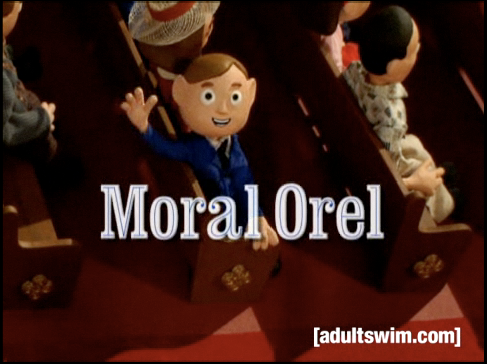
30. Moral Orel


I hate to sound like “60 Minutes” curmudgeon and first ballot Get-Off-My-Lawn-You-Bastard-Kids! Hall of Famer Andy Rooney, but kids today don't know how lucky they have it with television. Growing up in the 70s and early 80s, there were three network channels, a PBS station and about four UHF channels. Even though there was less than 10 channels, mst of the time, there was a pretty decent shot of finding something worthwhile on TV.

Except for Sunday morning.

God (no pun intended), what a craptastic selection of programs for anyone under ten-years-old. Your choices was either boring weekly-news-roundups or awful cartoons—I'm talking about 1930s “Popeye” or “Deputy Dog”. There wasn't any of that good Hanna-Barbera or the cool-toy cartoons (“He-Man” or “G.I. Joe” or “M.A.S.K.”), it was a wasteland. And why would there be any good TV on Sunday mornings? It's the morning that most people sleep in or go to church or spend the morning with the Sunday paper or do just about anything else besides watching TV. Putting good shows on Sunday is a complete waste.

The problem was I loved TV and I needed something to watch. The one show that I could tolerate was a claymation show created by the United Lutheran Church in America called “Davey and Goliath”. Every week Davey would get into some trouble and his belief God would get him out of the jam. Usually his talking dog Goliath acted as his conscious, but Davey ignored him every single time and went about his ignorant way. Each episode ended with a moral about “Loving your neighbor” or “Not vandalizing the town synagogue” or “listening to your elders” and Davey would always pledge to follow that lesson.

This show made “Leave it to Beaver” look like “The Wire” and even when I was a kid I knew that it was a pretty lame show. But there was nothing on, I liked the claymation (the people who did this also animated Gumby) and the opening and closing theme (which was called “A Mighty Fortress is Our God” by Johann Sebastian Bach—which is pretty bad ass and sticks in your head for weeks), so it grew on me.*

* When I was in college, the Boston Catholic Channel used to run this show every day in the afternoon. Whether in an altered state or not, I found myself watching it for two reasons: 1. watching the show ironically made it more funny and interesting (more on this when I review “Dragnet” and “Leave it to Beaver”) and 2. I did get a small twinge of nostalgia watching the show and remembering early mornings at my grandparents' house waiting for my grandfather to wake up so that he'd make me pancakes.

Anyway, this is a roundabout way of saying, “Moral Orel” is a lot like “Davey and Goliath” even though Dino Stamatopoulos says his show is based on sitcoms of the 1950s and 60s. I'm not going to argue with him, but Orel and Davey are very similar looking:


(ORAL)


(Davey)

In the end, it doesn't matter. The show was broadcast on Adult Swim and focuses on a town in the exact middle of the United States called Moralton, which is the capital of Statesota. Orel is a well-meaning young boy who is obsessed with God and following the rules set forth by his elders; inlcuding his parents, his teachers and the town's Protestant Reverend. These people rarely have Orel's well being in mind when they give him advice and often say things to get Orel out of their hair. Oftentimes the advice is contrary the Christian moral code, but Orel is too naïve to figure out any ambiguity and takes the advice at face value.

This, along with their general indifference causes Orel to misinterpret what his elders are trying to tell him. After Orel screws up his lesson, his father always brings him to his study where he gives Orel a few lashes with his belt and attempts to “explain” the lesson that Orel got wrong. This explanation is as bad or worse as Orel's interpretations and leaves him more confused than ever. One example of this is when Oral begins hanging around his friend Joe, who is the prototypical trouble maker. Joe continues to lead Orel down the wrong path culminating with the boys brutally beating up two homosexuals. What is the lesson that Orel's father teaches? Loyalty. He felt that Orel was disloyal to his established group of friends by spending more time with Joe and not including them.

As the show progresses, Orel begins to realize that adults don't always know what's best and realizes that confusion reigns over everyone and while they are more screwed up than children, adults just hide it better through hypocrisy, dishonesty and denial.

In the big picture, this show is Stamatopoulos' views on the so-called moral majority, ie the middle-American “red states” and how they interact with anyone who has values that are different from their's.

Many of the adult characters have deep-seeded, dark issues including alcoholism, crippling loneliness, dementia brought upon by rape and overall hatred that are buried below a cheerful, “moralistic” attitude. These demons are raised from time-to-time but instead of being dealt with, they are pushed down further under the surface causing anxiety and a misery. It is this facade of everything is fine on the surface which belies the true cesspool, that Stamatopoulos and Scott Adsit (who plays Pete Hornberger on “30 Rock” and is one of the writers and producers on “Moral Orel”) is most adept at writing about.

Being that most of these people of Moralton are church-going, conservative people, one can only assume that the writers feels that many right-wingers are self-effacing liars. Are the assertions true? Judging from the recent headlines of right wing politicians and mouth pieces, it looks as if he could be. It's not that the right have vices, everyone does, it's that they're so voracious about NOT having them. This is why many lefties enjoy the latest right-wing scandal.

While this show seems to be about the hypocrisy of the right and the way that a large majority of Americans think that there is “one correct way of living”, it really is about faith. From the very first episode to the last, Orel has always had the utmost enthusiastic faith in God. Week after week, events occurred where his faith should have been challenged, but week after week he bulldozed through those events secure that God was going to make things all better.

While some of the more well-known moments from the show are infamous, the bottom line is Orel doesn't make mistakes to spite God, he does it because he wants to honor God. One has to admire his focus and determination that a good, moral supreme being exists and that everything will work out in the end. Orel is a person who tries to do the right thing and one can argue that that is the overall lesson of the show, living by the Golden Rule. The only times that this rule becomes perverted is when people don't pay attention to it.

Stamatopoulos is a television hero of mine and the list of shows that he's worked on: “The Ben Stiller Show”, “Late Night with Conan O'Brien”, “The Late Show with David Letterman”, “The Dana Carvey Show”, “Mr. Show with Bob and David” and “Tom Goes to the Mayor” are a list of some of the better alternative comedy/anti-establishment shows in television history. His skewed view on society is acidic and over-the-top cynical, which is probably why not too many people know his work. His shows and humor are very polarizing and appeal to a limited type of person.

God, faith, hypocrisy are all extremely large issues to tackle and these issues are made even larger by the fact that “Moral Orel” was only a 15-minute show aired on the other side of midnight on Sundays. Stamatopoulos took the best swing at it and while it's not a no-doubt home run, it's pretty damn close. The way that he and Adsit were able to write and voice clay characters that the viewer cares about and ones that they will think about days after the show is over is remarkable.

Every day there is some preacher somewhere trying to “Save your soul” and telling you that salvation can be had if you give him $20. “Moral Orel” doesn't make claims on soul-saving or asks for your money, the show is an honest meditation on the role of religion in this country, warts and all. And that's what people need from religion, honesty.

Tuesday, February 05, 2008

47.Grosse Pointe


This entry is going to be about as long as the episode run of the series that I'm writing about: short. “Grosse Pointe” was a low-rated show on a little-watched network that started broadcasting in September 2000 and ended in February of 2001, lasting all of 17 episodes. If you're a fan of the show, you're a member of a small club that got to see a smart and subtle program that probably gave it's audience too much credit for their intelligence. The basic premise of the show was that it was centered on a group of actors who starred in a ripoff of “Beverly Hills 90210” and how they dealt with the Hollywood lifestyle and each other. Like “Entourage” or “30 Rock”, it was a show within a show.

Created by Darren Star, the guy behind “90210”, GP focused more on the behind-the-scenes stories that Star felt was way more interesting than anything that he was writing for 90210. You might remember that there was a little bit of controversy when this show first aired, as Star based one of the characters on Tori Spelling. Apparently, Aaron Spelling thought that this portrayal showed his daughter in a bad light (she was written as dumb as a post) and ordered Star to rewrite the character. Star complied and the Spelling character (named Marcy and played by Lindsay Sloan) turned out to be the defacto star of the show.

As an aside, I never bought into the hype and thought that Spelling was doing his old friend a favor by trying to get a little hype whipped up and it probably worked for an episode or two. The problem was any hype was short-lived and the ratings plummeted.

There were a multitude of reasons why this show failed. One was that the show wasn't clearly defined; is GP a drama? Is it a comedy? Is it both? This may have confused the WB core audience, which at the time were mostly teenage girls. During this time “Dawson's Creek” was a run away smash hit and “Seventh Heaven” was doing well for them too. Both of those shows were similar in their easy-to-follow story lines.

And how do you market a subtle satire aimed at a genre that they love? It would be like joining Sportscenter and ripping apart the sporting world while you were showing the highlights. Furthermore, the audience for teen dramas are teenagers. If you were going to make fun or show the behind-the-scenes action of a teen show how can you get people who don't like those programs to watch a program that is about them?

Despite these questions, the WB may have been emboldened with the modest success of “Buffy the Vampire Slayer” which paired smart writing with good acting and thought that these two ideals will carry “Grosse Pointe”. I'm just making a broad assumption here, but with “Grosse Pointe”, the completely underrated cartoon “Mission Hill” (more on that show later) and the ironically titled “Popular” all launching around the same time, it seems to me that the WB gave their audience too much credit. All three had subtle plots that focused more on character development and wit rather than a bunch of pretty faces and recycled plots.

Also the problem with a BVS comparison is that Buffy has one defined genre: fantasy, that has a gigantic following. There is really no cross-over so that if you like fantasy-based shows, you watch Buffy; if you don't, you find something else. With a show like “Grosse Pointe” there was never a chance to grab the folks who like comedies or the people who like teen dramas because the former is too broad of a market and the latter is too narrow a market.

I enjoy shows that show the behind-the-scenes action of Hollywood, like “Entourage” or “30 Rock”, but this is a very narrow audience and those shows have something that “Grosse Pointe” didn't have: it never mixed messages and standout characters.

“Entourage” is a show about the movie business and Jeremy Piven's Ari Gold is a character that people talk about and want to watch. On “30 Rock” you're behind the scenes of a sketch comedy show. Previous to “30 Rock” the first time most of the public met Tina Fey, she was behind the news desk of “Saturday Night Live” and so it makes sense to all that she would be on a fake sketch show. Plus Alec Baldwin and Tracy Morgan who are among the best characters in prime time today. There were none of these things on “Grosse Pointe”, because while the characters were terrific, they weren't particularly memorable.

That's ok. As I alluded to earlier, it was well written and the cast did a good job of getting into their roles. The two standouts were Sloan and Irene Molloy who played the Shannen Doherty character with great aplomb. Since “90210” was a guilty pleasure, it was fun to watch “Grosse Pointe” and which characters were the doppelgangers of their 90210 counterparts. One of the funnier running jokes (and Star insists that this was a joke) was that character based on 90210 patriarch Jim Walsh was secretly gay and wanted his “son”.

While this isn't a top echelon show, it was a decent take on the behind the scenes shenanigans at a television show. Whether the mistakes of “Gross Pointe” completely shape the aforementioned hits of “Entourage” and “30 Rock”, I'm not sure. But I do think that it was a help. If you ever come across the DVDs in a cut out bin or see the show on reruns, give it a try. It's worth a few hours of your time.