Showing posts with label Mr. Show. Show all posts

Friday, May 29, 2020

Top 19 -- Tenacious D: Tenacious D


We've come to the part of the Top 19 where I no longer talked about these albums on Facebook. Even though they're still in the Top 19  I guess you can consider them honorable mentions or runners up to the Top 10 Facebook list.*

This preamble seems highly unnecessary but so is this list.

Unlike when I relisten to yesterday's album, which reminds me of optimism, listening to this album now fills me with foreboding. Which is odd because Tenacious D is a comedy album and it's funny as hell, where Ice-T's "OG" is an album about how much everything sucked in the early 1990s. 

I got this album in the fall of 2002 on the advice of my roommate. At the time, I had moved into a place in Wakefield, MA where I had no idea who the two people I was living with were. We met on Craig's List and I got really lucky, because both guys turned out to be pretty normal and cool. The way that our place was set up was: you walk into the apartment and you enter the kitchen. To the right was my bedroom, down the hallway and to the right was a living room and to the left was a stairway that lead to my roommates' two rooms. I don't think I ever stepped foot up there. 

It was an awesome setup because we all just chilled in our rooms, unless we needed to use the kitchen--there wasn't even furniture in our living room. Each guy had a girlfriend and each duo pretty much kept to themselves. It was like having your own apartment but not having to pay full freight for rent and utilities. 

Anyway, this album reminds me of driving from my place in Wakefield to work in Marblehead. I didn't really love my job very much, but I was being paid to write and I figured that at 28-years-old, I better suck it up because this is pretty much what I was going to be doing for the rest of my life. My relationship with my girlfriend at the time seemed to be going pretty well too. 

 At the time I was starting to get into the alternative comedy scene and this, along with Adult Swim's original lineup, was my introduction to it. I had already watched "Mr. Show with Bob and David" and Tenacious D member Jack Black was on that show more than a few times. So with those bonafides, I gave it a listen and I grew to love this album so much.

It's funny as hell, the musicianship is actually really good and the idea that "Tribute" is a story about the greatest song in the world, but NOT that song is so fucking brilliant, that I can barely wrap my head around it. Black and Kyle Gass are terrific in their alter egos of JB and KG. I finally watched the Tenacious D trio of specials that were on HBO during the late 90s, early 2000s about a month ago. Again, awesome. The locations for the series was pretty much how I thought that mid-90s LA was all about.  

But how did this hilarious comedy album bring about so much foreboding? In late November of that year, our landlord came to us and told us that we all had to move out by January 1. He was sick of living beneath us, which was strange because we were barely around and when we were, we made zero noise, and wanted our apartment. He said that if we wanted, we could move to his place, but he was doubling the rent and there were only two bedrooms. He was a real dick about it too, like he read up on how to be aggressive in negotiating and just went over the top. I guess we probably could have fought him on this, because this seems highly illegal looking back on it, but we were all like "whatever" and went our separate ways. 

By Christmas, my roommates moved to different places with their respective girlfriends and I moved ... home. To my parents' house. Where I had no real bedroom. When I moved out, my Dad turned my room into his office, so I slept on a mattress on the floor. That sucked. 

Also around this time, my liaise faire attitude toward my job caught up with me and my manager really let me have it about taking a bigger interest and straightening up. It was then that I realized, writing about healthcare every month absolutely sucked and that I needed to make a change. I just wasn't sure what that was yet, so that uncertainty also sucked. 

Finally in early January, my girlfriend decided to give me my walking papers too. To be honest, I knew that things weren't great for a few months, but I ignored all of the signs. I didn't know what her deal was, but I wasn't going to ask because I was afraid of exactly what that conversation would lead to. And I wasn't ready for it -- though is anyone really prepared for that talk? The best part is that my (now ex) girlfriend and I worked at the same place and on the same team. So trying to forget her was made a little bit more difficult when I saw her eight hours a day, five days a week. That was a lot of fun. 

So now I was living at my parents' house, unsure about my future employment and newly single. And it was the dead of winter after the holidays. When I think back on the down moments of my life, this might have been the worst ebb that I've ever had to face. The good news is that these things don't last. You wallow for a while--I actually may have wallowed for more than a bit--but time marches on and things get better. 

As the months warmed up, I found a new job that I actually enjoyed in the same company. I got a new place to live with three cool guys in Somerville. And I didn't know it yet, but I was  about to meet the love of my life. To use sports as a metaphor for a moment--no one ever does this, right? I'm the first?--the end of my 2002 was like the end of the 2003 Red Sox season. Shit is as bleak as it ever was going to be, but then 2004 comes along with its brilliance and wonderfulness and it's like that shitty year was just what you needed to appreciate the greatness that is coming next. 

Unfortunately there needs to be a score for that shitty time and that score was Tenacious D. But when I hear that album, I know that it's dark; but it's going to be light again soon. And that's all that I need. 

Tuesday, May 19, 2020

Top 19 -- David Cross: Shut Up You Fucking Baby


On Facebook I was asked to list my top ten all-time albums that most influenced me. Since I can't list anything without a huge explanation, this is it. Not only that but I'm writing about my Top 19 instead of my Top 10. 

Here's what I wrote on Facebook today, "Here's another quick story: first off, this is a comedy CD. Secondly, when I bought it in the spring of 2003, I was familiar with David Cross (mostly from the seminal sketch show, "Mr. Show with Bob and David") but I didn't know his stand up act. I think that I listened to this CD front to back, probably 10,000 times. It crystalized everything that I was thinking (politically) at the time. And not only was Cross able to pinpoint exactly what was wrong with the country at the time, but he was able to do so in an uproariously funny way. If you haven't heard it yet, do so; "Shut Up You Fucking Baby" is the best."

2002 was a weird time. We were still really scared about terrorism, the year prior the towers came down and we started fighting in Afghanistan. The Bush administration was taking away our freedoms in exchange for our safety and his conservative cronies were clamping down on America and trying to turn the country into their vision. 


For the most part, no one really said anything. The reason was that there was so much patriotism, you worried about being labeled a traitor if you brought up that maybe the White House shouldn't be torturing prisoners or maybe we shouldn't be killing innocent people or maybe letting the President and the Vice President do what they want whenever they want however they want might be kind of shitty and maybe all of this flag waving, rah-rah, 'MERICA FUCKING RULES jingoism isn't really the best road to go down. 


Aside from a few comics, like Jon Stewart, this was some thoughts that were just bubbling under the surface. I heard them, and they started to germinate in my brain. But I wasn't completely on board until I heard "Shut Up You Fucking Baby". 


Let me step back, for the most part, I've identified myself as an Independent. However after listening to Cross, the idea that any Republican had my best interests in mind went out the window. This double album was scintillating. The way that Cross railed against the people in power--specifically the Republicans--and how they were using 9/11 as a cover to loot this company and reshape it into something that resembled the 1950s was absolutely astounding. 


Cross is able to deliver his message without sounding preachy. There is a thin line between comedy and whining. Cross never jumps over that line. He comes close some time, but he always slams it home with a joke. I have all of his concert albums and I've seen him live at least three times--like I said he's my favorite comedian--but nothing that he has done compares to this two-disc set. He's still awesome, but he's not as transcendent as he was here. That's a high bar to reach, BTW, I don't expect him to do so. 


After listening to this album, it became obvious to me that David Cross wasn't just the guy in the t-shirt and cargo shorts who stood next to the suit-ed Bob Odenkirk on Mr. Show. David Cross was a firebrand who spoke truth to power. This album literally shaped the way that I viewed public figures for the rest of my life. I haven't listened to this album in a long time, but I should revisit it. I didn't think that things could get much worse than the G.W. Bush administration, but it obviously has. 


I think that I need to listen to this again. 

Thursday, May 14, 2020

Top 19 -- Cake: Fashion Nugget


On Facebook I was asked to list my top ten all-time albums that most influenced me. Since I can't list anything without a huge explanation, this is it. Not only that but I'm writing about my Top 19 instead of my Top 10. 

This is what I wrote on Facebook: "I never lived in Los Angeles. I wanted to do, but I was too chicken to move across the country after I graduated college. Even though this band is from Sacramento, for some reason this album's sound seems like it would be the soundtrack from the mid-90s LA. I have no idea why I think this, I just do."

I've always been really interested in TV and movies. I've also been interested in writing. What I wanted to do more than anything in the world was to graduate college, move to LA and see if I could become a TV or movie writer. It never happen. The reason, which I explained above is because I was too chicken. I had a ton of excuses, "I'd my miss family and friends", "I wouldn't know anyone", "How would I get out there?", "How would I find a job, a place to live, etc?" but all of those questions boiled down to me not having the stones to go out there and try my luck as a writer or a comedian or something interesting. 

Instead, I played it safe and worked at jobs that, other than the newspaper, I really hated. I wasted a lot of time in my 20s just kind of finding myself. And while things worked out really well, it took a long time to get where I'm at. Which, I guess it's all about the journey, but some journeys are more exciting than other. 

How does Cake play into this? When I think of this band and their eclectic sound, I feel like this is the band that would be playing in LA dive bars, trying to make a name for themselves. The band that the cool people knew about before Cake broke big with "The Distance". And I think that it would have been cool to be a part of that scene. 

The other day I listened to a podcast (Movie Crush) with comedian Scott Aukerman and he came of age as a writer during the time and he was reminiscing about the mid-90s LA scene and it sounded like what I've thought it was like. He had a crew of young comedians (Patton Oswalt, Brian Posehn, David Cross, Sarah Silverman) that he worked (at the coolest show on TV, "Mr. Show") with and hung out with. Every afternoon they'd call each other and determine which bar they were going to hang out at and then spend the night talking and making each other laugh. It sounded awesome. 

Anyway, when he was telling this story this album was the soundtrack that I was picturing playing in the background. It's weird to feel nostalgic for someone else's past. 

In any event, I knew of Cake from the aforementioned single "The Distance" which was got really big at the end of the summer of 1996. And that sparks a different kind of melancholy in me, as that is when it began to dawn on me that summer was over and a. I had no real job (I was delivering pizzas) and b. I was never going back to school. Suddenly the summer was over, my friends were working and moving on with their lives, I was broke, alone and living in my parents house and I that depressed the hell out of me. 

I sort of forgot about Cake until the end of the decade when I started watching the reruns of the little-seen, but awesomely great WB cartoon "Mission Hill" on Adult Swim. The infectious theme song is an instrumental version of Cake's "Italian Leather Sofa". Once I figured out where I could find the song, I went on a mini Cake obsession that ebbed over the years. The last time it bubbled up was around the time when Giuliana was about seven months old and the new Cake album came out. 

So now instead of missed opportunities and other people's nostalgia, Cake reminds me of moving to Burlington and the first year of my first child. 

Tuesday, February 22, 2011

23. Tom Goes to the Mayor


Humor is a funny thing. There are those who think that humanity has some sort of skeleton key when it comes to making people laugh. Everyone loves a good knock-knock joke or an episode of “I Love Lucy” or seeing some guy get hit in the balls, right? Wrong. Two out of the preceding three aren’t funny at all, and three out of preceding three aren’t funny if you’re the guy whose balls are being hit.

Where do people get the idea that most humor is universal? I suppose that it comes from comedians who entertain large audiences or the communal viewing of a funny movie. If both examples are good, the majority of the crowd laughs together creating a sense of community or a veneer of shared comedic mores. People walk out of the theater or show assuming that all would enjoy what they just witnessed because the entirety of the crowd enjoyed it. It’s not that simple. For one thing, both of these groups are small sample sizes. And chances are good that if you go to a movie, you have a pretty good idea of the type of humor you’re about to see and thus you’re predisposed to liking it. And you're not the only one.

If I ever go to a Scary Movie-type flick, it’s because I was forced at gun point. Even if everyone is laughing around me, I doubt that I will crack a smile. And that’s because those movies aren’t my type of flicks. I'm not part of the overall audience reaction because I don't want to be part of that audience in the first place.

The same is true if you pay money to see a comedian.* A year or so ago my friend and I went to see David Cross. Cross is my favorite comedian of all time and there was no way that I wasn’t going to laugh. I laughed a ton (he really was legitimately funny) and I walked out of the Wilbur Theater saying that that was the best comedy show I’ve ever seen.

* The one exception to this is if you go to an open-mic night at your local Chuckle Hut. You have no idea what you’re getting there and if there’s a truly original comedian who galvanizes the crowd, that’s more of an exception than the rule. Many times, a new comedian is just cribbing off their comedy idol until they can find their voice. If the comedian worships at the feet of Jerry Seinfeld, you’re going to get some observational humor that might be clever at times. If you dig that sort of thing, you’ll like the comedian.

Establishing that different things makes different people laugh is hardly the revelation of the century. It's whether you tell people that you find something funny that the majority of folks don't that's the trick. You may find watching a handicapped or elderly person slip and fall on an icy street gut busting. Or you might be the type of person who enjoys a good Hitler joke now and then. But you're not going to tell anyone that you like these things. Why? Because you look like a complete sociopath and no matter how you explain why you think these things are funny, you're just digging a deeper hole for yourself.

This brings us to “Tom Goes to the Mayor” (TGTTM), which was created by comedic team Tim Heidecker and Eric Wareheim. If you’ve never seen it before, and chances are you probably haven’t, and that's a shame because it's a sublimely funny show. It began it’s run in late 2004 and lasted about two years (30 episodes) on Adult Swim. The basic plot of every 15-minute show is the same: local entrepreneur Tom Peters (played by Heidecker) stops by the Mayor of Jefferton’s (Wareheim) office to pitch a new money-making idea to him. The ideas are usually insane and aren’t grounded in reality, but the Mayor (and that’s his only name) usually loves the idea, agrees to go with the scheme and ultimately ruins it. It almost always ends poorly for Tom. Yet he's there week after week, pitching to the Mayor.

The show had it’s own unique form of animation, it’s hard to describe so I’ll let Wikipedia do the describing for me:

“The show features a crude yet distinctive limited animation style which is made by taking photos of the cast with different facial expressions and body language. The photos are filtered using the "photocopy" image filter in Adobe Photoshop, so that they are made up of only monochromatic blue and white, resembling mimeographs. There are some live-action scenes, usually on a television set within the show.”

It takes a bit of time to get used to the way the show is animated, but once you do it doesn’t even matter. The strength isn’t in the animation, it’s in the stories as Heidecker and Wareheim both have very broad senses of humor that works on multiple levels. They will take a comedic trope, amp up the action and at the same time make fun of the cliché. For example, if Tom gets hit in the testicles they will show that action to get a laugh from that (because seeing a guy getting hit in the balls is never not funny) but the duo will often over-exaggerate the action by having the actors mug wildly for the camera. The shots themselves will be lampooned and the dialogue and the resulting plot will also be ripped apart. What happens is that you’re laughing at the action itself and you’re laughing at the people who sincerely find this stuff funny.

It’s the ultimate form of having one’s cake and also eating it.

This is sort of a hard thing to explain while watching the show and is why my wife or 99% of my friends has never heard me talk about it—much less seen an episode, even though it’s one of my favorite shows. And while this isn't a show about Hitler jokes or poking fun at the handicapped, it is a show that if a viewer doesn't understand, it will result in a raised eyebrow at you. "You find this funny? Really? How could you? This show is too fucking weird. What the hell else is wrong with you?"

Ultimately, it's just easier not to say anything.

At first blush, it’s a strange show—though not as strange as classics as MTV's “Wonder Showzen”, “Tim and Eric, Awesome Show Great Job!” (created by the same Heidecker and Wareheim that created TGTTM) or any of the Kroft shows from the 70s. The show has a love it or hate it quality to it. If you love it, you really love it. And if you hate it, there is no amount of explanation by anyone to get you to tolerate it*.

* According to Wikipedia, Adult Swim fans hated this show so much they thought that the network was pulling a prank on them. When it was revealed that this wasn’t a prank, they flooded the AS website and message boards with complaints.

What drew me to this show is that it was produced by Bob Odenkirk. Odenkirk is the same guy behind one of my all-time favorite shows, “Mr. Show With Bob and David” and has a comedic resume of awesome projects a mile long. I figured that if he was involved with the show, I should at least give it a go. And I’m glad I did. Not only does Odenkirk make sporadic appearances, but it is a who’s who of mid-90s alternative comics: Cross, Sarah Silverman, Patton Oswalt, Brian Posehn, John Ennis, Michael Ian Black, Zach Galifianakis, Janeanne Garofolo and Tom Kinney. Also Jeff Goldblum, Garry Shandling, Jeff Garlin, Michael Cera, John C. Reilly and others make appearances.

I’ve often wondered exactly what the guests thought when they read the bizarre scripts and whether they were in on the joke or just there for a pay day. I have to think that this show didn’t pay that much and the exposure was small, so they had to be there because they thought the stuff was funny. In a way that makes me respect the people who took the chance and appeard on this show much more.

“Tom Goes to the Mayor” ushered in a new kind of show for Adult Swim. While it still had the comedic sensibilities of the four original shows, it also strayed away from what made the channel interesting. And while those shows did depend on a level of pop culture IQ (which it turned around and skewered), meta-humor and bizarre plots, TGTTM raised the bar a bit higher and made viewing a bit odder, a bit more uncomfortable. This uncomfortability humor was new-ish to the American airways when this show made its debut. Yes, the American version of "The Office" had been on, but it was hardly a hit. And the British version of the same show was still something that only a relative handful of people had seen.

So while it was easy to talk to my friends about anthropomorphizing food stuffs pulling pranks on each other, it’s a rare person that one can talk to about a guy trying to match dogs for marriage by sniffing their asses.But if you can find any of the episodes on YouTube, or if Adult Swim runs them in the future, set your DVR and check them out they’re well worth your time.

Rats off to ya, everyone!

Tuesday, November 02, 2010

24. The Honeymooners


Do you like television? Of course you do, you wouldn't be reading this if you didn't. You owe a bit of thanks to “The Honeymooners”, you know that? Even though the show only had 39 episodes and began airing in 1951*, it’s possible that this show is the blueprint for a majority of the comedies that we watch today.

* First as a recurring sketch on the “Cavalcade of Stars” on the DuMont Network and then on the “Jackie Gleason Show” before it was turned into a full-length 30-minute show for the 1955-56 season.

Certainly, the Flintstones is the biggest copy cat of the show; but pretty much every two-bit situation comedy on CBS owes a large debt to Gleason and his crew. Ralph Kramden (Gleason) and his wife Alice (Audrey Meadows) were the original no-way-in-hell-does-this-fat-guy-ever-get-this-hot-woman-to-be-his-wife-in-real-life couple. And while Kramden and his best buddy Ed Norton (Art Carney) were among television’s first fat-and-skinny best buddies, they didn’t invent that coupling either. Even by the fifties, this type of odd couple had been done to death (see Laurel and Hardy).

Another sitcom plum that the Honeymooners were among the first to pick, was that of the blowhard (in this case, Gleason) getting his just desserts, the wife (Meadows) outsmarting the husband (Gleason) or the now classic complete misunderstanding (“But I thought that you said, he said, humanna, humanna, humanna!”) “The Honeymooners” was the first show where the actors had to stop their lines because the studio audience went nuts when a main character entered the scene. Shades of “Seinfeld’s” Kramer or “Happy Days’” Fonzi, whenever Norton or Kramden made their entrance, the audience would applaud and cheer so loudly that oftentimes supporting actors had to repeat their lines.

There are a few things that made this show work, one were the actors. Gleason, Meadows, Carney and Joyce Randolph (who played Carney’s wife, Trixie) were terrific actors.* Not only did they played their parts well, but one could actually imagine them as their characters. I believed that Jackie Gleason was Ralph Kramden. I thought that in real life Gleason talked like Kramden, acted like Kramden and more importantly thought like Kramden. Same thing with the other three players.

Of course they didn’t, but I am shocked that Carney or Gleason escaped any sort of typecasting for the rest of their lives. They were that good. And while the writing is terrific (more on that in a moment) the way that the actors could convey an emotion without saying a word (Gleason’s saucer plate eyes, Carney’s plastic face, Meadows crossing her arms) is nothing short than amazing. And yes, it’s mugging and yes, unless you’re a talented actor, it can come across as hackey, but not with anyone from this troupe.

* Randolph wasn’t that great. I mean she was serviceable, but she tended to screech her lines which was ok, because she wasn’t really integral to any of the plots. She gave birth the to Trixie (later Betty—as in Rubble) Conundrum. There are only a few reasons why Trixie is important: one Ralph’s best buddy needs a wife (so no one wonders why Norton is bachelor), two Ralph’s wife needs a best friend. However, since Ralph is the lead character the show revolves around him. There aren’t too many situations where a man hangs around with his buddy’s wife, without some sort of shenanigans occurring

Also, there needs to be a person that either Ed or Alice can talk to about the latest crazy scheme that Ralph has gotten into. In this case, Trixie is basically a proxy for the audience. Since Alice can’t look into the camera and say, “My husband is such a big oaf, I can’t believe that he got mixed up in this again!” she says it to Trixie. If Alice did do that, the fourth wall wouldn’t just be broken, it would be completely and utterly bombed and the grounds would be salted.


The writing really is a thing of beauty. The plots were usually pretty simplistic—and really, you’ve probably seen all of the situations these people get into, but it’s interesting to see the genesis of a well-known gag like the main character getting a swelled head only to fail completely, getting his comeuppance at the end of the show. (Sorry for the lack of Spoiler Alert on that last sentence.) There’s not a lot of “Arrested Development”-esque back story or “Seinfeld”-ian ironies or “Simpson”-ian rifts on popular culture. What you see is what you got.

And while that simplicity could get stale after awhile, here it’s played straight ahead with a lot of laughs. With the laughs there was a lot of warmth beneath the surface. Many times Ralph kicked Norton out of the house, but the audience knew that he was coming back in two minutes. Often Ralph threatened to punch Alice so hard that he’d send her to the moon*, but you knew that a moment would pass before he’d apologize and tell her that “she was the greatest” and plant a kiss on her.

* There is no way in hell that Ralph’s famous catch phrases to Alice, “Pow! Zoom! Right to the moon!” or “One of these days! One of these days Alice! Pow! RIGHT IN THE KISSER!” complete with Ralph pantomiming punching his wife in the face would ever end up on television. People would have a complete meltdown. And rightly so, but on “The Honeymooners” the audience knew that Ralph was full of crap. If he had ever laid a finger on her, the next scene would be him jumping off the Brooklyn Bridge.

It was really that evident that the characters cared for each other, the actors cared for each other and in turn they all cared about the show.

One of my least favorite things about television taped in front of a live audience or when it’s actually live, is when a character breaks. This used to happen all the time on “The Carol Burnett Show” or during Saturday Night Live when Horatio Sanz and Jimmy Fallon (another fat and skinny comedy duo) used to do it every single skit. Every once in awhile Gleason and crew would break (or simply forget lines) but unlike Sanz and Fallon who would turn into 12-year-old girls and just giggle for the sake of giggling, the Honeymooner actors were true professionals who often ad-libbed their lines to minimize damage. Interestingly enough, oftentimes the ad-libbed lines were the funniest lines of the night.

The Bed-Stuy section of Brooklyn is where the show took place. Kramden and Norton were both blue collar workers (a bus driver and sewer worker respectively) so their apartments were sparsely furnished. The Nortons actually looked like that they lived better than the Kramdens, despite Ed’s job, and actually had a television, while the Kramdens had a lot of nothing. And the Kramden’s house is where most of the action took place.

The setting wasn’t anything special, it looked like a set. It was sort of cheap, appeared that everything was made from plywood and that the whole thing could come crashing down at any minute but that only added to the atmosphere of the Kramden’s poverty. In the long run, it didn’t matter. In Naomi Odenkirk’s book, “Mr. Show: What Happened?” the stars of Mr. Show, Bob Odenkirk and David Cross talk about the sets of their show and it can be applied to “The Honeymooners”.

Basically they said that compared to Saturday Night Live, Mr. Show’s sets looked like crap. They appeared cheap because they were, they didn’t have half of the budget that SNL had. They really had to make do with what they had*. However, since they didn’t have a great set they had to put their focus on their skits and their writing. They had to make the audience forget that they’re surrounded by plywood ovens or cheap plastic cars and focus on the funny.

* According to Odenkirk, who once worked at SNL, the sets for all the skits are made somewhere in New Jersey and are shipped to the show that Friday. They literally have a whole team of people working on sets all week long, that’s why things look so good. Unfortunately, it would be better if SNL spent more time working on script than sets. ZING!

That’s what “The Honeymooners” did too. When it was a particularly good episode, it didn’t matter that Ralph was not in a real Brooklyn apartment yelling to his buddy one floor above him. I mean, it’s obvious that he was just sticking his head through a fake window and yelling up. But by the time the audience even realized that, the scene had moved on and it didn’t matter much. The plot was moving and things were going on, realism be damned.

Overall, the show is amazing. If you happen to catch it on a late-night, watch it for the historical significance. By the end of the half-hour, I guarantee that you’ll be laughing your ass off.

Friday, October 30, 2009

A Dabbling of David Cross


Last Monday night my friend Jamie and I journey to Wilbur Theater in Boston to do something that I've been wanting to do since 2002: see my favorite comedian David Cross live. Cross has been in two of my favorite shows of all time, as himself in the greatest sketch show of all time: “Mr. Show” and as never nude psychiatrist Dr. Tobias Funke.

I have both of his comedy CDs: “Shut Up You Fucking Baby” and “It's Not Funny” and I pretty much have memorized each of them—especially SUYFB. His take on America post 9/11 was as acerbic and spot-on funny as any that I've heard. Not only has his views on the world entertained me, but it's also helped me look at our planet with a different perspective. This tour was to promote his new book of essays, “I Drink for a Reason”, which I am going to purchase very soon.

Like I said, I've been wanting to see Cross ever since I listened to SUYFB for the first time and I've scanned Pollstar and the Boston Phoenix at least once a week to see if he was playing a show in the Boston area. It wasn't until a few months ago that I found out that he was going to be in Boston. Needless to say, I grabbed those tickets quickly.

The Wilbur Theater is a pretty cool place to see a comedy show as it's an old theater with a palpable sense of history behind it. The seats are old-school straight backed ones that aren't very comfortable, but that's ok it makes the listener all that more alert to check out the act. Also there are two over hanging balconies and two private hanging boxes. Jamie and I were in the third to last row in the second balcony, so we were far away, but it didn't matter the old theater has great acoustics.

Last year, my friend Steve and I saw Stella at the Wilbur Theater (Michael Showalater, Michael Ian Black and David Wain) with Eugen Mirman opening for them. Since Steve grew up with Wain, we got awesome seats. Needless to say, that was amazing experience too.

After a warm-up comedian, Cross came on at 7:25 and performed for about two hours. I would have been happy with an hour of material, but this was a solid set of new bits that stretched on for double my expectations. Was ever joke a hit? Of course not, there were some bombs here and there, but for the most part it was really an awesome show.*

* He also showed a five-minute clip of his show that's going to be aired on the BBC called “The Increasing Poor Decisions of Todd Margaret”. It looks awesome and it sucks that it won't be played in the United States for awhile. The show also had a cameo from Cross' TV brother-in-law GOB Bluth, Will Arnett, which made it even better. **

** What also made the show pretty awesome is that he was taping it for either a DVD release or a Comedy Central or HBO special. I'm not why I find this so great and why I can't wait to buy the DVD, I mean I've already seen about 99% of what I'm going to see again, but for some reason I'm pumped for this to come out.


The one thing that I noticed about Cross is that his fans definitely have a look. Most of them are the true hipsters of the city: black, square rimmed glasses, ironic t-shirts, messed up bed head. And the women are similar too. I'm not saying that it's bad, but I guess that if you were to ask these people why they dress and act the way they do, they'd argue that they do so because they're trying to be different. The one problem is that when gathered together like they were last Monday, their actions of dressing different and being unique turns out to be so similar to each other that it's as if they all went to the same store and bought the exact uniform.

Looking over what I've written so far, it occurs to me that there isn't too much to write about a comedy show except to say whether it was good or not, and that's subjective to a bunch of outside influences: such like I listed above: venue, length of fandom, etc. It's occurred to me it's harder to write a comedy review than it is to write a concert review. A writer can convey the concert experience by listing the songs that were played and how the band sounds, but one can't do that with the comedian. It's hard to describe jokes, and unless the comedian was completely bored (like the time I saw David Spade while in college) there's not really too much to tell.

I'm not going to get the jokes correct and even if I did, Cross doesn't tell jokes per se. They're more wry observations on daily life punctuated with vocal inflections. The humor would get lost in my retelling and will not do any justice to the story. Just take my word for it that he was awesomely funny.

About a week after I saw Cross live I ran across this article. In a few words of summary: basically David Cross told the audience in DC that he and his girlfriend Amber Tamblyn were invited to the White House Correspondent's Dinner. While there, Cross said that he snorted a line of coke within yards of President Obama. He explained that he did this to show his friend that he could be “more outrageous”.

I'm not sure if this story is true, though I'd bet that it is, but if it is I thought that it was pretty lame. It's not the snorting of coke or even doing it in front of Obama, I think what I find most lame about it is that seems like something that Johnny Knoxville and Steve-O would do. And they're morons. “Yeah, I snorted coke right near Obama! Beat that, brah!”

One of the things that appealed to me about Cross is that he isn't an idiot, or if he is, he keeps it private.

The bottom line is this: I'm not going to stop laughing at Cross. But sometimes, I suppose that there is just too much information being passed around.*

* You know what, I don't really know what the point of this last story is. It seems to me that it's about being let down by a celebrity or someone that you admire. The thing is, I don't feel all that let down; Cross has made no secret of his drug use and, really why should I give a shit if he jams heroin needles into his eyeballs. I guess I feel more let down comedy-wise than anything else, the guy has built his standup on subtlety and well-crafted, well-thought out jokes. He shouldn't have to succumb to stupid shock jock crap like this. That's basically what my point is.

Tuesday, October 13, 2009

27. Chappelle's Show


Every day, thousands of people from podunk towns across the country migrate to Los Angeles, California in search of one thing: fame. In the last decade, the amount of people who have a desperate need to become famous has grown exponentially. It's not even about fame's partner anymore; fortune. People want to be noticed and known by other strangers. And with the way our society is going (growing smaller, but at the same time people are more apt to get lost) it's not all that strange for folks to want to be noticed.

For the fame flockers that come to Hollywood, there is a minuscule percentage of them that will reach their goal of world-wide popularity. And once they do, they react in different ways. Some take their notoriety very matter-of-factly, like George Clooney or Matt Damon. Others seemingly lose their minds and confuse infamy with being famous, like Paris Hilton or myriad reality TV personalities.

The latter group that don't have a grasp on what fame truly is, are usually the most desperate ones. They are the ones that are void of talent and will do anything to stay in the public eye. The ones that do offer something to the public are comfortable in their own skins (at least publicly) and seem to adjust to their lot in life very well.

That's why when David Chappelle reached the pinacle of his career, it was so bizarre to see him walk away from a reported $55 million dollar payday and leave the spotlight because of principles. But in 2005, that's exactly what David Chappelle did.

This wasn't a decision that came lightly, for in June 2004, during a standup gig in California, a member of the audience was shouting catch-phrases from Chappelle's gigantically popular sketch show. This caused Chappelle to angrily rebuke the audience member and it seemed to change the way he looked at the show and how it had evolved into something that was defining his life. About a year later, during show production in 2005, Chappelle felt that people were beginning to laugh at him, not with him. This was the final straw as he people were not getting what he was doing, so he left.

“The Chappelle Show” was the type of program that was subtly brilliant in that there were two levels: one in which the audience realizes that Dave Chappelle is making fun of social more, be it racism or sexism or class-ism. It really did a great job of satirizing those in power, without doing so in a whiny, PC sort of way. Of course, there was also the second level of watching the show, the sort-of idiot level where the audience laughs at just what Chappelle is doing and don't bother to delve behind the joke to determine why its funny.

For example, in one sketch, there is a white family who happen to have the unfortunate last name “Nigger”. They are a typical 1950s, “Leave it to Beaver” style family who are completely oblivious to their surname. Shot in black and white, which leads the viewer to believe that these characters live in an era where racial integration was nowhere on the radar, the Niggers go through a normal day that endss with the mother and father going to a fancy restaurant. This culminates in Chappelle—who plays the family's milk man—saying that he is happy that a nigger can get a table in that restaurant.

What Chappelle is brilliantly satirizing here is how different words, when applied to different objects, can take on different meanings. Also he's making fun of a group of people's ignorance to a potentially hurtful word. Throughout the skit, Chappelle says their name more than anyone else and is seen laughing at it. He's disarming the word from any hateful connotations—he's taking the power away.

Aside from these reasons, the skit also had terrific writing and made the viewer stop and take a few minutes to ponder that word. I believe that this is what Chappelle wanted us to do with a majority of his sketches. However, there are the steakheads out there who don't get concepts like this and heard the word “nigger” and just started laughing. These are the people that rankled Chappelle and drove him out of the business.

It wasn't all the steakheads' fault though.

“The Chappelle Show” was on Comedy Central for two seasons (I don't include the third “lost” season where Comedy Central grabbed whatever it could salvage and pasted a few episodes together*) and was shown ad nauseam. This show was a big money maker Comedy Central and I understand why they aired the show so many times, but it did take away from the impact. Because once you saw a certain sketch, over and over again, it does lose some of it's subtlety and a viewer just laughs when a catch phrase is uttered.

* I completely understand why Comedy Central ran the last season of "Chappelle's Show" without the blessing of it's star. They have a network to run and it the time, this was their highest rated show, so I guess that some David Chappelle is better than no David Chappelle. But, it's still a pretty crappy move considering that these sketches weren't finished products and therefore did not meet the high expectations of Chappelle.

Had “The Chappelle Show” continued past two seasons, it would be interesting to see how Chappelle approached each season. Reportedly, another part of the reason why Chappelle left his show was because he didn't think that he could keep his standards up. To me, that's an admirable quality. Television history is littered with programs that have overstayed their welcome. The fact that Chappelle was concerned about the quality says a lot for him as an artist.

Because Chappelle cared and took such chances and kept the bar raised were the main reasons why the show was so damn good. It's been boiled down to a cliché, but when “Charlie Murphy's True Hollywood Stories” episode aired (AKA: “I'm Rick James, Bitch!”) anyone who watched that night knew it was going to be an instant classic. While Chappelle's Rick James was a charicature, Charlie Murphy (who is Eddie Murphy's real-life brother) played the role so straight that it was impossible to determine whether the stories were true—supposedly these happened in the early 80s when Charlie was a member of his brother's entourage—or were exaggerations. Also, interspliced throughout the episode was the real Rick James who would explain his actions, giving the vignettes some authority.

Another of “Charlie Murphy's True Hollywood Stories” was aired later in the season when Murphy and his friends were challenged to a game of basketball by Prince (played by Chappelle). Murphy and his cohorts, who all look like they could play serious basketball, were soundly defeated by a gaunt Prince and his bandmates who played a type of “fruity defense”. While not as popular as the Rick James piece, again Murphy played the role so straight that the humor of watching five strong men getting their asses beat by five fey men was extremely funny.

Like many sketch shows, “The Chappelle Show” is a product of its time and there were a lot of pop culture touchstones skewered like MTV's “The Real World”. Chappelle wondered why MTV always stuck one black person in a house with six white people and wondered why the black person was always painted to be the “crazy one”. He flipped the roles and had a white guy (Christian Finnegan) stuck in a house with six inner city black people.

Again, the subtext is what made the whole skit work because Chappelle is right, adding a black cast member to a predominantly white house is not realistic nor is it progressive—despite what MTV wants their viewers to believe. It's actually the opposite and the token minority will never see eye-to-eye with their castmates because of where they come from. And all it takes is some editing to make that person look nuts. Especially when it's the “street” black guy arguing with the “naive, corn-fed” white girl. Yet, it happens in every season of “The Real World”.

These are just some of the better skits, it's impossible to list all of them. Other favorites include "The Player Hater's Ball", "If a Black Guy Was President" and "When Keeping it Real Goes Wrong". While everything wasn't gold (there are a few clunkers), it had the highest hit-to-miss ratio of any sketch comedy show that I've seen (with the exception of "Mr. Show").

Comedians are among the most honest commentators of our society. They see our scabs for what they are and still pick at it. Chappelle (and Chris Rock too) was among the best when it came to picking at America's most tender scab: race. To comment on race in a way where the people that you are making fun of (the majority) are laughing uproariously, as well as tweaking the minority so that they're laughing just as hard is truly a gift.

We were lucky that we got two seasons of “The Chappelle Show” though it is thoroughly depressing that he couldn't soldier on for another few seasons during the Bush administration. That's when we needed honesty and laughter the most.

Monday, September 21, 2009

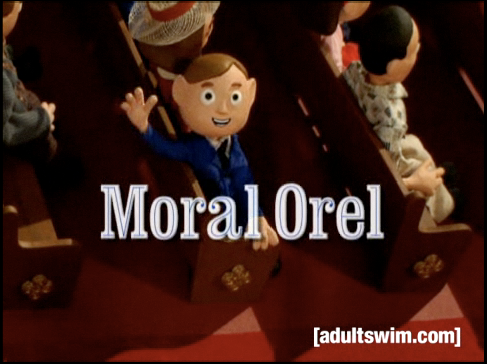
30. Moral Orel


I hate to sound like “60 Minutes” curmudgeon and first ballot Get-Off-My-Lawn-You-Bastard-Kids! Hall of Famer Andy Rooney, but kids today don't know how lucky they have it with television. Growing up in the 70s and early 80s, there were three network channels, a PBS station and about four UHF channels. Even though there was less than 10 channels, mst of the time, there was a pretty decent shot of finding something worthwhile on TV.

Except for Sunday morning.

God (no pun intended), what a craptastic selection of programs for anyone under ten-years-old. Your choices was either boring weekly-news-roundups or awful cartoons—I'm talking about 1930s “Popeye” or “Deputy Dog”. There wasn't any of that good Hanna-Barbera or the cool-toy cartoons (“He-Man” or “G.I. Joe” or “M.A.S.K.”), it was a wasteland. And why would there be any good TV on Sunday mornings? It's the morning that most people sleep in or go to church or spend the morning with the Sunday paper or do just about anything else besides watching TV. Putting good shows on Sunday is a complete waste.

The problem was I loved TV and I needed something to watch. The one show that I could tolerate was a claymation show created by the United Lutheran Church in America called “Davey and Goliath”. Every week Davey would get into some trouble and his belief God would get him out of the jam. Usually his talking dog Goliath acted as his conscious, but Davey ignored him every single time and went about his ignorant way. Each episode ended with a moral about “Loving your neighbor” or “Not vandalizing the town synagogue” or “listening to your elders” and Davey would always pledge to follow that lesson.

This show made “Leave it to Beaver” look like “The Wire” and even when I was a kid I knew that it was a pretty lame show. But there was nothing on, I liked the claymation (the people who did this also animated Gumby) and the opening and closing theme (which was called “A Mighty Fortress is Our God” by Johann Sebastian Bach—which is pretty bad ass and sticks in your head for weeks), so it grew on me.*

* When I was in college, the Boston Catholic Channel used to run this show every day in the afternoon. Whether in an altered state or not, I found myself watching it for two reasons: 1. watching the show ironically made it more funny and interesting (more on this when I review “Dragnet” and “Leave it to Beaver”) and 2. I did get a small twinge of nostalgia watching the show and remembering early mornings at my grandparents' house waiting for my grandfather to wake up so that he'd make me pancakes.

Anyway, this is a roundabout way of saying, “Moral Orel” is a lot like “Davey and Goliath” even though Dino Stamatopoulos says his show is based on sitcoms of the 1950s and 60s. I'm not going to argue with him, but Orel and Davey are very similar looking:


(ORAL)


(Davey)

In the end, it doesn't matter. The show was broadcast on Adult Swim and focuses on a town in the exact middle of the United States called Moralton, which is the capital of Statesota. Orel is a well-meaning young boy who is obsessed with God and following the rules set forth by his elders; inlcuding his parents, his teachers and the town's Protestant Reverend. These people rarely have Orel's well being in mind when they give him advice and often say things to get Orel out of their hair. Oftentimes the advice is contrary the Christian moral code, but Orel is too naïve to figure out any ambiguity and takes the advice at face value.

This, along with their general indifference causes Orel to misinterpret what his elders are trying to tell him. After Orel screws up his lesson, his father always brings him to his study where he gives Orel a few lashes with his belt and attempts to “explain” the lesson that Orel got wrong. This explanation is as bad or worse as Orel's interpretations and leaves him more confused than ever. One example of this is when Oral begins hanging around his friend Joe, who is the prototypical trouble maker. Joe continues to lead Orel down the wrong path culminating with the boys brutally beating up two homosexuals. What is the lesson that Orel's father teaches? Loyalty. He felt that Orel was disloyal to his established group of friends by spending more time with Joe and not including them.

As the show progresses, Orel begins to realize that adults don't always know what's best and realizes that confusion reigns over everyone and while they are more screwed up than children, adults just hide it better through hypocrisy, dishonesty and denial.

In the big picture, this show is Stamatopoulos' views on the so-called moral majority, ie the middle-American “red states” and how they interact with anyone who has values that are different from their's.

Many of the adult characters have deep-seeded, dark issues including alcoholism, crippling loneliness, dementia brought upon by rape and overall hatred that are buried below a cheerful, “moralistic” attitude. These demons are raised from time-to-time but instead of being dealt with, they are pushed down further under the surface causing anxiety and a misery. It is this facade of everything is fine on the surface which belies the true cesspool, that Stamatopoulos and Scott Adsit (who plays Pete Hornberger on “30 Rock” and is one of the writers and producers on “Moral Orel”) is most adept at writing about.

Being that most of these people of Moralton are church-going, conservative people, one can only assume that the writers feels that many right-wingers are self-effacing liars. Are the assertions true? Judging from the recent headlines of right wing politicians and mouth pieces, it looks as if he could be. It's not that the right have vices, everyone does, it's that they're so voracious about NOT having them. This is why many lefties enjoy the latest right-wing scandal.

While this show seems to be about the hypocrisy of the right and the way that a large majority of Americans think that there is “one correct way of living”, it really is about faith. From the very first episode to the last, Orel has always had the utmost enthusiastic faith in God. Week after week, events occurred where his faith should have been challenged, but week after week he bulldozed through those events secure that God was going to make things all better.

While some of the more well-known moments from the show are infamous, the bottom line is Orel doesn't make mistakes to spite God, he does it because he wants to honor God. One has to admire his focus and determination that a good, moral supreme being exists and that everything will work out in the end. Orel is a person who tries to do the right thing and one can argue that that is the overall lesson of the show, living by the Golden Rule. The only times that this rule becomes perverted is when people don't pay attention to it.

Stamatopoulos is a television hero of mine and the list of shows that he's worked on: “The Ben Stiller Show”, “Late Night with Conan O'Brien”, “The Late Show with David Letterman”, “The Dana Carvey Show”, “Mr. Show with Bob and David” and “Tom Goes to the Mayor” are a list of some of the better alternative comedy/anti-establishment shows in television history. His skewed view on society is acidic and over-the-top cynical, which is probably why not too many people know his work. His shows and humor are very polarizing and appeal to a limited type of person.

God, faith, hypocrisy are all extremely large issues to tackle and these issues are made even larger by the fact that “Moral Orel” was only a 15-minute show aired on the other side of midnight on Sundays. Stamatopoulos took the best swing at it and while it's not a no-doubt home run, it's pretty damn close. The way that he and Adsit were able to write and voice clay characters that the viewer cares about and ones that they will think about days after the show is over is remarkable.

Every day there is some preacher somewhere trying to “Save your soul” and telling you that salvation can be had if you give him $20. “Moral Orel” doesn't make claims on soul-saving or asks for your money, the show is an honest meditation on the role of religion in this country, warts and all. And that's what people need from religion, honesty.

Tuesday, September 01, 2009

32. The State


As I've talked about in the SuperRock entry* MTV was at a crossroads in the early to mid 1990s. On one hand, it seemed that it wanted to keep their FM-radio-on-TV-anything-goes type of vibe, but on the other hand Madison Avenue was banging on their door trying to figure out how to market their products to teenagers. Essentially, the network was a victim of their own success.

Predictably, they went the way of the marketers and started to segment their music and begin showing programs that were more easily targeted to the advertising folks. And I'm not anti-marketing (how could I be?) or anti-advertising. Companies need a return on their investment and pushing new Coke to a group of people that only wants to drink beer isn't a good way of spending cash.

* I find it interesting that when you type SuperRock into Google, my Blog is the first entry that comes up. If you type in my name, 19Thoughts doesn't come up first. Also, I go to an outside site to check where readers come from and at least three or four times a week I'll have a reader being directed to my site after looking up SuperRock.

MTV had already successfully introduced a reality show (“Real World”), a ton of game shows (“Singled Out” and “Remote Control”) and was unsuccessful in spinning off comedies and dramas. The question was, what is a cross between a sitcom and a reality show? A comedy sketch show.

Since MTV was still green when it came to producing their own show, they had to go with unexperienced comedians. Luckily, there was a troupe of 11 New York University graduates who were familiar to MTV and their audience, but weren't completely overexposed.*

* At MTV overexposure wasn't a bad word, everything successful was shoved down the viewers' throats ad nauseum. With that in mind, I'm surprised that an MTV sketch show didn't star Dan Cortez, Pauly Shore, Kennedy, Bill Belamy and Jenny McCarthy.


After the members of the State left NYU, they put on their act throughout New York City gradually building an- audience while honing both their writing skills and stage presence. By the time someone from MTV discovered them, they were already a well-oiled machine.

The first MTV show that they were apart of was called “You Wrote It, You Watch It”. Basically this show consisted of viewers writing down wacky situations and different groups of comedians would act it out. The guys from the State were the most popular of the players and while YWI, YWI came and left quickly, MTV realized that it had something in the State.

MTV also realized that it had something in the host of YWI, YWI as Jon Stewart was given a nightly talk show that was completely different from what he's doing now.

“The State” was recently released on DVD during the last month and there have been a lot of things written about the show, one article explained how much autonomy the group had when it came to their bosses. State cast member David Wain told the Onion AV Club that MTV basically gave them their space and told them to pretty much do whatever they want to do. And they did.

If you get the DVDs and watch “The State” now it seems pretty pedestrian. But when they first started popping up on the channel it was mind-blowing; especially considering the state (no pun) of sketch comedy at the time. “Saturday Night Live” had lost many of its older, stronger cast members (Phil Hartman, Dana Carvey, Mike Myers) and began to lean heavily on the David Spade, Chris Farley and Adam Sandler crew. While these guys were funny, they seemed to lack any sort of comedy trailblazing and imagination, it was the same old skits with the same catch phrases week after week after week. Even bringing comedy veterans like Chris Elliot or Michael McKeon or Janeanne Garofalo couldn't break the comedic malaise.

The only other televised sketch comedy choice was “In Living Color”, which was even more of the same old, same old except that none of the funnier Wayans brothers (Keenan or Damon) were around and Jim Carrey had his eyes on Hollywood. If you like hours of Tommy Davidson and David Alan Grier playing the same characters spouting the same things over and over again, than this was your comedy nirvana. Not even the addition of Chris Rock could save this mess.

Despite the popularity of comedy (stand-up comedians were dominating the ratings on network sitcoms) the traditional sketch show was at an all-time low in terms of laughs and creativity. It's not hyperbolic to say that “The State” rescued televised sketch shows.

The sketches on “The State” weren't like anything on television at that time. They rarely had reoccurring characters and they didn't have much in terms of catch phrases. Ironically, this type of familiarity was something that MTV wanted and that the troupe fought hard to stay away from. MTV eventually got their wish and a character named Louie was created, that was so obnoxious and so loud, that viewers were able to pick up the detest that the writers had for him. Louie was a one-trick pony played by Ken Marino. He had slicked back black hair and wore a short-sleeve dress shirt. He would always yell, “Can I dip my balls in it?” no matter what the scenario was.

One example of this is when Louie was depicted as one of Jesus' disciples and attended the Last Supper.

It was no dumber than the myriad catchphrases that was being passed off as zingers and found a home with the viewers who were “hip” to what the writers were trying to do and the folks who loved the phrase on face-value.

But the true greatness of the show came from the anonymity of the cast; who were these guys? Where did they come from? Why did MTV give a show to these dudes, they look like they could be in my dorm. And there's only one woman, who's going to play the female roles?

Add these questions to the sketches that were shown week to week and you have a show that went from cult worthy to a success in an instant. MTV does something very, very well: once it finds out what their demographic likes, it will shove that show down it's throat through endless marketing and hours of show marathons. With “The State” it wasn't like that. Sure, they would show weekend marathons, but I don't recall an all-out media blitz. They seemed to take a very hands off approach and continued to let the group churn out its off-beat brand of humor.

While MTV left the show alone, it's corporate partner CBS did not. In 1995 CBS wanted to get younger, most of their shows were geared for the geriatric set and that's not where the dollars are. The prime age group is 18-34 because theoretically the people in this age group have disposable income and are more apt to buy stuff. Part one of CBS' plan to get younger was to use MTV as a minor league team and their first call-up to the Big Leagues was “The State”.

From my recollection, CBS entered into an agreement with “The State” sometime in the beginning of that summer. That meant that they weren't going to produce any more new episodes for MTV and their focus was going to be on CBS, which gave them a big budget (bigger than MTV's anyway) for a Halloween show. As Halloween drew closer and closer, it has been reported that CBS got colder and colder feet about “The State”. Absolutely no marketing was done and to make matters worse, the Halloween show was going air on Halloween at 10:0 PM, which was on a Friday that year.

“The State's” major audience were high-school, college and young 20 somethings, all of whom would have something better to do than to sit around on a Friday night and wait for a show to come on. Especially when they were used to seeing that show running around the clock on MTV. Factor in that Halloween is among the top two biggest party nights of the year and it was no wonder that “The State Halloween Special” was a complete and total bomb.

After that debacle, “The State” sort of went underground for awhile. Every once in awhile you'd see one of them in a commercial or as a guest on a TV show, but there wasn't much going on. At the end of the 90s, Comedy Central aired a few seasons of “Viva Variety” which starred about half of the original State crew and it was a take on how Europeans translate American culture all whipped up into a variety show. It was pretty funny.

Then most of them got back together for the feature film, “Wet Hot American Summer” which was a spoof on the early 80s summer camp movies and while it wasn't a blockbuster, it did develop a very large cult following. After that, Comedy Central dabbled with members of the state for “Reno: 911!” which spoofed reality shows like “Cops”. This was probably the biggest hit post-State as it was on air for six seasons.

Comedy Central's partnership with members of “The State” continued with “Stella” an amusing send up of the traditional sitcom that starred Wain, Michael Ian Black and Michael Showalter. Although it was really funny (my favorite thing that any State alumni have done since the original show) it failed to catch on.* Showalter and Black were brought back to Comedy Central for a latest go-round with “Michael and Michael Have Issues”, which is pretty awesome.

* My neighbor grew up with David Wain and has remained really good friends with him through the years. In December, he got me tickets to see “Stella” live. It was really, really funny. Showalter, Wain and Black know each other so well that it seemed less like a comedy show and more like a bunch of friends sitting around trying to crack each other up. Their Comedy Central show was a lot like this except it had a framework of a plot.

What did "The State" wrought? One could argue that it did change television sketch comedy as in 1995 Lorne Michaels completely blew up the cast of SNL and started from scratch with a completely anonymous cast. A year or two later HBO also started their own off-beat sketch show called "Mr. Show" that was able to take what "The State" had done and go even further.

Would these shows have existed or changed without "The State"? That's debatable. I'm sure the Michaels was sick of the drek that was being pumped out by Sandler and Rob Schneider; but the 1995-96 season had a different edge to it. They weren't copying "The State" but one could sense the influences.

As for myself, after watching a few episodes of "The State" it occurred to me that comedy isn't about the name of the performer, it's about the set and how hard the performer works to get your laugh. Catch phrases and familiar characters are easy, you already know when to laugh. But getting a joke perfectly crafted or writing a tight scene isn't easy and it's not supposed to be. "The State" opened my eyes to that.

I guess that this is the point in the Blog where I list out my favorite sketches and defend them and their hierarchy, but aside from a few there aren't a heck of a lot of sketches that I remember. It has been about 14 or 15 years since I last saw the show. I haven't purchased the DVDs yet, but when I do I'm sure that I'll enjoy it again.

Wednesday, March 12, 2008

38. 24


I really do like this show a lot, but there are two reasons why this show is not higher on this list: a) I find repeated viewings of this program virtually unwatchable and b) last season was so bad, that the only reason why I continued watching it was out of consolation and to make fun of it.

Let me explain the second reason first: it probably wasn't totally the writers' fault why the fifth season was just so poor. For starters “24” is a hit show because of one reason, each week and each season the show has to be more exciting and more action-packed than the last. The American people always want more, they want their heroes to be bigger, stronger, faster and after a while a tipping point is reached where action-packed turns into sheer idiocy. Unfortunately, that tipping point was reached last year.

I would guess that each season's first writer's meeting begins with the following question “How do we top the previous season?” For the sixth season, the writers thought that a nuclear bomb exploding in a town just outside of Los Angeles would be the best thing to do to grab their audiences' attention. And that worked, however they had the bomb explode a little too early in the day thus rendering the rest of the day's action completely implausible.

Yes, I understand that when viewing “24” and thrilling to the heroics of Jack Bauer (Kiefer Sutherland) believability is usually suspended. It has to be so that the “real time” formula of the show can work correctly—Bauer is never in traffic (unless as a plot point), he never eats, sleeps or goes to the bathroom during this entire day, people eventually bend to his every whim and for the most part people do what he says. Fine. I can deal with all of that, this isn't a documentary.

But, here's what happens during Season Six' day: Bauer is released from 20 months in a Chinese torture prison, immediately he is put to work to help find five suitcase bombs, he finds four and the fifth one explodes in Valencia, CA, the President and the leader of a anti-American group (who is now working with the Americans) both are caught in a bombing that was set up by a secret cabal that includes the Vice President, he wants to turn the Middle East into a parking lot and hopes that the American people will buy that an Arab faction were the ones that wounded the President, also the Chinese and a renegade group of Russians come back into the picture with war on their mind and it's about to happen until Jack Bauer stops it.

BIGGEST. NEWS. DAY. EVER.

What would be on the front page of the following day's newspaper: War with China and Russia Averted? President in Coma? Coup D'etat Squashed? Nuclear Bomb Explodes Near LA? For example, when the bomb explodes, every one is in a panic for about 10 minutes. The rest of the day happens like there was no bomb. The President is in a coma and everyone is ok with that too and he comes out of it for a few minutes to stop the Vice President's “retaliatory” strike on an innocent Middle Eastern country. Oh yeah, the US government was rounding up Middle Easterners and throwing them in internment camps. Aside from a few people, no one really seemed to care.

See, there is just way too much going on and after awhile it was just silly. The best part of “24” was that there was a little bit of realism that went along with the show. In Season Six, the writers took all of that and threw it out the window. Jack Bauer could've been in outer space fighting dragons with a Wookie sidekick and I'd probably have taken it more seriously.

As far as the first reason, that's more on me than anything. “24” is syndicated on a couple of channels and I've tried to watch it, but when I know what's coming, the show just isn't as good. I know that a cougar is going to attack Kim Bauer in the first season. I know that President Palmer—who, BTW is the best fictional President ever, though his brother sort of sucked—is going to get some sort of virus from an unsavory character. Nina is going to turn on Jack and shoot his wife. Audrey is going to get amnesia. The kid from “Harold and Kumar Go to White Castle” is really a terrorist. Edgar may be a creep at first, but he's really a nice guy and is going to die from poison gas that wipes out most of CTU. These things just don't pack the same punch when seen a second time as they do when they are first viewed.

BTW, there were spoilers in that last paragraph.

And that's what I love most about this show: it's unpredictability. It's awesome that main characters get killed all the time, it's cool that Jack Bauer is as close to a super hero as we have on television, it's great that there are bad guys who are just evil. I love it, the whole black and white of all the situations are great. You don't have to think or feel conflicted, like you do in the real world. Bad guys are bad. Good guys are good. It's almost like I'm eight-years-old again.

And I think that the whole serialization of the show is brilliant. From January through mid-May you get a new episode or two every single week. No reruns, no waiting three weeks for a new episode. It's gratifying to know that next week, Jack is going to wiggle his way out his next dangerous encounter and kick some bad guy ass. I imagine this is what older generations loved about the “Superman” or “Tarzan” serials that were run before the main feature of a movie every Saturday. Watching a show unfold, as if it was a chapter in a book is terrific fun.

I know that I usually go on and on and on about characters, but this show is much more different than any show that I watch—as the plot is what I like most. The plots are involved, though not the most difficult thing to understand (“The Wire” is far more complicated as was “Rome”) and there are a few red herrings here and there, but for the most part they keep the viewer interested and engaged. The writers do cop out every now and again—how many moles could CTU hire in five years? It seems like 90% of the people that work there have other, more sinister obligations—but I can understand that and I give them a pass. I would bet that writing “24” is not a typical gig for a writer.

The characters are usually right out of central casting, but that allows the viewer to concentrate on the plot. Yes, nerdy computer girl (Chloe, played by “Mr. Show” alum Mary Lynn Rajskub) may look like she won't help Jack, but in the end she will. And the hard ass CTU boss (there are a million of them) may not like the way Bauer does business, but damn it, he gets results!

The one character that is a bit different is Jack Bauer, of course. Yes, he is a machine who will stop at nothing to get the job done, but he also has a conscious which sets him apart from the drug lords, mercenaries, war lords and terrorists that he faces every day. And while that can be a little hacky, the writers at least allow him to lose something tangible (his wife in the first season, his partner and daughter in the third, his girlfriend and all of his friends in the fifth) so that it's not just lip service. This makes him a hero with flaws, which is something that we don't see too much—even in this age of anti-heroes.

My hope is that with the writers' strike cancelling this season of “24” it will allow the writers to look back and study what made older seasons of the show so great. Then they will go forward with better ideas and realize that bigger is not always better. The one thing that I am nervous about is that one of the series creator, Joel Surnow, has left the show. In my view “24” seems to have a liberal bent (most of the “evil” politicians are conservative) but what I find interesting is that Surnow is about as right wing as one can get. He ultra conservative and favors isolationism, but his writing doesn't seem to follow his ideas. I think that this is really cool for some reason.

Are there better written dramas out there? Of course. But is there a more fun drama? I doubt it. Another thing that I really like is that each episode is like a mini movie, with explosions and fire fights that rival big screen action movies. The producers and the tech guys spend a lot of time and money on this show and the viewers can tell.

Having said that, will this be a show that goes down in the annals of television history? Probably not. I suspect that in 10 or 15 years, people will look at “24” the way that we look at “The A-Team” or “Knight Rider” now; innocent fun that seemed far more serious at the time. Especially since there is going to be a whole group of people that will parody the way that the show is shot, will have the digital clock countdown and other aspects from the show. The same thing happened to "The Matrix" when everyone copied the slow motion fighting. It took away from the original project and made it a cliche. If imitation is the sincerest form of flattery, I guess that will be just fine.