Showing posts with label gilligan's island. Show all posts

Tuesday, June 13, 2017

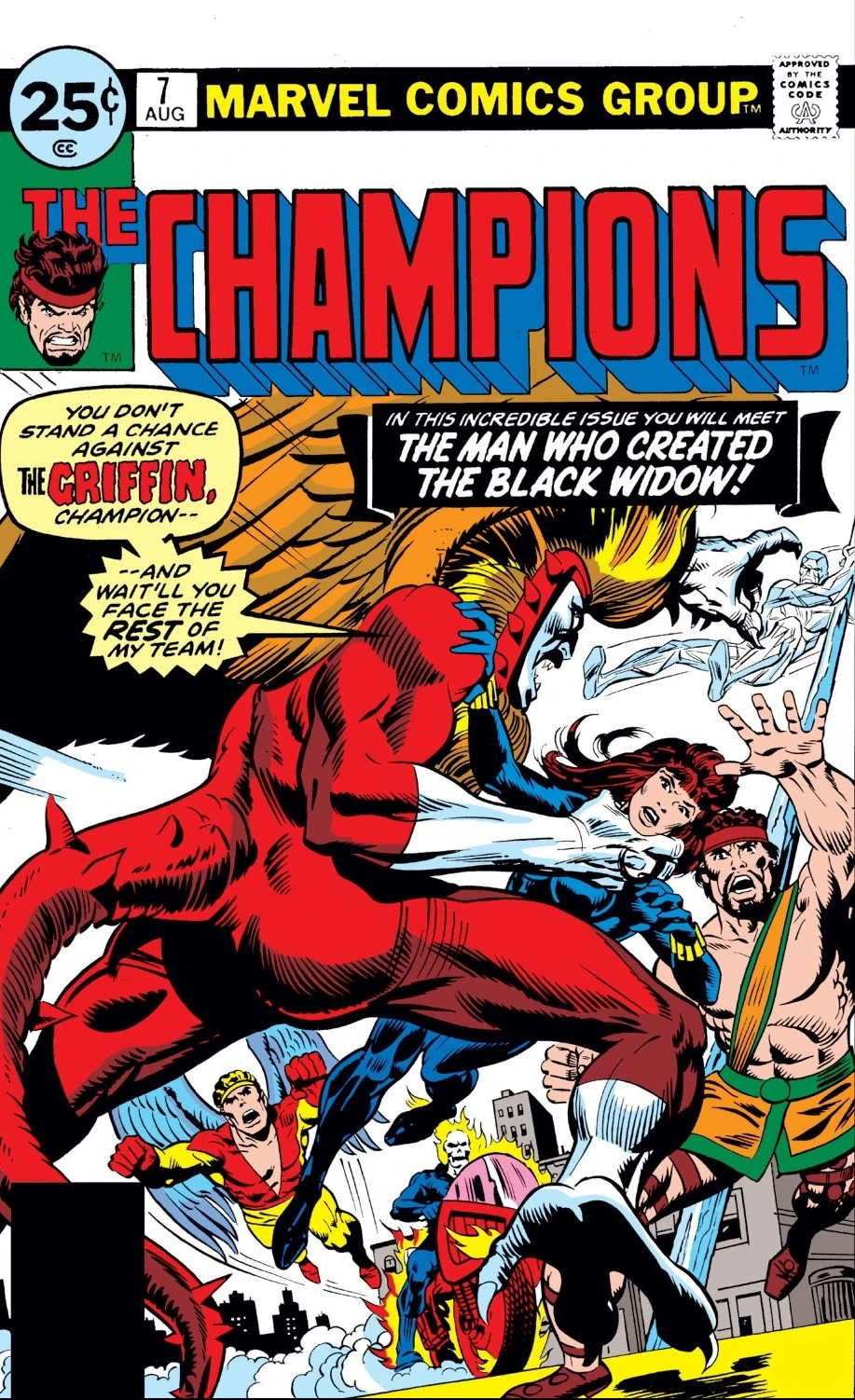
The Man Who Created the Black Window


This is another good issue of the Champions, writer Tony Isabella has really found his groove and things are going along pretty well. This is a classic set-up issue where stories are being laid out, so there’s not a ton of action. Well, meaningful action.

It opens with Hercules, Ice Man and Champions business manager Richard Fenster being attacked by some sort of remote control bomb. It takes them about three pages for the trio to capture it and then they give it to Natasha and her pal Ivan. The Russian ex-pats are going to look into this thing because something seems a bit too familiar about this rocket.

While this is going on, Ghost Rider and the Angel are visiting Stuart Clarke, aka Rampage, in the hospital. The Angel is trying to get Clarke to accept his gift of a lawyer, so that he can be defended in court. Clarke doesn’t want it (I don’t blame him) and he’s being a bit of a dick about it too. Oh yeah, he’s smoking. In a hospital. The 1970s were a weird time, man.

Angel wants to help Clarke because he feels bad for him. Johnny Blaze is like, “Dude, that’s dumb. I’m going to turn into Ghost Rider and scare him into taking your charity!”

As he bursts into the hotel room, he sees the villains Darkstar and the Griffin taking Clarke. Ghost Rider is so taken aback he yells, “Sweet jumping catfish!”

I didn’t read a ton of Ghost Rider books when I was a kid, but I don’t remember him talking like a stereotypical 1950’s TV cowboy. It’s really strange to see a guy with a flaming skull for a head, speak with these south western, homespun axioms. I’d think that you want a guy who looks like a demon, to talk like a demon. But that’s just me.

Otherwise he sounds like Jethro Bodine.

(I know this guy isn't a cowboy, but man alive Ghost Rider, any second now you're going to be prattling on and on about your ce-ment pond and Mrs. Drysdale. BTW, I really did not like "The Beverly Hillbillies". Even when I was a kid, I thought it was too low-brow and I genuinely like "Car 54, Where Are You?" and "Gilligan's Island")

Speaking of looks, the Griffin looks absolutely ridiculous. He’s got brown wings, a chalk white face that surrounded by shockingly yellow mane and he’s clad in a bright red onesie. Ghost Rider calls him “a homicidal maniac”, but he looks completely ridiculous.
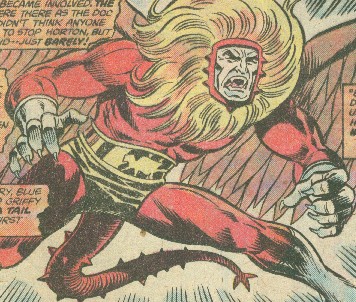

(He even has a picture of a griffin on his belt! The fuck, dude?) 

While GR is fighting the bad guys, Angel rescues Clarke. How does Clarke repay WWIII? He punches him in the gut with one his exo-gloves that Darkstar smuggled in for him. Angel and Ghost Rider regroup and go back to the Champions headquarters, located in downtown LA.

Hercules, Ice Man and Fenster are walking around looking for the bomb perpetrator and the Champions business manager won’t shut up about tomorrow. Apparently, the Champions are going to announce to the world that they’re a new super team and looking for a bad guy in their headquarters could be bad publicity. Ice Man gets pissed and calls Fenster, “Dickey Boy” all while completely missing one of the bad guys hiding behind a file cabinet.

Apparently, Ice Man can either come up with a sick burn or be a detective. HE CAN’T DO BOTH!

The trio think that they stumble upon the bad guy, but it turns out to be a crybaby kid who wants the Champions to help him. We don’t know what, exactly, he wants them to do but he starts sobbing on Hercules and hugging him. Zounds indeed! The stealthily hidden villain, who I think is the Outcast (they never get around to mentioning his name), goes down the back staircase and out the door to freedom.

Which is fine because we move our attention to Ivan and Natasha. Ivan has taken apart the bomb and realizes that it wasn’t really a bomb at all, it was a remote-controlled device that was delivered a message. The message? One black pearl. That’s all Black Widow needs to hear and she jumps out a window. Was the pearl scary? No, she saw a guy on the rooftop, so she decided to track him down.

She meets up with him and realizes that it’s her old teacher – they guy from the title of this book! The man who created the Black Widow! He was about to tell her something, but he got shot by the Titanium Man. And that’s where this book ends.

When you think of classic Marvel teams like the Avengers or the X-Men or the Fantastic Four, they all came about in the early 1960s. The Champions debuted 15 years later, which isn’t really that much time, yet it feels like a completely different dynamic. Like I said, I think things are starting to go in the right direction for this book, but it still has a weird, ad-hoc sort of vibe to it.

When you go back and read those other team books, it seemed like there was more cohesion, it was more tightly knit. And I’m not sure whether that’s due to the writing of Stan Lee and art of Jack Kirby (two of the all-time titans of the industry). Or whether it’s because I didn’t read those first books until much later, after I already knew the stories and the background, so I was more familiar with the characters and willing to smooth over the rough, early patches.

But even though Isabella is doing a fine job and the books are entertaining, something seems to be off. Perhaps it’s because I know that I’m reading a finite book that most people have forgotten and that has colored my view – almost as if I’m looking for the one panel where the collective comic community threw up its hands and said, “We’re out!” but there’s no real sense of gravitas here.

It sounds as if it’s me, I’m the one who needs to change my perspective on this book and just read it for what it is: a fun, weird book centered around some C-list Marvel characters and not worry about any larger significance. One of the things that bugs me about modern comics is how super serious every character seems to be. I like books, like Kate Bishop: Hawkeye (I know that’s not the title), where there are some stakes, but the writing is bouncy and fun. The Champions are a lot like that, but in a more ironic way. It is intended to be serious and full of consequences (Ice Man has been having an existential crisis and bitching about quitting the super hero game to become an accountant – which sounds really funny after I reread it) but it’s not.

In a few issues, the Champions are going to fight a former Nazi scientist who’s made of bees. And that sounds pretty damn awesome.

BTW, despite the aesthetics of the Griffin, the cover is pretty damn dope. Six out of seven!

Anyway, I’d give this issue of Champions three out of five Angels wearing a vest.


Friday, February 29, 2008

41. WKRP in Cincinnati


Comedic law #1: Ensemble casts usually make the best comedies. I'm not sure why this is true, though it probably has something to do with the fact that if you don't like one character, if you wait a few minutes he'll be off the screen and another one will come along. Sort of the Chinese Buffet way of thinking: I don't like egg rolls, but I like the General Gau's chicken. And one of the best orders of General Gaus—I mean ensemble casts—was featured on the great “WKRP in Cincinnati”.

To my knowledge, none of the cast members were big stars before the show took CBS' airwaves in the late 1970s. Most played bit roles in television or movies and were known as character actors. That's why the show was so great, it wasn't built around a star or was a vehicle for one particular person—an aside: the show “Friends” was initial a vehicle for Courtney Cox and that's why a majority of the first season revolves around her character Monica, who may be the least interesting character of the six. If “Friends” stayed in this format, who knows if it would have been a monster hit in the ratings.

With “WKRP” the stories and the plots were the stars, and they were mostly character driven. Much like another MTM ensemble show (“The White Shadow”), to enjoy “WKRP” was to enjoy the characters. In other words, the hook of the show, a group of radio workers, isn't what made it beloved. It was the heart within these people. Yes, Dr. Johnny Fever (Howard Hessman) was a burn out who had nothing in common with slick sales man Herb Tarlek (Frank Bonner) or Les Nessman (Richard Sanders), but it was apparent that the cast cared for each other and that showed on the screen.

Every member of the cast worked very well with all of the other members, but there were certain pairings that were terrific and the writers often went to the well with these duos: Fever and Venus Flytrap (Tim Reid), Mr. Carlson (Gordon Jump) and Andy Travis (Gary Sandy), Tarlek and Nessman. Even the woman, who seemed as if they had nothing in common; smarter-than-she-appears secretary Jennifer Marlowe (Loni Anderson) and industry new comer Bailey Quarters (Jan Smithers) had a great deal of chemistry. In each pairing, the latter was usually the straight guy, while the other character played off of him/her. This wasn't gospel and sometimes it changed up, however.

The Jennifer/Bailey debate among young men who grew up watching the show in syndication is that generation's version of the Ginger/Mary Ann debate from “Gilligan's Island”. While Jennifer was a knockout in every sense, there was something “sneaky hot” about Bailey that a lot of guys found intriguing. It was almost if Jennifer was the sure thing (good looking, brains, rich) but Bailey had something under the surface that could be better than Jennifer. The girl you picked probably had more to say about picker, than anything: did you lean towards the favorite or were you a champion of the under dog?

As stated before, while the acting was top notch, the plots were the engine that made this show run. Perhaps one of the greatest episodes in television history is when the station came up with the idea of a Thanksgiving turkey giveaway. Instead of simply going to a store or food shelter and handing out turkeys, the group decided to have station manager Mr. Carlson go up into a helicopter and drop turkeys to the people on the ground. The thought was that when the birds were released, the turkeys would fly down and land softly in the arms of the people. One problem: turkeys can't fly.

Instead of seeing the turkeys fall to earth, we are then shown program director Travis sitting in Carlson's office listening to the radio as the promotion that will put them on the map is underway. As he is listening to Nessman's description of the events (reminiscent of Herbert Morrison's description of the Hindenburg disaster), Travis realizes (too late) that turkeys can't fly. This led to one of the great lines in television history from Carlson, “As God as my witness, I thought turkeys could fly!”

And the fact that the director left the scene of turkeys bombing down on Cincinnatians to the imagination of the audience makes the scene that much more funny.

Not all episodes were that slapstick-y, there was another episode when the gang had to play a softball game against their rival station and the only one who was excited about it was baseball fan, Nessman. The problem was he stunk at the game partly due to his mother's constant harping of him having to practice the violin while the other kids played ball. With the station clinging to a one-run lead, the bases loaded and two out in the bottom of the ninth, Nessman is stuck in deep right field. Suddenly the viewer hears the crack of the bat and it's obvious that the ball is coming his way. As the ball is coming, Nessman is day dreaming of his mother's shrill tone imploring him to practice. Suddenly he notices the ball, puts his glove up and ... the show ends.

While the nerdy guy making the decisive play in a baseball game isn't new territory, the juxtaposition of Nessman's enthusiasm coupled with the reason for him being so bad was a different way of telling the story. That is another reason why the show worked well. It never really broke a lot of new ground in the way it was filmed and most of the plots and characters could be consider either cliché or done already, but the writers often took different routes to those “places”.

And no show about a radio station would be complete without some music, and “WKRP” had a fine lineup of the day's biggest artists. The problem is, due to licensing money, you can't hear them any more. According to Wikipedia, when the show went into syndication the original music from artists like the Rolling Stones, KISS and the Doors were too expensive to pay, so they would have a band record generic rock and replace the well-known songs. These generic replacements followed the episodes to DVD and while there may be some loss, it is mostly incidental.

While not the first ensemble comedy, “WKRP in Cincinnati” showed that America can support a show with a lot of characters and smart plots. A direct influence on another off-beat, ensemble comedy about the radio business, “Newsradio”, “WKRP” was also responsible for a number of unique characters bringing the biggest laughs.

Friday, December 07, 2007

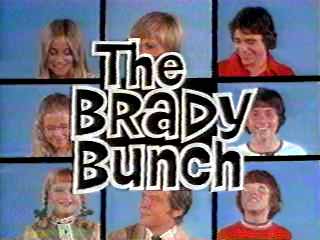
56.Gilligan's Island / Brady Bunch


This entry isn't just about the two shows, but also about their creator: Sherwood Schwartz.

While reading a bit about him on his Wikipedia page, I found that it was interesting that Schwartz and Red Skelton hated each other. So much so that while Schwartz was a writer on Skelton's show (which did very well in the ratings), Schwartz had it written in his contract that he never had to see the star of the show face-to-face.

That's a pretty ballsy move.

It's also pretty ballsy to walk into a head of a network and claim that the idea for your new show was an allegory as to show how seven people (the seven continents) can live and work together on one island (the Earth) in peace. After the head buys the idea, Schwartz gave them “Gilligan's Island”.

Here's the thing about these two shows that will always be linked because of a lot of different reasons, but the main reason is that Schwartz created them both. And he did it in a way that was appealing to adults, but also to kids. What GI or BB, each episode was essentially the same: during the first five minutes a trivial problem (though monumental in the eyes of the protagonist) is discovered. During the next ten minutes, the main character either mopes about said problem or attempts to fix it, which results in the problem becoming even larger. During the last 15 minutes, the rest of the cast is brought in on the problem, solves it and they all live happily ever after.

The one monkey wrench in this comparison between the two shows is that “The Brady Bunch” didn't have the deus ex machina that is Gilligan. In order for the castaways to continue their show, Gilligan had to screw up every episode so that they're still stuck on the island.

This repetition of theme and plot made the shows lovable to children and teens alike. It has been proven that babies enjoy and need repetition: from white noise sounds soothing them to sleep to endlessly enjoying the same shows hour after hour. As one grows up, the familiar becomes boring, yet there is still a desire for the familiar—even if the show is “new”. I believe that Schwartz was aware of this and became the backbone of both shows.

And while he never had any more hit shows (“It's About Time” sounded terrible), that's ok because he gave the world two generational touchstones and two theme songs that most people under 60 know better than the national anthem.

Everyone knows that Gilligan is going to blow it in the end or that Mike and Carol Brady are somehow going to save the day; this is precisely why we watch. Even for thirty minutes, all is right in the world.

A few nights ago, I was watching an episode of “The Monkees” (more on them in a subsequent entry) and it occurred to me that there were a few jokes that went over my head when I was a kid—in this particular episode, Mickey was looking for a Marshal Dillon and tried to make a phone call for him. The person on the other line only had a Bob Dylan who couldn't help you, but would write a song about your troubles. That was funny to me now, but I know that I had no idea what a Marshal Dillon was or a Bob Dylan and why anyone would get them confused.

The BB and GI do not have a higher level of comedy (and that's comparing them to “the Monkees”), what you see was what you got. Bobby wasn't an archtype for Che Guerva and Mrs. Howell wasn't the personification of greed and stupidity. There is something refreshing about this one dimensionality and if I catch these shows on television today it takes me to when I was a kid. Back then I enjoyed watching a show because it was my favorite show, not because it made a social statement. And make no mistake, the kids who grew up on this stuff; whether they're black, white, yellow, or green didn't care either, they were able to identify with the characters because their struggles are universal.

Who hasn't been picked on, whacked on the head with a sailor cap, formed a song and dance troupe to compete on television for their parents' anniversary present, stole a rival school's mascot, met your favorite band and got them to perform a private concert just for you (a plot that happened on both shows-Davy Jones on BB and the Beatlesque Mosquitoes on GI). This is the reason why my grandchildren will probably be watching these shows, long after every cast member is long dead.

On a personal note, both programs bring back a ton of memories for me: watching “Gilligan's Island” on Sundays at 11:30 am at my aunt's house after we went to church and had a big breakfast meant that I was about to be shipped outside because football or baseball was about to be put on (I was too young to understand either game). And when 5:00 rolled around, I know that I could watch the Bradys and then eat dinner before it was time to do homework or go to bed. BTW, both shows were on Channel 56 in Boston.

Like I said earlier, every one wants to go back to a simpler time. It's hard-wired in our brains—just like these shows.