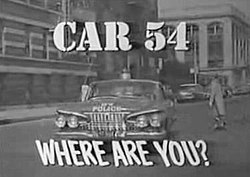

I'm not here to write an exquisite prose about the cultural merits of “Car 54, Where are You”. I'm not going to say that it was a wonderfully sublime show that worked on eight different philosophical levels. Nor am I going to say that the show reinvented the sitcom, and forced us to look at ourselves and our lives differently. I'm not going to say this because it's not true. I am going to paraphrase a certain NFL head coach and say, “Car 54 was what it was.” And what the show was was a screw-ball comedy about two oddly coupled Bronx cops and the people they helped and worked with every day.
Quick aside, everyone has met that guy; the one who always has to bring the must mundane, mindless pleasures up to a certain level so that he can explain why he enjoys them. Usually the medium involved is either music or books, especially comic books (“I read the Amazing Spider-man because of the subtle and sophisticated commentary on social mores that I can't find anywhere else.”). Every once in awhile he'll turn his attention to a television show that's “beneath him” and find some sort of crazy high-brow justification for why he watches it. I've never found anything wrong with this reason: I like it because I like it.
And that's the reason why I enjoy “Car 54”, the show does what it sets out to do: make me laugh. Each episode's plot was pretty much the same: something out of the ordinary happens to Gunther Toody (played by Joe E. Ross) or his partner Francis Muldoon (Fred Gwynne). And it's the typical sitcom faire: they have to take care of a baby or a dog, Gunther has problems with his wife, Muldoon can't find a date, etc. During the next 30 minutes, there's a few misunderstandings, some shenanigans ensue and the duo return to the status quo. To make things even better (Or worse depending on your point of view) neither of them ever bring up any of the previous episodes' “major” calamity.
If you've been reading some of my other entries, you'll notice that I harp on one thing: it's not the plot, it's the characters. And that runs true here: Muldoon is the typical straight man who is both sharp and level headed. Toody is the buffoon, whose responsible for most of the laughs. They bicker like a married couple, but they genuinely have a strong affection for each other, which is something that the audience can tell.
As actors, the two couldn't have been more different. Up until his role on the Phil Sivers' show “Sgt. Bilko”, Ross cut his teeth as a comedian who was the first act at a lot of strip clubs and bars. Gwynne was a Harvard-educated ad man who, like previous entry and Harvard alum Conan O'Brien, was the president of the Harvard Lampoon. He loved performing but found it tough getting a steady job (which is why he worked at an advertising agency) until “Car 54” came along. Of course, Gwynne was to become most famous for his turn as Herman Munster in “The Munsters” which aired a year after “Car 54” was cancelled. Joining him on “The Munsters” was Al Lewis who played his father-in-law Grandpa. In “Car 54” Lewis played fellow officer Leo Schnauser.
It is these differences that helped make the show shine. Officer Toody looked like a guy that would be a hacky comedian working at a strip club while Officer Muldoon looked like a guy that would've gone to Harvard. The writers were smart not to go against type and let these two guys play to their strengths. And like future sitcoms like “Seinfeld” there was never a “learning or hugging” moment in the program—though, I doubt that was an official edict as it was on the Seinfeld set. Gunther and Toody were two Bronx cops who happened to be involved in funny situations and for the most part, the producers left it like that.
When I started this entry, I promised that there wouldn't be any other reason for liking this program other than “because I like it”. However there was another interesting dynamic to the show that wasn't prevalent in the era: and that was the “dignified” appearance of black people on a TV show. I put dignified in quotes because of a few reasons, but the biggest one is that television in the 1950s and 1960s was typically a white world, when a black person was on TV usually he or she was in a role as servant or in some other menial job. On “Car 54” there were a few black cops, most notably Nipsey Russell who took on the role of Officer Anderson. They were treated the same as the white cops and as actors, Russell in particular, had some great lines.
Was “Car 54” the Rosa Parks of the sitcom world? No. But showing black people and white people equally working together was a step in the right direction.
Another reason why I liked this show was sort of the reason why I liked "The Andy Griffith Show" and that's there is no way that this program could ever be on TV now. America is too different of a place than it was in the early 1960s. Like Andy Griffith what made this show funny is that there was a certain respect that cops had that they don't have now. The neighborhood policeman was a pillar of the community and the jokes about them were seen as good natured fun. The modern day lampooning of police officers is a little more edgy, a little more mean and that's because of the way that cops are seen. Whether or not we're better off, I'm not sure, but while I can't see Jimmy McNulty and Bunk Moreland joining the 53rd Precinct, I couldn't see Toody and Muldoon signing up for a tour on "The Wire" either.
Perhaps the lasting memory of “Car 54, Where are You?” is the opening theme song:
“There's a holdup in the Bronx!
Brooklyn's broken out in fights!
There's a traffic jam in Harlem
That's backed up to Jackson Heights!
There's a scout troop short a child!
Khrushchev's due at Idlewild!
Car 54, where are you?!”
Of course, I know that Idlewild is the old name for the current John F. Kennedy International Airport, but when I was a kid I thought that the line was “Krushchev is doing Ida Wild”. It sounded dirty, which didn't make sense in the context of the show, but I had no idea who Ida Wild was. I think I may have even asked my parents, who also had no clue what the hell I was talking about.
“Car 54” ran for two seasons before it was cancelled. According to Fred Gwynne biography I watched over the weekend—yes, I am that much of a dork—the show was still popular when it ended, but the biography didn't give a reason why it was cancelled.* And after that it spent some time in syndication reruns before landing at Nick at Nite during the late 80s, which is where I found it.
* The same thing happened to “The Munsters” as it was a ratings bonanza when it debuted in 1964—which coincidentally was also the year that “The Addams Family” and “Bewitched” debuted, which says a lot about the copy-cat industry that is television even in those days. However, it fizzled once “Batman” came on the air the following year in the opposite time slot. Gwynne didn't care that his show was on the way out because by that time he was pretty sick of playing Herman Munster. From the hours it took to get him into makeup to the ridiculous Munster plots, Gwynne didn't go on a full-fledged Robert Reed rant, but he did make it known that he wasn't thrilled playing the role that would make him so famous.
In 1994, someone got the idea of revising the “Car 54, Where are You?” franchise for a full-length movie starring John C. McGinley as Muldoon (you may know him better as Dr. Cox on Scrubs) and David Johansen as Toody (you may know him as Buster Pointdexter who sang that insufferable “Hot, Hot, Hot” song that's played at every single wedding and the guy who lead the cross-dressing pre-punk New York Dolls). Adding to the cast were Fran Drescher, Rosie O'Donnell, Jeremy Pivin and Daniel Baldwin. There were also cameos by Russel and Lewis.
It was one of the biggest bombs of the year and given the cast, who could blame them from staying away from the theater. I have no idea why the producers used the “Car 54” name for the project as it really had nothing to do with the original show. McGinley and Johansen are just playing mismatched cops, like Eddie Murphy and Nick Nolte did in “48 Hours”. Why go with the “Car 54” name? Call it something else, especially considering that this wasn't a time piece it was updated for the 1990s. I don't think that a name change could have saved the movie, but at least the show wouldn't have been connected to this stink bomb—which IMDB.com readers listed as the 28th worst movie of all time.
Watch the original TV show, but avoid this movie at all costs.


