Showing posts with label The White Shadow. Show all posts

Friday, February 29, 2008

41. WKRP in Cincinnati


Comedic law #1: Ensemble casts usually make the best comedies. I'm not sure why this is true, though it probably has something to do with the fact that if you don't like one character, if you wait a few minutes he'll be off the screen and another one will come along. Sort of the Chinese Buffet way of thinking: I don't like egg rolls, but I like the General Gau's chicken. And one of the best orders of General Gaus—I mean ensemble casts—was featured on the great “WKRP in Cincinnati”.

To my knowledge, none of the cast members were big stars before the show took CBS' airwaves in the late 1970s. Most played bit roles in television or movies and were known as character actors. That's why the show was so great, it wasn't built around a star or was a vehicle for one particular person—an aside: the show “Friends” was initial a vehicle for Courtney Cox and that's why a majority of the first season revolves around her character Monica, who may be the least interesting character of the six. If “Friends” stayed in this format, who knows if it would have been a monster hit in the ratings.

With “WKRP” the stories and the plots were the stars, and they were mostly character driven. Much like another MTM ensemble show (“The White Shadow”), to enjoy “WKRP” was to enjoy the characters. In other words, the hook of the show, a group of radio workers, isn't what made it beloved. It was the heart within these people. Yes, Dr. Johnny Fever (Howard Hessman) was a burn out who had nothing in common with slick sales man Herb Tarlek (Frank Bonner) or Les Nessman (Richard Sanders), but it was apparent that the cast cared for each other and that showed on the screen.

Every member of the cast worked very well with all of the other members, but there were certain pairings that were terrific and the writers often went to the well with these duos: Fever and Venus Flytrap (Tim Reid), Mr. Carlson (Gordon Jump) and Andy Travis (Gary Sandy), Tarlek and Nessman. Even the woman, who seemed as if they had nothing in common; smarter-than-she-appears secretary Jennifer Marlowe (Loni Anderson) and industry new comer Bailey Quarters (Jan Smithers) had a great deal of chemistry. In each pairing, the latter was usually the straight guy, while the other character played off of him/her. This wasn't gospel and sometimes it changed up, however.

The Jennifer/Bailey debate among young men who grew up watching the show in syndication is that generation's version of the Ginger/Mary Ann debate from “Gilligan's Island”. While Jennifer was a knockout in every sense, there was something “sneaky hot” about Bailey that a lot of guys found intriguing. It was almost if Jennifer was the sure thing (good looking, brains, rich) but Bailey had something under the surface that could be better than Jennifer. The girl you picked probably had more to say about picker, than anything: did you lean towards the favorite or were you a champion of the under dog?

As stated before, while the acting was top notch, the plots were the engine that made this show run. Perhaps one of the greatest episodes in television history is when the station came up with the idea of a Thanksgiving turkey giveaway. Instead of simply going to a store or food shelter and handing out turkeys, the group decided to have station manager Mr. Carlson go up into a helicopter and drop turkeys to the people on the ground. The thought was that when the birds were released, the turkeys would fly down and land softly in the arms of the people. One problem: turkeys can't fly.

Instead of seeing the turkeys fall to earth, we are then shown program director Travis sitting in Carlson's office listening to the radio as the promotion that will put them on the map is underway. As he is listening to Nessman's description of the events (reminiscent of Herbert Morrison's description of the Hindenburg disaster), Travis realizes (too late) that turkeys can't fly. This led to one of the great lines in television history from Carlson, “As God as my witness, I thought turkeys could fly!”

And the fact that the director left the scene of turkeys bombing down on Cincinnatians to the imagination of the audience makes the scene that much more funny.

Not all episodes were that slapstick-y, there was another episode when the gang had to play a softball game against their rival station and the only one who was excited about it was baseball fan, Nessman. The problem was he stunk at the game partly due to his mother's constant harping of him having to practice the violin while the other kids played ball. With the station clinging to a one-run lead, the bases loaded and two out in the bottom of the ninth, Nessman is stuck in deep right field. Suddenly the viewer hears the crack of the bat and it's obvious that the ball is coming his way. As the ball is coming, Nessman is day dreaming of his mother's shrill tone imploring him to practice. Suddenly he notices the ball, puts his glove up and ... the show ends.

While the nerdy guy making the decisive play in a baseball game isn't new territory, the juxtaposition of Nessman's enthusiasm coupled with the reason for him being so bad was a different way of telling the story. That is another reason why the show worked well. It never really broke a lot of new ground in the way it was filmed and most of the plots and characters could be consider either cliché or done already, but the writers often took different routes to those “places”.

And no show about a radio station would be complete without some music, and “WKRP” had a fine lineup of the day's biggest artists. The problem is, due to licensing money, you can't hear them any more. According to Wikipedia, when the show went into syndication the original music from artists like the Rolling Stones, KISS and the Doors were too expensive to pay, so they would have a band record generic rock and replace the well-known songs. These generic replacements followed the episodes to DVD and while there may be some loss, it is mostly incidental.

While not the first ensemble comedy, “WKRP in Cincinnati” showed that America can support a show with a lot of characters and smart plots. A direct influence on another off-beat, ensemble comedy about the radio business, “Newsradio”, “WKRP” was also responsible for a number of unique characters bringing the biggest laughs.

Tuesday, February 26, 2008

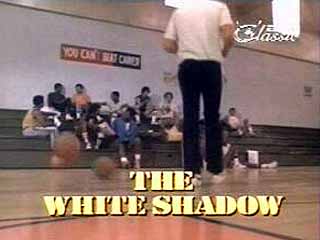
42. The White Shadow


It's sounds like a corny premise for a show: former NBA player forced to retire because of bad knees comes back to his old high school and finds that everything has changed since he left. The principal of the school happens to be his former roommate at Boston College and talks him into taking the job of basketball coach at the alma mater. One problem, the principal says, the kids are tough and times (and kids) are different.

It's a story that has been told a million times, “Welcome Back Kotter” is one example, but “The White Shadow” was so much more than a Kotter copy. Produced by Bruce Paltrow (Gwyneth's father) and MTM productions (the same folks who brought you “Mary Tyler Moore” and “Rhoda”), this wasn't the basketball version of the insanely popular WBK. It was something much different, much more serious. For the first time a prime time, network show was centered around teenagers (black and Hispanic teens to me more precise) that didn't reduce the characters into caricatures. Each character was fleshed out and was given a true personality, one that didn't just see in strict black and whites—they understood that there were gray areas in life too.

Ken Howard plays the Shadow, Coach Ken Reeves, who uses a lot of old-school logic and toughness to whip the Carver High School basketball team into city champions. Set in South Central Los Angeles, it would have been easy for the writers to go the Kotter route and make the kids lovable goofballs who might be tough on the outside, but are really nice and sweet on the inside. Quick aside: for all of the Sweathogs' tough talk, when did the audience ever see these guys get into a fight? Are we to believe that the toughest kids in a Brooklyn school all worshipped at the altar of their teacher—himself a second-rate Groucho Marx? There have been a lot of stupid things foisted on the American public, but “Welcome Back Kotter” has to be one of the dumbest.

Instead of goony antics, over-the-top camera mugging and worn-out catchphrases, “The White Shadow” brought a gritty realness to prime time television and showed the viewers that a. modern teenagers don't live carefree lives and b. kids living in the ghetto are constantly bombarded with negative influences. From gangs to point shavings to drugs to high school prostitutes to even a member of the team getting gunned down in a liquor store before the city championship, if you were a Carver High graduate, you've pretty much seen the entire gambit of human misery. And it would've been easy for the writers to go the complete opposite way of the Kotter kids and make each episode a weekly “After School Special” about the danger du jour. They didn't do that either.

What made “The White Shadow” so perfect was that there was a nice combination between the serious and the funny. The team members constantly busted each others' balls, got together after games to party and had traverse the troubles of the classroom. In other words, it was about as close to real life as you were going to get in the late 1970s. And another important thing: the kids at Carver High actually looked like they could play basketball. Nothing takes a viewer out of a TV show than an actor trying to do something that he simply can't do. One of the worst parts of “Teen Wolf” was watching Michael J. Fox try and dribble a basketball without watching what he was doing. I could buy the lycanthropy, I can buy car surfing, I can even buy the whole town rallying around a werewolf, but I can't buy Fox playing hoop.

For former “high school heroes” or if you played sports at any level, one of the reasons why this show worked is because you might be able to see your team or members of your team in the Carver High bunch. Like I said before, nostalgia sells. But this wasn't to say that the squad was a big happy family, like most teams there were disagreements and some people didn't like other people for a variety of reason. Abner Goldstein, who was the only Jewish guy who played hoop and often felt ostracized from his teammates who were mostly black. The issue was eventually cleared up and most of the guys treated him as a teammate, but it wasn't a one and done event. I believe that his awkwardness around the team lasted most of the first season. There were a lot of racial aspects explored in the show, but mostly the racial stuff was either not talked about or was dealt with separate from the team—in one episode three players were held in suspicion of mugging an old lady, simply because they were black.

The one goofy portion of the show were the shower scenes. I'm not sure why the producers did this, but they decided to focus on the singing ability of the team. Worse than that, the “Shower of Power” (what the group was called) would often sing rock and R&B songs from the 1950s and early 60s. For a program that was built on the cornerstone of being “real” this was a transcendence into absurdity which never worked because of two reasons. One, most high school basketball players aren't singers and if they are, they aren't doing it in the shower. Two, if we buy the premise that these kids love to sing, they aren't going to sing a bunch of tunes that even the nerdiest of them would consider lame.

As the show progressed cast members left and were added, as the mainstays of Thorpe, Coolidge and Salami stayed constant. By far the team's best player, Coolidge was also the player Reeves was most close to and was seen to be the one where basketball was not just a game, but a life's occupation. However, in a brilliant piece of casting, Coolidge ends up on another MTM show—“St. Elsewhere” as an orderly.

Despite some players leaving for graduation, often times they would return to visit their coach and update him on what they were doing: Haywood worked for a law firm, Goldstein joined the Marines and Reese drove a cab while simultaneously pursuing his dream of becoming a singer. These little vignettes allowed the viewer to catch up cast members who left, which is something that most shows don't do. Once you leave the set, the character is usually forgotten for good. This was proof that the writers cared about their characters.

The show did well, but never caught fire like CBS intended it to and was cancelled after three seasons. For awhile it reran on Nick At Nite and ESPN Classic, but has since left the airwaves, which is a shame because while the basketball shorts are really short and no one posts up in Chuck Taylors anymore, well-crafted stories never go out of style.