Let’s get this out of the way right now: “Dragnet” is not a great show, it’s a pretty good show, but it isn’t great. The most obvious question is, if this isn’t a great show, why is it on this list? The reason why I added this show to this list is because it taught me a thing about television shows, all shows can be made fun of and mocked.
I was way too young when this show (and we’re talking about the 98 episodes that aired from 1967-1970, not the ones that were broadcast in the 50s and certainly not the ones aired on the radio) had it’s initial run. I caught them when I badgered my father* into watching them on Nick at Nite or TVLand during the early 1990s.
* When this show started on Nick at Nite, I didn’t have cable in my bedroom and my dad controlled the downstairs TV with an iron fist. He would often say, “I hated this show when it was first on and there’s no way that I’m watching this crap now.” I literally had to beg him to watch an episode because he found “Dragnet” boring, obvious and just an overall mess. I’m not sure exactly what he thought of me for watching it—I tried to tell him that you needed to watch this show ironically (though I probably never said it like that). But I don’t think that he ever agreed with me that watching TV could be an active activity, rather than a passive one.
And holy cow, 98 episodes? The show started in January 1967 and ran through the end of the 1970 season when Jack Webb decided to focus on another show he was producing, “Adam-12”. That’s almost 100 episodes jammed into three-and-a-half seasons. That doesn’t happen today.
Webb, who wrote, produced, directed and starred in this show played the notoriously square cop Sargent Joe Friday. His partner was veteran TV actor Harry Morgan who played his partner Bill Gannon. Morgan would go on to greater fame in his subsequent show “M*A*S*H”. I’m not sure what kind of cases Friday and his partner (it wasn’t Gannon) solved in the 1950s, but in the series they made an effort to bust up the counter culture. And that meant hippies, teens and sometimes teenage hippies.
Showing the “strange and bizarre” world of the counterculture was the absolute life blood of the show. I’m not sure why Webb went in this direction, maybe hippies were scary to middle America and the older generation. Maybe these people had no idea what their kids were up to and they looked at this program as a way to peer inside their world.
But if the latter is true, they didn’t get much insight from “Dragnet”, in fact one could say that they got the exact opposite view of what their lives were. Even someone who was 20 years removed from the hippie movement could see that Webb had no idea how to write for or about young people. It was obvious that he didn’t have a grasp on their culture and what made them tick. Thus, there was no real attempt at any insight. To Webb and his conservative views, hippies and their ideas were just as dangerous as someone who wants to rob a bank.
That lead to a lot of unintentional comedy, which isn’t good for a show that is taking itself so seriously—but it’s good for an audience that was growing up in the age of irony. Their phrases were rote and robotic, the characters were cartoons and the situations they found themselves in (drugs, street gangs, overall no-gooding) were cliched and more comical than anything on TV at the time.
One of my favorite episodes was about a hippie kid named Blue Boy. If you haven’t seen this episode you may ask about the name—I don’t think that hippies referred to themselves as anything but their real names. Was it because of his affinity for the Thomas Gainsborough painting of the same name*? No. That was not it. Was it because the character liked to hold his breath? Nope. Think again. Was it because he favored homosexual oral sex? Bite you tongue, sir!
The reason why Blue Boy was called Blue Boy was because he painted half of his face blue and dropped a lot of acid. That’s it. That’s the only reason why he called himself Blue Boy.

* The characters from “Leave it to Beaver” have this same painting hanging in their living room. I know that this wasn’t intentional, but to me it was a nice bridge between the two best shows to watch ironically. More on LitB in the coming weeks.
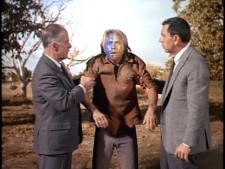
At the beginning of the episode Blue Boy is wandering around, talking silly acid-head stuff (“I’m a tree! I have leaves!” while trying to plant himself in a hole)*, but not really bothering anyone. Friday and Gannon pick him up, sober him up, set him straight on the evils of drugs and he’s back on the streets. However, by the end of the episode, Blue Boy is dead—I think that he thought he was a bird and jumped off a building—and Joe and Bill just stare glumly at the body and shake their head. This was the parental freak-out pay off: your kids could be dead if they take even one hit of acid.
* Or at least what Webb thought that kids on acid say and do.
I’ve never done acid, but I know plenty of people who have dropped and this is not what they’re like. Do they say stupid things and act sort of weird? I suppose. But their entire personalities don’t disappear and they don’t become lucid morons.
And that was what was so great about the show, everyone knew it was complete bullshit, but it was fun to watch anyway because there aren’t a lot of shows perpetrate a level of intelligence that just isn’t there. A great portion of the audience was so much smarter and more worldly than the show, that you just had to feel sorry for it.
And worse, you had to feel sorry for the people who thought that this was real. “Dragnet” went to great lengths to let the audience know that, “the story they were about to see is true. Only the names have been changed to protect the innocent.” This was the disclaimer that came before the episode began and they ran a similar disclaimer at the end. Were the stories true? From what I’ve read, Webb was a pretty big police buff and would often talk to the officers at the Los Angeles Police Department to get ideas for the TV show. Hell, his badge number 714* was retired by the LAPD.
* Jack Webb was a huge baseball fan. The badge number 714 was chosen because that was the number of home runs that Babe Ruth hit in his career. The badge numbers of the Webb-produced “Adam-12” were 2430 and 744. I thought that there was some connection between these two numbers and baseball, but I can’t seem to find anything.
But no matter what era Webb lived in, a majority of these tales are completely sanitized and made to fit into the “Dragnet” mold of honest cops, crooked criminals and defenseless civilians. There is never any derision from the formula.
And the formula was as much the show as the actors and scripts, Webb and Gannon wore the same suit in every episode. There were six episodes (I believe) where Webb didn’t wear his gray flannel suit and those were when Friday was kicking back (or in one episode at college and sort of undercover) in his red cardigan sweater. The reason why they always wore the same stuff was because as the producer, Webb wanted to be able to splice older scenes where he and Gannon were walking around into newer episodes, saving both time and money. With a revolving array of different colored suits, this couldn’t be done.
And while the suits looked familiar, so did the actors. Many of the crooks and teens and concerned citizens were used in multiple episodes. You begin to notice this if you watch enough episodes, but if there is a “Dragnet” marathon on it’s inescapable. I don’t know whether Webb liked working with this people much or whether they were cheap labor. I suppose that it was a little bit of both.
As slow and silly as this show is, especially compared to the grittier cop shows that followed (could you imagine “The Wire” starring Joe Friday? He’d be dead before the opening credits ended) it does hold my interest for a half-hour. And while there is a lot to laugh at, Webb took his work seriously and it showed.
In an era where blacks and immigrants were reduced to cheap stereotypes, Webb never went that route. The black and Latino guys on the police force were as much a part of the LAPD family as anyone. Whether this is historically accurate is debatable, but like I said, Webb was a big fan of the police department and wanted them shown in favorable light. Considering the crap that all law enforcement was getting during that time (the late 60s) this is a pretty honorable attempt.
He wasn’t interested in showing the police officers that were smacking students on the head at anti-war rally protests, or the police that were firing tear gas at the 1968 Democratic Convention protesters or turning on the fire hose at black people demanding their rights from an unrelenting South. His interest was showing the every day beat cop, the honest-hard working guy that stood for what America once represented. His police officers were the ones who risked their lives capturing thieves and no-goodniks who made the ordinary citizen’s lives miserable.
Did he go overboard with the depiction? Of course, but if I was a police officer and had to hear people that I was sworn to protect call me pig every day, turn on the nightly news and see my brothers committing reprehensible acts, I wouldn’t mind entering Jack Webb’s world for 30 minutes. While the crime rate is a bit high, it seems like a nice place overall. And if one your crimes is not accurately portraying hippies, than that’s a misdemeanor in my book.
Everyone knows that hippies suck.