Aside from the Patriots loss in Super Bowl XLII (more on that later) there isn't a hell of a lot of big things going on right now in sports. There are a couple of small things and I'll try to touch them all in this odds-and-ends edition of 19 Thoughts.
+ Curt Schilling is out for at least half the year, maybe more. There have been some conflicting reports as to how long Schilling is going to be sitting on the bench. Some people (including Schilling and the Red Sox) say that he'll be back right after the All-Star break, while Schilling's own doctor thinks that he might be gone for the entire year. Either way you look at it, it's a blow to the Red Sox.
It's now up to the kids (Jon Lester and Clay Buchholz specifically) to anchor the back end of the staff, which may be a bit ahead of schedule. Josh Beckett should be his normal dominant self and after a year in the Major Leagues, I'm expecting Daisuke Matsuzaka to pitch lights-out this year. I assumed that Tim Wakefield was going to miss some time and that Buchholz would make a spot start or two after spending some time in AAA. However, this is going to change, barring a trade for a starter.
How will having two young pitchers in the rotation work for the Sox? Will Lester be on a strict pitch count (it's assumed that Buchholz will be)? Does Julian Tavarez make some appearances for the Red Sox, and if so will how awkward is it for Terry Francona since Tavarez was left off last year's postseason roster?
And when is Francona going to get his contract extended?
+ Speaking of questions: what the hell is up with these trades? After months of speculation Johan Santana was sent to the New York Mets for a quartet of prospects that were decent, but not great. Erik Bedard was sent from Baltimore to the Seattle Mariners, and the Orioles got centerfield prospect Adam Jones. The preeminent Seattle Mariners blog The USS Mariner feels that their team got royally screwed.
In the NBA, the Los Angeles Lakers aquired Pau Gasol from the Memphis Grizzlies for essentially Kwame Brown and a couple of draft picks. Not to be outdone, the Phoenix Suns traded Shawn Marion and the rotting corpse of Marcus Banks to the Miami Heat for the Big Aristotle himself, Shaquille O'Neal.
Two of these trades look like outright steals for one of the teams, one looks like it could be a steal and the other doesn't make a hell of a lot of sense. The Mets and the Lakers made out very well for themselves, as New York didn't have to give up their best prospect in exchange for the best American League pitcher over the last five years and they didn't have to pay him as much as was expected. Imagine being fleeced by Omar Minaya. The Lakers gave up on a stiff and two low first-round picks for a guy that will work really well with Kobe Bryant. And when Andrew Bynum comes back, watch out for Los Angeles in a tough Western Conference.
I'm not sure that I completely agree with the USS Mariner, as I think that Bedard is a special pitcher and will do well in Safeco. However, I do agree with their assertion that the Mariners were not really an 88-win team last year. According to the runs scored/runs allowed metric, the M's scored a bunch less than their opponent. This means they were lucky to have won as many games as they did and probably should have won between 82 and 85. Getting Bedard for your top prospect to augment a .500 team is not a good idea, especially if Seattle regresses. Mariners GM Bill Bavasi better hope that Jones sucks, or he's going to be the Lou Gorman of the next century. This is a toss-up, especially if the Mariners don't sign Bedard to a long-term deal.
As for the Sun/Heat deal, it's a head scratcher. Phoenix loves to push the ball up the court. Shaq can't run any more. What style is going to shake out in the end? This could either be a brilliant trade that allows Amare Stoudemire to play his more natural power forward or this could completely destroy this team during the stretch run. Like Bavasi, GM Steve Kerr has a lot riding on this trade and news out of Phoenix was that Shaq was winded during his first practice. Of course, Shaq hasn't played in Miami in awhile because he's been injured. We'll have to wait and see.
+ The Patriots lost the Super Bowl. I'm not going to write too much about this because it's done and there's nothing that can be done about it. The New York Giants upset the Pats, despite giving New England at least five chances to win it at the end. You know the old adage, “Give a good team five chances on one final drive and it will come back to bite you in the ass.”
I'm not saying that the Giants suck. They played a perfect game and controlled the tempo while the Pats played like crap. They had no answers for the Giants' defensive line, for some reason the offense never really got going until two minutes left in the final quarter and I still have no idea why Coach Bill Belichick went for it on 4th and 13 instead of kicking a 48-yard field goal.
And looking on the bright side, the Patriots went to four Super Bowls within seven years and won three of them. That's pretty awesome. Look at the Minnesota Vikings or the Buffalo Bills, they went to the Super Bowl four times and came away empty handed. You think that those fans (especially the Bills, who are on the verge of losing their team to Toronto) wouldn't trade places with New England fans?
There's a thought that New England fans were being greedy but the thing that's so disappointing about this loss was that the Patriots blew a chance to make history. They blew a chance to get rid of the 1972 Dolphins forever—the most arrogant, pretentious collection of assholes ever. Do football fans have to wait another 35 years to see a team come close to perfection? By that time I'll be 68-years-old. Jesus. I'll just about be dead. My three-month old will be older than I am now. That's so damn depressing, I think that I might go drink a bottle of Jack Daniels.
+ The Bruins. Who cares about them? 68-years-old. Gah.
+ The New York papers are claiming that the Yankees are going to keep Joba Chamberlain in the bullpen, instead of turning him into a starter. In addition there is going to be a strict 140 inning count for the entire year. That's bad news for Red Sox fans, as long as there weren't any bugs around, Chamberlain was nasty last year. I thought that the Yankees were making a big mistake by putting him in the starting rotation. Seems as if they realized their mistake early. Or perhaps they have a deal cooking for a starting pitcher? C.C. Sabathia or Joe Blanton, maybe?
+ Well at least I'm not Roger Clemens. Tomorrow the seven-time Cy Young Award winner faces his toughest opponent ever, the United States government. He's getting dragged in front of Congress to testify under oath about his involvement with steroids. His former trainer, Brian McNamee was an instrumental part of the Mitchell Report, which fingered a bunch of current and former major leaguers as steroid abusers and cheats. Clemens was one of the players in that report.
Most of those named have come clean with some sort of lame excuse like, “I was just trying to get better after an injury” or “I only did it once”. However Clemens has been steadfast in holding his ground and says that McNamee is a lying liar who lies. From his awkward interview with Mike Wallace on “60 Minutes” to his press conference where he played a tape of a phone call he had with McNamee that didn't prove anything, Clemens has gone out of his way to try and prove that this is all a gigantic falsehood.
The problem is, no one is believing him. Clemens' best buddy Andy Pettitte was named in the same report and has pretty much gone along with everything that McNamee has said. McNamee has old syringes, bloody gauze pads and other evidence that he claims is from Clemens. This could get real messy for the Clemens kin as McNamee even claims that he shot the Rocket's wife up with HGH before the two posed for a swimsuit picture for the Sports Illustrated swimsuit issue.*
* Two things, one what could be more horrible than walking to the mailbox and getting the swimsuit issue and finding out that your mom is posing in it? That's a terrible image. And does anyone really care about the swimsuit issue any more? Isn't this just a relic from a more pedestrian past? If I want to see half-naked models there are a million places I can go. And if I want to see naked chicks, there's even more places to find them. Being naked or nearly nude does not care a stigma any more. For all of the talk that America is a conservative place now, the reality is; it isn't.
Whatever happens tomorrow, and there are whispers that if Clemens screws this up he can be going to jail for perjury, the court of public opinion has already rendered its opinion on him: guilty. And while I don't have a lot of love for Roger Clemens any more (give me an hour and I'll tell you why), he was the first baseball player that I idolized. I can remember getting his poster for Christmas after he his first great year—it was one of those old Sports Illustrated ones, with the clunky white borders, the san sarif type font, an action shot and that was it. So it is with a bit of melancholy that I'm going to watch him hang himself in front of the world.
Because as he's proved time and time again, Roger Clemens can pitch; he just can't speak.
Tuesday, February 12, 2008


Friday, February 08, 2008
46.Andy Richter Controls the Universe

It occurred to me that the problem with my last entry was that I spent way too much time focusing on why the show (“Grosse Pointe”) didn't work, rather than the purpose of the Blog: why a particular show works for me. After all, this is my Blog, my list on my favorite shows, who cares why it didn't work for the rest of the TV-watching world? (Jesus, that last sentence had more “my's” than a Johnny Gill song). That being said, at first blush, the title of this show, “Andy Richter Controls the Universe” could be considered among the worst titles ever imagined for a sitcom.
But look again.
Unless you were a fan of “Late Night with Conan O'Brien”, the name Andy Richter probably meant nothing to you. If you were a fan, you might have been saying to yourself, “Sure, Richter is funny, but he can't star in a television show, much less control the universe.” And that may have been the exact point the producer was trying to make about the show and life in general. Andy Richter (the character on the show has the same name as the actor) was just normal guys who worked from 9-5 at a place he didn't like because it paid the bills. Despite never realizing his dream of becoming a writer, Richter still controlled the universe in his mind. The show was sort of an updated version of the classic short story “The Secret Life of Walter Mitty” by James Thurber.
The premise of the show was simple and a bit mundane: Richter got into a sticky mess and 30 minutes later he got out of it. Standard stuff.
But the genius wasn't how he got out of the mess per se, but like Mitty, it was the journey that he took to get out of the mess. Laced with dream sequences of how Andy really wanted things to go, talking to his company's 170-year-old (and dead) founder and using an omnipotent narrator (Richter) the show fooled with typical TV and story telling conventions. For example, the company's founder would often portray Andy's “bad” side and urge him to look at or solve problems in a less-than-PC way. Or Richter would dream of solving a problem in a most absurd or violent way, before ultimately deciding against it.
These solutions were often the funniest and more surreal bits of comedy on the show and despite an often absurd dream solution, grounded Richter as a nice guy who does the right thing.
ARCTU only ran for 19 episodes over two years and when the show originally aired, I vowed not to watch a second of it because it took the place of another favorite of mine, “Undeclared”. However, I broke down after the initial episode and found that it was both quirky and smart. Which meant that it was going to be cancelled soon. Fox pulled the show after a few weeks and aired it again as a mid-season replacement the following year before giving it the Old Yeller treatment at the end of the 2003 season.
Aside from Conan O'Brien, who guest starred in an episode late in the show's run, Fox never tried to use any sort of stunt casting that they would often do to spice up low-rated programs. For example, on the aforementioned “Undeclared” both Adam Sandler and Will Ferrell were key guest stars on different episodes and it was not an uncommon occurrence to see someone like Oscar-winning actress Charlize Theron guest star on “Arrested Development”. This allowed for the cast and the writing to speak for itself. Unfortunately not a lot of people were listening.
As with the last show that I looked back on, Irene Molloy was the “hot one” in this show too. But unlike her character in “Grosse Pointe”, Molloy played a sweet, almost naïve girl who is the secretary that is new to the office. Andy is silently smitten with her, but she is unaware of his feelings as she is dating his best friend. Obviously this is vein that has been mined many times in many different sitcoms, however ARCTU put a new spin on it with some of the unconventional story telling methods listed above.
In spite of it's short run and relative obscure cast list, “Andy Richter Controls the Universe” was a fun, original television show. If you happen to catch the reruns or bump into the DVD (which hasn't been released yet—though there are rumors that say that it will be), do yourself a favor and watch it.
Richter is a terrific talent that was utilized well on the Conan O'Brien show and was excellent in his one appearance on “Arrested Development”, even his subsequent show “Andy Barker, PI” was decent too, though it lacked the originality of ARCTU. The problem isn't that he's a bad actor, he's great with the right roles, it may be that the public that knows him sees him a second banana (from his days on Conan) and the public that doesn't know him, don't find much in the way of his subtle comedy stylings. And that's a shame.
Tuesday, February 05, 2008
47.Grosse Pointe

This entry is going to be about as long as the episode run of the series that I'm writing about: short. “Grosse Pointe” was a low-rated show on a little-watched network that started broadcasting in September 2000 and ended in February of 2001, lasting all of 17 episodes. If you're a fan of the show, you're a member of a small club that got to see a smart and subtle program that probably gave it's audience too much credit for their intelligence. The basic premise of the show was that it was centered on a group of actors who starred in a ripoff of “Beverly Hills 90210” and how they dealt with the Hollywood lifestyle and each other. Like “Entourage” or “30 Rock”, it was a show within a show.
Created by Darren Star, the guy behind “90210”, GP focused more on the behind-the-scenes stories that Star felt was way more interesting than anything that he was writing for 90210. You might remember that there was a little bit of controversy when this show first aired, as Star based one of the characters on Tori Spelling. Apparently, Aaron Spelling thought that this portrayal showed his daughter in a bad light (she was written as dumb as a post) and ordered Star to rewrite the character. Star complied and the Spelling character (named Marcy and played by Lindsay Sloan) turned out to be the defacto star of the show.
As an aside, I never bought into the hype and thought that Spelling was doing his old friend a favor by trying to get a little hype whipped up and it probably worked for an episode or two. The problem was any hype was short-lived and the ratings plummeted.
There were a multitude of reasons why this show failed. One was that the show wasn't clearly defined; is GP a drama? Is it a comedy? Is it both? This may have confused the WB core audience, which at the time were mostly teenage girls. During this time “Dawson's Creek” was a run away smash hit and “Seventh Heaven” was doing well for them too. Both of those shows were similar in their easy-to-follow story lines.
And how do you market a subtle satire aimed at a genre that they love? It would be like joining Sportscenter and ripping apart the sporting world while you were showing the highlights. Furthermore, the audience for teen dramas are teenagers. If you were going to make fun or show the behind-the-scenes action of a teen show how can you get people who don't like those programs to watch a program that is about them?
Despite these questions, the WB may have been emboldened with the modest success of “Buffy the Vampire Slayer” which paired smart writing with good acting and thought that these two ideals will carry “Grosse Pointe”. I'm just making a broad assumption here, but with “Grosse Pointe”, the completely underrated cartoon “Mission Hill” (more on that show later) and the ironically titled “Popular” all launching around the same time, it seems to me that the WB gave their audience too much credit. All three had subtle plots that focused more on character development and wit rather than a bunch of pretty faces and recycled plots.
Also the problem with a BVS comparison is that Buffy has one defined genre: fantasy, that has a gigantic following. There is really no cross-over so that if you like fantasy-based shows, you watch Buffy; if you don't, you find something else. With a show like “Grosse Pointe” there was never a chance to grab the folks who like comedies or the people who like teen dramas because the former is too broad of a market and the latter is too narrow a market.
I enjoy shows that show the behind-the-scenes action of Hollywood, like “Entourage” or “30 Rock”, but this is a very narrow audience and those shows have something that “Grosse Pointe” didn't have: it never mixed messages and standout characters.
“Entourage” is a show about the movie business and Jeremy Piven's Ari Gold is a character that people talk about and want to watch. On “30 Rock” you're behind the scenes of a sketch comedy show. Previous to “30 Rock” the first time most of the public met Tina Fey, she was behind the news desk of “Saturday Night Live” and so it makes sense to all that she would be on a fake sketch show. Plus Alec Baldwin and Tracy Morgan who are among the best characters in prime time today. There were none of these things on “Grosse Pointe”, because while the characters were terrific, they weren't particularly memorable.
That's ok. As I alluded to earlier, it was well written and the cast did a good job of getting into their roles. The two standouts were Sloan and Irene Molloy who played the Shannen Doherty character with great aplomb. Since “90210” was a guilty pleasure, it was fun to watch “Grosse Pointe” and which characters were the doppelgangers of their 90210 counterparts. One of the funnier running jokes (and Star insists that this was a joke) was that character based on 90210 patriarch Jim Walsh was secretly gay and wanted his “son”.
While this isn't a top echelon show, it was a decent take on the behind the scenes shenanigans at a television show. Whether the mistakes of “Gross Pointe” completely shape the aforementioned hits of “Entourage” and “30 Rock”, I'm not sure. But I do think that it was a help. If you ever come across the DVDs in a cut out bin or see the show on reruns, give it a try. It's worth a few hours of your time.
Friday, February 01, 2008
48. Head of the Class

Edit: I think that making fun of a decade's fashion faux pas are about the hackiest thing one could do, but this picture is just awesome.
I purposely stayed away from 1980s sitcoms for one simple, reason: they mostly suck. It's a hard fact to grasp, especially if you grew up during that time and you revolved your TV-watching schedules around Arnold Jackson, Webster Long, Ricky Straton and Blair Warner like I did. But the truth is, if you get the opportunity to check these shows out now, there's really not much in terms of plot or laughs.
Actually the laugh track could be one of the worst inventions ever created for television. Why do you need canned laughter to let you know what's funny? Shouldn't this be a discovery you make on your own? Have you ever watched a show without a laugh track with people who depend on a laugh track? Whenever something hilarious happens they look around and wait to be prompted to guffaw. This is one of my least favorite inventions.
For example, on “Diff'rent Strokes” the entire show is one long build up to Arnold (Gary Coleman) busting out his catch phrase, “Watchotalkinbout Willis?” Each episode was so formulaic that oftentimes logic took a vacation in order to wrap the show up in 30 minutes. The writing is stilted, the acting is often wooden and there is no real substance at all.
One show was different and that was “Head of the Class” starring a post “WKRP in Cincinnati” Howard Hessman. Though he played a former hippie in this show as well, his character was a different beast than the iconic Dr. Johnny Fever. While Fever was the ultimate FM DJ, Hessman's Mr. Moore was the best teacher that a student could wish to have.
What made HotC different from its sitcom brothers and sisters? It's hard to say, because a lot of times the episodes were formulaic and the students were straight out of central casting (the fat one, the uber nerdy one, the conservative, the foreigner, the hippie, the artsy one, the bad ass, the precocious kid genius, the black one and the nice one—who was also black). However, there was a certain intelligence to the show that you weren't going to find on “Who's the Boss?”—and if that isn't the definition of a back handed compliment, then nothing is. None the less, it's true. The show didn't always take the easy way out, there are times where the main characters actually didn't succeed.
The writers also didn't always go for the simple joke or the “funniest” pun. Despite being archtypes, most of the show's jokes were based on the characters' different personalities. With ten students in the class, some characters were more developed than others, but I often thought that development was based on the actor rather than the character.
For example, Arvid was probably the most popular character because of the way he looked and acted. The guy who played him (Dan Frischman) never portrayed him as a “Revenge of the Nerds” type nerd; which would've been easy as the movie had just been released two years prior to this show and was fresh in the collective conscious of the American public. Frischman chose to portray him as a smart guy who happened to be different in his looks and his interests. In the world of the 1980s sitcom, that is “Hamlet”-like depth.
Most of the show's plots reflected the dichotomy that is the high school jungle: the kids who made up the cast of HotC were the brightest of the school (their class was the Independent Honors Program or IHP), yet they were perceived by their classmates as losers. Most of the student body never took them seriously and the class was either mocked or held in contempt. The class worked and studied hard because they had nothing else going for them. That is until Hessman's character, Charlie Moore began teaching them.
Originally a substitute teacher, Moore was only supposed to be in the class for a few days and move on with his life. For some reason, he took a liking to the class and began teaching them about the other side of history—the stuff that you can't find in books. He also made them try new things and to expand their horizons outside of the library. The kids learned a lot and to the dismay of the vice principal (Dr. Samuels, who saw this group of kids as a learning machine) Moore was named the permanent history teacher for the Honors program.
This is the most basic template for most high school-related television shows; teacher shows the kids something that they never know, kids learn something other than school work and teacher learns something too. The fact is, it's a template because it works. With “Head of the Class” there was a Jeter-like intangible that made this show better than all those other shows like “Welcome Back Kotter”.
Kotter was a loud and obnoxious show that was filled with lies and hammy actors all mugging for the camera. HotC had a sense of sincerity and it wasn't loud or relied on cheap jokes and catch phrases to get laugh. To the 12-year-old, it seemed like it could've been shot in any number of high school. “Head of the Class” was more honest than anything that I was watching on television at that point in my life.
Even when I was eight, I knew that “Diff'rent Strokes” and “Silver Spoons” were bullshit shows. They were enjoyable bullshit shows, but there was no way that any of the plots could happen. On HotC, there was a possibility that most of the plots were built around a kernel of truth. I wanted to know that there are teachers in the world who really care about their students and high school is filled maladjusted social retards looking to break out of their shells.
At least that's what I was hoping for.
At the time this show was popular, I was in the midst of three years in hell—otherwise known as junior high school. None of my teachers were as interested in their students' lives as Mr. Moore was (it was more of adversarial relationship—or at the very least a I-won't-bother-you-if-you-don't-bother-me truce) and being in the “smart classes” I had an affinity for what the students went through, especially because I felt I was a maladjusted, social retard. “Head of the Class” provided some sort of faint hope that going to high school was going to be a different ball game than being stuck in junior high without any hope for parole.
And while Amesbury High School wasn't anything like Millard Fillmore High School, it was a better place than Amesbury Middle School.
Wednesday, January 30, 2008
The Potential of Potential and the Rules of Winning
There are only two ways you can look at yesterday's trade of Johan Santana from the Minnesota Twins to the New York Mets if you're a Boston Red Sox: a. awesome we get to keep our kids and the Yankees don't get Santana or b. why didn't we try harder to get him? Ultimately the choice you make colors the way you look at winning.
Inspired by a thread on Sons of Sam Horn, “Are there rules to winning?”, this entry is about the aesthetics of winning. In other words, is there a correct way or an incorrect way of building a championship team? To the hard core, “winning is the only thing” type of fan; no, there isn't a right or wrong way. The bottom line is where you finish. If you finish as the World Series runner-up, you didn't have a good year and need to retool right away by any means necessary.
The other side of that coin, is that in order to win “right” a team can't be a collection of guys assembled from other teams. They have to come up and be nurtured through your farm system for a few years to be considered “real” members of your team. Trades and free agency can augment your team, but it can never be the sole mortar used for assembling a championship squad. For some reason, these people want a degree of difficulty added to an already difficult proposition.
Think of the 2003 Red Sox. They had a team that was a brain fart and five outs away from going to the World Series. Did General Manager Theo Epstein and his front office crew think that lightening would strike twice and they were destined to be in the same place the following year with the exact same team? No. They got rid of Grady Little and hired a manager that would heed their scouting reports. Traded some minor league chaff to the Arizona Diamondbacks in exchange for their ace, Curt Schilling, and spent a boatload of cash to land the best reliever on the market, Keith Foulke. At mid-season, they traded their home grown shortstop for a better shortstop and some bench depth.
You know the rest, the 2004 team went on to win the World Series. Was there disappointment because the team only had two home grown players (Kevin Youkilis and Trot Nixon), four if you include Curt Schilling (originally drafted by the Sox, but never played for the team) and Ellis Burks (also drafted and starred for Boston early in his career)? I don't think so. That year, the Red Sox were essentially a team of well-paid baseball Hessians that won the Series after 86 years of failure. From David Ortiz to David McCarthy, none of those players will ever have to pay for a drink in Boston again.
In contrast, look at the 2007 Red Sox. Another World Champion, but this time there are six home grown players, nine if you count Schilling and Japanese imports Hideki Okajima and Daisuke Matsuzaka. Does this team resonate any more or less with you than the 2004 team (forget that the 2004 team erased 86 years of history—I know it's a big caveat, but stay with me on this) simply because Jonathan Papelbon was a Lowell Spinner or Jon Lester spent some time in Pawtucket? Of course not, both teams overcame great post season odds and established themselves champions by playing hard at the right times. Who cares where they played ball before Boston? In the long run, aside from Manny Delcarmen, none of these men are true Bostonians or Massachusetts residents before they put on the Red Sox jersey.
People may have been a bit more exuberant to celebrate the 2004 team than the 2007 team, but that was strictly because of decades of frustration being shrugged off in one magical three-week period. There is no asterisk next to the 2004 Championship.
What does this have to do with Johan Santana? It's simple, there is a faction of people in blogland and in print and on the radio, who feel that the Sox somehow bettered themselves by not landing the best lefthander of the last seven years. They will argue that when/if the Sox win the Series next they'll have done so with their own players and thus not end up like the Yankees. That's the favorite target of these people, pointing to the bloated payroll of a collection of travelling All-Stars who routinely buy their way into postseason year after year.
In addition to supporting a team with the second highest payroll and not understanding that the rest of Baseball America lumps the Sox in with the Yanks, in terms of grossly overspending for talent, many of these same people are smitten with the idea that the the potential for greatness is better than greatness itself.
It's not.
Sure, Jon Lester or Jacoby Ellsbury or Jed Lowrie or Justin Masterson (all names rumored to go to Minnesota in exchange for Santana) could be either good or great players down the road for the Red Sox. The key word in that last sentence is “could” and Santana is great now. Barring injuries, having him anchor a rotation of Beckett, Matsuzaka, and Buccholz for the next five years would've been terrific.
Chances are good that some of those prospects either aren't going to get a chance to prove their mettle in Boston (for example, Julio Lugo is signed for three more years and Dustin Pedroia isn't getting traded—what does that mean for Lowrie?) or they're going to flame out (Phil Plantier, anyone?). If one of them will be even half as dominant as Santana, I'll be surprised. But that's the understood gamble with prospects, only some people don't seem to remember that when it comes time to let go of them.
For every Jeff Bagwell, there's a Frankie Rodriguez. For ever Hanley Ramirez, there's a Tony Armas Jr. or Brandon Lyon. In order to get value, you have to give up value. Trading your highly ranked prospects isn't “going the way of the Yankees” or some other inaccurate cliché. It's Baseball Economics 101. There are 25-30 guys drafted every year, all of them will not be making the big club. The trick in establishing a championship team is keeping the two or three draftees that will make you a better team and unloading the others on poor schmucks for their better players. That's not just the way baseball works, it's the way all sports works.
Whether Red Sox fans like it or not, if the Yankees are number 1 in terms of payroll, the Sox are seen as 1A. It's about time that the fandom embraces that, because the Little Engine that Could version of the Sox left the station the first year their payroll went over $100 million. And that's ok, it's alright to have a team make a lot of money and use that money to win. The owners of the Twins and the Royals are among the richest people in America, do you think that the citizens of Minnesota and Kansas City would rather have them use their money to better their teams or line their coffers? The answer is obvious.
There are no bonus points for winning a World Series through some arbitrary “correct way”. A winner is a winner is a winner, no matter how the team is constructed. When it comes to professional athletics, Vince Lombardi was correct, “Winning isn't everything, it's the only thing.”
Inspired by a thread on Sons of Sam Horn, “Are there rules to winning?”, this entry is about the aesthetics of winning. In other words, is there a correct way or an incorrect way of building a championship team? To the hard core, “winning is the only thing” type of fan; no, there isn't a right or wrong way. The bottom line is where you finish. If you finish as the World Series runner-up, you didn't have a good year and need to retool right away by any means necessary.
The other side of that coin, is that in order to win “right” a team can't be a collection of guys assembled from other teams. They have to come up and be nurtured through your farm system for a few years to be considered “real” members of your team. Trades and free agency can augment your team, but it can never be the sole mortar used for assembling a championship squad. For some reason, these people want a degree of difficulty added to an already difficult proposition.
Think of the 2003 Red Sox. They had a team that was a brain fart and five outs away from going to the World Series. Did General Manager Theo Epstein and his front office crew think that lightening would strike twice and they were destined to be in the same place the following year with the exact same team? No. They got rid of Grady Little and hired a manager that would heed their scouting reports. Traded some minor league chaff to the Arizona Diamondbacks in exchange for their ace, Curt Schilling, and spent a boatload of cash to land the best reliever on the market, Keith Foulke. At mid-season, they traded their home grown shortstop for a better shortstop and some bench depth.
You know the rest, the 2004 team went on to win the World Series. Was there disappointment because the team only had two home grown players (Kevin Youkilis and Trot Nixon), four if you include Curt Schilling (originally drafted by the Sox, but never played for the team) and Ellis Burks (also drafted and starred for Boston early in his career)? I don't think so. That year, the Red Sox were essentially a team of well-paid baseball Hessians that won the Series after 86 years of failure. From David Ortiz to David McCarthy, none of those players will ever have to pay for a drink in Boston again.
In contrast, look at the 2007 Red Sox. Another World Champion, but this time there are six home grown players, nine if you count Schilling and Japanese imports Hideki Okajima and Daisuke Matsuzaka. Does this team resonate any more or less with you than the 2004 team (forget that the 2004 team erased 86 years of history—I know it's a big caveat, but stay with me on this) simply because Jonathan Papelbon was a Lowell Spinner or Jon Lester spent some time in Pawtucket? Of course not, both teams overcame great post season odds and established themselves champions by playing hard at the right times. Who cares where they played ball before Boston? In the long run, aside from Manny Delcarmen, none of these men are true Bostonians or Massachusetts residents before they put on the Red Sox jersey.
People may have been a bit more exuberant to celebrate the 2004 team than the 2007 team, but that was strictly because of decades of frustration being shrugged off in one magical three-week period. There is no asterisk next to the 2004 Championship.
What does this have to do with Johan Santana? It's simple, there is a faction of people in blogland and in print and on the radio, who feel that the Sox somehow bettered themselves by not landing the best lefthander of the last seven years. They will argue that when/if the Sox win the Series next they'll have done so with their own players and thus not end up like the Yankees. That's the favorite target of these people, pointing to the bloated payroll of a collection of travelling All-Stars who routinely buy their way into postseason year after year.
In addition to supporting a team with the second highest payroll and not understanding that the rest of Baseball America lumps the Sox in with the Yanks, in terms of grossly overspending for talent, many of these same people are smitten with the idea that the the potential for greatness is better than greatness itself.
It's not.
Sure, Jon Lester or Jacoby Ellsbury or Jed Lowrie or Justin Masterson (all names rumored to go to Minnesota in exchange for Santana) could be either good or great players down the road for the Red Sox. The key word in that last sentence is “could” and Santana is great now. Barring injuries, having him anchor a rotation of Beckett, Matsuzaka, and Buccholz for the next five years would've been terrific.
Chances are good that some of those prospects either aren't going to get a chance to prove their mettle in Boston (for example, Julio Lugo is signed for three more years and Dustin Pedroia isn't getting traded—what does that mean for Lowrie?) or they're going to flame out (Phil Plantier, anyone?). If one of them will be even half as dominant as Santana, I'll be surprised. But that's the understood gamble with prospects, only some people don't seem to remember that when it comes time to let go of them.
For every Jeff Bagwell, there's a Frankie Rodriguez. For ever Hanley Ramirez, there's a Tony Armas Jr. or Brandon Lyon. In order to get value, you have to give up value. Trading your highly ranked prospects isn't “going the way of the Yankees” or some other inaccurate cliché. It's Baseball Economics 101. There are 25-30 guys drafted every year, all of them will not be making the big club. The trick in establishing a championship team is keeping the two or three draftees that will make you a better team and unloading the others on poor schmucks for their better players. That's not just the way baseball works, it's the way all sports works.
Whether Red Sox fans like it or not, if the Yankees are number 1 in terms of payroll, the Sox are seen as 1A. It's about time that the fandom embraces that, because the Little Engine that Could version of the Sox left the station the first year their payroll went over $100 million. And that's ok, it's alright to have a team make a lot of money and use that money to win. The owners of the Twins and the Royals are among the richest people in America, do you think that the citizens of Minnesota and Kansas City would rather have them use their money to better their teams or line their coffers? The answer is obvious.
There are no bonus points for winning a World Series through some arbitrary “correct way”. A winner is a winner is a winner, no matter how the team is constructed. When it comes to professional athletics, Vince Lombardi was correct, “Winning isn't everything, it's the only thing.”
Monday, January 28, 2008
49. The Banana Splits

Note: Since I didn't have any pictures for my last entry, you get two here.

When I was younger—like two or three-years-old—I only wanted to do two things: sleep and watch television. Hell, that's what I'd like to do now, but I have to do adult stuff now. Anyway, the first show that I can remember being completely obsessed with was “The Banana Splits”.
Let me step back for a second; the first thing on television that I was obsessed with was a British short that went by the name of “Simon and the Land of Chalk Drawings” that ran every other day during “Romper Room”. You might remember this as the skit that Mike Myers did when he was in his English phase during his later years of SNL. Basically this kid would hop over a fence and enter into this world of stick figures where he was essentially the king because he could draw well. Whenever the cartoon would end, I'd go crazy and cry uncontrollably. My mother told me that one day I bawled so much that after three hours of hysterics she told me that Simon lived on my wall (luckily for her, I had a border of stick-drawn kids running at the top of my room that I had never noticed before) and that he wouldn't come around if I continued to cry. That shut me up.
That was the first short on television that I was completely and totally obsessed with. The first show was the aforementioned “Banana Splits”. What did I like about them? I'm not sure, I think that what attracted me to the show initially was the bright, psychedelic set colors. Remember, I was the kid who'd wake up at 5:00 am to watch the test pattern until the local UHF channel began its broadcasting day. Colors really had a great impact on what I watched when I was a kid; the brighter, the better.
I enjoyed how the cartoon were “real”—the main characters of Fleagle, Bingo, Drooper and Snorky were costumed actors who did things that animated characters did, like get hit on the head with a hammer or run at a high rate of speed with bongo noises in the background. The show's format was like none that I had seen before as it was a variety show that would often have three different cartoons a day. I was used to watching just Yogi Bear or just Huckleberry Hound. To me, “The Banana Splits” was like watching four shows at once.
The shorts were often animated, but the live action shorts that sticks out the most was a serial called “Danger Island”. The plot details are murky, but the episodes centered on a father (who was a professor), his two kids (one of which was a young Jan Michael Vincent) their guide and the guide's spastic helper, Chongo who were stuck on an island. The group was often chased by a pirate who had a cadre of henchmen called the Skeleton Men (guys painted like skeletons – and were terrifying to a three-year-old) who thought that the professor knew where a treasure was burried. Whenever the group would get into trouble someone would scream, “Uh-oh Chongo!” and Chongo would go crazy, beating the crap out of anyone within three feet of him.
The more I think of it, the more that I think that Chongo was the first mentally retarded person on television, predating Corky from “Life Goes On” by about 20 years. Chongo had retard strength, no doubt. Other shorts included: “The Adventures of Tom and Huck”, “The Three Muskateers” and “The Adventures of Gulliver”. I have a feeling that these shorts, based on some of the best books ever written, could be the genesis of why I enjoy reading so much.
And that's about all I remembered of “The Banana Splits” until I happened upon the show one night about a decade ago when I was a little tipsy. Much like the time I came across “In Search Of ...” I was completely fascinated with the show and in my altered state began trying to recapture the wonderment I had when I was a kid. The thing that I found was that I still enjoyed the show as an adult and started watching it whenever I could. The colors were still vibrant, the actions of the characters were still cartoon-y, but it still made me smile. The last time I caught the show was three years ago—it was on Boomerang at the time, but after we switched cable companies we lost the channel. It's a shame because I really dug the show and hope to see it again.
One thing that I enjoy about this show is that it's not burnt into the collective conscious of the American people. Therefore it hasn't been turned into a cliché, like some of the other characters from the Hanna Barbera universe. In fact people only have a very hazy recollection of the program when asked if they remember it. Mostly, they can recall the opening song, but that's about it. As an aside, when I was in college, my favorite retro t-shirt was a Banana Splits shirt that I wore just about every weekend. It was always a cool conversation starter that usually ended with “I sort of remember them, but I don't. What were they about again?”
While doing some research on “The Banana Splits” here are some interesting things that I found:
- The live amusement park scenes were not filmed at King's Island in Cincinnati. King's Island wasn't open until 1972, two years after the show ended. The scenes were filmed at Six Flags in Arlington, TX and Coney Island in Cincinnati. I guess I thought that it was filmed in King's Island because of the “Brady Bunch” episode where the gang heads to Cincinnati.
- According to Wikipedia, the show was not based on “The Monkees”, rather it was based on “Rowan and Martin's Laugh In”. The characters themselves were loosely based on the Monkees, who were based on the Beatles. I was thinking about this the other day and came up with a chart:
Fleagle = Davy Jones = Paul McCartney
Drooper = Mike Nesmith = John Lennon
Snorky = Peter Tork = George Harrison
Bingo = Mickey Dolenz = Ringo Starr
- Barry White, yes that Barry White, sang one of the Banana Splits songs. It was called “Doing the Banana Split”. I am as surprised as you are. And Bob Marley said that “Tra, la, la, la's” from the opening theme were a strong influence on the chorus of “Buffalo Soldier”. Dread locked Rasta indeed.
- The costumes were designed by Sid and Marty Kroft. I am not 100% sure of this, but I read somewhere that Sid and Marty Kroft got next to nothing for creating this from Hanna and Barbera and this slight was the impetus for the Krofts to branch out on their own. So fans of HR Puffenstuff, you owe something to the greed of Hanna and Barbera.
- One last thing, check out Snorky from Season One to Season Two:
Season One, a kick-ass Wooly Mammoth looking thing:

Season Two, just a regular old elephant:

Why the change?
Wednesday, January 23, 2008
50. Superock
I would bet that a majority of people who are reading this probably had never heard of this show before and that's not surprising. Usually when I write one of these entries I do a bit of Internet research on Wikipedia or Google, but I haven't been able to find anything about this show, so there will be no title card graphic today.
During the early to mid 1990s, MTV was in its genesis of getting more and more segmented both musically and how they programmed their channel. The sad state of affairs that MTV is in today (no music, crappy reality show after crappy reality show) is the direct result of the people that complain about the sad state of affairs that MTV is in. When MTV first hit the airwaves, it was literally like radio on television, pretty much wall-to-wall videos with some band interviews and some general information from one of the five VJs about the artists.
First the channel became a phenomena with the youth of America with some thinking that it was a passing fad. Once MTV proved it had staying power, the advertising and marketing executives descended on the channel and came up with an idea on how to make money off MTV's youthful audience. It's basic targeted advertising, their rational was that it was difficult to market a product where the audience was an unknown. Put it this way if you run a block of videos that has Pat Benatar, Michael Jackson, Journey and W.A.S.P. in it, who knows who's watching. It could be a heavy metal fan, a pop fan, etc. However, if you bundle these genres up you have a good idea of what your audience is going to be.
That is how shows like “Club MTV”, “Yo! MTV Raps” and “Headbangers Ball” came to exist. Many of the same commercials ran during these shows, but others were specifically targeted toward the demographic of each program and that was determined by the normal guidelines: race, gender, income bracket. Not surprisingly, these shows were hits. Instead of waiting two hours with the slight hope of watching the latest Public Enemy or Slaughter video, you could just tune into one of the shows and check them out.
Also around this time, (the late 80s) MTV started experimenting with non-music shows. The first that I can remember was “Remote Control”, which was a brilliant game show that combined humor with useless trivia. I loved it and it turned out that it was one of the biggest hits on MTV. As most successful business are wont to do, MTV built on their success and produced other shows that became just as successful like “The Real World”, “Beavis and Butthead”, “The State”, “Singled Out”. Unlike today, these shows were sprinkled through their lineup and while some were aired ad nauseam during marathons, the music was still the backbone of the channel. This all changed in the late 90s when MTV turned their back on music and became a youth-culture channel, but that is another story for another day.
During this time where MTV is going through its growing pains, a new type of music is coming to the scene: alternative. By about 1993, alternative had grown to become the most popular type of rock (causing some to ask what was the alternative to alternative music) and MTV quickly jumped on and exploited this trend too, by having two late-night shows centered around alternative rock. One was the daily “Alternative Nation” which starred the annoying alterna-chick Kennedy. The show pretty much played the staples of the day, the more mainstream alternative stuff: Pearl Jam, Nirvana, Live, Soundgarden, etc. On Sunday nights, MTV allowed the real alt stuff to come out with “120 Minutes”. This was two hours of the videos that were a little off-centered or from England that “serious” music fans really liked.
This brings us to the subject of today's blog, “Superock”. Unlike “Alternative Nation” and “120 Minutes” and MTV's entire programming philosophy, “Superock” was much different. To me, SR was a throwback to the days of early FM radio, where you could literally hear anything. Not that I was around to hear the early days of FM, but I've read stories of Boston's WBCN playing a rock song, followed by a classical piece, followed by a blues album in the span of 20 minutes. SR wasn't that extreme, but it was the one place where diversity was worshipped.
Most of the videos were of the alternative type; but there was a bunch of rap, older stuff and hard rock mixed in. It was the prototype for the iPod shuffle setting. One minute you'd see Eric B and Rakim and then you'd see Biohazard followed by Alice In Chains and then a cut from the Beastie Boy's “Paul's Boutique”.
Another aspect that made this show unique was that there were no VJs yammering at you or trying to impress you with their obnoxious antics. By this time in MTV's history, VJs began to think that they were the talent and that the videos interrupted what they had to say—you can probably blame this phenomena on Pauly Shore. In any event, this and “Unplugged” were probably the last shows on MTV where the music was actually the focus.
Aside from the “randomness” of the play list, seeing videos from two or three years prior was a novelty. There weren't music sharing sites or iTunes where you could download a song that popped into your head. If you didn't have the tape or CD, you were out of luck. Not so with “Superock”, one of the videos that I remember them playing was Urban Dance Squad's “A Deeper Shade of Soul”, which has always been a favorite of mine.
The main downfall of the program was that the show was on at a really crappy time: Saturdays at midnight so there wasn't an audience for it. Anyone who'd be into a show like this was probably at a bar or at a party or simply not in front of their televisions. And after 12 weeks, it died a quick death—the death knell was that it was preempted for an MTV special of Madonna's release of her shit album “Bedtime Stories”. After that, SR never returned. Chalk that up as another crime Madonna has perpetrated on the American pop culture landscape.
Inevitably, “Superock” was a half decade ahead of its time. If the show was shelved for five more years (it was first broadcast in the winter of 1994) I am confident that it would've been a hit. The late 1990s were the hay days of the rap-rock cross over and with the seemingly randomness of the playlists—rock spliced with rap—it probably would've been something.
During the early to mid 1990s, MTV was in its genesis of getting more and more segmented both musically and how they programmed their channel. The sad state of affairs that MTV is in today (no music, crappy reality show after crappy reality show) is the direct result of the people that complain about the sad state of affairs that MTV is in. When MTV first hit the airwaves, it was literally like radio on television, pretty much wall-to-wall videos with some band interviews and some general information from one of the five VJs about the artists.
First the channel became a phenomena with the youth of America with some thinking that it was a passing fad. Once MTV proved it had staying power, the advertising and marketing executives descended on the channel and came up with an idea on how to make money off MTV's youthful audience. It's basic targeted advertising, their rational was that it was difficult to market a product where the audience was an unknown. Put it this way if you run a block of videos that has Pat Benatar, Michael Jackson, Journey and W.A.S.P. in it, who knows who's watching. It could be a heavy metal fan, a pop fan, etc. However, if you bundle these genres up you have a good idea of what your audience is going to be.
That is how shows like “Club MTV”, “Yo! MTV Raps” and “Headbangers Ball” came to exist. Many of the same commercials ran during these shows, but others were specifically targeted toward the demographic of each program and that was determined by the normal guidelines: race, gender, income bracket. Not surprisingly, these shows were hits. Instead of waiting two hours with the slight hope of watching the latest Public Enemy or Slaughter video, you could just tune into one of the shows and check them out.
Also around this time, (the late 80s) MTV started experimenting with non-music shows. The first that I can remember was “Remote Control”, which was a brilliant game show that combined humor with useless trivia. I loved it and it turned out that it was one of the biggest hits on MTV. As most successful business are wont to do, MTV built on their success and produced other shows that became just as successful like “The Real World”, “Beavis and Butthead”, “The State”, “Singled Out”. Unlike today, these shows were sprinkled through their lineup and while some were aired ad nauseam during marathons, the music was still the backbone of the channel. This all changed in the late 90s when MTV turned their back on music and became a youth-culture channel, but that is another story for another day.
During this time where MTV is going through its growing pains, a new type of music is coming to the scene: alternative. By about 1993, alternative had grown to become the most popular type of rock (causing some to ask what was the alternative to alternative music) and MTV quickly jumped on and exploited this trend too, by having two late-night shows centered around alternative rock. One was the daily “Alternative Nation” which starred the annoying alterna-chick Kennedy. The show pretty much played the staples of the day, the more mainstream alternative stuff: Pearl Jam, Nirvana, Live, Soundgarden, etc. On Sunday nights, MTV allowed the real alt stuff to come out with “120 Minutes”. This was two hours of the videos that were a little off-centered or from England that “serious” music fans really liked.
This brings us to the subject of today's blog, “Superock”. Unlike “Alternative Nation” and “120 Minutes” and MTV's entire programming philosophy, “Superock” was much different. To me, SR was a throwback to the days of early FM radio, where you could literally hear anything. Not that I was around to hear the early days of FM, but I've read stories of Boston's WBCN playing a rock song, followed by a classical piece, followed by a blues album in the span of 20 minutes. SR wasn't that extreme, but it was the one place where diversity was worshipped.
Most of the videos were of the alternative type; but there was a bunch of rap, older stuff and hard rock mixed in. It was the prototype for the iPod shuffle setting. One minute you'd see Eric B and Rakim and then you'd see Biohazard followed by Alice In Chains and then a cut from the Beastie Boy's “Paul's Boutique”.
Another aspect that made this show unique was that there were no VJs yammering at you or trying to impress you with their obnoxious antics. By this time in MTV's history, VJs began to think that they were the talent and that the videos interrupted what they had to say—you can probably blame this phenomena on Pauly Shore. In any event, this and “Unplugged” were probably the last shows on MTV where the music was actually the focus.
Aside from the “randomness” of the play list, seeing videos from two or three years prior was a novelty. There weren't music sharing sites or iTunes where you could download a song that popped into your head. If you didn't have the tape or CD, you were out of luck. Not so with “Superock”, one of the videos that I remember them playing was Urban Dance Squad's “A Deeper Shade of Soul”, which has always been a favorite of mine.
The main downfall of the program was that the show was on at a really crappy time: Saturdays at midnight so there wasn't an audience for it. Anyone who'd be into a show like this was probably at a bar or at a party or simply not in front of their televisions. And after 12 weeks, it died a quick death—the death knell was that it was preempted for an MTV special of Madonna's release of her shit album “Bedtime Stories”. After that, SR never returned. Chalk that up as another crime Madonna has perpetrated on the American pop culture landscape.
Inevitably, “Superock” was a half decade ahead of its time. If the show was shelved for five more years (it was first broadcast in the winter of 1994) I am confident that it would've been a hit. The late 1990s were the hay days of the rap-rock cross over and with the seemingly randomness of the playlists—rock spliced with rap—it probably would've been something.
Friday, January 18, 2008
51.In Search Of ...

There's not a lot of things that I remember about the 1970s. When the decade ended, I was five years, three months and 22 days old. So the only things that I remember are waking up early to watch the UHF test pattern—which I called “the wheel” (I wasn't a complete psycho because it had music playing over the background), the blizzard of 1978 and a few TV shows. One of which was the Leonard Nimoy hosted “In Search Of ...”
I begin this entry with that caveat because my assumptions based are still from the eyes of a three-year-old, specifically a three-year-old who wouldn't stay in his crib at night and wound wander out to the living room to hide next to the sofa and watch as his father watched “In Search Of ...” From beginning to end, ISO was a 70s freakout to a little kid (and actually, just about anyone): from the weird beginning that featured grainy, old pictures of cults, Bigfoot and UFOs to the strange, halting music to the reenactments of whatever phenomena that the show was searching for that week to Leonard Nimoy himself; the show was a bit off putting. To a kid under five, it was down right scary.
Quick aside, the strangest thing that I found when researching this show is that there was an album dedicated to the music of “In Search Of ...” If I heard that right now, I'd probably crap my pants in terror. Though I'd love to find it. If anyone knows where I can get this, drop me a line.
One of my earliest memories is seeing the orange back drop of the ending credits where the flashing pictures of Amelia Earhart, a castle on Loch Ness, a ceremony at Stonehenge and other “spooky” things flashed on the screen (the screen grab above, shows what the title screen was like and it's was similar to the credit screen). BTW, I don't mean to suggest that Amelia Earhart was scary, but for some reason when I was younger black and white photos bugged me and add that to the fact that she was a part of ISO and she may as well have been Darth Vader. After seeing those credits I remember running back to my room, putting a pillow over my head and trying to go to sleep.
So, yes, this entry has more to do with child trauma than anything.
Right now you're probably wondering how a show that was obviously so scarring, could be considered a favorite. Good question. As with a lot of childhood things remembered later, you begin to wonder if it really was that bad. For the most part, you never get to see what spooked you as a kid and you're left wondering if you were truly scared or just young. Luckily for me, during the mid-90s A&E reran the show and to my surprise, it was well done and most of the episodes weren't terrifying at all. Even the ending credits were tame—though I did get that embedded nostalgic scare a half second before they ran (the first time I watched the reruns). You'll be happy to know that unless you find a gaffer or a best boy frightening, the end credits aren't so bad.
As I continued watching the show in reruns, my nostalgia turned into a general fondness for the program. Even though I assumed that every episode was either about Bigfoot, UFOs, the Loch Ness Monster or ghosts—because this was the first TV show I can remember and most of the first books I read, which were written in the 70s, were about this stuff, I sincerely believed that every person in the 1970s had either a ghost or monster living around them—the fact remains there was a lot of good, historical stuff being covered. And it was done is a way where it wasn't beating you over the head with biased information.
According to Wikipedia, there were six seasons (1977-1982) of ISO and 144 episodes were produced. The program was spun off from two movie-length documentaries “In Search of Ancient Astronauts” (which was the film version of the seminal alien close encounter story, “Chariots of the Gods”) and “In Search of Ancient Mysteries”, both hosted by Rod Sterling. When Serling died, Nimoy (who was already a God in the world of Science Fiction, thanks to his turn as Mr. Spock on “Star Trek”) took over the hosting job.
And I'm glad as ISO wouldn't have been even half the show it was without Nimoy. Sure Serling had a pretty good resume of hosting weird programs, but Nimoy (and I can't believe I'm going to say this) brought a sort of smoothness to the show that Serling's halting, speech patterns wouldn't have lent. That was another terrific thing about the show, it never tried to convince you that what you were seeing was absolutely true. The opening monologue said it all:
"This series presents information based in part on theory and conjecture. The producer's purpose is to suggest some possible explanations, but not necessarily the only ones, to the mysteries we will examine."
It's almost as if they were saying, “You want to believe in the Amityville Horror? That's cool. Here's a few reasons why it might be true.” And that what makes the show different from any documentaries on today, it allowed the audience to make up their own mind. With that being said, there's probably no way that they could make a show like this today. There are far too many ways of getting information and unless there is an obvious angle to the mystery, the modern audience won't want to watch it.
Forget about the rip-off show that came along four years after “In Search Of ...” was taken off the air (the Robert Stack hosted “Unsolved Mysteries”), ISO was really the forefather of a genre of cables channels that includes the History Channel and the Discovery Channel. To appeal to today's viewers, many of the ISO-inspired shows on these channels have to ratchet up the suspense factor. This means murder and violence.
For a show that dealt with mysterious topics, many of them were non violent. Just looking at the list of show topics, I could only find one real episode based on a serial killer (Jack the Ripper), two if you include the one on Jim Jones. Today, a program like this would need to have a few episodes on serial killers (Manson, Zodiac, Nightstalker, etc) to capture anyone's attention. Like the oft-repeated mantra of tabloid television, if it bleeds, it leads. That goes for unsolved mysteries shows too.
And that's a shame, because it seems like even the things that freak us out have grown bigger.
Tuesday, January 15, 2008
Boring is the Head that Wears the Crown
Aside from the easy signings of their veteran free agents (Mike Lowell and Curt Schilling), this has been a quiet winter for the boys from Yawkey Way. Actually that's not true, they did manage to scrape together $600,000 and resign backup catcher Doug Mirabelli.
Not to get all Dennis Miller on you, but can I go off on a rant for a second: I understand the reasons behind Red Sox signing Dougie Parmesan: it's a fairly cheap salary and he provides insurance in case the real backup catcher they sign can't seem to handle Tim Wakefield's knuckle ball. I get this. But you mean to tell me that there is no one out there that is better than Mirabelli? Really?
Two years ago, he was coming off an atrocious season and last year he was all but washed up with a .202/.278/.360 and five homers and 16 RBIs. Just about anyone would be able to reach those numbers and most catchers should be able to pass these numbers. Wait. I forgot. There's only one person on the planet that can catch Tim Wakefield's knuckler and that's Mirabelli. Doug Mirabelli didn't come to Boston knowing how to catch a knuckle ball, through hard work and practice he became proficient at it. The same can happen for either a young catcher in the organization or one from outside Boston.
In the long run, a team's backup catcher is small potatoes; but it can hurt the Sox one way: more playing time for Varitek. I'm not saying that Varitek stinks, he doesn't, but he's going to turn 36 this season (same as Mirabelli) and catcher magically lose their effectiveness after age 35. Having a young or at least capable backstop behind Varitek could allow him to catch a few more games in the upcoming season and keep him fresh for October.
Put it this way, you're Terry Francona, you'd love to give Varitek a night off but the only option you have is Doug Mirabelli and his Mendoza-line average. Do you risk losing more offense or do you roll the dice and hope that Varitek doesn't get hurt and doesn't wear down. I think you choose the latter and cross your fingers. That's a crappy way to manage.
Rant over.
Since there isn't a lot of Red Sox moves to analyze, lets take a peek at some moves that recently happened around the majors and some potential moves (mostly happening with the Orioles).
The St. Louis Cardinals trade 3B Scott Rolen to the Toronto Blue Jays for 3B Troy Glaus. This is one of those straight up, you take my headache and I'll take you headache that sometimes work out well for both teams. This is the second city that Rolen has shot his way out of—though to be honest any enemy of Tony LaRusa is a friend of mine—and he's starting to get a reputation. He also has a bum shoulder and $36 million left on his contract. He should hit ok in the Blue Jays lineup where he'll be expected to be just a contributor and not a main cog and should shore up their infield defense.
Glaus is a little younger, has less cash and years in his contract and has a lot more power. His problem is that he may be on the drugs. The performance enhancing drugs. That's not good for business, though the Cards fans took to Mark McGwire rather famously. You know who won't take to Glaus? Cardinals pitching. In the words of “Major League” manager Lou Brown, Glaus is going to be doing that Dorn “Ole bullshit”. Only Tony LaRusa won't make him do pushups—maybe he'll make him do a shot for every ball that goes by him. He still has the power though and that should be a lot more helpful behind Albert Pujols than anything Rolen was going to contribute.
And if you're a fan of the disabled list, both of these guys will probably make an appearance at one point or another this season.
What does this mean for the Red Sox? It gets a notorious Sox killer (Glaus) out of the division and into the heartland of America. And it gets a guy who has seen his power sapped over the last few years into a Toronto uniform. While Rolen may steal a hit or two from the Sox during the season, I'm not sure if that adds up to winning a game with a bomb in the eighth or ninth which is what Glaus is wont to do occasionally. My take: win for the Sox.
The Oakland Athletics trade OF Mark Kotsay to the Atlanta Braves for Ps Joey Devine and Jamie Richmond. According to Rotoworld.com, Devine is a potential closer who has a lot of giddyap on his fastball while Richmond could project to be a fifth starter some day. Both prospects were ranked in the top 20 of Atlanta's system. Before John Schurholtz left the Braves, there was barely a chance that he'd get snookered out of two worthwhile prospects, but Frank Wren is running the ship now and he doesn't have the same benefit of the doubt. Especially when Oakland GM Billy Beane is on the other end of the trade table.
With Devine in tow, this probably means that closer Huston Street's days in the home of Digital Underground (that's Oaktown to those who don't know) could be numbered. And if they're going to get rid of Street and they've already said good bye to Kotsay, Dan Harren and Nick Swisher; Joe Blanton, Eric Chavez and Bobby Crosby probably won't be sticking around too long either. So, it's rebuilding time by the Bay with an eye towards their new park which opens in a few years.
As far as Mark Kotsay? He was hurt last year and when he did play (56 games) he was terrible (.214/.279/.296). You have to think that the Braves feel that he has made a full recovery will go back to the years when he was batting between .275 and .315 and slugging at a .459 clip, while playing a decent center field.
What does this mean for the Sox? Aside from getting another team to bludgeon, the Sox lost a potential trading partner in Atlanta. The Braves were supposed to be hot and heavy for Coco Crisp. Looks like they don't need him any more. And that means the list of of teams that reportedly wanted Crisp (White Sox, Rangers, Twins and Braves) has now been halved (Swisher was sent to the ChiSox, though Kenny Williams does have the flexibility of putting Swisher in left and Coco in center).
See anyone you like on Baltimore? Make them an offer. If the newspapers and the Internet are to be believed (and when have they steered us wrong?) the Orioles are very close to sending their only good pitcher (Erik Bedard) to the Seattle Mariners for a boatload of prospects including center fielder of the future Adam Jones, right hander Chris Tillman or Jeff Clement, shortstop Carlos Triunfel and reliever George Sherrill. The best Mariners blog USS Mariner is dead set against this deal because they feel that Triunfel and Jones are going to be major stars. And they would absolutely kill themselves if Clement was somehow involved in this deal too (this is supposedly the Mariner's sticking point).
They feel that because Bedard is going to be owed so much money in the future (he's a free agent after the 2009 season) and that the players are so good, the M's will be setting themselves back a few years if they make this trade.
Another Mitchell boy, second baseman Brian Roberts is also rumored to be on the move. He's supposedly going to the North Side of Chicago for Ronny Cedeno, Sean Gallagher and Sean Marshall. Marshall and Gallagher are both pitchers, while Cedeno is a shortstop. These guys aren't on the caliber of ball players as the Mariners are giving up, but they are all solid prospects who have the potential to become contributing major leaguers. And that's something that the Orioles don't have too much of.
What does this mean for the Sox? In the short run, both of these trades are great for the Sox as it gets rid of a terrific pitcher and one of the best hitters on a division rival. And since new GM Andy McPhail is going in a complete rebuilding mode (Miguel Tejada was traded to the Astros last month), that adds a couple of more wins to the Sox tally. However, these guys are going to get their seasoning and will eventually turn pretty good. So if you combine a now stocked minor league with the riches of Peter Angelos, they could be a bit of problem in the future.
Minnesota is going to trade Johan Santana to the Boston Red Sox, New York Yankees or New York Mets. Seriously. They're gonna. I swear. When I heard about this deal way back in December, I was pumped. A legit ace being traded to either the Sox or the Yanks, big drama in the offseason. It has turned out to be the biggest cock tease of the last 20 years. I almost wish that he stays in Minnesota.
One day the Yankees say they're in the Santana derby, the next day they say that they're out. Minnesota is crying because no team is going to give them the prospects that they want for the best left hander of the past five years, still in his prime. And that reason is simple, the guy wants $20 million a year for the next seven years. Even the Yankees aren't that crazy.
Meanwhile, the Sox are sitting back telling Minnesota; “You have our two best offers, pick one or don't we could care less.” Boston is sitting pretty with their rotation and team in general for this season and while they would love to get Johan, they don't need him. Plus, if recent history is any indicator Minnesota is going to end up giving him to Boston anyway just like they did with David Ortiz, Kevin Garnett and Randy Moss.
Remember that while the Yankees need Johan, but they don't desperately need him like ...
The New York Mets do. With the biggest late-season collapse still fresh in the memories of the players and the fans, the Mets have to do something to get that terrible taste out of their collective mouths. Getting Johan Santana would be the perfect after dinner mint. He could slide into another lefthander's place in the rotation (Tom Glavine) and the Mets would be much better for it. Plus, with their new park opening in 2009, the Mets would like a centerpiece pitcher. John Maine ain't that guy.
Right now, the only thing that's holding this transaction up is that the Twins want this to be a five-for-one deal, while the Mets are holding out for a four-for-one trade. The Twins will only agree to a four-for-one swap if the Mets throw in Jose Reyes. That's not going to happen.
Either way, Minnesota is going to get all of the Mets good young players (it really doesn't matter who) and New York is going to have to pray that Santana's elbow is ok. The last time the Mets and Twins made a deal like this, Minnesota sent LHP Frank Viola home to Flushing for a package that included Rick Aguilera, Kevin Tapani, David West and one more. The first two did pretty well in the Twin Cities, while Viola did ok in New York and Boston (two of his three years as a Sox were highly underrated) before bouncing around to Cincinnati and Toronto. If the Twins could recoup that kind of package, they'd be happy. BTW, the year after they traded Viola, they won the World Series.
What does this mean for the Sox? If the Mets get Santana, it's a win-win-win for the Sox. Win #1, he's not going to the Yankees. Win #2, the Mets getting Santana could tweak new Lil' Boss Hank Steinbrenner and force him into a panic move. Win #3, the Sox keep the money earmarked for Santana and their prospects and hope that a few turn out ok.
Less than one month until pitchers, catchers and Doug Mirabelli report to Fort Myers. Thank God.
Not to get all Dennis Miller on you, but can I go off on a rant for a second: I understand the reasons behind Red Sox signing Dougie Parmesan: it's a fairly cheap salary and he provides insurance in case the real backup catcher they sign can't seem to handle Tim Wakefield's knuckle ball. I get this. But you mean to tell me that there is no one out there that is better than Mirabelli? Really?
Two years ago, he was coming off an atrocious season and last year he was all but washed up with a .202/.278/.360 and five homers and 16 RBIs. Just about anyone would be able to reach those numbers and most catchers should be able to pass these numbers. Wait. I forgot. There's only one person on the planet that can catch Tim Wakefield's knuckler and that's Mirabelli. Doug Mirabelli didn't come to Boston knowing how to catch a knuckle ball, through hard work and practice he became proficient at it. The same can happen for either a young catcher in the organization or one from outside Boston.
In the long run, a team's backup catcher is small potatoes; but it can hurt the Sox one way: more playing time for Varitek. I'm not saying that Varitek stinks, he doesn't, but he's going to turn 36 this season (same as Mirabelli) and catcher magically lose their effectiveness after age 35. Having a young or at least capable backstop behind Varitek could allow him to catch a few more games in the upcoming season and keep him fresh for October.
Put it this way, you're Terry Francona, you'd love to give Varitek a night off but the only option you have is Doug Mirabelli and his Mendoza-line average. Do you risk losing more offense or do you roll the dice and hope that Varitek doesn't get hurt and doesn't wear down. I think you choose the latter and cross your fingers. That's a crappy way to manage.
Rant over.
Since there isn't a lot of Red Sox moves to analyze, lets take a peek at some moves that recently happened around the majors and some potential moves (mostly happening with the Orioles).
The St. Louis Cardinals trade 3B Scott Rolen to the Toronto Blue Jays for 3B Troy Glaus. This is one of those straight up, you take my headache and I'll take you headache that sometimes work out well for both teams. This is the second city that Rolen has shot his way out of—though to be honest any enemy of Tony LaRusa is a friend of mine—and he's starting to get a reputation. He also has a bum shoulder and $36 million left on his contract. He should hit ok in the Blue Jays lineup where he'll be expected to be just a contributor and not a main cog and should shore up their infield defense.
Glaus is a little younger, has less cash and years in his contract and has a lot more power. His problem is that he may be on the drugs. The performance enhancing drugs. That's not good for business, though the Cards fans took to Mark McGwire rather famously. You know who won't take to Glaus? Cardinals pitching. In the words of “Major League” manager Lou Brown, Glaus is going to be doing that Dorn “Ole bullshit”. Only Tony LaRusa won't make him do pushups—maybe he'll make him do a shot for every ball that goes by him. He still has the power though and that should be a lot more helpful behind Albert Pujols than anything Rolen was going to contribute.
And if you're a fan of the disabled list, both of these guys will probably make an appearance at one point or another this season.
What does this mean for the Red Sox? It gets a notorious Sox killer (Glaus) out of the division and into the heartland of America. And it gets a guy who has seen his power sapped over the last few years into a Toronto uniform. While Rolen may steal a hit or two from the Sox during the season, I'm not sure if that adds up to winning a game with a bomb in the eighth or ninth which is what Glaus is wont to do occasionally. My take: win for the Sox.
The Oakland Athletics trade OF Mark Kotsay to the Atlanta Braves for Ps Joey Devine and Jamie Richmond. According to Rotoworld.com, Devine is a potential closer who has a lot of giddyap on his fastball while Richmond could project to be a fifth starter some day. Both prospects were ranked in the top 20 of Atlanta's system. Before John Schurholtz left the Braves, there was barely a chance that he'd get snookered out of two worthwhile prospects, but Frank Wren is running the ship now and he doesn't have the same benefit of the doubt. Especially when Oakland GM Billy Beane is on the other end of the trade table.
With Devine in tow, this probably means that closer Huston Street's days in the home of Digital Underground (that's Oaktown to those who don't know) could be numbered. And if they're going to get rid of Street and they've already said good bye to Kotsay, Dan Harren and Nick Swisher; Joe Blanton, Eric Chavez and Bobby Crosby probably won't be sticking around too long either. So, it's rebuilding time by the Bay with an eye towards their new park which opens in a few years.
As far as Mark Kotsay? He was hurt last year and when he did play (56 games) he was terrible (.214/.279/.296). You have to think that the Braves feel that he has made a full recovery will go back to the years when he was batting between .275 and .315 and slugging at a .459 clip, while playing a decent center field.
What does this mean for the Sox? Aside from getting another team to bludgeon, the Sox lost a potential trading partner in Atlanta. The Braves were supposed to be hot and heavy for Coco Crisp. Looks like they don't need him any more. And that means the list of of teams that reportedly wanted Crisp (White Sox, Rangers, Twins and Braves) has now been halved (Swisher was sent to the ChiSox, though Kenny Williams does have the flexibility of putting Swisher in left and Coco in center).
See anyone you like on Baltimore? Make them an offer. If the newspapers and the Internet are to be believed (and when have they steered us wrong?) the Orioles are very close to sending their only good pitcher (Erik Bedard) to the Seattle Mariners for a boatload of prospects including center fielder of the future Adam Jones, right hander Chris Tillman or Jeff Clement, shortstop Carlos Triunfel and reliever George Sherrill. The best Mariners blog USS Mariner is dead set against this deal because they feel that Triunfel and Jones are going to be major stars. And they would absolutely kill themselves if Clement was somehow involved in this deal too (this is supposedly the Mariner's sticking point).
They feel that because Bedard is going to be owed so much money in the future (he's a free agent after the 2009 season) and that the players are so good, the M's will be setting themselves back a few years if they make this trade.
Another Mitchell boy, second baseman Brian Roberts is also rumored to be on the move. He's supposedly going to the North Side of Chicago for Ronny Cedeno, Sean Gallagher and Sean Marshall. Marshall and Gallagher are both pitchers, while Cedeno is a shortstop. These guys aren't on the caliber of ball players as the Mariners are giving up, but they are all solid prospects who have the potential to become contributing major leaguers. And that's something that the Orioles don't have too much of.
What does this mean for the Sox? In the short run, both of these trades are great for the Sox as it gets rid of a terrific pitcher and one of the best hitters on a division rival. And since new GM Andy McPhail is going in a complete rebuilding mode (Miguel Tejada was traded to the Astros last month), that adds a couple of more wins to the Sox tally. However, these guys are going to get their seasoning and will eventually turn pretty good. So if you combine a now stocked minor league with the riches of Peter Angelos, they could be a bit of problem in the future.
Minnesota is going to trade Johan Santana to the Boston Red Sox, New York Yankees or New York Mets. Seriously. They're gonna. I swear. When I heard about this deal way back in December, I was pumped. A legit ace being traded to either the Sox or the Yanks, big drama in the offseason. It has turned out to be the biggest cock tease of the last 20 years. I almost wish that he stays in Minnesota.
One day the Yankees say they're in the Santana derby, the next day they say that they're out. Minnesota is crying because no team is going to give them the prospects that they want for the best left hander of the past five years, still in his prime. And that reason is simple, the guy wants $20 million a year for the next seven years. Even the Yankees aren't that crazy.
Meanwhile, the Sox are sitting back telling Minnesota; “You have our two best offers, pick one or don't we could care less.” Boston is sitting pretty with their rotation and team in general for this season and while they would love to get Johan, they don't need him. Plus, if recent history is any indicator Minnesota is going to end up giving him to Boston anyway just like they did with David Ortiz, Kevin Garnett and Randy Moss.
Remember that while the Yankees need Johan, but they don't desperately need him like ...
The New York Mets do. With the biggest late-season collapse still fresh in the memories of the players and the fans, the Mets have to do something to get that terrible taste out of their collective mouths. Getting Johan Santana would be the perfect after dinner mint. He could slide into another lefthander's place in the rotation (Tom Glavine) and the Mets would be much better for it. Plus, with their new park opening in 2009, the Mets would like a centerpiece pitcher. John Maine ain't that guy.
Right now, the only thing that's holding this transaction up is that the Twins want this to be a five-for-one deal, while the Mets are holding out for a four-for-one trade. The Twins will only agree to a four-for-one swap if the Mets throw in Jose Reyes. That's not going to happen.
Either way, Minnesota is going to get all of the Mets good young players (it really doesn't matter who) and New York is going to have to pray that Santana's elbow is ok. The last time the Mets and Twins made a deal like this, Minnesota sent LHP Frank Viola home to Flushing for a package that included Rick Aguilera, Kevin Tapani, David West and one more. The first two did pretty well in the Twin Cities, while Viola did ok in New York and Boston (two of his three years as a Sox were highly underrated) before bouncing around to Cincinnati and Toronto. If the Twins could recoup that kind of package, they'd be happy. BTW, the year after they traded Viola, they won the World Series.
What does this mean for the Sox? If the Mets get Santana, it's a win-win-win for the Sox. Win #1, he's not going to the Yankees. Win #2, the Mets getting Santana could tweak new Lil' Boss Hank Steinbrenner and force him into a panic move. Win #3, the Sox keep the money earmarked for Santana and their prospects and hope that a few turn out ok.
Less than one month until pitchers, catchers and Doug Mirabelli report to Fort Myers. Thank God.
Friday, January 11, 2008
52.Diners, Drive-Ins and Dives

When the Food Network first began operating in 1993, the concept bothered me. Eating is a tangible experience, what's the fun of watching someone cook and create an abundance of great food when you can't have a taste? To an eater like me, it was more torture than pleasure.
Plus, there were only two types of food programs: cooking shows and restaurant shows. Like it's distant cousin painting shows, ala Bob Ross or Cap'n Bob, cooking shows move too quickly for you to scribble down recipes or try to make the meal in concert with the host. And the host was usually some unattractive Frau like Julia Child or some guy. Nothing really appealing in either sense. Basically, you're watching something that you're never going to do yourself; unless you take the effort to find the recipe, copy it down and then make it yourself. That's a lot of work.
And restaurant shows are inherently useless unless you happen to live in the area where the restaurant is being reviewed. Who cares if the Hungry Heifer in Butte, Montana got four stars? I'm probably not going there and if I did find myself there, I probably wouldn't remember the restaurant's name anyway.
That all changed once I actually started watching the Food Network a few years ago. The channel has long ago shed the image that cooking shows had to be hosted by personalities without personalities. Some of the women, like Giada DeLaurentiis and Rachel Ray, are pleasing to look at. They've come up with interesting ideas about the science behind food and why things taste good (I will be covering this in the “Good Eats” entry), reality shows about a cake store in Baltimore (trust me, “Ace of Cakes” is a lot better than it sounds) plus shows like “Iron Chef America” and answers the question to “What ever happened to the guy who hosted 'Double Dare'?”
Marc Summers is the former host's name and he is actually on a couple of Food Network shows, most notably “Unwrapped” which tracks the history of popular foods. An interesting fact: Summers suffers from obsessive compulsive disorder, which must have driven him crazy when he was hosting “Double Dare” and kids were throwing all sorts of crap at each other.
That little aside leads us to “Diners, Drive-Ins and Dives” which is hosted by Guy Fieri. The basic gist of the show is that each episode Fieri various holes-in-the-wall throughout the country to find the best tasting food that fits the theme of the day's program. Sometimes it will be about the best cheeseburger, other times the best local hangout or the best breakfast. Then Fieri interacts with the owners, workers and customers.
At first blush Fieri seems like a bit of a tool, using outdated phrases like “money” and “da bomb” while pounding fists. But despite his frat boy mannerisms, he actually seems like a fun person to hang out with and he's definitely the correct fit for a program like this. An accomplished chef who graduated from UNLV during the Runnin' Rebels' NCAA dominance years, Fieri won the second season of “The Next Food Network Star” and also hosts “Guy's Big Bite” on the same channel. When it comes to food, he definitely knows what he's talking about. His big personality does give the show a fun quality and keeps the people who run these diners—who probably have never been on camera and are nervous as hell—at ease.
The latter part is most important because if Fieri was bouncing around and the diner owners were as stiff as day old bread, the show wouldn't work. Fieri banters back and forth, tries to figure out the “secret ingredients” of the signature dishes and is just enjoying himself.
And who wouldn't enjoy a gig like that? I'm sure that the Food Network doesn't make Fieri drive to every location like the show intimates, but he gets to do a lot of traveling on someone else's dime and gets to sample a lot of great faire that he probably wouldn't have a chance to do. Because of this, it's the perfect escape show.
One of my biggest regrets is not buying a convertible automobile after I graduated college and just crisscross the state for the summer. There's a lot of exceptional things to see in this country that you can't see by flying from one coast to the other or spending your time in a state's most populous city. “Diners, Drive-Ins and Dives” shows the viewer the food the missed hidden jewels and more importantly, the stories by the owners of these places.
I've been a purveyor of greasy spoons my entire life, but I've also missed a few places here and there. Fieri actually went to a diner in Somerville, MA that was about three blocks from my old apartment. I'm not exactly sure why I never went there when I lived there, but you can bet that it's on my list of places to go before I move out of Boston proper.
And that's a great philosophy of living your life: trying new things, taking the time to actually speak with people and find out their stories. In this age where we have any information we'd ever need at our fingertips, we often don't find the time to get the real interesting nuggets of information. That's the stuff that makes life so sweet.
For example in 1910, Cleveland's Nap Lajoie beat out Detroit's Ty Cobb for the American League batting championship by one percentage point (.384 to .383). Pretty straight forward, right? Wrong. At the beginning of the season, a car manufacturer offered a new car to the player who won the batting crown, on the penultimate day of the 1910 season Cobb was leading Lajoie by a slim margin which infuriated the rest of the league, because Cobb was such a dick and no one wanted to see him win the car. So the team playing Cleveland (I think it was St. Louis) began making errors on purpose so that Lajoie would win the title—errors counted as hits before this and Lajoie went 5-5 on the final day bringing his average above the Georgia Peach. Cobb, of course, was beyond pissed and never forgot this slight.
Wednesday, January 02, 2008
53.The Andy Griffith Show

For a stereotypical cynical slacker like myself, “The Andy Griffith Show” would seem to be the last show that you would expect to find on a list like this. Especially since I don't enjoy it ironically like “Leave it to Beaver”. The list ranking of TAGS is based on its own merits and to add a caveat, this is only for the black and white episodes -- I've never seen the ones filmed in color.
What's there to like about the show; it's not particularly “real” or cutting edge. It doesn't really speak to where I'm from (geographically, socially and generationally) but it does say something. Much like “My Name is Earl”, after I watch TAGS I feel pretty good about myself and the world at large. Sure, the show is moralistic and some of the wisdom is corn-fed and homespun, however that's ok. That's what the show is about: being good to your fellow person and respecting them. The show has never apologized for this stance and they shouldn't because the Golden Rule is one that we should be trying to live by, not explain away. (Note: I am writing this the day after I made my New Year's resolution, so I still have a lot of optimism about myself and the human condition)
A lot of the things that make me laugh usually has some sort of disrespect tied to it; from making fun of someone to laughing at the shortcomings and bad luck of somebody else, I normally find that very humorous. And I know that I'm not alone, nor is this a new form of humor. Yes, during the past 15 years or so comedy culled from irony, sarcasm and cynicism has grown in leaps and bounds, but it's always been there. Don Rickles made an entire career on calling audience members hockey pucks and George Carlin and Lenny Bruce used sarcasm as an observational—mostly truth-telling sabre—that cut through the bullshit of the 60s.
Which brings us to “The Andy Griffith Show”. If you haven't seen an episode lately, Andy Taylor (played by Andy Griffith) was the single-fathered Sheriff of a small town in North Carolina called Mayberry who dispensed wisdom more than he threw people in jail. His son Opie was played by Ron Howard and his deputy and cousin Barney Fife was played by Don Knotts. Taylor's Aunt Bea (Francis Bavier) kept house and a variety of the town's characters (Floyd the barber, Otis the town drunk and Gomer and Goober) kept things interesting.
Andy is easily the most intelligent person in town and the bulk of his day is spent dealing with the less intelligent townsfolk. While I wouldn't call the average Mayberrian and idiot, they aren't far from idiot county. What makes this show work is that Andy doesn't lord his intelligence (which is really clear-thinking wisdom, Andy isn't about to split the atom any time soon) over the people he interacts with. Having an island of intelligence in a sea of stupidity has long been a (cliched) comedy staple, but the writers of TAGS don't normally stoop to that level. Andy treats his friends and people that he lives with a certain amount of respect and in turn they treat him that way too.
For example, Taylor knows that Barney Fife shouldn't be within 100 yards of a handgun, but he's a cop so he has to have one. Because he doesn't want him to shoot his big toe off, Taylor tells Fife to leave the gun unloaded and keep one bullet in his shirt pocket. Of course, Taylor doesn't tell Fife his reasoning which is why Barney goes along with his instructions.
Taylor deals with circumstances like this every day and with every person in the town.
As sheriff and brightest bulb in Mayberry Andy is the de facto mayor and if he wanted to, could use that position to his advantage. He doesn't. The only time that Andy's hackles are raised is when an outsider comes to town and tries to pull one over on the townspeople. When this occurs (and this was a story that the writers went to the well for a lot) Andy usually plays the “Aww-shucks, backward Southerner who is really smarter than expected” role to the hilt sending the offenders scurrying for the nearest big city where they can try to sandbag someone “less wily”.
In fact, this is essentially how the show began. Originally a spin off of “Make Room for Daddy”, Andy busts Danny Thomas (the star of MRFD) for running a stop sign. Thomas tries to big league Taylor and spends time in jail which makes him late for his show. After figuring out that he needs to respect Taylor and the Mayberry ways, Thomas is released and the audience learns that despite their modern conveniences and new ways city slickers don't always have it over their country bumpkin cousins.
Home style wisdom being the best solutions and life was better in an uncomplicated time were both undercurrents of the show. Many of the people who had televisions when this show was popular lived in the urban or suburban areas and had fast-paced, modern lifestyles. This show was an ode to slow living and patience. And since nothing catastrophic ever happened in Mayberry, one could argue that the overall message of the series was that the modern world is moving too quickly. One needs to stroll down main street, stop every once in awhile and talk face-to-face with your neighbors—learn about your surroundings. The end result is that you'll probably have a friendly society filled with more respect (BTW, I've alluded to or said the word “respect” more times in this essay that Ali G ever did during his show).
I think that is why I enjoy watching this show. I was born in 1974 so I am going to have to assume that most towns and cities weren't actually like this during the early 1960s. Petty grievances and gripes come up all the time and can not be solved in 30 minutes (minus commercials) with a drawl and some of Aunt Bea's famous peach cobbler. In real life, minor grievances and gripes tend to fester and turn into generational feuds that ruin families and destroy communities. But during this program, even if someone is angry with another, they always respected them enough to work their differences out.
And the respect that Andy, an officer of the law, is shown on a day-to-day basis is also refreshing. As someone who graduated a suburban high school the year after the Rodney King incident, blasted NWA's “Fuck the Police” from his father's Ford Tempo and has bitched about personal interactions with John Law (parking fines and speeding infractions) this reason may seem a bit odd. Though, I think that much of society's ills towards law enforcement is the result of the disrespect of the badge.
I've read articles and pieces about people who said that when they were kids, the neighborhood police officer was a position of great respect. Kids were taught that cops were their friends and should be the first person to run to while in trouble. During the last few decades, these thoughts have been turned on its ear. I've heard parents use the police as a scare tactic or worse, a threat; as in “If you're not good I'll have that policeman over there throw you in jail.” How does teaching a child to fear authority also show them to trust and respect the police? It doesn't; this type of parenting creates paranoia and disrespect towards authority.
Sheriff Taylor didn't have to deal with that and as such his town was a virtual utopia. Crime was nonexistent, people seemed happy. Of course respect is a two-way street and to pretend that there aren't crooked cops or people who mistake their badge as an all-access pass to take advantage of any and all situations would be naïve.
This idyllic world is a great world to live in, even if it is only for 30 minutes (minus commercials) and it's in black and white.
Bit of trivia for you: the title of the infectious theme song is called “The Old Swimming Hole”. I had no idea about that until today.
Saturday, December 29, 2007
54. The Odd Couple
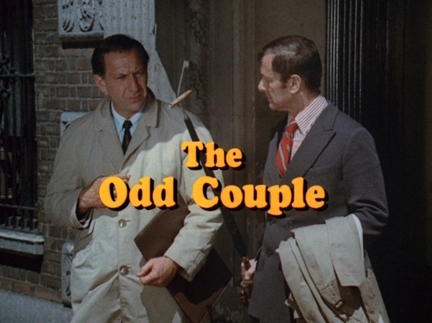
"On November 13, Felix Unger was asked to remove himself from his place of residence. (Unger's unseen wife slams door. She reopens it and angrily hands Felix his saucepan) That request came from his wife. Deep down, he knew she was right, but he also knew that someday, he would return to her. With nowhere else to go, he appeared at the home of his childhood friend, Oscar Madison. Sometime earlier, Madison's wife had thrown him out, requesting that he never return. Can two divorced men share an apartment without driving each other crazy?"
There are a lot of ways to set the scene of a sitcom; but for my money there has never been a better way of doing so than this. Never heard of “The Odd Couple”? Just tune in to the opening credits and you’ll know everything that you need to know about the premise of the show.
The scenario isn’t overly original, there have always been odd couples from Ralph Kramden and Ed Norton to Wally Cleaver and Eddie Haskell but Felix Unger (Tony Randall) and Oscar Madison (Jack Klugman) set the new gold standard. You know the story: Unger was the anal retentive neat freak photographer while Madison was the compulsive slob sports writer. From the above the surface neat vs. messy dynamic to the undercurrent of words vs. pictures, Madison and Unger were as different as can be.
Yet they survived with each other for five solid seasons.
And that’s what the mid to late 60s were all about; surviving with someone that you have nothing in common with for the better good. I know that before the television show there was the play and the movie, but for a generation the television version of the “Odd Couple” is the only version that resonates. And like a number of other shows aired during that time, the comedy was garnered from surviving with someone that was foisted on to you by uncontrollable circumstances.
In that way, the “Odd Couple” is a lot like two other shows I’ve discussed (“The Brady Bunch” and “Gilligan’s Island”). Look at early episodes of the Bradys, those kids hated each other and weren’t happy with their parents for sticking them with another three siblings. And with Gilligan, the original idea behind the show was to put –isms aside in order to thrive. The Howells were clearly classists, but they needed working schlubs like the Skipper and Gilligan to survive. The professor obviously had no use for idiots, yet he need Mary Ann and Ginger in order to eat.
This type of programming was radical for the time. The Bradys and Gilligan were obviously geared for kids, but “The Odd Couple” was aimed at adults. Shows like these were the bridge from family-friendly entertainment like “The Patty Duke Show”, “Gidget” and the like to the Norman Lear “serious” comedies that preceded it. “All in the Family”, “The Jeffersons”, etc. were great programs and probably would’ve been hits, but without shows like “The Odd Couple” it would’ve taken much longer.
For one reason, it showed the viewing audience that it’s ok to tackle something like divorce and that the results of divorce don’t mean that the person has to walking around with a scarlet D on their chest. If Americans can handle that, then an episode about a menopausal Jean Stapleton is only a hop, skip and jump away.
The great thing about “The Odd Couple” wasn’t that the show wasn’t really heavy; in fact I don’t recall a serious episode. Divorce was a bit more serious subject a generation and a half ago (sure the Brady boys’ mother died, but what the heck ever happened to Carol’s husband .. see a fate worse than death itself), but TOC was a light hearted look at it. The show proved that it actually could be sort of fun, as long as Felix Unger wasn’t your roommate. Their relationship, which bore the comedy crux of the show, was more mother-son than friend-friend. And while that was funny, Oscar telling Felix off was the best part. Because although you love mom, when you’re 14 who doesn’t want to tell her to leave you alone?
And make no mistake about it, Oscar was the consummate 14-year-old; he’d have his buddies over for poker every week, he played the horses, he threw crap all over the floor. Felix always cleaned up after him and he did it in the most obnoxious way possible: by lecturing him and making faces. It was great.
With two different actors, the characters of Felix and Oscar could either be completely obnoxious, flat or worse of all—forced. Klugman and Randall (especially Randall) were able to bring some sort of humanity to their archtypes. I know that this is probably heresy to say this about two characters written by Neil Simon (and to be fair, he wrote one play—there was more than over 100 episodes), but one guy was a slob and the other was a neatnik. That’s it. “Your motivation in this scene Jack, is that you don’t like to pick things up and when Tony tells you to, you get mad.”
With anyone else, this show could’ve turned into “Shasta McNasty” after three episodes. Both Klugman and Randall brought something else to the table, which is probably why this show is an all-time classic. If either was off, it wouldn’t matter how good the other was. Playing a walking cliché is tough, but these two brought their A games every single week. If you met or had to live with either one in real life you’d want to kill them, but each week you tuned in to see what they were up to.
The one thing that rang a bit untrue was the opening credits, specifically the end where Oscar and Felix are in Central Park and are dancing around a May Pole with a bunch of little kids. Huh? I don’t get this. Maybe Felix would do this; he had a little girl and maybe she wanted her daddy to dance around a pole with her friends. But Oscar? Mr. Big Time Sports Writer? That was a little weird. Whatever, every show needs an unsolved mystery, even if it’s a little one.
Thursday, December 20, 2007
Play for me Johan Santana
You're the Boston Red Sox. You have won the American League East, the American League pennant and the World Series Championship (the second time in four years). You have a bonafide stud pitcher in Josh Beckett, a potential stud in Daisuke Matsuzaka (both under 28-years-old) and two veterans who probably have something left in the tank in Curt Schilling and Tim Wakefield. You also have a slew of prospects that have done well in their brief call-ups (Jon Lester and Clay Buchholz) plus a bunch of kids on the farm.
You want the best left handed pitcher of the last ten years but you don't need him as much as your chief rival to the south does. If you mortgage the farm and paid upwards of $20 million a year for the next five years, you can pretty much count on going to the playoffs every year for the next half a decade. Do you trade for him?
(The last two paragraphs employ a style that New York Daily News columnist Jimmy Cannon made famous. I didn't intentionally think about writing the first couple of sentences like this, but I guess I was influenced by Cannon's collection of columns bound into the book, “Nobody Asked Me, But ...” which I am currently reading. It's a decent read if you care about sports from the 50s and 60s and you should be able to get it at a used bookstore.)
Let's look at what we do know: despite a mediocre record last year (which doesn't really mean a hell of a lot) and the fact that he gave up way more home runs than he did during any point in his career, with the Red Sox, Johan Santana is a lock to win at least 18 games. You slot him as your number two guy after Beckett and the Sox staff gets longer. Daisuke, who I think is going to have a monster year this year, goes to three, Schilling goes to four and either Wakefield or Buchholz takes the fifth slot. Even with an injury, either Wakefield or Buchholz takes the injured pitcher's spot and the Sox don't miss a beat.
No one can match this rotation. Not the Yankees, who on their best days have three number two guys (Wang, Pettitte and Mussina) and a couple of kids (Kennedy, Hughes and maybe Chamberlain). But the wheels on Pettitte and Mussina could easily come off (as Schilling and Wakefield's could) and Wang proved during last year's post season that he's not an elite star. And how good are the rookies? They are pinning their hopes for two fifths of their rotation on kids. Is that a recipe for success? I don't know.
Now, let's look at what we don't know: is Santana coming down from his super star stratosphere? It would seem that the answer is no, as his peripherals were still solid last year. But what if he spits the bit in Boston? What if the number of players that the Sox give (and there are some reports that this could be a five-for-one swap) almost dry out the system making other in season trades impossible? Is the money that Santana will command worth it? Does the check he cashes eventually trickle down to Beckett, David Ortiz, etc.? Guys that were here, proved themselves in Boston and now want to be paid as much as the new guy?
Obviously, you can't worry about the latter question, but one thing you could concern yourself about is what I heard a few weeks ago on WEEI, a Twins beat writer from one of the Twin Cities (I can't remember who it was) expressed thoughts that Santana could be nicked up a bit, which is why he was hit harder last year than in previous years. He claims that Santana wasn't throwing the slider as much because his elbow was killing him. I have no doubts that the Sox will do their due diligence in checking over the medical records, but the injury concern will always be there for a guy who has thrown the amount of innings that Santana has.
I suppose that one has to look back at the last times that the Sox made a transaction such as this. In 2005 Boston sent Hanley Ramirez, Anibel Sanchez and two minor leaguers to the Florida Marlins for Josh Beckett and Mike Lowell. The rap on Beckett was that he'd eventually cost big money (the Fish were selling him on the cheap because they were afraid of Beckett's up coming arbitration case and the Sox had to take Lowell because he was making too much cash). Ramirez has turned into one of, if not the best, shortstops in the National League. Sanchez threw a no-hitter his rookie year and had solid numbers, but was hurt for most of last year and the other two kids haven't made the bigs yet.
Despite concerns about arms injuries (there was actually a rumor floating around that Beckett's agent told the righthander to go on an extended Texas hunting trip so that he could not be reached if the Sox called to inquire about it) and blister questions, Beckett has been as good as advertised. It took him a season to get settled (which is why I think Matsuzaka is going to be great in 2008) but he won 20 games and destroyed the Angels, Indians and Rockies during the 2007 post season.
In 1997, the Red Sox were desperate for a starter since the Steve Avery experiment failed miserably and Boston GM Dan Duquette sent highly regarded prospects Carl Pavano and Tony Armas Jr. to the Montreal Expos for Pedro Martinez. This is a more apt comparison because people were questioning Pedro's body size (too small), acumen (“wild” headhunter who played before just family and friends at Olympic Stadium) and add in the fact that he wanted a big contract extension. How did it turn out for the Sox? Pedro was absolutely transcendent for most of his Boston career—the pitching numbers he threw up at the end of the century were among the best ever, perhaps all time if you take into account the era and home park he played in as well as the team behind him. He was a main cog in the 2004 championship. Pavano and Armas are both good pitchers, but they aren't Pedro.
What I'm saying is that the Red Sox were able to win two World Series Championships in direct result of trading youth for known greatness. In the long run, were these trades worth it? If you're the Sox, no matter how good Ramirez does or how well Pavano pitched, yes these trades were worth it because the bottom line for this franchise is winning. Were the Boston Red Sox a better team with Pedro Martinez and Josh Beckett? Yes. Would they have been able to win a World Series without either? It's hard to say, but probably not.
The beauty of having a lot young chips is cashing them in for a guy like Martinez or Beckett or Santana. You can't have everyone in your rotation or in your starting lineup. The trick is to keep the great ones and trade the good ones.
Do these history lessons make the trade a slam dunk? Of course not, but judging how this same scenario played out twice in the recent past plus the added caveat of keeping Santana away from the Yankees, one would have to think that the Red Sox should do whatever they can to import another star from Minnesota.
You want the best left handed pitcher of the last ten years but you don't need him as much as your chief rival to the south does. If you mortgage the farm and paid upwards of $20 million a year for the next five years, you can pretty much count on going to the playoffs every year for the next half a decade. Do you trade for him?
(The last two paragraphs employ a style that New York Daily News columnist Jimmy Cannon made famous. I didn't intentionally think about writing the first couple of sentences like this, but I guess I was influenced by Cannon's collection of columns bound into the book, “Nobody Asked Me, But ...” which I am currently reading. It's a decent read if you care about sports from the 50s and 60s and you should be able to get it at a used bookstore.)
Let's look at what we do know: despite a mediocre record last year (which doesn't really mean a hell of a lot) and the fact that he gave up way more home runs than he did during any point in his career, with the Red Sox, Johan Santana is a lock to win at least 18 games. You slot him as your number two guy after Beckett and the Sox staff gets longer. Daisuke, who I think is going to have a monster year this year, goes to three, Schilling goes to four and either Wakefield or Buchholz takes the fifth slot. Even with an injury, either Wakefield or Buchholz takes the injured pitcher's spot and the Sox don't miss a beat.
No one can match this rotation. Not the Yankees, who on their best days have three number two guys (Wang, Pettitte and Mussina) and a couple of kids (Kennedy, Hughes and maybe Chamberlain). But the wheels on Pettitte and Mussina could easily come off (as Schilling and Wakefield's could) and Wang proved during last year's post season that he's not an elite star. And how good are the rookies? They are pinning their hopes for two fifths of their rotation on kids. Is that a recipe for success? I don't know.
Now, let's look at what we don't know: is Santana coming down from his super star stratosphere? It would seem that the answer is no, as his peripherals were still solid last year. But what if he spits the bit in Boston? What if the number of players that the Sox give (and there are some reports that this could be a five-for-one swap) almost dry out the system making other in season trades impossible? Is the money that Santana will command worth it? Does the check he cashes eventually trickle down to Beckett, David Ortiz, etc.? Guys that were here, proved themselves in Boston and now want to be paid as much as the new guy?
Obviously, you can't worry about the latter question, but one thing you could concern yourself about is what I heard a few weeks ago on WEEI, a Twins beat writer from one of the Twin Cities (I can't remember who it was) expressed thoughts that Santana could be nicked up a bit, which is why he was hit harder last year than in previous years. He claims that Santana wasn't throwing the slider as much because his elbow was killing him. I have no doubts that the Sox will do their due diligence in checking over the medical records, but the injury concern will always be there for a guy who has thrown the amount of innings that Santana has.
I suppose that one has to look back at the last times that the Sox made a transaction such as this. In 2005 Boston sent Hanley Ramirez, Anibel Sanchez and two minor leaguers to the Florida Marlins for Josh Beckett and Mike Lowell. The rap on Beckett was that he'd eventually cost big money (the Fish were selling him on the cheap because they were afraid of Beckett's up coming arbitration case and the Sox had to take Lowell because he was making too much cash). Ramirez has turned into one of, if not the best, shortstops in the National League. Sanchez threw a no-hitter his rookie year and had solid numbers, but was hurt for most of last year and the other two kids haven't made the bigs yet.
Despite concerns about arms injuries (there was actually a rumor floating around that Beckett's agent told the righthander to go on an extended Texas hunting trip so that he could not be reached if the Sox called to inquire about it) and blister questions, Beckett has been as good as advertised. It took him a season to get settled (which is why I think Matsuzaka is going to be great in 2008) but he won 20 games and destroyed the Angels, Indians and Rockies during the 2007 post season.
In 1997, the Red Sox were desperate for a starter since the Steve Avery experiment failed miserably and Boston GM Dan Duquette sent highly regarded prospects Carl Pavano and Tony Armas Jr. to the Montreal Expos for Pedro Martinez. This is a more apt comparison because people were questioning Pedro's body size (too small), acumen (“wild” headhunter who played before just family and friends at Olympic Stadium) and add in the fact that he wanted a big contract extension. How did it turn out for the Sox? Pedro was absolutely transcendent for most of his Boston career—the pitching numbers he threw up at the end of the century were among the best ever, perhaps all time if you take into account the era and home park he played in as well as the team behind him. He was a main cog in the 2004 championship. Pavano and Armas are both good pitchers, but they aren't Pedro.
What I'm saying is that the Red Sox were able to win two World Series Championships in direct result of trading youth for known greatness. In the long run, were these trades worth it? If you're the Sox, no matter how good Ramirez does or how well Pavano pitched, yes these trades were worth it because the bottom line for this franchise is winning. Were the Boston Red Sox a better team with Pedro Martinez and Josh Beckett? Yes. Would they have been able to win a World Series without either? It's hard to say, but probably not.
The beauty of having a lot young chips is cashing them in for a guy like Martinez or Beckett or Santana. You can't have everyone in your rotation or in your starting lineup. The trick is to keep the great ones and trade the good ones.
Do these history lessons make the trade a slam dunk? Of course not, but judging how this same scenario played out twice in the recent past plus the added caveat of keeping Santana away from the Yankees, one would have to think that the Red Sox should do whatever they can to import another star from Minnesota.
Tuesday, December 18, 2007
55.Law And Order

Even if you hate cop or lawyer shows, you've seen at least one episode.
There have been about 10 different spin-offs (actually there are four) of this show, but only one holds a small place in my heart and that's the original “Law and Order”. You know the one, Chris Noth or Jesse L. Martin or Benjamin Bratt is paired off with either Jerry Orbach or Dennis Farina as the no-nonsense cops on the Law side. And Sam Waterston is the crusty executive assistant District Attorney with the semi-hot assistant and has Fred Thompson or Steven Hill (Diane Weist absolutely sucked) is his boss on the Order side.
The show has been on since September of 1990 and is shown on a perpetual rerun loop on TNT every single day.
Despite its omnipresence, “Law and Order” is a good show. It's just thoughtful enough to keep you engaged, but it's not so taxing as to make you run to the local law library to review cases. Quite frankly, TNT has this correct: it's the perfect show for the daytime set.
A typical episode begins like this: two people are usually walking around a borough of New York City talking about something that has nothing to do with the case. Sometimes, the initial conversation is more intriguing than the actual show. They come across someone who was murdered or raped and murdered or robbed, raped and murdered. In any event the person is dead. The two people stop their conversation and call the cops.
The normal cops will either set up a tight perimeter or screw something up royally which will get one of the detectives to yell at them. The latter doesn't happen that much and I'm convinced that when it does it's because one of the writers got a parking ticket or some other small infraction with the law and needs to let out some residual anger. It's usually pretty good.
Once the detectives are on the scene, they begin picking up clues like there's no tomorrow, only they can't always piece them together themselves so it's back to the precinct where the Buddah-like Lieutenant (S. Epatha Merkson) puts most of the pieces together and tells the duo to get back out on the street and start interviewing people.
This is where you are supposed to remember that it's a television show and suspend belief for a couple of minutes. In order for the cops to make the correct bust everyone in New York city from the top CEOs to the guys pushing brooms or hot dog carts have the greatest long term memory for the benign that you'd ever want to meet.
Cop 1: “Do you remember that car that you parked next to, eight months ago?”
Witness: “You mean the 2001 silver Honda Civic sedan with a dent in the passenger side door, a scrape of paint missing from the bumper and the antenna bent a bit?”
Cop 2: “Yeah. That's the one. What can you tell us about it?”
Witness: “If I remember right it had just over 85,000 miles which I thought was funny because it looked like it should only have 84,500 miles. Also it seemed to take Ultra Plus gas instead of regular because of the residue on the pavement. Sorry that I can't give you more information than that. I only saw the car for a second.”
Cop 1: “I guess it'll have to do.”
All of this information is then used to bust the perp and bring him or her down town. While in the holding tank the detectives take the old good cop/bad cop routine to the Nth degree; throwing people up against the wall, badgering them for information, everything except beating a confession out of them. This is usually where we meet Waterston's assistant. Nine out of ten times, she's smoking hot and none was hotter than Elisabeth Rohm. Two things about Rohm: apparently she was quite the party girl in real life so seeing her dressed up and serious is probably a stretch for her and two she can't act for shit.
Who cares, because like I said, she's supposed to be hot. The woman before her, Angie Harmon, actually did a decent job though and the two after her aren't too shabby either. She gets all of the information down and sends it off to Watterston who then begins his weekly crusade against something.
Waterston does a terrific job of playing the smug, douche-y lawyer that is convinced beyond a shadow of any doubt that he is 100% right about everything. He comes in lays out the facts, tries to bully the judge, rolls his eyes at the defendant and does everything in his power to make sure the criminal goes to jail for a long time. Then it's judgement time and we go home.
Waterston's character is sort of a prick, in fact most of these characters are self-righteous pricks, but Waterston takes the cake. That's why I love it when he loses and he's awesome to root against. Because when he loses his case, man, that's just awesome. And this is no Perry Mason where Waterston wins everything, he loses his fair share; though recently with him as the DA he hasn't lost a heck of a lot – but the drama is stil there.
Why do I like this show if it's filled with a bunch of assholes and the cases (RIPPED FROM TODAY'S HEADLINES!) are fundamentally simple? Because like “Gillian's Island” and “The Brady Bunch” “Law and Order” follows a pretty simple formula every episode. You can sit back and root for the people you like, scoff at the things that are unbelievable and kvetch about the decision ... especially when the DA has the last witty retort. The show is a terrific way to kill a post-New Year's Eve, post-July 4th or post-Arbor Day hangover.
And sometimes, that's just enough.
Friday, December 07, 2007
56.Gilligan's Island / Brady Bunch

This entry isn't just about the two shows, but also about their creator: Sherwood Schwartz.
While reading a bit about him on his Wikipedia page, I found that it was interesting that Schwartz and Red Skelton hated each other. So much so that while Schwartz was a writer on Skelton's show (which did very well in the ratings), Schwartz had it written in his contract that he never had to see the star of the show face-to-face.
That's a pretty ballsy move.
It's also pretty ballsy to walk into a head of a network and claim that the idea for your new show was an allegory as to show how seven people (the seven continents) can live and work together on one island (the Earth) in peace. After the head buys the idea, Schwartz gave them “Gilligan's Island”.
Here's the thing about these two shows that will always be linked because of a lot of different reasons, but the main reason is that Schwartz created them both. And he did it in a way that was appealing to adults, but also to kids. What GI or BB, each episode was essentially the same: during the first five minutes a trivial problem (though monumental in the eyes of the protagonist) is discovered. During the next ten minutes, the main character either mopes about said problem or attempts to fix it, which results in the problem becoming even larger. During the last 15 minutes, the rest of the cast is brought in on the problem, solves it and they all live happily ever after.
The one monkey wrench in this comparison between the two shows is that “The Brady Bunch” didn't have the deus ex machina that is Gilligan. In order for the castaways to continue their show, Gilligan had to screw up every episode so that they're still stuck on the island.
This repetition of theme and plot made the shows lovable to children and teens alike. It has been proven that babies enjoy and need repetition: from white noise sounds soothing them to sleep to endlessly enjoying the same shows hour after hour. As one grows up, the familiar becomes boring, yet there is still a desire for the familiar—even if the show is “new”. I believe that Schwartz was aware of this and became the backbone of both shows.
And while he never had any more hit shows (“It's About Time” sounded terrible), that's ok because he gave the world two generational touchstones and two theme songs that most people under 60 know better than the national anthem.
Everyone knows that Gilligan is going to blow it in the end or that Mike and Carol Brady are somehow going to save the day; this is precisely why we watch. Even for thirty minutes, all is right in the world.
A few nights ago, I was watching an episode of “The Monkees” (more on them in a subsequent entry) and it occurred to me that there were a few jokes that went over my head when I was a kid—in this particular episode, Mickey was looking for a Marshal Dillon and tried to make a phone call for him. The person on the other line only had a Bob Dylan who couldn't help you, but would write a song about your troubles. That was funny to me now, but I know that I had no idea what a Marshal Dillon was or a Bob Dylan and why anyone would get them confused.
The BB and GI do not have a higher level of comedy (and that's comparing them to “the Monkees”), what you see was what you got. Bobby wasn't an archtype for Che Guerva and Mrs. Howell wasn't the personification of greed and stupidity. There is something refreshing about this one dimensionality and if I catch these shows on television today it takes me to when I was a kid. Back then I enjoyed watching a show because it was my favorite show, not because it made a social statement. And make no mistake, the kids who grew up on this stuff; whether they're black, white, yellow, or green didn't care either, they were able to identify with the characters because their struggles are universal.
Who hasn't been picked on, whacked on the head with a sailor cap, formed a song and dance troupe to compete on television for their parents' anniversary present, stole a rival school's mascot, met your favorite band and got them to perform a private concert just for you (a plot that happened on both shows-Davy Jones on BB and the Beatlesque Mosquitoes on GI). This is the reason why my grandchildren will probably be watching these shows, long after every cast member is long dead.
On a personal note, both programs bring back a ton of memories for me: watching “Gilligan's Island” on Sundays at 11:30 am at my aunt's house after we went to church and had a big breakfast meant that I was about to be shipped outside because football or baseball was about to be put on (I was too young to understand either game). And when 5:00 rolled around, I know that I could watch the Bradys and then eat dinner before it was time to do homework or go to bed. BTW, both shows were on Channel 56 in Boston.
Like I said earlier, every one wants to go back to a simpler time. It's hard-wired in our brains—just like these shows.
Subscribe to:
Posts (Atom)


