Showing posts with label Florida Marlins. Show all posts

Thursday, July 27, 2017

Andre Dawson 1986 Topps


On June 4, 2016, I received the above card from the Baseball Card Bandit. That day, I wrote this on Facebook:

After about a week of hiding, the Baseball Card Bandit reappears with Hall of Famer and subject of an awkward rhyme: Awesome Andre Dawson. (Awesome and Dawson don't rhyme.)
Anyway, what the BBC doesn't know is that I witnessed Dawson's 400th homer in person as a young college lad. The Hawk and I are connected via round numbers.

For a long time, I’m not so sure if it’s true now, the mantra for every comic book writer was something to the effect of, this issue could be someone’s first issue, so you have to explain everything. This is why if you binge read a collection of comics from the 60s, 70s or 80s, it seems incredibly repetitive. Plots are retold, powers and secret identities are re-explained and things don’t seem to really get going until page 5 or 6. They didn’t want to lose readers.

The same mantra should have been uttered by baseball card photographers during those times too. Andre Dawson was an incredibly exciting player who happened to play in baseball Siberia: Montreal. It was dark, dreary and growing up an American League city, I didn’t get to see them play that much because the Expos were rarely on Saturday’s Game of the Week*.

** The wasn’t exactly true. Since there once was a high population of French Canadians that settled in my town, Amesbury’s cable company (this was before there were three or four national cable providers, most towns had their own little mom and pop operation so channels varied widely from town-to-town) had a Montreal station as part of its basic package. The entire channel was in French and not only did they show those terrible old Marvel Comics cartoons from the 1960s dubbed in French, but they also ran Canadiens games and once in a while, Expos games. I would never watch the games though, for some reason seeing the quality of the broadcast combined with the French language, freaked me out. I’d change the channel immediately. Other than that, I do remember in 1987 when the Expos were on NBC’s Saturday Game of the Week. Tim Raines was making his return to the Expos lineup after being held out of games for a month. Back then, if you were a free agent and didn’t sign with your team by mid-January (I think), you weren’t allowed to negotiate with your team until May 1. Which is a fucking insane rule, but with owner collusion (they all decided not to sign free agents) and this rule, Raines wasn’t able to rejoin the Expos until the beginning of May. The day he returned, he destroyed Mets pitching going 4-4 and hitting a grand slam in the top of the tenth inning. He was awesome.

Damn, that was a long detour. Anyway, the point was this baseball card sucks. It’s Dawson, without a hat in a blue practice jersey in front of a blue wall. He looks like a regular dude just sitting around. When I first pulled this card from a pack, I hated it. It’s boring and I never heard of him before, which meant that Andre Dawson must not have been very good. I was incredibly wrong. Dawson didn’t suck, he was actually incredibly good. I just didn’t get it then.

Like Raines, Dawson was part of that 1986-87 free agent class of players who were found by a court to be unlawfully colluded against. Aside from Raines, Red Sox catcher Rich Gedman was in the May 1 situation, and it seemed as if he never bounced back from not having a spring training that year. He was terrible in 1987, worse in 88 and was relegated to a backup for the rest of his career. As a two-time All Star in 1985 and 86, this was an ignominious way to end his career. But unlike Gedman and Raines, Dawson didn’t wait until May 1 to return to the Expos. Unlike fellow free agent, Jack Morris, he didn’t crawl back to his old club and accepted whatever pittance they gave him.

Dawson believed in himself and knew that he was getting screwed, so he did what he felt was best: he went to the Chicago Cubs and basically said, “I need to get off of the turf in Montreal (it completely destroyed his knees) and I want to play for the Cubs. Here is a blank contract, fill it in for what you think I’m worth and then we’ll renegotiate.” The Cubs were over a barrel here, on one hand the team felt that they had to be loyal to the rest of the owners but on the other hand, they were terrible and Dawson was practically giving himself to them. They settled on a $500,000 contract plus bonuses if he played well.

Dawson played out of his mind in 1987.  He led the National League in home runs with 49 and runs batted in with 137 (this is when people gave a shit about RBIs). Writers were so impressed that despite finishing in dead last place, Andre Dawson won the National League’s Most Valuable Player. And he only made $700,000. The following offseason, the Cubs signed him to a much better contract and all was right with the world. Aside from the homers, the one thing that I remember most about Dawson is when he got drilled in the face by Padres pitcher Eric Show. Sports Illustrated captured the picture and put it on that week's cover:
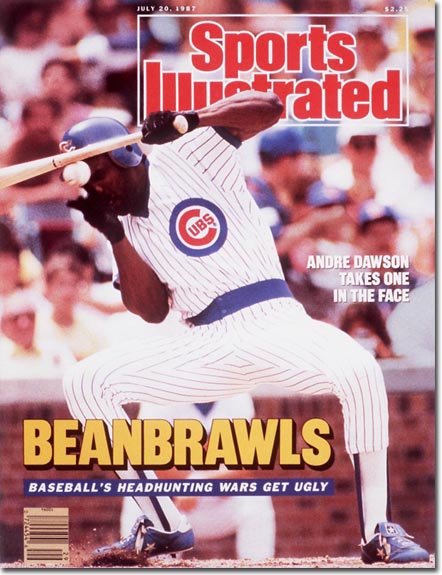


From what I remember Eric Show was a bit of a prick.  He hit Dawson on purpose because the Hawk had hit three homers in five at bats against San Diego. Seems like a good reason to break a guy's cheek bone. But according to Wikipedia, Show was busted using meth a few years later. So, there may have been a reasons for this. 

After his seasons in Chicago, he went to the Red Sox where he played on some truly terrible teams before ending up going home to his native Florida and playing out the string as a Marlin. By the time he played for those two organizations, he was in his late 30s. Age and injuries robbed these fans of seeing the vibrancy of a young Andre Dawson, instead he plodded along occasionally hitting a homer, trying to fight the inevitable one at bat at a time.

Andre Dawson had a fantastic career, he slugged over 400 homers, stole over 300 bases, and had a career OPS+ of 119. He ended up getting the call to the Hall of Fame in 2010 and he’s widely considered one of the all-time great outfielders. But there are always the questions of what if that plague him. What if he didn’t play in Montreal? What if he didn’t play 81 games on the turf of Olympic Stadium?

When he was younger, Andre Dawson was amazing. He could run, he could hit for power and average, he had a plus arm and was a tremendous defender. By playing in Montreal and especially on the “turf” (which seemed to be green-painted concrete) Dawson’s knees were brutalized. He was always hurt, or when he was “healthy” he spent hours icing his knees and legs to make sure that he was ready to go the next day.


Imagine if Dawson played his entire career in a big baseball mecca like New York or Chicago or Los Angeles? More people would know the Hawk and dopey kids in Amesbury, Massachusetts wouldn’t look at his baseball card and immediately assume that he stunk based only on a terrible photo.

Thursday, December 20, 2007

Play for me Johan Santana

You're the Boston Red Sox. You have won the American League East, the American League pennant and the World Series Championship (the second time in four years). You have a bonafide stud pitcher in Josh Beckett, a potential stud in Daisuke Matsuzaka (both under 28-years-old) and two veterans who probably have something left in the tank in Curt Schilling and Tim Wakefield. You also have a slew of prospects that have done well in their brief call-ups (Jon Lester and Clay Buchholz) plus a bunch of kids on the farm.

You want the best left handed pitcher of the last ten years but you don't need him as much as your chief rival to the south does. If you mortgage the farm and paid upwards of $20 million a year for the next five years, you can pretty much count on going to the playoffs every year for the next half a decade. Do you trade for him?

(The last two paragraphs employ a style that New York Daily News columnist Jimmy Cannon made famous. I didn't intentionally think about writing the first couple of sentences like this, but I guess I was influenced by Cannon's collection of columns bound into the book, “Nobody Asked Me, But ...” which I am currently reading. It's a decent read if you care about sports from the 50s and 60s and you should be able to get it at a used bookstore.)

Let's look at what we do know: despite a mediocre record last year (which doesn't really mean a hell of a lot) and the fact that he gave up way more home runs than he did during any point in his career, with the Red Sox, Johan Santana is a lock to win at least 18 games. You slot him as your number two guy after Beckett and the Sox staff gets longer. Daisuke, who I think is going to have a monster year this year, goes to three, Schilling goes to four and either Wakefield or Buchholz takes the fifth slot. Even with an injury, either Wakefield or Buchholz takes the injured pitcher's spot and the Sox don't miss a beat.

No one can match this rotation. Not the Yankees, who on their best days have three number two guys (Wang, Pettitte and Mussina) and a couple of kids (Kennedy, Hughes and maybe Chamberlain). But the wheels on Pettitte and Mussina could easily come off (as Schilling and Wakefield's could) and Wang proved during last year's post season that he's not an elite star. And how good are the rookies? They are pinning their hopes for two fifths of their rotation on kids. Is that a recipe for success? I don't know.

Now, let's look at what we don't know: is Santana coming down from his super star stratosphere? It would seem that the answer is no, as his peripherals were still solid last year. But what if he spits the bit in Boston? What if the number of players that the Sox give (and there are some reports that this could be a five-for-one swap) almost dry out the system making other in season trades impossible? Is the money that Santana will command worth it? Does the check he cashes eventually trickle down to Beckett, David Ortiz, etc.? Guys that were here, proved themselves in Boston and now want to be paid as much as the new guy?

Obviously, you can't worry about the latter question, but one thing you could concern yourself about is what I heard a few weeks ago on WEEI, a Twins beat writer from one of the Twin Cities (I can't remember who it was) expressed thoughts that Santana could be nicked up a bit, which is why he was hit harder last year than in previous years. He claims that Santana wasn't throwing the slider as much because his elbow was killing him. I have no doubts that the Sox will do their due diligence in checking over the medical records, but the injury concern will always be there for a guy who has thrown the amount of innings that Santana has.

I suppose that one has to look back at the last times that the Sox made a transaction such as this. In 2005 Boston sent Hanley Ramirez, Anibel Sanchez and two minor leaguers to the Florida Marlins for Josh Beckett and Mike Lowell. The rap on Beckett was that he'd eventually cost big money (the Fish were selling him on the cheap because they were afraid of Beckett's up coming arbitration case and the Sox had to take Lowell because he was making too much cash). Ramirez has turned into one of, if not the best, shortstops in the National League. Sanchez threw a no-hitter his rookie year and had solid numbers, but was hurt for most of last year and the other two kids haven't made the bigs yet.

Despite concerns about arms injuries (there was actually a rumor floating around that Beckett's agent told the righthander to go on an extended Texas hunting trip so that he could not be reached if the Sox called to inquire about it) and blister questions, Beckett has been as good as advertised. It took him a season to get settled (which is why I think Matsuzaka is going to be great in 2008) but he won 20 games and destroyed the Angels, Indians and Rockies during the 2007 post season.

In 1997, the Red Sox were desperate for a starter since the Steve Avery experiment failed miserably and Boston GM Dan Duquette sent highly regarded prospects Carl Pavano and Tony Armas Jr. to the Montreal Expos for Pedro Martinez. This is a more apt comparison because people were questioning Pedro's body size (too small), acumen (“wild” headhunter who played before just family and friends at Olympic Stadium) and add in the fact that he wanted a big contract extension. How did it turn out for the Sox? Pedro was absolutely transcendent for most of his Boston career—the pitching numbers he threw up at the end of the century were among the best ever, perhaps all time if you take into account the era and home park he played in as well as the team behind him. He was a main cog in the 2004 championship. Pavano and Armas are both good pitchers, but they aren't Pedro.

What I'm saying is that the Red Sox were able to win two World Series Championships in direct result of trading youth for known greatness. In the long run, were these trades worth it? If you're the Sox, no matter how good Ramirez does or how well Pavano pitched, yes these trades were worth it because the bottom line for this franchise is winning. Were the Boston Red Sox a better team with Pedro Martinez and Josh Beckett? Yes. Would they have been able to win a World Series without either? It's hard to say, but probably not.

The beauty of having a lot young chips is cashing them in for a guy like Martinez or Beckett or Santana. You can't have everyone in your rotation or in your starting lineup. The trick is to keep the great ones and trade the good ones.

Do these history lessons make the trade a slam dunk? Of course not, but judging how this same scenario played out twice in the recent past plus the added caveat of keeping Santana away from the Yankees, one would have to think that the Red Sox should do whatever they can to import another star from Minnesota.