Showing posts with label the monkees. Show all posts

Tuesday, February 24, 2015

Good Songs XVI


Over the Hills and Far Away – Led Zeppelin
D’Yer Mak’er – Led Zeppelin
Mistadobalina – Del the Funkee Homosapien
Crumbs on the Table – D-Nice
Call Me D-Nice – D-Nice
Steady Mobbin – Ice Cube
Misty Mountain Hop – Led Zeppelin
Mama Said Knock You Out – LL Cool J
The Jingling Baby – LL Cool J
Jet City Woman – Queensryche
Empire – Queensryche
Silent Lucidity – Queensryche
Bring the Noise – Public Enemy and Anthrax

When I was in high school, one of my best friends, Jamie, drove a  beat upHonda CR-X. At the time, he was the only one of my friends who could drive and we’d pack as many kids into this two-seat death trap as we could. If his girlfriend was along with us that day, the front seat was thus occupied, so it was in the back you went. Since there was no real back seat—it was essentially a hatch back—you considered yourself lucky if you could snag a piece of real estate near the back of the front seats. If you squatted there, there was only a slight chance of getting scoliosis. If you were stuck in the way back, you had a side dish of claustrophobia with your spine curvature.

I created this mix tape in the winter of 1993 but it has a real high school flavor to it. Specifically, the fall of 1990 which was a turning point in my life. My friend had his license, so I kinda had wheels. I was an upper classman, which was fun. Our soccer team finally won a game after literally 75 tries, that was a bonus. The weather seemed unusually warm that year, there seemed to be more parties and I was slightly less invisible to girls. It was a good time to be alive. One of the bigger life changes was being introduced to the music of Led Zeppelin for the first time*.

* Let me amend this statement, I had heard Led Zeppelin before 1990. But I only knew them as the group that sang the song [“Stairway to Heaven”] that closed out every junior high and high school dance. Also at the time, their boxset was constantly being advertised on MTV so I knew snippets of songs, but I was never really into them. 

Jamie’s car had a tape player, which at the time was the height of both wealth and technology and he played  “Over the Hills and Far Away” and “D’yer Mak’er” over and over and over and over again every day on our way to soccer practice. Every single day. I don’t know why, but I never really got sick of either of those songs, though I probably should have. The good thing about the way those two songs were situated on “Houses of the Holy” was that as soon as one song ended, you could flip the tape and hear the other. And Jamie’s stereo was so advanced that you didn’t even have to take the tape out to flip it, you just pressed a button. WHAT A WORLD!

To this day, OtHaFA is my favorite Led Zeppelin song and it’s probably because it reminds me of the fun that I had as a 16-year-old when the sun was always shining, the girls were pretty, the open road was new and my life was ahead of me. And I can guarantee that’s the reason why I lead this mix tape (which I made my freshman year in college) with that particular song.

Today “D’yer Mak’er” probably wouldn’t make my top 50 favorite Zep songs, but like Over the Hills, if I close my eyes and scrunch up into a ball (just for old times sake), I can still recall what it feels like to be 16 again.

There’s no two ways about it, “Mistadobalina” is a tremendous song. Written and rapped by Ice Cube’s cousin*, Del the Funkee Homosapien, it’s one of those tunes that nearly everyone who grew up in this era recalls, but doesn’t know much else about.

* If I was being clever, I would have put “Steady Mobbin’” after this cut. Or if I was being really clever, I would have included Ice Cube’s “Turn Off the Radio” which featured a snippet of Del “calling into” to a radio show to express his displeasure with commercial radio. Del was a member of Ice Cube’s band: Da Lench Mob – which had to change their name from the Lynch Mob because Dokken’s ex-guitarist, George Lynch, was touring with a band with the same name. Del to Dokken, so easy.

The interesting thing about the song’s hook, “Mr. Dobalina, Mr. Bob Dobalina” is from Peter Tork. You may remember him from as the goofy guitarist from the Monkees. One day, near the end of their run of thier TV series, the Monkees and Jack Nicholson (yes, that Jack Nicholson) decided to drop a crap load of acid, go out to the desert and write a movie that ended up being titled “Head”*. That script was completely bonkers (the first scene had the Monkees escaping the crush of their fans by committing suicide and jumping off a bridge) and didn’t do very well at box office. The first scene alienated their pre-teen fans who didn’t have access to the hard drugs needed to properly see the movie. This was the death knell for the Monkees.

* The Monkees were hoping that “Head” would be so successful that they’d be able to film a sequel. The tagline was already written too: “From the group that gave you ‘Head’!” I bet Mickey Dolenz came up with that, he seemed very bawdy. Or maybe Mike Nesmith wrote it, but not Davy Jones. Even though he’s English, that doesn’t seem to be cheeky enough to create this type of pun.

In one scene Peter Tork just aimlessly walks around reciting the Mr. Dobalina line. Apparently, Del thought that this was just weird enough to loop into a single. And it worked. At least it worked for me, looking at Wikipedia, “Mistadobalina” didn’t chart in the US, but it seemed to kick some serious ass in Scandinavia and central Europe—it was a top ten hit.

If things went different, Del the Funkee Homosapien may have been a hit with the Third Reich.

Queensyrche wasn’t your typical metal band. For one thing, they hailed from Seattle before that was a thing. And for another thing, it seems that most of their albums were concept albums. With the iTunes and downloading music, the flow of an album doesn’t matter much any more. Most folks only buy singles and the days of songs being placed on albums so one seamlessly leads to another is a lost art. That spelled the end of the concept album*, which always seemed to me as a way for a band to show their fans and critics (mostly critics) that they were “smart” and “serious”.

* Kanye West is the only artist today that I could envision creating a concept album. And that’s because he’s nuts and he wants people to think that he’s a smart and talented dude with something to say.

The concept album usually ended up in a mangled mess. Themes that were introduced at the beginning of the album were forgotten by the fifth track. Story lines and plot were nebulous at best. And by the last track, the entire band seemed frustrated, bored and wanted to get it over with as soon as possible. It seemed to me that a concept album is like putting together a 10,000 piece jigsaw puzzle only you have a dozen people trying to tell you where each piece goes.

If you want to experience a terrible concept album created by a band who desperately wanted people to take them seriously, listen to KISS’ “Music from the Elder”. It’s awful and stupid. And to make matters worse, the title is confusing because it insinuates that the Elder was also a movie. In a textbook example of putting the cart before the horse, KISS (as only KISS could do) thought that this album was going to be so big, and people were going to be so blown away by their songwriting abilities, they titled the album because they thought that a film was inevitable. It was not. And their hubris almost completely destroyed the band.

Interestingly enough, Queensryche seemed to have the discipline to decently do a concept album. “Operation: Mindcrime” and “Empire” both were pretty good. And they were able to pull off the trick of releasing good sounding singles that were also integral to the story of the album. The funny thing is that though they were able to do concept albums well, they never reached the popularity or career longevity of KISS.

I guess that begs the question: would you rather be smart and good at your job but severely lacking in the popularity (and money) department or would you rather be dumb and shitty but popular and rich? I guess only Geoff Tate and the rest of Queensyrche knows for sure*.

* I just looked something up on Wikipedia and former Queensryche guitarist Mike Stone was also a member of a band called Criss. That band was helmed by former KISS drummer Peter Criss. 19 Thoughts is all about coming full circle, kids!

I was never a big Queensryche guy. I understood that they were a notch above the musical evolutionary scale of say Motely Crue or Poison, but their fans always seemed a bit too intense for me. They had long hair, were in a band, also were obsessed with the band Dream Theater and spent a lot of time arguing about what each song meant and how it fit into that particular album and Queensryche’s oeuvre as a whole. And yes, they would use the word “oeuvre”. A lot.

They may not have been book smart, but man, they knew their music inside and out. In short, they were a bit intimidating.

Speaking of popularity and the crossroads bands sometime find themselves at, when Public Enemy and Anthrax released “Bring the Noise”, I thought that PE was going to explode. MTV played the hell out of that video in the late summer of 1991. This song along with the PE shirt that Edward Furlong (young John Connor) wore through out the entirety of “Terminator 2” signaled to me that Public Enemy was going to be one of the biggest bands of the 90s.

For a variety of reasons, it didn’t happen. Public Enemy was certainly extremely popular and has legions of fans, but I thought that they’d be everywhere, which would instantly validate my fandom of the band*. What I didn’t understand was that Public Enemy was never going to be that type of band. And I don’t think that they ever wanted to be, mainly because you’d have to change your stance on a lot of politics (soften it up) to appeal to the masses.

* For some reason, I was obsessed with my choices being validated and proven “right”. Whether it was music, TV, movies or sports whatever I was in to, I wanted it to be the most popular, most coolest thing around. It didn’t occur to me, until much later, that when niche things start getting really popular, they lose a lot of their shine. Once I learned that being happy with something and not caring about what anyone else thinks is the right way to consume media. Haters gonna hate.

Chuck D and Public Enemy weren’t going to do that, so they just kept soldiering on. Still famous, but also under the radar.

This song also made me think that the rap/rock crossover was going to start a new music revolution where it didn’t matter if you played hip hop or rock, music was music. That didn’t really happen either, it did for awhile I guess, but then Limp Bizkit showed up and brought with them a bunch of really, really crappy groups. That sent rock into a deep tailspin and splintering music into a million different genres.


Be careful what you wish for, I guess.

Wednesday, February 20, 2013

Nostalgia for Nothing

The above title isn’t indicative of what this post is going to be about, but it was alliterative and reflected the spirit better than Nostalgia for Nihilism, so I went with it.

My wife and I have two daughters under the age of six. The oldest one is five and the youngest one has just turned two. Each kid has their own personalities that will undoubtedly change between now and their teenage years. As their parents, Aly and I worry about them constantly. While a lot of our concerns overlap, there are things that she freaks out about more than I do and vice-versa.

One of the things that I think about is what I’m giving to my children and how it ultimately affects them. If you’ve read this Blog over the years, you’ll find that the one thing I’m a tad obsessed about is nostalgia. I write about it all the time. Most of my jokes and references are rooted in a 70s/80s/90s/early 00s pop culture quagmire that is becoming less relevant to anyone outside of my generation as the days go by. So it should come as no shock that when I talk to my kids and share things with them, most of the time, I’m sharing things that I liked when I was a boy.

This leads me to over-thinking about whether I am making my kids nostalgic for a past that they never had.

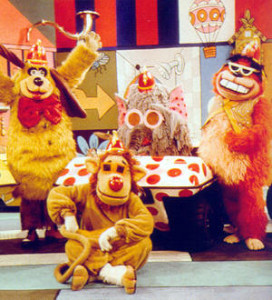
To wit: for the longest time, my kids’ favorite song was “The Banana Splits Theme Song”. Do you know how many times they’ve seen that show? The youngest one has never watched an episode and the oldest saw half an episode once but asked me to shut it off because “The Arabian Knights” cartoon was too scary. Yet, they love the Banana Splits song and ultimately the idea of the Banana Splits, especially when I tell them how much I used to love the show as a kid and how I would always wake up from my nap at 1:30 pm so I could flip on TV-56 and watch the Splits* do something funny.

* The interesting thing is that the Banana Splits was a take-off on the Monkees which was a take-off on the Beatles. So while what I was watching was a third-generation version of the original, my daughters are grooving to a fourth (or fifth) generation of the Fab Four. Let’s all do the Banana Split, indeed.

When we read comics, I’m usually reading the old Marvel stuff that I used to love and the girls are reading updated kiddie versions of that same old stuff.

When they hunker down to watch TV they both beg to watch Boomerang, which is Cartoon Network Classic. Or they ask to tune into The Hub, which has old stuff from the 80s like JEM, Transformers, GI Joe* and updated stuff from the same era. Even Nickelodeon (to an extent) and Disney keep churning entertainment built on characters from their past. My youngest is obsessed with Tinkerbell, so much that we have to watch one of the movies (usually the 30-minute short) every night before she goes to bed. And while these movies are new, the character of Tinkerbell has to be about 60 years old now.

* By the way all of the shows we liked as kids suck now. There is literally no rhyme, reason or logic to any of the plots—which are so warmed over and hackneyed they’d make Chuck Lorre blush in their unoriginality.

The toys that they own are things both my wife and I played with when younger: Legos, Cabbage Patch Dolls, Barbie (I’ll let you guess which of the proceeding toys I played with the most – answer below!). Even some of the toys that weren’t around when I was a kid have some sort of mooring to the past. For example, the oldest was on an American Girl Dolls kick a few months ago. These are extremely expensive dolls and accessories that have back stories set in the past*. Some dolls are set during the Revolutionary War, some dolls are from the Civil War, others are part of the Great Depression (so fun!). My oldest loves Julie, who is based in the 1970s.

* There are some dolls that have adventures in the present, but the ones that American Girl seems to focus on and market are the ones from past era.

Many of the toys that are on the shelves today seem to be a derivative of something that sold well in the past. And I know why this is true: nostalgia is big business. If you can tap into a parent’s past and polish it up to look like something current it’s going to serve two masters. One, the parent won’t mind purchasing it (“It’s just like what I used to play with!”) and two, it’s new and shiny and current so the child will crave it. The first part of that last sentence is most important because the parent controls the purse strings and when they’re spending cash, they want to make sure that it will be something that’s “worth it”.

To put it another way, I remember how much fun I used to have playing with Legos when I was a kid. Therefore I have no problem spending a small fortune on buying them Legos. Subconsciously I’m thinking, “I had a great time with these toys when I was a kid, so why shouldn’t my child have the same memories?” The feeling of shared memories—even brokered over decades—is strong and manufacturers understand and exploit this.

And the most important reason for this is: it’s just plain easier (and cheaper) to repackage things that sold well a generation ago than to come up with a brand new idea.

It will be interesting to see what this does to children of this generation. If adults are stalled in an arrested development that trickles down to their, what will the effects be? I am not suggesting that Gen Xers or Baby Boomers* grew up in an idyllic era of completely new products and ceaseless imagination. There are plenty of toys that I played with, television shows that I watch, songs that I listened to that were from my parents’ childhoods. Same with them and my grandparents. However, it seems that this recycling is on a grander scale.

* Who names generations anyway? Is it some sort of pop culture collective that come up with these increasingly ridiculous monikers? Because these names are down-right embarrassing. I wouldn’t even use them if they weren’t so darn handy.

Perhaps because there are more things vying for the attention of children, toy manufacturers need a proven commodity to make money. There is a multitude of television channels that need hundreds of hours of programming. Imagination and originality are a finite (and expensive) resource, no matter what Willie Wonka tells you. On average, our kids may be getting more original programming but it’s getting lost in the non-stop caterwauling of children’s television. Just by simple necessity, the old stuff outweighs the new stuff by at least three-to-one.

The final piece to this puzzle is accessibility. When my dad or mom would tell me about things they enjoyed from when they were children, it was a story and once it was done, it was lost in the ether. Unless one of my grandmothers kept one of their toys, I wasn’t going to be able to see it, hold it, experience it. They may as well have been telling me about the first steam engine. Same thing goes for their TV shows. Every once in awhile I’d tune in to the original “Mickey Mouse Club” or see an old cartoon, but very rarely would my parents and I talk about the show and I’d see it immediately.

There was no real tangible connection.

In this era, if we can remember it, we can see it. A few days ago I was humming a seemingly long-forgotten song from an Charlie Brown show that somehow wormed its way to the front of my brain. My daughter wanted to know what I was humming, I told her, she laughed and within seconds we were on YouTube checking it out. Now her memory is of watching this show after my brain regurgitated a once lost memory. In effect, I had to experience this first before she could.

I don’t think that’s the way it has always been this way.

At the beginning of this piece I wrote about how my kids have never seen a full episode of the Banana Splits, but love the song and idea of the show; especially when I talk about it from my perspective. While it’s true, they’ve barely seen the show, they’ve seen the opening theme/introduction to the show probably well over one thousand times. In fact, my oldest runs up the playground slide backwards and playfully falls on her side because she’s seen Drooper do it so many times.

Because of the instant accessibility of our childhood combined with the repurposing of old toys and TV shows, I worry that our kids are going to have false memories. I can picture my daughter telling her friends about how she used to run up the slide backwards and fall because she remembers a anamorphic lion from a program that she used to watch “all the time” doing the same thing. But the fact is she didn’t watch the show, she watched only a part of the show though she may not intrinsically know, or really understand, this fact.

Perhaps we as a culture will one day decide that “true” memories aren’t valid or even necessary anymore. These new societal mores may eventually pave the way for a scenario that echos the beginning of the movie/short story “Total Recall”. Specifically the scene when the main character Douglas Quaid (played by Arnold Schwarzenegger because fuck Colin Farrell in the remake – and yes, I get the irony in relation to what I’m writing about) enters the travel agency to has his brain implanted with memories of a vacation he never took may not be science fiction.

Then we’ll be that much closer to finding a woman with three boobs.

Thursday, March 20, 2008

37. The Monkees


Though it was only on for two seasons (which is really surprising to me as I thought it ran longer than that), “The Monkees” was an important show that had long-lasting ramifications on the television industry. Though that's not the reason why I like the show. Truthfully, I have no idea whether just preteens made up the audience or whether hippies thought it was a lame attempt of Hollywood scrubbing up the late 60s love movement for middle America (though both are probably true), but it is an enjoyable show. The show's plots aren't anything special and in most cases don't make a lot of sense, but you don't watch “The Monkees” for the plot. You watch for two reasons: the music and for the band members.

This entry isn't going to be a debate about the validity of the Monkees' music. Like many pop acts, there is some good stuff and some bad stuff, but the Monkees basically were a carbon copy of the Beatles from their Help! days. They were poppy, had a slight edge to some of their songs, but mostly sang about love and trivial subjects. The group had a lot of aid from professional song writers like Neil Diamond and Carole King, which made those subjects take on a more interesting tone. And the group also took advantage of session musicians until their musical chops were built up. However, a strict judgement on whether the music is “good”or “bad” misses the point of the show.

The point was to have a weekly show that would take suburbia into the wacky (albeit safe) lifestyle of the day's youth. Aside from a few things that never show (drug use, conjugal visits with scores of groupies, legendary battles with their producer Don Kirshner) I don't think that Mickey Dolenz, Mike Nesmith, Peter Tork or Davy Jones were playing characters that were too far off from themselves. The show was also among the first to use a lot of the slang that 60s youth was using. Most important about this is that the language didn't sound stilted or scripted. It also portrayed the youth of that time as caring and centered—having a good head on their shoulders—despite media reports that the baby boomer generation wasn't living up to their parents' generation and were shiftless and lazy.

While this probably went over the heads of older viewers—if it reached them at all—this is probably the main reason why the show resonated with a lot of young people. Here was a show with young people getting by without a care in the world. The only time that a problem did enter their world was brought in by a person outside of their “universe”, normally someone from their previous generation who didn't, or couldn't, understand the world today. The Monkees normally took care of this problem through nonviolent, and often slapstick, means which resulted not in vanquishing the foes, but turning enemies into friends.

Was that the way of the world? No. But it was a television show that never made any bones that it was more cartoon than documentary.

Despite the cartoon nature of the show, there were some serious aftershocks of “The Monkees”. For one thing, it was one of the first instances to prove the power of music on television. Yes, Ricky Nelson became a heart throb to millions of girls in the early 60s after singing a few songs on his parents' show “The Adventures of Ozzie and Harriet”, but the Monkees were a juggernaut that provided their audiences with new songs week after week after week. And you pair those new songs with movie shorts, interspliced with the television show (often these shorts had zero to do with the program's main plot) and kids seemed to love the song much more.

Thus, the music video was born.

And it wasn't just the music industry that was revolutionized. While “Dobbie Gillis” was the first to break down the so-called “fourth wall”—where an actor talks to the audience—the Monkees also did this and further shattered the illusion of television when the cast members would stop the action to converse with camera men and stage hands while the show was being filmed. This nonlinear form of television was also extended to drawn out dream and fantasy sequences and inserts and jump cuts. All of these innovations have had a profound impact on the television and movies that we watch even today.

No matter what the ramifications that the shows had on later television programs or any social impact that it may or may not have had, the bottom line is that “The Monkees” were a fun program. Any time you tuned in, you knew what you were going to get and that's ok. Because a show does not deviate from it's norm, that doesn't make it a bad show. This is precisely what killed the band though.

Fed up with their bubble gum image, once the show was cancelled in 1968, they along with a young actor/writer named Jack Nicholson came up with a movie called “Head”. Written over a weekend where a lot of acid was ingested, the movie's first scene opened with the band jumping off a bridge and killing themselves. It only got weirder from there. The group's core base of fans (mostly young teens) were confused as to the radical 180 degree turn the band took and rejected them.

And the group of fans that the band did want—the more serious, older hipster crowd—thought that they were a fake band that was put together by Hollywood suits. They literally were a band without an audience and with their show running (and doing well) in constant reruns, the Monkees were constantly reminded of the past and how things once were. The Monkees would break up, try solo endeavors and reunite over the next 30 years, but they always remained in America's pop culture consciousness.

For me, and other members of my generation, the Monkees were a summer TV show first and foremost, I had no idea that the group had any chart success at all. Every June, Channel 56 knew that kids were being let out for summer break and would schedule the show to run in the afternoon. And I'd be in front of the tube watching as jokes about 60s culture went flying over my head. I watched an episode recently and the group was in ghost town being held hostage by gangsters. Mickey used an old phone and was hoping to get Marshall Dillon (the erstwhile sheriff from “Gunsmoke” to help out). He got a grizzly prospector who said that there is a Dylan in town (Bob Dylan) who could write a protest song for you, but couldn't help much more than that. Interesting (and funny) juxtaposition of Bob Dylan and Marshall Dillon, but one that an eight-year-old would never get.

That's what I get when I tune into “The Monkees” now, I get to remember what it was like when I was younger and had zero responsibilities and I'm able to appreciate some witty writing. That's not a bad two-for-one combination.

Friday, December 07, 2007

56.Gilligan's Island / Brady Bunch


This entry isn't just about the two shows, but also about their creator: Sherwood Schwartz.

While reading a bit about him on his Wikipedia page, I found that it was interesting that Schwartz and Red Skelton hated each other. So much so that while Schwartz was a writer on Skelton's show (which did very well in the ratings), Schwartz had it written in his contract that he never had to see the star of the show face-to-face.

That's a pretty ballsy move.

It's also pretty ballsy to walk into a head of a network and claim that the idea for your new show was an allegory as to show how seven people (the seven continents) can live and work together on one island (the Earth) in peace. After the head buys the idea, Schwartz gave them “Gilligan's Island”.

Here's the thing about these two shows that will always be linked because of a lot of different reasons, but the main reason is that Schwartz created them both. And he did it in a way that was appealing to adults, but also to kids. What GI or BB, each episode was essentially the same: during the first five minutes a trivial problem (though monumental in the eyes of the protagonist) is discovered. During the next ten minutes, the main character either mopes about said problem or attempts to fix it, which results in the problem becoming even larger. During the last 15 minutes, the rest of the cast is brought in on the problem, solves it and they all live happily ever after.

The one monkey wrench in this comparison between the two shows is that “The Brady Bunch” didn't have the deus ex machina that is Gilligan. In order for the castaways to continue their show, Gilligan had to screw up every episode so that they're still stuck on the island.

This repetition of theme and plot made the shows lovable to children and teens alike. It has been proven that babies enjoy and need repetition: from white noise sounds soothing them to sleep to endlessly enjoying the same shows hour after hour. As one grows up, the familiar becomes boring, yet there is still a desire for the familiar—even if the show is “new”. I believe that Schwartz was aware of this and became the backbone of both shows.

And while he never had any more hit shows (“It's About Time” sounded terrible), that's ok because he gave the world two generational touchstones and two theme songs that most people under 60 know better than the national anthem.

Everyone knows that Gilligan is going to blow it in the end or that Mike and Carol Brady are somehow going to save the day; this is precisely why we watch. Even for thirty minutes, all is right in the world.

A few nights ago, I was watching an episode of “The Monkees” (more on them in a subsequent entry) and it occurred to me that there were a few jokes that went over my head when I was a kid—in this particular episode, Mickey was looking for a Marshal Dillon and tried to make a phone call for him. The person on the other line only had a Bob Dylan who couldn't help you, but would write a song about your troubles. That was funny to me now, but I know that I had no idea what a Marshal Dillon was or a Bob Dylan and why anyone would get them confused.

The BB and GI do not have a higher level of comedy (and that's comparing them to “the Monkees”), what you see was what you got. Bobby wasn't an archtype for Che Guerva and Mrs. Howell wasn't the personification of greed and stupidity. There is something refreshing about this one dimensionality and if I catch these shows on television today it takes me to when I was a kid. Back then I enjoyed watching a show because it was my favorite show, not because it made a social statement. And make no mistake, the kids who grew up on this stuff; whether they're black, white, yellow, or green didn't care either, they were able to identify with the characters because their struggles are universal.

Who hasn't been picked on, whacked on the head with a sailor cap, formed a song and dance troupe to compete on television for their parents' anniversary present, stole a rival school's mascot, met your favorite band and got them to perform a private concert just for you (a plot that happened on both shows-Davy Jones on BB and the Beatlesque Mosquitoes on GI). This is the reason why my grandchildren will probably be watching these shows, long after every cast member is long dead.

On a personal note, both programs bring back a ton of memories for me: watching “Gilligan's Island” on Sundays at 11:30 am at my aunt's house after we went to church and had a big breakfast meant that I was about to be shipped outside because football or baseball was about to be put on (I was too young to understand either game). And when 5:00 rolled around, I know that I could watch the Bradys and then eat dinner before it was time to do homework or go to bed. BTW, both shows were on Channel 56 in Boston.

Like I said earlier, every one wants to go back to a simpler time. It's hard-wired in our brains—just like these shows.