Showing posts with label Lee Smith. Show all posts

Monday, November 03, 2025

My Favorite Red Sox Players 31-26


31. Rickey Henderson
This year I'm doing a countdown of my all-time Top 31 Favorite Boston Red Sox players. Note: these are players that I consciously remember seeing play. So Ted Williams, Yaz, Luis Tiant, Fred Lynn, Moe Berg aren't on the list.

Kicking off the list is one of my top five favorite baseball players of all time. He didn't contribute a lot to the Boston club, though he did have his moments. He was old, but still funny as hell. And it was awesome just to watch him get into his crouch and hit.

I'm talking about the one and only Rickey Henderson. When I was a kid, my brother and I worshipped Rickey. We thought that he was the absolute pinnacle of speed and power and cool. Having him on the Red Sox, even if he was a shadow of himself, was a dream come true.

Rickey is Rickey is Rickey now matter how old he was.


30. Dennis "Oil Can" Boyd
Number 30 on the list of my All-Time Favorite Red Sox players is one Mr. Dennis "Oil Can" Boyd. He was temperamental, a little crazy but loved to pitched. He kept going well into his 40s in different pro and semi pro leagues.

If he made the All-Star team in 1986 (and he probably should have), could things have been different for him and the Sox that year? Maybe he wouldn't have gotten blasted the night before Game 7 of the World Series and be counted on to pitch instead of Al Nipper? Who knows? But that was the Can.

I have a feeling that if Boyd pitched a generation later, he'd have been something. There was a lot of bullshit that he had to deal with that had he had a more sympathetic front office or supporting system, it may have benefited him greatly. Even in this burst of a career, he shown brightly.


29. Mike Boddicker
Boddicker may no longer be a widely remembered name in Boston but when the Sox got him in 1988 (for minor leaguers Curt Schilling and Brady Anderson) he was the perfect number three starter (behind Clemens and Hurst).

A control pitcher with a dominating hook, Boddicker was quietly component and was the pitcher that you depended on most in the ensuing years. Yes, even more than the combustible Roger Clemens.

I liked watching him pitch because he was thinking out there, seemingly a step or two ahead of the hitter. You could do worse with a staff that had Mike Boddicker at the two or three position. Had the Sox kept Bruce Hurst after the 1988 season and they had a starting staff of Clemens, Hurst and Boddicker; they could have done some stuff during that time. Maybe, just maybe, they could've have slid past the A's one year--provided one of these guys got hot.


28. John Marzano
Number 28 in the list of my favorite Red Sox is a guy who’s every one’s Olympic hero. Yes, I’m talking about John Marzano.

Part of the stacked 1984 Olympic team Marzano was drafted by the Sox, given very opportunity to win a job and ended up as the team’s backup catcher. He had his moments and he was a part of the wave of exciting rookies that made their debuts in 1987.
Marzano was the classic, if he was on a great team, then he must be great too type of players. That 1984 Olympic team was legendary by the time Marzano hit the scene: Barry Larkin, Will Clark, Mark McGwire, BJ Surhoff; if Marzano was on that team, he had to be great, right? It doesn't always work out that way. Marzano made the majors, which is awesome. He hung around for a bunch of years, also awesome. But he was never really a star.

However, for a little while he held the hope of being the next star.

But what I like most about John Marzano is his takes on the Red Sox message board Sons of Sam Horn. Whoever that person is, they know their stuff. This entry is a salute to that guy (or gal)!


27. Lee Smith

The day the Sox got Lee Smith, I was truly shocked. It may have been the first time the Sox have shocked me in a good way. And it was for Calvin Schiraldi and Al Nipper. Smith’s first game was tough, he blew an Opening Day save against the Tigers, but he was nails for 1988 and 89.

For some reason GM Lou Gorman signed Jeff Reardon in the 89 offseason and so the Sox had two really great closers on the roster at once. The idea was that Gorman was going to trade Smith despite the promise that "both men will share the closing duties", which even back then seemed like the biggest pile of shit ever. In May Smith was sent to St. Louis for Tom Brunansky, who was fine. And that was it for Lee Arthur in Boston.

All in all, I'd rather have saved the Reardon money, kept Smith and not had Brunansky. Gorman was so weird because by the early-90s, it seemed that he was trying to recapture the glory of the 1987 Minnesota Twins with Reardon, Brunansky and Frank Viola all on the roster. I mean they did win the World Series, but they really shouldn't have; both the Tigers (and Blue Jays) and Cards were so much better than them.

I never understood why Gorman spent the money on Reardon. No one has ever explained it either other than Gorman like Reardon better. But that was Lou Gorman in a nutshell, sometimes he could make a brilliant move (like getting Lee Smith for nothing) and then he could turn around and make a dumb move (like signing Reardon when Smith is already on your roster).


26. Wade Boggs

He’s number 26 on your scorecard and number 26 on this list. Of course I’m talking about the guy who literally can drink the most beers—and not some fabrication your dumbest friend in college made up—Wade Boggs.

When Boggs was on the Sox I never liked him very much. I mean, I liked that he was on the team and got a ton of hits and peppered the wall with a billion doubles but I focused more on what he didn’t do. Namely hit home runs.

Getting on base, working his ass off to be play a good third base, walking. That was stuff for wimps. I wanted one-dimensional homerun hitters on my team. I wanted guys who were fast and athletic. And when he did decide to hit home runs, like he did in 1987 (a years everyone did, incidentally) I used that against him.

Boggs was a strange dude that I never appreciated but I should have. All he did was hit. And hit. And hit. That’s not easy at all. In fact it’s probably more difficult than swinging from your heals every at bat.

A lot of people hold it against him that he went to the Yankees but the Sox released him and New York offered him a job, what else was he suppose to do? Not only that but Boston let him languish in the minors for years despite him being ready for prime time.

I’d have probably told the Sox to pound sand too.

Friday, November 08, 2019

Tom Brunansky 1990 Score

In mid-September 2019 I received this card from the Baseball Card Bandit (BCB):


The first year I really started to obsessively follow baseball was 1986. Watching the Red Sox that year was total exhilaration, until it came to the second-to-last and last games of the season. Then it sucked. Hard. But you already know that story and I’m not going to talk about it because it doesn’t matter in the greater context of this blog entry. 

The thing that no one really warns you about, is that once the season ends; baseball pretty much disappears. When you follow the game every single day for eight months, this is god damn jarring. No longer is the sports page abuzz with team notebooks and game summaries and box scores. Maybe once or twice a week, you’ll get a few inches on what the Sox are thinking about and every Sunday Peter Gammons or Larry Whiteside filled a broadsheet of rumors, but that was it. You were supposed to go cold turkey on baseball. 

But eventually, things heat up a little bit at the beginning of December where all 26 teams (there was only 26 teams back then) came together in some hotel in a warm part of the country and they’d sit around and make deals and sign free agents and new uniforms would be announced. It was like a baseball Hanukah, because it happened over a week, and every day there were gifts as players were changing teams at a rapid pace. Anyway, during the Winter Meetings of 1986, it seemed that just about every team—except for the two teams* in the World Series—made moves. When they showed up to Spring Training in 1987, mostly everything was the same. 

* The Mets made one memorable move, sending a bunch of players (including Kevin Mitchell) to San Diego for Kevin McReynolds. The only thing that the Sox did was alienate Roger Clemens and colluded against catcher Rich Gedman.  

Using this first offseason as my template, I thought that was how champions and runners-up behaved. Don’t fix what isn’t broken. Of course, the Sox and Mets stumbled a bit in 1987 and didn’t make the postseason. So, I should have learned a lesson. 

What does this lengthy preamble have to do with Tom Brunansky? In 1987, Tom Brunansky was a key member of the World Champion Minnesota Twins. He was their rightfielder and was a key bat in the middle of their lineup. About a month into the 1988 season, the Twins sent him to the Cardinals (the team that they just beat the previous October!) for second baseman Tommy Herr. 

I had questions.

Tommy Herr? Why would the Twins make that deal? They had veteran Steve Lombardozzi, a Massachusetts native to boot, manning second base. They won a World Series with that guy, why would they trade for someone to replace him? Especially from a team whose ass they just kicked? And why would they trade a power bat like Brunansky? Who was going to play rightfield and hit 30+ home runs?  

Here’s the thing that I didn’t really get about baseball back then. The clichés are usually true. Especially the two that fit here: to get something good, you have to give up something good and the proverbial trade that helps both teams. 

In the late 80s, the Cards needed power, badly. All they had was Jack Clark hitting dingers and he took his bat to San Diego (along with former Sox lefty Bruce Hurst). The only power threat they had was former Brave Bob Horner, who was returning from a year in Japan. He was no Cecil Fielder and was pretty much running on fumes by this point in his career. With this trade, the Cards got their middle-of-the-order bat in Brunansky. However, even with Brunansky and his 22 homers in 1988, St. Louis managed 71 homeruns all year. I know that they were still in the midst of Whitey Ball, but that’s less homers than Barry Bonds hit by himself in 2001. Consequently, they finished behind the Mets for the National League East title. 

The Twins were looking for someone that could play second base and hit. Despite being born in Malden, Massachusetts, and starting for a championship team (I was obsessed with this for some reason, like I thought because you started and your team won, that automatically meant you were really good) Lombardozzi was a terrible batter. That World Series cornerstone slashed 238/298/352 in 1987, and those were some of his better numbers. They needed a second baseman who could hit and run a little. They had power with first baseman Kent Hrbek, third baseman Gary Gaetti and centerfielder Kirby Puckett. Therefore, Brunansky was the odd man out. So Herr, who was a few years away from finishing in the top five in the 1985 NL MVP race behind teammate Willie McGee, was slotted in at second and Lombardozzi roamed around the infield, not hitting but being a pretty good gloveman (I assume, I don’t have his defensive numbers in front of me). 

Even with Herr, the Twins finished second to the budding dynasty that was beginning in Oakland. Herr stuck around for less than a year and joined up with the Phillies in 1989 before ending his career with the Mets and Giants two years later. 

Brunansky was a Cardinal for about two seasons before he was sent to the Red Sox in exchange for Hall of Fame (that’s still really weird to write) reliever Lee Smith in 1990. Brunansky reunited with former Twin Jeff Reardon and made a spectacular catch in the corner of rightfield in Fenway Park off the bat of Chicago White Sox shortstop Ozzie Guillen that clinched the 1990 AL East flag for Boston. It was probably the highlight of his Red Sox run. 

I’ve talked about this before, but I never understood why Boston GM Lou Gorman signed Reardon in the first place when he had Smith in the backend of his bullpen. And I was really angry when they shipped Smith to St. Louis for a fading power hitter in Brunansky. I talked about it here and here

For some really awful Red Sox teams in 1991 and 1992, Brunansky was the only one who supplied any sort of power with 16 and 15 round-trippers. That second number led the entire team. Fifteen home runs was the best that a Red Sox player could do in 1992, despite playing half of their games in Fenway Park. It was abysmal. Brunansky played with the Brewers in 1993 before coming back with to the Sox in 1994, where he hit his last 10 dingers. 

For a guy from West Covina, California (I wonder if he knows Josh Chan? Shout out to “Crazy Ex Girlfriend”) with mediocre power and a mustache, Tom Brunansky not only brought a lot of questions, but he also ended up teaching me a lot about baseball – mostly that nothing should stay the same. You have to keep moving, getting better and improving. And if that means trading your fourth-best power hitter. 


Tuesday, February 19, 2019

Dennis Lamp 1990 Fleer

On December 14, 2018 I received this card from the Baseball Card Bandit (BCB):


On Facebook, I wrote: A few days ago I received this illuminating card from the BCB. If you aren’t a fan of the 1985 Toronto Blue Jays, you might not remember Dennis Lamp. However, that was the year he put it all together and allowed him to have a career that spanned three decades. 

2019 Notes: "Illuminating", I've never met a pun I didn't love. I'm shocked that I didn't use the Brick Tamland quote, "I LOVE LAMP!" in this entry. I don't care what anyone says, "Anchorman" is still really funny.

I usually hate doing this because what does any profession really look like, but Dennis Lamp doesn't look like a ballplayer. He looks like a fireman or a driving instructor. I bet that, even now, he could kick my ass in anything athletic.  

In 1977 he made his debut with Cubs as a starter and was traded across town to the White Sox. Funny thing is that the Cubs and White Sox worry less about intercity trades than other franchises — hell, the Sox sent the Cubbies Sammy Sosa for a broken down former member of the 85 Blue Jays, George Bell. 

Tangent: I bet it would be cool to be traded from one side of the city to another. So much less work. You can keep your own house!

Anyway, Lamp went to the White Sox, started a bit and moved into the bullpen. After the 84 season he moved on from the Sox only this time it wasn’t across a city but from one country to another. 

This is when he had his career year going 11-0 with three saves and a 3.32 ERA. Yes, wins are a dumb stat especially for someone coming out of the bullpen, but 11 straight wins is pretty impressive. And it got him some MVP votes, ultimately finishing 20 spots behind winner Don Mattingly. 

The 1985 was the high water mark for Lamp and he never approached those numbers again. Already a journeyman, Lamp bounced around to four different teams before calling it quits in 1992. 

I’m not sure how Lamp had such a magical season in 85. He didn’t have overpowering stuff or a funky delivery. I don’t remember a devastating curve or a wackadoo slider. He was just the best Dennis Lamp he could possibly be that year. 

And when he was with the Red Sox, he was fine. He didn’t inspire dread like Calvin Schiraldi nor did he bring confidence like Lee Smith. Sometimes he’d extinguish the fire but other times, he’d make it worse.

That was Dennis Lamp. And he was okay. 

Sports is unlike most other professions in that one's worth can be measured in neat time capsules. If you have enough good years, people will think you’re good. Have enough bad years and you’re out of a job. But an outlier year like 1985 makes people scratch their heads. And it provides hope for GMs to offer you another job.

“Can he catch lightning in a bottle again and go 11-0? I don’t know. Let’s find out!” 

Lamp played 16 season and finished with a 96-96 record which means that without 1985, he’d be 11 games under .500. And maybe without that amazing year he doesn’t hang on for another seven seasons. 

The moral is all you really need is one really good year to stay employed. And that seems like enough.

2019: Like yesterday's Tom Bolton entry, I don't have a heck of a lot to add. During the last few entries, I guess I was more wordy on the Facebook entries. Aside from the two Sox, Cubs and Jays; Lamp also found his way into the Athletics and Pirates organizations. 

Lamp never made an All-Star team (and if he was, it would be 1985) or pitched in a World Series. 

I know that I spent a lot of words talking about how must've looked at Lamp and wondered if they could recapture his 1985 record, but I wonder when that stopped (aside from 1992 -- his last year in the Majors)? At some point it had to dawn on everyone that Dennis Lamp was who he was, a below .500 pitcher who got really lucky one year. I wonder if in 1985 Lamp thought that he was fooling the league and waiting for the other shoe to drop or whether he thought that he was finally reaching his full potential. 

Knowing that baseball is a game obsessed with pessimism, my thought is that while 1985 looked like a lot of fun for Lamp; I bet that it wasn't. And then spending all winter wondering whether he could keep it going, I bet it drove him nuts. 

Dennis Lamp had to look at himself every day and think, "I'm not an 11-0 pitcher. Nowhere close. Why is this happening to me?" And then the following year when he ended up 2-5, with an ERA almost two runs higher than it was the previous year, he probably had to talk more and more about how 1985 was an anomaly and that he was always who he was. That's a monkey paw wish that must've been maddening. 

"I don't know why people are hitting me so hard. I don't understand why I'm not undefeated. I'm doing all of the same stuff."

Success can be a curse, you guys. 

Wednesday, February 06, 2019

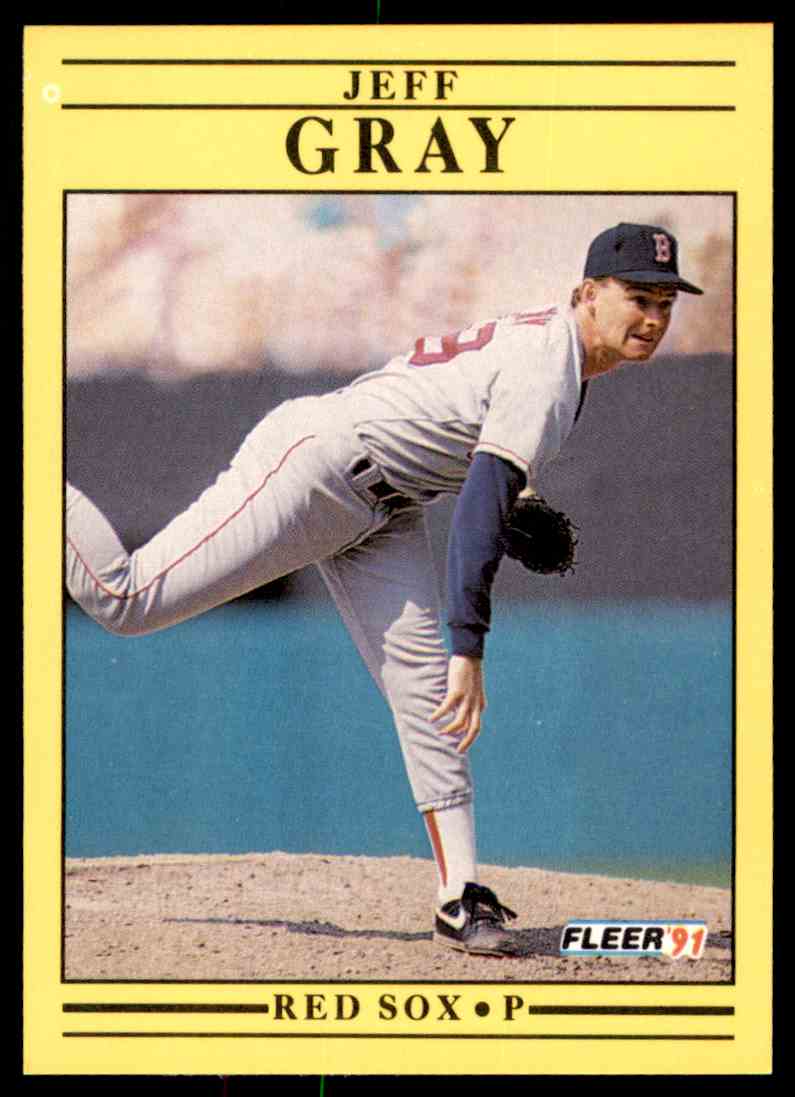
Rich Gedman 1989 Topps, Lee Smith 1990 Topps and Jeff Gray 1991 Fleer

On September 5, 2017 I received these cards from the Baseball Card Bandit (BCB):


On Facebook, I wrote: I've been really lax in my BCB updates. I received three cards in the last few weeks -- all Red Sox. 

The interesting thing is that on the Rich Gedman envelope, the return address was "BCB My Hometown". Gedman is from Worcester, it seems the BCB dropped a hint and that eliminates my first suspect. 

Looks like I'll have to rethink who it is. 

Quick hits:
Gedman: famous for his helicopter swing, two-time All Star that was flummoxed by Charlie Hough's knuckleball, victim of ownership collusion who never got his career back on track. Played 150 games a year because his back up was Marc Sullivan. 

2019: Rich Gedman was the local boy made good. He grew up in Massachusetts and the next thing you know, he's the starting catcher for the local nine. As someone who probably idolized Carlton Fisk, this was a big deal. And he did really well too. For a time.

But for Gedman, his career highs where like Monkey Paw wishes. He played in the 1985 and 86 All-Star Game, but Charlie Hough's knuckleball made Gedman look like a Little Leaguer in 1986. He just couldn't catch the things and they rolled all over the place. He was a laughingstock. Then there was his first World Series where Stanley bounced the ball in front of him and it rolled to the backstop putting Ray Knight in scoring position. After the season ended he was poised to be a big time free agent, only with Collusion rearing its ugly head, he didn't get an offer and due to the weird free agent rules of the day, signed with the Sox but could not report until May 1. 

The same thing happened to Tim Raines but while Raines was still awesome that year, Gedman never got on track and had a horrible 1987. And that snowballed into horrible 1988 and 1989. Gedman was a Walt Hriniak disciple and needed precise timing for his helicopter swing to work. I've always thought that missing 1987 Spring Training screwed up his timing and his lost season turned into a lost career. It also meant that Boston fans had to suffer through a month of Marc Sullivan catching. 

Gedman has had a pretty good post career where he's managed his hometown Worcester Tornados for a bit and is working for the Red Sox now. Gedman wasn't a bad guy, I used to like him a lot, he was just really unlucky. 

Lee Smith: hulking borderline HoFer reliever who pitched well in Boston but GM Lou Gorman couldn't leave well enough alone so he signed Jeff Reardon. Was traded for quarters on the dollar for Tom Brunansky. Said he'd literally sleep through the first five innings of every game before waking up, stretching and getting to the bullpen. 

2019: Since 2017, Smith has turned from a borderline Hall of Famer, to a real Hall of Famer as he was inducted by the Veteran's Committee (or whatever they're calling that now) about two months ago. Gorman's trade to get Smith was brilliant: Calvin Schiraldi and Al Nipper to the Cubs. That was it. But like I said above, he couldn't just leave well enough alone. He had to tinker and futz. Next thing you know, Smith is on his way to St. Louis for Brunansky. 

Smith had some really great years after he left Boston while the Red Sox bullpen was always a question mark. Who knows what could have been?

Look at his card, dude looked hulking. How could you not want him as your closer?

I wrote a bit more about this trade twice, in the Reardon pieces here and here

Jeff Gray: decent middle reliever most "famous" for having a stroke in the before a 1991 game. He was actually having a terrific year for the Sox before this injury occurred. He tried to come back but never could do it. According to Wikipedia he and Jody Reed owned a restaurant in Sarasota, FL called Beef O'Gradys. I want to go there.

2019: I still want to go to Beef O'Grady's. It sounds like a magical place. 

Wednesday, August 16, 2017

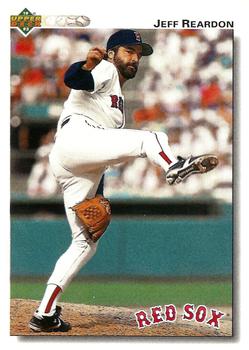
Jeff Reardon 1992 Upper Deck


On July 1, 2016, the Baseball Card Bandit sent the above card. I took to Facebook that day to write this:

“The BCB is at it again but this time there's a wrinkle in his (I assume it's a man) game. Look at the postmark! This card, of Terminator Jeff Reardon, was sent from New York City where Reardon spent the last 11 games oh his career sans trademark beard. 
Reardon was needed when he was with the Sox (Boston had potential HoFer Lee Smith) but for some reason GM Lou Gorman picked him up. Maybe that's what led him to real world troubles he had in Florida after he retired. 
Or maybe it was just Florida. Man, that state just sucks.”

I was never a big Jeff Reardon guy. I just didn't think that he fit a need for the Red Sox and wondered why they were spending money on him. It was a needles bauble, as far as I was concerned. Sign a starting pitcher, an outfielder with pop, anything but another lights-out closer. We already had one. And he was good.  

When the Red Sox picked him up as a free agent after the 1989 season, I was a little shocked. Boston still had Lee Smith*, who had a really good previous year. Smith was 6-1 with a 3.57 ERA (which is unfair metric to judge for closers) and had 25 saves and a 12.2 strikeout over nine innings ratio. Reardon had a 5-4 record, a 4.07 ERA, saved 31 games and 5.7 SO/9. Plus, Reardon was two years older and cost more money. 

*The Lee Smith deal was probably Lou Gorman's best deal ever. He traded Calvin Schiraldi and Al Nipper to the Cubs for Smith. Gorman should have been arrested for larceny. It was that good of a deal. 

Why would you sign a closer when you already had a really good one in the back of your bullpen. I wasn’t sure what Red Sox General Manager Lou Gorman was thinking. But I assumed that since Reardon was signed in December 1989, Smith would be gone by Spring Training. Again, not true. When the Sox reported to Winter Haven, Florida both Reardon and Smith were there too. They spent a lot of time talking about who was the closer and they gave similar pat instances about how “these things have a way of working out” and “whoever had the hot hand”. Crap like that.

If there was ever a manager who could make this work, it was Sox skipper Joe Morgan. He said the same thing. When camp broke that April, both Reardon and Smith were on the roster. This lasted about a month before Gorman traded Smith to the St. Louis Cardinals for Reardon’s former Twin teammate Tom Brunansky.

Brunansky was slotted in right field and was the Red Sox only power threat in some very lean years. He did make a pretty awesome catch off of Chicago White Sox shortstop Ozzie Guillen to clinch the 1990 American League East. Other than that, he was completely adequate.

I often wondered why Reardon chose the Red Sox that off season. He knew about Lee Smith and he understood that the Sox really didn’t need a closer. Reardon grew up in Dalton, MA, so maybe he wanted to come home. Gorman gave him a crap-load of money to pitch here. Maybe Gorman told him that the team didn’t like Smith anymore and that he would be traded soon and that there was nothing to worry about.

I’m not sure. But he came in and pitched well. In two plus seasons, he had 88 saves for the Red Sox and made the All-Star team in 1991. That was also the year where he gagged the American League East flag. The Sox were making a pretty hard run late in the season when the Sox were on the verge of beating the New York Yankees to get closer to the league-leading Toronto Blue Jays.

With two outs in the top of the ninth and the Red Sox leading 5-4, Reardon gave up a game tying shot to Roberto Kelly. The next inning, Matt Young and Dan Petry couldn’t get out of their own ways and gave two runs to Bombers who won the game 7-5. From that game forward, the Sox lost 10 of their next 13 and finished in second behind the Blue Jays.

The Sox were never a serious contender until 1995 when another Massachusetts boy, Dan Duquette took the reigns as Boston General Manager and remade the Sox on the fly following the strike-shortened 1994 season. Duquette was Reardon’s catcher at UMass-Amherst.

Late in the 1992 season, Reardon was traded to the Braves for a minor leaguer. From there he bounced to Cincinnati and the Yankees—two teams that had strict rules of facial hair. If Reardon wanted to continue pitching, he had to shave off the beard that made him famous and intimidating. He retired after the abbreviated 1994 season.

Jeff Reardon was an interesting character. He looked like James Brolin from the original “Amityville Horror” movie. He was a Met for a while, but was traded to the Montreal Expos where he began his career as the unstoppable stopper. That’s also where he got his nickname “The Terminator”. He’d come in, throw gas by everyone, save the day and walk off the mound. He never showed a lot of emotion and when you mix his beard plus playing in the “wilds of Canada” he seemed scary as hell.

After the 1986 season, he signed with the Minnesota Twins and was dominant that year. He was probably their Most Valuable Player that year as he brought a ton of stability to the bullpen. The Twins believed that the game was over once Reardon was on the mound. Twins manager Tom Kelly used him brilliantly and was the best weapon in the American League that year riding him all the way to Minnesota’s first world championship in any sport.

The years after his retirement were not kind to Reardon. This is from Wikipedia (and references what I wrote about him in the original Facebook post):

On December 26, 2005, Reardon was taken into custody and charged by the Palm Beach Gardens, Florida Police Department for allegedly committing armed robbery at a Hamilton Jewelers store at the Gardens Mall. Reardon attributed his actions to the influence of the medications that he had been taking since his son died in 2004. Soon after the episode at the mall and his release from an overnight stay in jail, Reardon returned to a psychiatric facility, and was an inpatient for nearly two months. His doctors drastically reduced his medications and began to administer electroshock treatments. However, Reardon still had to stand trial.
Reardon was eventually found not guilty of the charges by reason of drug-induced insanity. The judge ruled that because Reardon had been taking anti-depressants and mood stabilizers, and was distraught over his son's death, there was no reasonable explanation for the robbery. In addition, Reardon was not required to be committed after the ruling.”

I haven’t read much about Reardon since then, so I assume he’s doing okay. At least that’s what I want to believe. Because even dominant relievers need some relief.