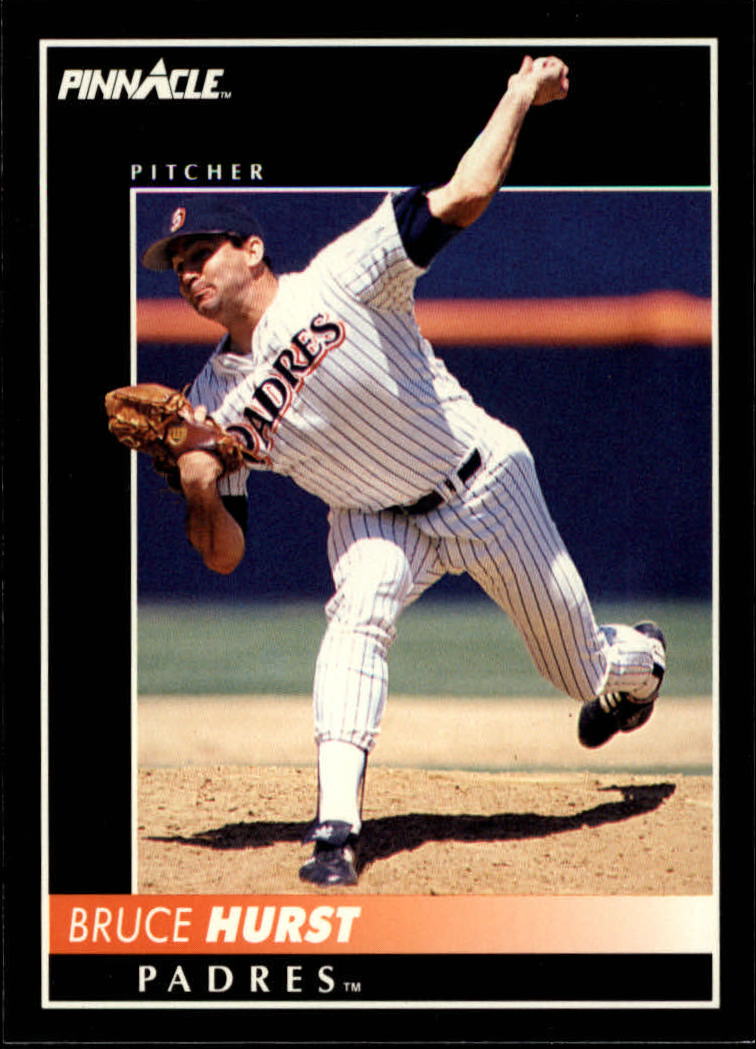
20. Bruce Hurst
By the time the 1988-89 offseason rolled around, I considered myself an astute baseball fan. I had seen it all: older post season heroes leaving for greener pastures, youth movements began, managers had been fired, a big trade had been swung, winning streaks, losing streaks, fire, rain, whatever. I pretty much considered myself the Peter Gammons of Amesbury, MA.
The one thing that I hadn’t experienced was one of our free agents, a guy we needed to keep, spurning the Hub for another town. Until that offseason. That person was 1986 World Series hero Bruce Hurst. That dude packed up his curve ball and went to San Diego.
The Padres? He went to the Padres? The team with the brown and orange uniforms, who play in a stadium named after a sportswriter, who are both anonymous and sucky? Those Padres? Why? Why would he do that?
Before baseball landed a deal with ESPN and before any modern convenience that started in the 90s, baseball in San Diego and Seattle was like Siberia. Do they even play 162 games in those places? Do they even have fans? They’re never on TV so if there’s a homer without anyone seeing it, did it happen?
Why would Hurst go there? I couldn’t understand it; he’d been a Red Sox since he was drafted by the club, why wouldn’t he want to stay here? When this sort of thing happens, you go through a bunch of stages, starting with disbelief which I just chronicled.
Then anger, “fine fuck that guy, I hope his arm snaps. He’s going to look dumb in brown, which is the perfect color for him, but the way. That piece of crap.”
After that you sorta start thinking you don’t need him anymore. “Fuck it, we have Clemens and Boddicker and Tom Bolton’s supposed to be pretty good. Fuck that guy. Enjoy the West Coast and no ‘real’ fans, dude.”
Then you just get over it until it seems like Hurst played for the Padres forever. “Bruce Hurst? Oh yeah, he pitched here, right? I kinda remember him, he was pretty okay. I guess. He’s no Rob Woodward though.”
Obviously Bruce Hurst was better than pretty okay, he was a monster in the 86 post season. In fact, he really came into his own that season. While Clemens was getting all the love and Oil Can a bunch of attention, Hurst was quietly pitching really well. With that big looping curveball that would make hitters’ knees buckle, he was everything Roger wasn’t: thoughtful and crafty.
It sucked losing him. It really did. But he went to SD for a bunch of really good reasons: more money, better weather, less pressure. Plus it was closer to his Provo, Utah home. As an adult, I can totally see why Hurst would want to put Boston in his rear view mirror.
I’ve lived here my whole life and if someone gave me that opportunity, I’d be gone too. Why wouldn’t a laid back, west coast Mormon want to do that?
I’m not sure how much Hurst enjoyed his time here, there was an incident in his first Spring Training where a coach questioned his manhood because he didn’t drink, smoke or chase women. The whole Wade Boggs/Margo Adams thing didn’t sit well with him either.
Why not go to San Diego and get paid and not have a bunch of asshole frat guys around telling you what a wuss you are? Fuck ‘em.

19. Xander Bogaerts
He came up during the last few months of the 2013 season, the best prospect in the system, and played really well on a team loaded with big personalities and veterans. For a couple of down years, team-wise, he manned short (though he’d bounce to third when the Sox became fascinated with Stephen Drew for some reason) until the next wave of prospects showed up.
By then he was an All-Star, a veteran presence, a team leader. Beginning in 2016, the Sox turned into a juggernaut, making the playoffs every year before culminating with a World Series championship in 2018.
He seemed to like being in Boston, he certainly had the attitude for it: never too high, never too low, appreciated the fans, went out and produced every day. He even signed a team-friendly, long term contract with a player option after two seasons, that no one really expected him to take.
Why would he? He was getting paid a lot, the team was winning, all were happy. At some point Owner John Henry wasn’t happy when he looked at his payroll and the Sox started to get rid of Bogaerts’ teammates. The team bottomed out and Bogaerts was probably like, “screw it. If this team is going to suck I may as well get paid” and he exercised his option to be a free agent.
Chaim Bloom is my least favorite GM/PoBO the Red Sox ever employed. Not because he was Henry’s hatchet man, but mostly because it didn’t seem like he had any idea what he was doing. In the 2022-23 offseason, he said the club’s biggest thing to do was sign Bogaerts.
Bloom completely misread the market, offered Bogaerts a below market value contract and then watched as Bogaerts signed with San Diego (just like Bruce Hurst!) According to Globe writer Julian McWilliams, he said that Bloom was talking to reporters at the airport following the Winter Meetings, got a text telling him about Bogaerts and needed five minutes to compose himself.
You can argue whether Bogaerts “deserve” the money that the Padres gave him (he probably didn’t) but what Bloom further showed there let me know that "this guy, he’s not my guy" to quote Frank Costanza.
Do I wish Bogaerts stayed? Yeah, I do. I think it’s important for a club to have some connection to its past, especially when young players are coming up. Would I pay him what SD did? No. But it’s not my money. I think that there was middle ground that Bogaerts would have accepted that would have allowed him to retire in Boston.
That would’ve been pretty cool.
(I’m going to get more into the way players are viewed by the front office and how it’s different from fans. I just don’t want to get into it quite yet.)


18. Keith Foulke and Koji Uehara
Two, two, two for the price of one! We’re looking at my two favorite players for number 18! Why didn’t I make one 17 and the other 18? Good question. I just didn’t.
The ability to close down a game in high-tension situations may be the most important thing in the mix of championship team. You can have swashbuckling cowboys like Jonathan Papelbon or you can have roller coaster closers like Craig Kimbrel or you can have the two players here. But you need someone.
Uehara and Foulke are a lot alike. They were both quiet guys who came from other organizations whose first names begin with K, who just took control of a situation and locked. It. Down.
Foulke was part of a 2003-04 spending spree where the Sox got better at positions that were weak on an all-time team. In 2003, the Sox front office collected a bunch of arms and informed them that they were going to be a “bullpen by committee” which meant no one had a defined role. They could come in the sixth inning or the ninth or whenever, theoretically it didn’t matter.
But the bullpen is home to actual people and people like repetition and rules and defined expectations, and the Bullpen by Committee was a disaster. They traded Shea Hillenbrand to the Diamondbacks for Byun-Yung Kim, (mostly) stabilized the pen and it was absolute smooth sailing for the rest of the year and into the playoffs.
Except it wasn’t. GM Theo Epstein was shocked to find mistakes in his 2003 plan, so he got rid of the the guy who screwed it up, picked up the best closer on the market, made sure the entire understood their roles and the Sox streaked to an easy championship! (Also, not exactly true.)
In the playoffs, Foulke earned his money by pitching in multiple high-leverage situations night after night after night after night. When he needed a strikeout, he got one. When he needed a double play, he got one of those too. The amount of wear and tear he put on his right arm that month is insane.
As much as I love Manny, Foulke should’ve been the postseason MVP that year.
After his stellar October, his arm suffered and he never was quite the same. He heard boo birds in early 05 (which, seriously fuck all the way off) which understandably got under his skin, said some stuff and was gone after his contract was up. Time healed all wounds and Boston rightfully has welcomed him back as a conquering hero.
Around the time that Boston fans got their collectives heads out of their collective asses regarding Foulke, the Sox were putting together a frisky team for the 2013 season. Like 2004, GM Ben Cherington was collecting arms for the bullpen and he signed a little known Japanese import.
Roles were defined and Joel Hannahan was going to be the closer. Except he got hurt. Then it was going to be Andrew Bailey. And he got hurt. Finally manager John Farrell had no one to turn to except for Uehara.
Lucky for Sox nation, Uehara had the best season a Sox closer ever had. And it’s not even close. He had a 1.09 ERA, 0.56 WHIP (!!) and struck out 12.2 per nine. In the playoffs he was more dominant. His ERA in the ALCS and the World Series was 0.00 (!!!) and his WHIP was even better than his regular season number. He gave up ONE run that entire post season in 12 games.
And he was also 38-years-old.
He was as close to automatic as anyone I’ve ever seen and there was literally no worrying when he showed up on the mound. Man, he was terrific.
Guys, you really do need a closer.

I don’t recall a ton of buzz when it came to Valentin as he made his way through the minors. But when he made it to Boston he took over shortstop and just hit. And hit. And hit. He could also field a bit too.
In back-to-back games he turned two triple plays and hit three home runs. I was at one of those games, but don’t ask me which one because I can’t remember. I know it was against the Mariners, I’m positive that I was in college, I was with my buddy Skaus and we bought SRO tickets, which didn’t have the game date printed on them.
So I tell people I was at both of those games even though I was only at one.
In any event 1995 was Valentin’s year as he mashed. It was also Mo Vaughn’s year as he won the MVP from surly Cleveland slugger Albert Belle. But Valentin had the highest WAR in the league (8.3!!) and maybe should have won the trophy. But people didn't pay attention to that stat back in the day, so he was ignored.
The messed up thing is, he never made an All-Star team. Which is dumb. He put up big numbers, played in Boston, played on some good teams, why didn’t he get the recognition? I have no idea, I guess life is all about timing and also, it just isn’t fair sometimes.
Speaking of unfair in 1997, Valentin was told that he was being moved to third base because this new dude is scorching the minors and he’s ready to play in the Show. That person was Nomar Garciaparra. Valentin, was understandably miffed, and left Spring Training in protest.
These protests never, ever work and it makes the protestee look like a baby. He came back after a day or two, played a terrific third base and the Sox had a really good infield.
After ten seasons with the Red Sox, Valentin played a year with the Mets. Then he was done. While nowhere close to a Hall of Famer, Valentin had a great career that was lost to the ages. That kinda sucks but I’m sure he’s okay with it. Tonight, if you’re hoisting a few, remember John Valentin and hoist one for him.

16. Troy O'Leary
There was a time when the Red Sox weren’t the RED SOX and they just didn’t generate the revenue that they do now. Ownership didn’t have the cash, or at least they didn’t want to spend the money, and we were all kinda okay with it. "Whatyagonnado? These players are too greedy! They're playing a kid's game! They should give some of that money back!"
We just didn’t know better.
After a bunch of bad years, Dan Duquette was brought in to bring the Sox into the future. He had a plan, trade for good players, develop good players and grab players that other teams overlooked.
The minor leagues were in disarray so he couldn’t do the first two parts of his plan, so he started to do number three. It was basically dumpster diving.
Troy O’Leary was one of those guys. Languishing in Milwaukee, O’Leary was overlooked and the wasn’t getting any at bats. Duquette remembered him from his days in Suds City and signed him. When given the opportunity, O’Leary flourished. He wasn’t an all-star but he put up respectable numbers for five or six seasons.
But O’Leary’s biggest night also occurred on one of Pedro Martinez’ biggest nights so it gets a little forgotten (like the man himself). Bret Saberhagen and Derek Lowe got pounded by Cleveland in the winner-take-all Game 5 of the 1999 ALDS. Sabes gave up five runs in one inning, Lowe three runs in two.
The Sox looked cooked.
But O’Leary was there to rescue them. Cleveland manager Mike Hargrove walked Nomar Garciaparra to load the bases. O’Leary hits a grand slam. Two innings later Hargrove again elects to intentionally walk Nomar and O’Leary deposits another bomb, this time a three run homer, over the right field fence.
Pedro came out of the bullpen and no hit Cleveland and their stacked lineup for six innings. The Sox added five more runs and they won 12-8. O’Leary had an absolute monster game but Pedro was a bit better, so he gets the pub. I guess that’s okay because this was how O’Leary’s career went.
One of my favorite things about him is how huge he came up when his number was called. I’d like to think that if in a similar situation I would do the same. I think that’s the lesson of Troy O’Leary; it doesn’t matter where you started or how you got to where you are, if given an opportunity, seize it. If people disregard your talents, make them pay.
Troy O’Leary is the patron saint of doing that shit.