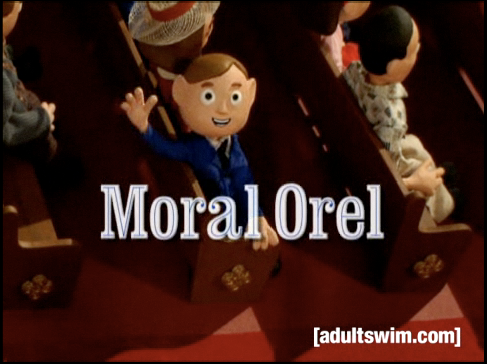
I hate to sound like “60 Minutes” curmudgeon and first ballot Get-Off-My-Lawn-You-Bastard-Kids! Hall of Famer Andy Rooney, but kids today don't know how lucky they have it with television. Growing up in the 70s and early 80s, there were three network channels, a PBS station and about four UHF channels. Even though there was less than 10 channels, mst of the time, there was a pretty decent shot of finding something worthwhile on TV.
Except for Sunday morning.
God (no pun intended), what a craptastic selection of programs for anyone under ten-years-old. Your choices was either boring weekly-news-roundups or awful cartoons—I'm talking about 1930s “Popeye” or “Deputy Dog”. There wasn't any of that good Hanna-Barbera or the cool-toy cartoons (“He-Man” or “G.I. Joe” or “M.A.S.K.”), it was a wasteland. And why would there be any good TV on Sunday mornings? It's the morning that most people sleep in or go to church or spend the morning with the Sunday paper or do just about anything else besides watching TV. Putting good shows on Sunday is a complete waste.
The problem was I loved TV and I needed something to watch. The one show that I could tolerate was a claymation show created by the United Lutheran Church in America called “Davey and Goliath”. Every week Davey would get into some trouble and his belief God would get him out of the jam. Usually his talking dog Goliath acted as his conscious, but Davey ignored him every single time and went about his ignorant way. Each episode ended with a moral about “Loving your neighbor” or “Not vandalizing the town synagogue” or “listening to your elders” and Davey would always pledge to follow that lesson.
This show made “Leave it to Beaver” look like “The Wire” and even when I was a kid I knew that it was a pretty lame show. But there was nothing on, I liked the claymation (the people who did this also animated Gumby) and the opening and closing theme (which was called “A Mighty Fortress is Our God” by Johann Sebastian Bach—which is pretty bad ass and sticks in your head for weeks), so it grew on me.*
* When I was in college, the Boston Catholic Channel used to run this show every day in the afternoon. Whether in an altered state or not, I found myself watching it for two reasons: 1. watching the show ironically made it more funny and interesting (more on this when I review “Dragnet” and “Leave it to Beaver”) and 2. I did get a small twinge of nostalgia watching the show and remembering early mornings at my grandparents' house waiting for my grandfather to wake up so that he'd make me pancakes.
Anyway, this is a roundabout way of saying, “Moral Orel” is a lot like “Davey and Goliath” even though Dino Stamatopoulos says his show is based on sitcoms of the 1950s and 60s. I'm not going to argue with him, but Orel and Davey are very similar looking:

(ORAL)

(Davey)
In the end, it doesn't matter. The show was broadcast on Adult Swim and focuses on a town in the exact middle of the United States called Moralton, which is the capital of Statesota. Orel is a well-meaning young boy who is obsessed with God and following the rules set forth by his elders; inlcuding his parents, his teachers and the town's Protestant Reverend. These people rarely have Orel's well being in mind when they give him advice and often say things to get Orel out of their hair. Oftentimes the advice is contrary the Christian moral code, but Orel is too naïve to figure out any ambiguity and takes the advice at face value.
This, along with their general indifference causes Orel to misinterpret what his elders are trying to tell him. After Orel screws up his lesson, his father always brings him to his study where he gives Orel a few lashes with his belt and attempts to “explain” the lesson that Orel got wrong. This explanation is as bad or worse as Orel's interpretations and leaves him more confused than ever. One example of this is when Oral begins hanging around his friend Joe, who is the prototypical trouble maker. Joe continues to lead Orel down the wrong path culminating with the boys brutally beating up two homosexuals. What is the lesson that Orel's father teaches? Loyalty. He felt that Orel was disloyal to his established group of friends by spending more time with Joe and not including them.
As the show progresses, Orel begins to realize that adults don't always know what's best and realizes that confusion reigns over everyone and while they are more screwed up than children, adults just hide it better through hypocrisy, dishonesty and denial.
In the big picture, this show is Stamatopoulos' views on the so-called moral majority, ie the middle-American “red states” and how they interact with anyone who has values that are different from their's.
Many of the adult characters have deep-seeded, dark issues including alcoholism, crippling loneliness, dementia brought upon by rape and overall hatred that are buried below a cheerful, “moralistic” attitude. These demons are raised from time-to-time but instead of being dealt with, they are pushed down further under the surface causing anxiety and a misery. It is this facade of everything is fine on the surface which belies the true cesspool, that Stamatopoulos and Scott Adsit (who plays Pete Hornberger on “30 Rock” and is one of the writers and producers on “Moral Orel”) is most adept at writing about.
Being that most of these people of Moralton are church-going, conservative people, one can only assume that the writers feels that many right-wingers are self-effacing liars. Are the assertions true? Judging from the recent headlines of right wing politicians and mouth pieces, it looks as if he could be. It's not that the right have vices, everyone does, it's that they're so voracious about NOT having them. This is why many lefties enjoy the latest right-wing scandal.
While this show seems to be about the hypocrisy of the right and the way that a large majority of Americans think that there is “one correct way of living”, it really is about faith. From the very first episode to the last, Orel has always had the utmost enthusiastic faith in God. Week after week, events occurred where his faith should have been challenged, but week after week he bulldozed through those events secure that God was going to make things all better.
While some of the more well-known moments from the show are infamous, the bottom line is Orel doesn't make mistakes to spite God, he does it because he wants to honor God. One has to admire his focus and determination that a good, moral supreme being exists and that everything will work out in the end. Orel is a person who tries to do the right thing and one can argue that that is the overall lesson of the show, living by the Golden Rule. The only times that this rule becomes perverted is when people don't pay attention to it.
Stamatopoulos is a television hero of mine and the list of shows that he's worked on: “The Ben Stiller Show”, “Late Night with Conan O'Brien”, “The Late Show with David Letterman”, “The Dana Carvey Show”, “Mr. Show with Bob and David” and “Tom Goes to the Mayor” are a list of some of the better alternative comedy/anti-establishment shows in television history. His skewed view on society is acidic and over-the-top cynical, which is probably why not too many people know his work. His shows and humor are very polarizing and appeal to a limited type of person.
God, faith, hypocrisy are all extremely large issues to tackle and these issues are made even larger by the fact that “Moral Orel” was only a 15-minute show aired on the other side of midnight on Sundays. Stamatopoulos took the best swing at it and while it's not a no-doubt home run, it's pretty damn close. The way that he and Adsit were able to write and voice clay characters that the viewer cares about and ones that they will think about days after the show is over is remarkable.
Every day there is some preacher somewhere trying to “Save your soul” and telling you that salvation can be had if you give him $20. “Moral Orel” doesn't make claims on soul-saving or asks for your money, the show is an honest meditation on the role of religion in this country, warts and all. And that's what people need from religion, honesty.


