Showing posts with label Leave it to Beaver. Show all posts

Friday, November 13, 2020

My Brother


Wednesday was the first day in 15,498 days where the sun rose and my brother, Jason Magrane, wasn’t around to see it. He passed away on Tuesday November 10, 2020 at 12:42 pm at Portsmouth Regional Hospital in Portsmouth, NH surrounded by his mother, father and me.


That last sentence is the type of “just the facts” information that I would throw down when I was a reporter writing obituaries. It’s not very personal and it doesn’t give much of a picture of who the deceased was, it was more of a record that this person existed for a time and then departed the world.


Like you, I’ve experienced death before, but the passing of Jason has hit me hard. He was much more than a range of dates, he was a father, a son, a husband, a friend, an employee, a boss, but most importantly to me, he was a brother. As I’m writing this blog post on November 12, I can only think of the future and the past. Jay is going to be laid to rest two days from right now but three years ago to the day, I gave the best man’s speech at Jason’s wedding. Below is a portion of what I wrote, this was supposed to be a toast to Jason’s nuptials, never did I envision it becoming part of a eulogy:  


“According to Magrane lore, when my mother came home and told me that she was going to have another baby and it was going to be a boy, I was inconsolable. I wanted a sister and the thought of having a brother muscling in on my territory and sharing my toys was too much.


Despite my best wishes, Jay never turned into a girl, so I was stuck with a brother for my childhood. And it turned out to be pretty awesome. Growing up, Jay and I were pretty much alone at any extended family gathering—and we used to see our family a lot. I would think about friends who had dozens of cousins and how they’d talk about hanging out with them at family gatherings and it sounded pretty great.


But with Jay and I growing up together, we had to be each other’s best friends. Whether it was at my grandmother’s house or Aunty Rita’s or at Cousin Kathy’s in New York, it was just him and me. That meant he and I would play He-Man and GI Joe, read comics, or draw or play Wiffle Ball. It was always Jay and By or By and Jay. With us being together that much, it could have gone a few different ways, but we became close.


A few years later, as I got into high school and had my own group of friends; I began to notice that my friends—all of them—took a liking to Jay. Was I happy about this turn of events? No, I was not. It used to drive me crazy that my friends always invited Jay to come with us whenever we did something, whether it was hoops or pond hockey, Indian ball or football, Jay was always a part of the crew. And not only that, but my friends genuinely liked him and respected him.


It wasn’t until a few years later that it dawned on me: some of my friends had younger siblings and they were never invited to do stuff with us. Jay was included because he was funny and smart, athletic and loyal; he was included because he was one of us.”


It’s funny, when you grow up with a brother, you’re inundated with a lot of media about how close brothers have to be: from Wally and the Beav to Greg, Peter and Bobby to Willis and Arnold, all of those brothers were the best of friends.


But real life isn’t like that. Life isn’t scripted, each person doesn’t know exactly what the other person is always thinking and problems aren’t solved in 30 minutes (minus time for commercials). The idea that two people could be complete and total best friends forever and ever and ever without any disagreements is a silly, unrealistic myth.  


As we grew into adulthood, Jay and I were close-ish. We were both independent men who had their own life and their own life’s philosophies. Mine was a bit more conservative in regard to risk and rewards. Jay was the opposite. Jay lived his life the way he wanted to live his life, which I found admirable and a little concerning, but that wasn’t how my brain worked. Jay could talk to literally anyone—he had no fear in that department, made everyone feel comfortable—which is an awkward endeavor was for his older brother, was fun, constantly laughing and wondering when the next good time was going to happen.


As we grew up we worked through our differences and over the last few years, we began to get closer. While we didn’t agree on everything, I could at least understand why Jay was doing what he was doing. And I think he could see things from my point of view too. Even though we were closer, Jay still wouldn’t (or couldn’t) tell me what was bothering him when asked. And it wasn’t just me, Jay didn’t want to burden anyone with what he considered his “trivial problems”.


“By, you have a family, focus on them,” he’d always say. But what I don’t think that Jay got was that even though I have a wife and two children, Jay was my family and I did want to focus on him. But his carefree persona or his pride or whatever he felt at the time wouldn’t allow him to tell me what was really going on. Would I have helped him? Would Jay be here today? I don’t know. Maybe. It’s a question that I’ll have to live with.


The thing is, Jason was 42-years-old and you could ask him what’s wrong, I could ask him what’s wrong, Bo Jackson could ask him what’s wrong and Jay wasn’t obliged to give us an answer. Jay’s stubbornness knew no bounds. He was the Michael Jordan of stubborn. Things were easier when we were kids and if I wanted to really know what his problem was, I could jump on him (I always weighed more than him), sit on his chest, put my knees on his biceps and tickle him until he told me his deal. I wish I thought of doing that a few months ago, but that approach seems sort of weird now that I think about.


You’re never going to get a straight answer out of tickle torturing someone and just because you ask someone to do something, doesn’t mean that they’re going to do it. For example, Jay went into the hospital last Monday and that prognosis looked grim even back then. While I was putting away that evening’s dishes, I decided to try and honor my brother by playing the Grateful Dead Pandora station. The Dead were Jay’s favorite band (he saw them at the old Boston Garden in 1994) and he was always trying to get me to listen to them. Aside from a few albums and a couple of singles, the Dead and jam bands never appealed to me. But last Monday night, I was going to listen to the Dead in honor of my brother.


I made it three minutes. I’m sorry Jay, and I know that you understand, but I just couldn’t do it.


Alas.


There’s a lot of things that suck about my brother’s untimely passing, but I think that the biggest one is that he and I are never going to get the chance to be as close as we were when we were kids and that truly makes me sad. I was looking forward to the day when Jay and I take our kids to a Sox game. Or he could ask me for the millionth time why I don’t like Bill Simmons anymore. Or when we could have a moment and remember long-passed relatives who seem to exist in the fogs of our minds. Or he could recommend a podcast to me. Or when a tragedy happens and I need someone beside my wife to talk to, so that I can get through the latest malady without losing my mind.


All of that has been taken from me and it makes me very sad.


Earlier this morning I was thinking about a random memory of Jay and me. It had to be during the spring of 1990 and I was in my room probably obsessing over my baseball cards or reading a magazine while listening to Public Enemy’s newest tape “Fear of a Black Planet”. There’s a song on that album called “Welcome to the Terrordome” and if you know anything about PE—and especially that album—you know that it’s a wall of sound. It’s literally a pastiche of samples and cuts laid upon one another to make new beats.


At 1:47 into the song there is a horn that wails unsettingly loud and shrill. That day in 1990, I thought it was my brother calling, “Byyyyyyyyron!” from downstairs. And it wasn’t just that day, for like the first 10 or 15 times I listened to that song, hear that sound, amble over to my stereo, shut off my tape and yell, “WHAT DO YOU WANT JAY?” And he’d always say that he never called me, I’d press play and grumble to myself about Jay being a pain in the ass.


Today I listened to that song and in particular that shrill horn and it made me smile and cry. Jay may be gone, but he’ll never be forgotten.

Tuesday, March 01, 2011

22. Dragnet


Let’s get this out of the way right now: “Dragnet” is not a great show, it’s a pretty good show, but it isn’t great. The most obvious question is, if this isn’t a great show, why is it on this list? The reason why I added this show to this list is because it taught me a thing about television shows, all shows can be made fun of and mocked.

I was way too young when this show (and we’re talking about the 98 episodes that aired from 1967-1970, not the ones that were broadcast in the 50s and certainly not the ones aired on the radio) had it’s initial run. I caught them when I badgered my father* into watching them on Nick at Nite or TVLand during the early 1990s.

* When this show started on Nick at Nite, I didn’t have cable in my bedroom and my dad controlled the downstairs TV with an iron fist. He would often say, “I hated this show when it was first on and there’s no way that I’m watching this crap now.” I literally had to beg him to watch an episode because he found “Dragnet” boring, obvious and just an overall mess. I’m not sure exactly what he thought of me for watching it—I tried to tell him that you needed to watch this show ironically (though I probably never said it like that). But I don’t think that he ever agreed with me that watching TV could be an active activity, rather than a passive one.

And holy cow, 98 episodes? The show started in January 1967 and ran through the end of the 1970 season when Jack Webb decided to focus on another show he was producing, “Adam-12”. That’s almost 100 episodes jammed into three-and-a-half seasons. That doesn’t happen today.


Webb, who wrote, produced, directed and starred in this show played the notoriously square cop Sargent Joe Friday. His partner was veteran TV actor Harry Morgan who played his partner Bill Gannon. Morgan would go on to greater fame in his subsequent show “M*A*S*H”. I’m not sure what kind of cases Friday and his partner (it wasn’t Gannon) solved in the 1950s, but in the series they made an effort to bust up the counter culture. And that meant hippies, teens and sometimes teenage hippies.

Showing the “strange and bizarre” world of the counterculture was the absolute life blood of the show. I’m not sure why Webb went in this direction, maybe hippies were scary to middle America and the older generation. Maybe these people had no idea what their kids were up to and they looked at this program as a way to peer inside their world.

But if the latter is true, they didn’t get much insight from “Dragnet”, in fact one could say that they got the exact opposite view of what their lives were. Even someone who was 20 years removed from the hippie movement could see that Webb had no idea how to write for or about young people. It was obvious that he didn’t have a grasp on their culture and what made them tick. Thus, there was no real attempt at any insight. To Webb and his conservative views, hippies and their ideas were just as dangerous as someone who wants to rob a bank.

That lead to a lot of unintentional comedy, which isn’t good for a show that is taking itself so seriously—but it’s good for an audience that was growing up in the age of irony. Their phrases were rote and robotic, the characters were cartoons and the situations they found themselves in (drugs, street gangs, overall no-gooding) were cliched and more comical than anything on TV at the time.

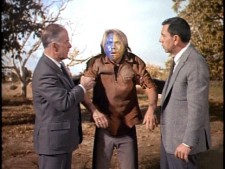
One of my favorite episodes was about a hippie kid named Blue Boy. If you haven’t seen this episode you may ask about the name—I don’t think that hippies referred to themselves as anything but their real names. Was it because of his affinity for the Thomas Gainsborough painting of the same name*? No. That was not it. Was it because the character liked to hold his breath? Nope. Think again. Was it because he favored homosexual oral sex? Bite you tongue, sir!

The reason why Blue Boy was called Blue Boy was because he painted half of his face blue and dropped a lot of acid. That’s it. That’s the only reason why he called himself Blue Boy.


* The characters from “Leave it to Beaver” have this same painting hanging in their living room. I know that this wasn’t intentional, but to me it was a nice bridge between the two best shows to watch ironically. More on LitB in the coming weeks.


At the beginning of the episode Blue Boy is wandering around, talking silly acid-head stuff (“I’m a tree! I have leaves!” while trying to plant himself in a hole)*, but not really bothering anyone. Friday and Gannon pick him up, sober him up, set him straight on the evils of drugs and he’s back on the streets. However, by the end of the episode, Blue Boy is dead—I think that he thought he was a bird and jumped off a building—and Joe and Bill just stare glumly at the body and shake their head. This was the parental freak-out pay off: your kids could be dead if they take even one hit of acid.

* Or at least what Webb thought that kids on acid say and do.

I’ve never done acid, but I know plenty of people who have dropped and this is not what they’re like. Do they say stupid things and act sort of weird? I suppose. But their entire personalities don’t disappear and they don’t become lucid morons.

And that was what was so great about the show, everyone knew it was complete bullshit, but it was fun to watch anyway because there aren’t a lot of shows perpetrate a level of intelligence that just isn’t there. A great portion of the audience was so much smarter and more worldly than the show, that you just had to feel sorry for it.

And worse, you had to feel sorry for the people who thought that this was real. “Dragnet” went to great lengths to let the audience know that, “the story they were about to see is true. Only the names have been changed to protect the innocent.” This was the disclaimer that came before the episode began and they ran a similar disclaimer at the end. Were the stories true? From what I’ve read, Webb was a pretty big police buff and would often talk to the officers at the Los Angeles Police Department to get ideas for the TV show. Hell, his badge number 714* was retired by the LAPD.

* Jack Webb was a huge baseball fan. The badge number 714 was chosen because that was the number of home runs that Babe Ruth hit in his career. The badge numbers of the Webb-produced “Adam-12” were 2430 and 744. I thought that there was some connection between these two numbers and baseball, but I can’t seem to find anything.

But no matter what era Webb lived in, a majority of these tales are completely sanitized and made to fit into the “Dragnet” mold of honest cops, crooked criminals and defenseless civilians. There is never any derision from the formula.

And the formula was as much the show as the actors and scripts, Webb and Gannon wore the same suit in every episode. There were six episodes (I believe) where Webb didn’t wear his gray flannel suit and those were when Friday was kicking back (or in one episode at college and sort of undercover) in his red cardigan sweater. The reason why they always wore the same stuff was because as the producer, Webb wanted to be able to splice older scenes where he and Gannon were walking around into newer episodes, saving both time and money. With a revolving array of different colored suits, this couldn’t be done.

And while the suits looked familiar, so did the actors. Many of the crooks and teens and concerned citizens were used in multiple episodes. You begin to notice this if you watch enough episodes, but if there is a “Dragnet” marathon on it’s inescapable. I don’t know whether Webb liked working with this people much or whether they were cheap labor. I suppose that it was a little bit of both.

As slow and silly as this show is, especially compared to the grittier cop shows that followed (could you imagine “The Wire” starring Joe Friday? He’d be dead before the opening credits ended) it does hold my interest for a half-hour. And while there is a lot to laugh at, Webb took his work seriously and it showed.

In an era where blacks and immigrants were reduced to cheap stereotypes, Webb never went that route. The black and Latino guys on the police force were as much a part of the LAPD family as anyone. Whether this is historically accurate is debatable, but like I said, Webb was a big fan of the police department and wanted them shown in favorable light. Considering the crap that all law enforcement was getting during that time (the late 60s) this is a pretty honorable attempt.

He wasn’t interested in showing the police officers that were smacking students on the head at anti-war rally protests, or the police that were firing tear gas at the 1968 Democratic Convention protesters or turning on the fire hose at black people demanding their rights from an unrelenting South. His interest was showing the every day beat cop, the honest-hard working guy that stood for what America once represented. His police officers were the ones who risked their lives capturing thieves and no-goodniks who made the ordinary citizen’s lives miserable.

Did he go overboard with the depiction? Of course, but if I was a police officer and had to hear people that I was sworn to protect call me pig every day, turn on the nightly news and see my brothers committing reprehensible acts, I wouldn’t mind entering Jack Webb’s world for 30 minutes. While the crime rate is a bit high, it seems like a nice place overall. And if one your crimes is not accurately portraying hippies, than that’s a misdemeanor in my book.

Everyone knows that hippies suck.

Wednesday, October 20, 2010

Would the Fonz Be a Good Dad?


Yesterday’s passing of Tom Bosley, coupled with Saturday’s death of Barbara Billingsley, got me thinking about old TV show and in particular how the two of them were probably the best TV mom and dads ever. Although, I think that Billingsley’s June Cleaver (from “Leave it to Beaver”) turned into a hysterical old shrew by the end of the series’ run*, for the first few seasons she was pretty awesome. She always kept a tidy house, baked an endless supply of cookies and listened to her kids, often running interference for them so Ward wouldn’t freak out when he got home.

* Two things: one by the last two seasons, any time the boys did something wrong, June would fall completely to pieces. And it’s not as if Wally and Beaver were doing anything really bad (for that matter, Eddie Haskell wasn’t either) but she’d just completely lose her shit over the smallest things. I actually felt bad for Wally and the Beave when this would happen because they were tight asses already, not wanting to disappoint their mom (or listen to her prattle on) probably made them more repressed.

The other thing is, I wonder how Tony Dow and Jerry Mathers feel about Billingsley’s death. I’m sure that they’re broken up, but it must be weird that the whole world thinks that their mom just died, when in reality, it was a lady playing their mom. From what I read, both Mathers and Dow were quite close to Billingsley, but she wasn’t their real mom. For some reason, if I were either of them and a reporter asked me about the death of my “mother”, I’d probably snap at them.


Bosley was a really awesome dad in his own right. As Howard Cunningham on “Happy Days” you can make the argument that he was the coolest guy on the show. When high schoolers Richie and Potsie got all of their money taken by a bunch of frat guys at the University of Wisconson, it wasn’t Fonzie that got their cash back. It was Mr. C. When local no-goodnik Arthur Fonzerelli needed a place to live, Mr. C stepped up and allowed him to live over his garage and eat dinner with his family every, single night. He even had a damn good looking wife (Marion Ross) that he often nailed—get it? Mr. C owned a hardware store. “Nailing” is a euphemism for the sex. That’s comedy!

The point of this entry isn’t to eulogize two great TV parents, the point is to determine whether the breakout star of “Happy Days”, the aforementioned Arthur “Fonzi” Fonzerelli, would be a good father.

Let’s set up the premise: assuming that once the show ended, Fonzi found a woman that he could eventually settle down with and they had a couple of kids. He still owns the garage that he worked at it through the show’s run and he’s settled in a house down the street from the Cunninghams. Let’s put together a Pro and Con list to determine whether Fonzi would be an “Ayyyyyyyyy!” or a “Sit on It*” dad.

* Why hasn’t “Sit on It” stayed in our pop cultural lexicon? It’s quaint, it’s exclusionary (how many kids from this or the last generation watched “Happy Days”?) and it sounds vaguely dirty. “Sit on it? Sit on what? Oh, that. No way, I’m not sitting on that pile of crap.” Also if you say it fast enough, it almost sounds like you’re saying shit. That’s an underratedly fun word to say.

Pro:
- He’s the Fonz.
- He could probably fix your car if you got into an accident and wouldn’t get all bent out of shape (more comedy) if you came home with a motorcycle.
- Has a nice head of hair. You’d probably have a nice head of hair too.
- Already acted as a mentor to his nephews Spike and Chachi. Chachi turned out alright, though we never saw Spike again—perhaps he joined Richie’s older brother Chuck somewhere in Happy Days limbo. Anyway, one for two isn’t bad. And plus, Fonzi seems to learn from mistakes.
- Could probably give you good advice at scamming chicks and scamming free meals from nice, midwesterners.
- Could give you pointers on water skiing and all-night danceathons.
- Would definitely take your side if some asshole cop was trying to run you out of town.
- He showed patience and restraint despite years of hanging around annoyances like Potsie and Ralph Malph. I would guess the actions of little children would be a picnic compared to those two.
- Knew the prime spots at Inspiration Point.
- Would be able to fix a jukebox with a swift punch.
- Learned at the feet of the Mr. Miagi of Dads, Mr. Howard Cunningham.

Cons:
- Would be in constant fear that he would leave your mom for an Aloha Pussycat.
- Would be in constant fear that he’d have sex with any and all of your girlfriends.
- How could you live up to your father, the Fonz? I bet every day Dale Berra heard people tell him that he wasn’t Yogi Berra. Dale Berra turned to cocaine and sucked at baseball. Though the two things weren’t related.
- For all of his bravado of being “cool”, often he freaked out pretty easily.
- You’d have Uncle Potsie over your house every Sunday. Worse yet, he’d probably break into song at any possible moment.
- He punches jukeboxes to fix them. Maybe he thinks kids work the same way?
- He has no family, the dude cuts ties easier than Don Draper. What makes you think that you’d last?
- He’s an expert at everything, your self-esteem would be destroyed.
- Would hang around your hang out.
- Could never say that he was “wrong” or “sorry”. WTF, Fonz?
- Would probably call you “Shortcake”--which would doubly suck if you were his son.

Even though this Pro/Con list is knotted at 11, I have to say that the gravity of the Cons outweighs the Pros. It’s best that Fonzi keep his status as a 30-something bachelor only interested in high school girls.

Tuesday, October 13, 2009

27. Chappelle's Show


Every day, thousands of people from podunk towns across the country migrate to Los Angeles, California in search of one thing: fame. In the last decade, the amount of people who have a desperate need to become famous has grown exponentially. It's not even about fame's partner anymore; fortune. People want to be noticed and known by other strangers. And with the way our society is going (growing smaller, but at the same time people are more apt to get lost) it's not all that strange for folks to want to be noticed.

For the fame flockers that come to Hollywood, there is a minuscule percentage of them that will reach their goal of world-wide popularity. And once they do, they react in different ways. Some take their notoriety very matter-of-factly, like George Clooney or Matt Damon. Others seemingly lose their minds and confuse infamy with being famous, like Paris Hilton or myriad reality TV personalities.

The latter group that don't have a grasp on what fame truly is, are usually the most desperate ones. They are the ones that are void of talent and will do anything to stay in the public eye. The ones that do offer something to the public are comfortable in their own skins (at least publicly) and seem to adjust to their lot in life very well.

That's why when David Chappelle reached the pinacle of his career, it was so bizarre to see him walk away from a reported $55 million dollar payday and leave the spotlight because of principles. But in 2005, that's exactly what David Chappelle did.

This wasn't a decision that came lightly, for in June 2004, during a standup gig in California, a member of the audience was shouting catch-phrases from Chappelle's gigantically popular sketch show. This caused Chappelle to angrily rebuke the audience member and it seemed to change the way he looked at the show and how it had evolved into something that was defining his life. About a year later, during show production in 2005, Chappelle felt that people were beginning to laugh at him, not with him. This was the final straw as he people were not getting what he was doing, so he left.

“The Chappelle Show” was the type of program that was subtly brilliant in that there were two levels: one in which the audience realizes that Dave Chappelle is making fun of social more, be it racism or sexism or class-ism. It really did a great job of satirizing those in power, without doing so in a whiny, PC sort of way. Of course, there was also the second level of watching the show, the sort-of idiot level where the audience laughs at just what Chappelle is doing and don't bother to delve behind the joke to determine why its funny.

For example, in one sketch, there is a white family who happen to have the unfortunate last name “Nigger”. They are a typical 1950s, “Leave it to Beaver” style family who are completely oblivious to their surname. Shot in black and white, which leads the viewer to believe that these characters live in an era where racial integration was nowhere on the radar, the Niggers go through a normal day that endss with the mother and father going to a fancy restaurant. This culminates in Chappelle—who plays the family's milk man—saying that he is happy that a nigger can get a table in that restaurant.

What Chappelle is brilliantly satirizing here is how different words, when applied to different objects, can take on different meanings. Also he's making fun of a group of people's ignorance to a potentially hurtful word. Throughout the skit, Chappelle says their name more than anyone else and is seen laughing at it. He's disarming the word from any hateful connotations—he's taking the power away.

Aside from these reasons, the skit also had terrific writing and made the viewer stop and take a few minutes to ponder that word. I believe that this is what Chappelle wanted us to do with a majority of his sketches. However, there are the steakheads out there who don't get concepts like this and heard the word “nigger” and just started laughing. These are the people that rankled Chappelle and drove him out of the business.

It wasn't all the steakheads' fault though.

“The Chappelle Show” was on Comedy Central for two seasons (I don't include the third “lost” season where Comedy Central grabbed whatever it could salvage and pasted a few episodes together*) and was shown ad nauseam. This show was a big money maker Comedy Central and I understand why they aired the show so many times, but it did take away from the impact. Because once you saw a certain sketch, over and over again, it does lose some of it's subtlety and a viewer just laughs when a catch phrase is uttered.

* I completely understand why Comedy Central ran the last season of "Chappelle's Show" without the blessing of it's star. They have a network to run and it the time, this was their highest rated show, so I guess that some David Chappelle is better than no David Chappelle. But, it's still a pretty crappy move considering that these sketches weren't finished products and therefore did not meet the high expectations of Chappelle.

Had “The Chappelle Show” continued past two seasons, it would be interesting to see how Chappelle approached each season. Reportedly, another part of the reason why Chappelle left his show was because he didn't think that he could keep his standards up. To me, that's an admirable quality. Television history is littered with programs that have overstayed their welcome. The fact that Chappelle was concerned about the quality says a lot for him as an artist.

Because Chappelle cared and took such chances and kept the bar raised were the main reasons why the show was so damn good. It's been boiled down to a cliché, but when “Charlie Murphy's True Hollywood Stories” episode aired (AKA: “I'm Rick James, Bitch!”) anyone who watched that night knew it was going to be an instant classic. While Chappelle's Rick James was a charicature, Charlie Murphy (who is Eddie Murphy's real-life brother) played the role so straight that it was impossible to determine whether the stories were true—supposedly these happened in the early 80s when Charlie was a member of his brother's entourage—or were exaggerations. Also, interspliced throughout the episode was the real Rick James who would explain his actions, giving the vignettes some authority.

Another of “Charlie Murphy's True Hollywood Stories” was aired later in the season when Murphy and his friends were challenged to a game of basketball by Prince (played by Chappelle). Murphy and his cohorts, who all look like they could play serious basketball, were soundly defeated by a gaunt Prince and his bandmates who played a type of “fruity defense”. While not as popular as the Rick James piece, again Murphy played the role so straight that the humor of watching five strong men getting their asses beat by five fey men was extremely funny.

Like many sketch shows, “The Chappelle Show” is a product of its time and there were a lot of pop culture touchstones skewered like MTV's “The Real World”. Chappelle wondered why MTV always stuck one black person in a house with six white people and wondered why the black person was always painted to be the “crazy one”. He flipped the roles and had a white guy (Christian Finnegan) stuck in a house with six inner city black people.

Again, the subtext is what made the whole skit work because Chappelle is right, adding a black cast member to a predominantly white house is not realistic nor is it progressive—despite what MTV wants their viewers to believe. It's actually the opposite and the token minority will never see eye-to-eye with their castmates because of where they come from. And all it takes is some editing to make that person look nuts. Especially when it's the “street” black guy arguing with the “naive, corn-fed” white girl. Yet, it happens in every season of “The Real World”.

These are just some of the better skits, it's impossible to list all of them. Other favorites include "The Player Hater's Ball", "If a Black Guy Was President" and "When Keeping it Real Goes Wrong". While everything wasn't gold (there are a few clunkers), it had the highest hit-to-miss ratio of any sketch comedy show that I've seen (with the exception of "Mr. Show").

Comedians are among the most honest commentators of our society. They see our scabs for what they are and still pick at it. Chappelle (and Chris Rock too) was among the best when it came to picking at America's most tender scab: race. To comment on race in a way where the people that you are making fun of (the majority) are laughing uproariously, as well as tweaking the minority so that they're laughing just as hard is truly a gift.

We were lucky that we got two seasons of “The Chappelle Show” though it is thoroughly depressing that he couldn't soldier on for another few seasons during the Bush administration. That's when we needed honesty and laughter the most.

Monday, September 21, 2009

30. Moral Orel


I hate to sound like “60 Minutes” curmudgeon and first ballot Get-Off-My-Lawn-You-Bastard-Kids! Hall of Famer Andy Rooney, but kids today don't know how lucky they have it with television. Growing up in the 70s and early 80s, there were three network channels, a PBS station and about four UHF channels. Even though there was less than 10 channels, mst of the time, there was a pretty decent shot of finding something worthwhile on TV.

Except for Sunday morning.

God (no pun intended), what a craptastic selection of programs for anyone under ten-years-old. Your choices was either boring weekly-news-roundups or awful cartoons—I'm talking about 1930s “Popeye” or “Deputy Dog”. There wasn't any of that good Hanna-Barbera or the cool-toy cartoons (“He-Man” or “G.I. Joe” or “M.A.S.K.”), it was a wasteland. And why would there be any good TV on Sunday mornings? It's the morning that most people sleep in or go to church or spend the morning with the Sunday paper or do just about anything else besides watching TV. Putting good shows on Sunday is a complete waste.

The problem was I loved TV and I needed something to watch. The one show that I could tolerate was a claymation show created by the United Lutheran Church in America called “Davey and Goliath”. Every week Davey would get into some trouble and his belief God would get him out of the jam. Usually his talking dog Goliath acted as his conscious, but Davey ignored him every single time and went about his ignorant way. Each episode ended with a moral about “Loving your neighbor” or “Not vandalizing the town synagogue” or “listening to your elders” and Davey would always pledge to follow that lesson.

This show made “Leave it to Beaver” look like “The Wire” and even when I was a kid I knew that it was a pretty lame show. But there was nothing on, I liked the claymation (the people who did this also animated Gumby) and the opening and closing theme (which was called “A Mighty Fortress is Our God” by Johann Sebastian Bach—which is pretty bad ass and sticks in your head for weeks), so it grew on me.*

* When I was in college, the Boston Catholic Channel used to run this show every day in the afternoon. Whether in an altered state or not, I found myself watching it for two reasons: 1. watching the show ironically made it more funny and interesting (more on this when I review “Dragnet” and “Leave it to Beaver”) and 2. I did get a small twinge of nostalgia watching the show and remembering early mornings at my grandparents' house waiting for my grandfather to wake up so that he'd make me pancakes.

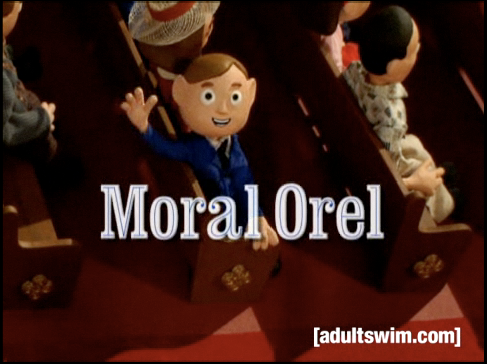
Anyway, this is a roundabout way of saying, “Moral Orel” is a lot like “Davey and Goliath” even though Dino Stamatopoulos says his show is based on sitcoms of the 1950s and 60s. I'm not going to argue with him, but Orel and Davey are very similar looking:


(ORAL)


(Davey)

In the end, it doesn't matter. The show was broadcast on Adult Swim and focuses on a town in the exact middle of the United States called Moralton, which is the capital of Statesota. Orel is a well-meaning young boy who is obsessed with God and following the rules set forth by his elders; inlcuding his parents, his teachers and the town's Protestant Reverend. These people rarely have Orel's well being in mind when they give him advice and often say things to get Orel out of their hair. Oftentimes the advice is contrary the Christian moral code, but Orel is too naïve to figure out any ambiguity and takes the advice at face value.

This, along with their general indifference causes Orel to misinterpret what his elders are trying to tell him. After Orel screws up his lesson, his father always brings him to his study where he gives Orel a few lashes with his belt and attempts to “explain” the lesson that Orel got wrong. This explanation is as bad or worse as Orel's interpretations and leaves him more confused than ever. One example of this is when Oral begins hanging around his friend Joe, who is the prototypical trouble maker. Joe continues to lead Orel down the wrong path culminating with the boys brutally beating up two homosexuals. What is the lesson that Orel's father teaches? Loyalty. He felt that Orel was disloyal to his established group of friends by spending more time with Joe and not including them.

As the show progresses, Orel begins to realize that adults don't always know what's best and realizes that confusion reigns over everyone and while they are more screwed up than children, adults just hide it better through hypocrisy, dishonesty and denial.

In the big picture, this show is Stamatopoulos' views on the so-called moral majority, ie the middle-American “red states” and how they interact with anyone who has values that are different from their's.

Many of the adult characters have deep-seeded, dark issues including alcoholism, crippling loneliness, dementia brought upon by rape and overall hatred that are buried below a cheerful, “moralistic” attitude. These demons are raised from time-to-time but instead of being dealt with, they are pushed down further under the surface causing anxiety and a misery. It is this facade of everything is fine on the surface which belies the true cesspool, that Stamatopoulos and Scott Adsit (who plays Pete Hornberger on “30 Rock” and is one of the writers and producers on “Moral Orel”) is most adept at writing about.

Being that most of these people of Moralton are church-going, conservative people, one can only assume that the writers feels that many right-wingers are self-effacing liars. Are the assertions true? Judging from the recent headlines of right wing politicians and mouth pieces, it looks as if he could be. It's not that the right have vices, everyone does, it's that they're so voracious about NOT having them. This is why many lefties enjoy the latest right-wing scandal.

While this show seems to be about the hypocrisy of the right and the way that a large majority of Americans think that there is “one correct way of living”, it really is about faith. From the very first episode to the last, Orel has always had the utmost enthusiastic faith in God. Week after week, events occurred where his faith should have been challenged, but week after week he bulldozed through those events secure that God was going to make things all better.

While some of the more well-known moments from the show are infamous, the bottom line is Orel doesn't make mistakes to spite God, he does it because he wants to honor God. One has to admire his focus and determination that a good, moral supreme being exists and that everything will work out in the end. Orel is a person who tries to do the right thing and one can argue that that is the overall lesson of the show, living by the Golden Rule. The only times that this rule becomes perverted is when people don't pay attention to it.

Stamatopoulos is a television hero of mine and the list of shows that he's worked on: “The Ben Stiller Show”, “Late Night with Conan O'Brien”, “The Late Show with David Letterman”, “The Dana Carvey Show”, “Mr. Show with Bob and David” and “Tom Goes to the Mayor” are a list of some of the better alternative comedy/anti-establishment shows in television history. His skewed view on society is acidic and over-the-top cynical, which is probably why not too many people know his work. His shows and humor are very polarizing and appeal to a limited type of person.

God, faith, hypocrisy are all extremely large issues to tackle and these issues are made even larger by the fact that “Moral Orel” was only a 15-minute show aired on the other side of midnight on Sundays. Stamatopoulos took the best swing at it and while it's not a no-doubt home run, it's pretty damn close. The way that he and Adsit were able to write and voice clay characters that the viewer cares about and ones that they will think about days after the show is over is remarkable.

Every day there is some preacher somewhere trying to “Save your soul” and telling you that salvation can be had if you give him $20. “Moral Orel” doesn't make claims on soul-saving or asks for your money, the show is an honest meditation on the role of religion in this country, warts and all. And that's what people need from religion, honesty.

Thursday, August 13, 2009

Change That We Can ALL Believe In


If I was the President of the United States, I would probably push for any canceled television shows that I loved to be put back on the air.

"Undeclared"
"Freaks and Geeks" (poor Seth Rogen would have to do double duty)
"Seinfeld" (though I'd be ok with the reunion that is supposed to occur on "Curb Your Enthusiasm")
Either the "Larry Sanders Show" or "It's Garry Shandling's Show" (both were awesome)
"Mr. Show"

Maybe, just for kicks, I'd see if Jerry Mathers could squeeze into his jeans and baseball cap to recreate Beaver Cleaver. That would be funny. Then I'd probably make him dance and throw nickels at him, yelling, "This displeases Hugh Beuamont" until he broke down in tears.

I would broadcast this every week on Pay-Per-View , with a new celebrity of course, until we got enough money to solve the deficit.

But I would definitely make it my mission to get "Arrested Development" back on TV. And if Michael Cera didn't want to do it, I'd excommunicate him.*

* I know that excommunication can only be done by the Pope, but it would be a modern miracle if I ended up as President, so I may as well go the whole nine yards and become the world's first Pope/President.

Anyhow, Cera would be living the rest of his life in Liberia or Burma (or is it Myanmar now?) or maybe the Arctic Circle until he wised up.

But this sort of thing happen--not the excommunication of Michael Cera--command performances by the wealthy and powerful.

When Michael Jackson died, I read an interview with Carrie Fisher, who was one of his buddies and she spoke about what a loving father the man was. As an example of his love, she said that Jackson's kids were crazy for "Star Wars" and one Christmas, as a surprise to them, Jackson asked Fisher to come over and act out a few scenes.

And she did it!

What scenes did she reenact? Did she do the Jaba, metal bra one? Did she put her hair in those space cinabuns for the kids? Did she tell Mark Hammil to quit watering her lawn for the day and come and help her out?

Can you even imagine being that insanely rich or powerful that you could call Carrie Fisher or some other actor or actress and have them come over to your house on Christmas day and recite lines from one of their movies? Of all the things I read about Jackson after his death, that's the one that stopped me in my tracks.

Elephant man bones? Meh.
Secret room in his closet he used to stash kids? Figures.
He had no nose because of all the plastic surgery and needed to wear a prosthetic--that may or may not have been stolen from the morgue the day he died? Weird, but ... no. That's really weird.

But the Carrie Fisher thing made me think that even though the guy lived the life of a pariah for the last two decades of his life, he still had a ton of influence. I wonder how much he paid her. I mean, he had to pay her, right?

And here's the thing, I know why Jackson's kids had no friends; there's no way that their parents could ever top any thing Michael Jackson did.

It's like that scene from "The Simpsons" where Homer goes to Krusty Klown Kollege* and becomes a regional Krusty. Unbeknownst to the Millhouse family, they hire him thinking that they got the real Krusty. Bart knows different, which leads to perhaps one of the greatest exchanges in Simpsons history:

Millhouse: Surprised Bart? My dad got Krusty the Klown for my birthday.
Bart: Oh. I'm sure I could do that too.
Millhouse: I don't know Bart, my dad's a pretty big wheel down at the cracker factory.

In other words, no matter how big of a wheel your dad is at his cracker factory, you're not going to beat Michael Jackson.

* This episode had so many awesome lines and was so good, yet no one talks about it. It's criminally underrated.**

** BTW, my wife hates my asterisk interludes, but I like them a lot. Sorry honey.

So if you like my platform, remember: Magrane in 2016! I don't want to run against Obama--I heard he reunited the Sweathogs just so that he could shave Gabe Kapplan's mustache.

Wednesday, January 02, 2008

53.The Andy Griffith Show


For a stereotypical cynical slacker like myself, “The Andy Griffith Show” would seem to be the last show that you would expect to find on a list like this. Especially since I don't enjoy it ironically like “Leave it to Beaver”. The list ranking of TAGS is based on its own merits and to add a caveat, this is only for the black and white episodes -- I've never seen the ones filmed in color.

What's there to like about the show; it's not particularly “real” or cutting edge. It doesn't really speak to where I'm from (geographically, socially and generationally) but it does say something. Much like “My Name is Earl”, after I watch TAGS I feel pretty good about myself and the world at large. Sure, the show is moralistic and some of the wisdom is corn-fed and homespun, however that's ok. That's what the show is about: being good to your fellow person and respecting them. The show has never apologized for this stance and they shouldn't because the Golden Rule is one that we should be trying to live by, not explain away. (Note: I am writing this the day after I made my New Year's resolution, so I still have a lot of optimism about myself and the human condition)

A lot of the things that make me laugh usually has some sort of disrespect tied to it; from making fun of someone to laughing at the shortcomings and bad luck of somebody else, I normally find that very humorous. And I know that I'm not alone, nor is this a new form of humor. Yes, during the past 15 years or so comedy culled from irony, sarcasm and cynicism has grown in leaps and bounds, but it's always been there. Don Rickles made an entire career on calling audience members hockey pucks and George Carlin and Lenny Bruce used sarcasm as an observational—mostly truth-telling sabre—that cut through the bullshit of the 60s.

Which brings us to “The Andy Griffith Show”. If you haven't seen an episode lately, Andy Taylor (played by Andy Griffith) was the single-fathered Sheriff of a small town in North Carolina called Mayberry who dispensed wisdom more than he threw people in jail. His son Opie was played by Ron Howard and his deputy and cousin Barney Fife was played by Don Knotts. Taylor's Aunt Bea (Francis Bavier) kept house and a variety of the town's characters (Floyd the barber, Otis the town drunk and Gomer and Goober) kept things interesting.

Andy is easily the most intelligent person in town and the bulk of his day is spent dealing with the less intelligent townsfolk. While I wouldn't call the average Mayberrian and idiot, they aren't far from idiot county. What makes this show work is that Andy doesn't lord his intelligence (which is really clear-thinking wisdom, Andy isn't about to split the atom any time soon) over the people he interacts with. Having an island of intelligence in a sea of stupidity has long been a (cliched) comedy staple, but the writers of TAGS don't normally stoop to that level. Andy treats his friends and people that he lives with a certain amount of respect and in turn they treat him that way too.

For example, Taylor knows that Barney Fife shouldn't be within 100 yards of a handgun, but he's a cop so he has to have one. Because he doesn't want him to shoot his big toe off, Taylor tells Fife to leave the gun unloaded and keep one bullet in his shirt pocket. Of course, Taylor doesn't tell Fife his reasoning which is why Barney goes along with his instructions.

Taylor deals with circumstances like this every day and with every person in the town.

As sheriff and brightest bulb in Mayberry Andy is the de facto mayor and if he wanted to, could use that position to his advantage. He doesn't. The only time that Andy's hackles are raised is when an outsider comes to town and tries to pull one over on the townspeople. When this occurs (and this was a story that the writers went to the well for a lot) Andy usually plays the “Aww-shucks, backward Southerner who is really smarter than expected” role to the hilt sending the offenders scurrying for the nearest big city where they can try to sandbag someone “less wily”.

In fact, this is essentially how the show began. Originally a spin off of “Make Room for Daddy”, Andy busts Danny Thomas (the star of MRFD) for running a stop sign. Thomas tries to big league Taylor and spends time in jail which makes him late for his show. After figuring out that he needs to respect Taylor and the Mayberry ways, Thomas is released and the audience learns that despite their modern conveniences and new ways city slickers don't always have it over their country bumpkin cousins.

Home style wisdom being the best solutions and life was better in an uncomplicated time were both undercurrents of the show. Many of the people who had televisions when this show was popular lived in the urban or suburban areas and had fast-paced, modern lifestyles. This show was an ode to slow living and patience. And since nothing catastrophic ever happened in Mayberry, one could argue that the overall message of the series was that the modern world is moving too quickly. One needs to stroll down main street, stop every once in awhile and talk face-to-face with your neighbors—learn about your surroundings. The end result is that you'll probably have a friendly society filled with more respect (BTW, I've alluded to or said the word “respect” more times in this essay that Ali G ever did during his show).

I think that is why I enjoy watching this show. I was born in 1974 so I am going to have to assume that most towns and cities weren't actually like this during the early 1960s. Petty grievances and gripes come up all the time and can not be solved in 30 minutes (minus commercials) with a drawl and some of Aunt Bea's famous peach cobbler. In real life, minor grievances and gripes tend to fester and turn into generational feuds that ruin families and destroy communities. But during this program, even if someone is angry with another, they always respected them enough to work their differences out.

And the respect that Andy, an officer of the law, is shown on a day-to-day basis is also refreshing. As someone who graduated a suburban high school the year after the Rodney King incident, blasted NWA's “Fuck the Police” from his father's Ford Tempo and has bitched about personal interactions with John Law (parking fines and speeding infractions) this reason may seem a bit odd. Though, I think that much of society's ills towards law enforcement is the result of the disrespect of the badge.

I've read articles and pieces about people who said that when they were kids, the neighborhood police officer was a position of great respect. Kids were taught that cops were their friends and should be the first person to run to while in trouble. During the last few decades, these thoughts have been turned on its ear. I've heard parents use the police as a scare tactic or worse, a threat; as in “If you're not good I'll have that policeman over there throw you in jail.” How does teaching a child to fear authority also show them to trust and respect the police? It doesn't; this type of parenting creates paranoia and disrespect towards authority.

Sheriff Taylor didn't have to deal with that and as such his town was a virtual utopia. Crime was nonexistent, people seemed happy. Of course respect is a two-way street and to pretend that there aren't crooked cops or people who mistake their badge as an all-access pass to take advantage of any and all situations would be naïve.

This idyllic world is a great world to live in, even if it is only for 30 minutes (minus commercials) and it's in black and white.

Bit of trivia for you: the title of the infectious theme song is called “The Old Swimming Hole”. I had no idea about that until today.