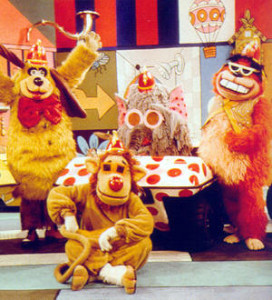
The above title isn’t indicative of what this post is going to be about, but it was alliterative and reflected the spirit better than Nostalgia for Nihilism, so I went with it.
My wife and I have two daughters under the age of six. The oldest one is five and the youngest one has just turned two. Each kid has their own personalities that will undoubtedly change between now and their teenage years. As their parents, Aly and I worry about them constantly. While a lot of our concerns overlap, there are things that she freaks out about more than I do and vice-versa.
One of the things that I think about is what I’m giving to my children and how it ultimately affects them. If you’ve read this Blog over the years, you’ll find that the one thing I’m a tad obsessed about is nostalgia. I write about it all the time. Most of my jokes and references are rooted in a 70s/80s/90s/early 00s pop culture quagmire that is becoming less relevant to anyone outside of my generation as the days go by. So it should come as no shock that when I talk to my kids and share things with them, most of the time, I’m sharing things that I liked when I was a boy.
This leads me to over-thinking about whether I am making my kids nostalgic for a past that they never had.
To wit: for the longest time, my kids’ favorite song was “The Banana Splits Theme Song”. Do you know how many times they’ve seen that show? The youngest one has never watched an episode and the oldest saw half an episode once but asked me to shut it off because “The Arabian Knights” cartoon was too scary. Yet, they love the Banana Splits song and ultimately the idea of the Banana Splits, especially when I tell them how much I used to love the show as a kid and how I would always wake up from my nap at 1:30 pm so I could flip on TV-56 and watch the Splits* do something funny.
* The interesting thing is that the Banana Splits was a take-off on the Monkees which was a take-off on the Beatles. So while what I was watching was a third-generation version of the original, my daughters are grooving to a fourth (or fifth) generation of the Fab Four. Let’s all do the Banana Split, indeed.
When we read comics, I’m usually reading the old Marvel stuff that I used to love and the girls are reading updated kiddie versions of that same old stuff.
When they hunker down to watch TV they both beg to watch Boomerang, which is Cartoon Network Classic. Or they ask to tune into The Hub, which has old stuff from the 80s like JEM, Transformers, GI Joe* and updated stuff from the same era. Even Nickelodeon (to an extent) and Disney keep churning entertainment built on characters from their past. My youngest is obsessed with Tinkerbell, so much that we have to watch one of the movies (usually the 30-minute short) every night before she goes to bed. And while these movies are new, the character of Tinkerbell has to be about 60 years old now.
* By the way all of the shows we liked as kids suck now. There is literally no rhyme, reason or logic to any of the plots—which are so warmed over and hackneyed they’d make Chuck Lorre blush in their unoriginality.
The toys that they own are things both my wife and I played with when younger: Legos, Cabbage Patch Dolls, Barbie (I’ll let you guess which of the proceeding toys I played with the most – answer below!). Even some of the toys that weren’t around when I was a kid have some sort of mooring to the past. For example, the oldest was on an American Girl Dolls kick a few months ago. These are extremely expensive dolls and accessories that have back stories set in the past*. Some dolls are set during the Revolutionary War, some dolls are from the Civil War, others are part of the Great Depression (so fun!). My oldest loves Julie, who is based in the 1970s.
* There are some dolls that have adventures in the present, but the ones that American Girl seems to focus on and market are the ones from past era.
Many of the toys that are on the shelves today seem to be a derivative of something that sold well in the past. And I know why this is true: nostalgia is big business. If you can tap into a parent’s past and polish it up to look like something current it’s going to serve two masters. One, the parent won’t mind purchasing it (“It’s just like what I used to play with!”) and two, it’s new and shiny and current so the child will crave it. The first part of that last sentence is most important because the parent controls the purse strings and when they’re spending cash, they want to make sure that it will be something that’s “worth it”.
To put it another way, I remember how much fun I used to have playing with Legos when I was a kid. Therefore I have no problem spending a small fortune on buying them Legos. Subconsciously I’m thinking, “I had a great time with these toys when I was a kid, so why shouldn’t my child have the same memories?” The feeling of shared memories—even brokered over decades—is strong and manufacturers understand and exploit this.
And the most important reason for this is: it’s just plain easier (and cheaper) to repackage things that sold well a generation ago than to come up with a brand new idea.
It will be interesting to see what this does to children of this generation. If adults are stalled in an arrested development that trickles down to their, what will the effects be? I am not suggesting that Gen Xers or Baby Boomers* grew up in an idyllic era of completely new products and ceaseless imagination. There are plenty of toys that I played with, television shows that I watch, songs that I listened to that were from my parents’ childhoods. Same with them and my grandparents. However, it seems that this recycling is on a grander scale.
* Who names generations anyway? Is it some sort of pop culture collective that come up with these increasingly ridiculous monikers? Because these names are down-right embarrassing. I wouldn’t even use them if they weren’t so darn handy.
Perhaps because there are more things vying for the attention of children, toy manufacturers need a proven commodity to make money. There is a multitude of television channels that need hundreds of hours of programming. Imagination and originality are a finite (and expensive) resource, no matter what Willie Wonka tells you. On average, our kids may be getting more original programming but it’s getting lost in the non-stop caterwauling of children’s television. Just by simple necessity, the old stuff outweighs the new stuff by at least three-to-one.
The final piece to this puzzle is accessibility. When my dad or mom would tell me about things they enjoyed from when they were children, it was a story and once it was done, it was lost in the ether. Unless one of my grandmothers kept one of their toys, I wasn’t going to be able to see it, hold it, experience it. They may as well have been telling me about the first steam engine. Same thing goes for their TV shows. Every once in awhile I’d tune in to the original “Mickey Mouse Club” or see an old cartoon, but very rarely would my parents and I talk about the show and I’d see it immediately.
There was no real tangible connection.
In this era, if we can remember it, we can see it. A few days ago I was humming a seemingly long-forgotten song from an Charlie Brown show that somehow wormed its way to the front of my brain. My daughter wanted to know what I was humming, I told her, she laughed and within seconds we were on YouTube checking it out. Now her memory is of watching this show after my brain regurgitated a once lost memory. In effect, I had to experience this first before she could.
I don’t think that’s the way it has always been this way.
At the beginning of this piece I wrote about how my kids have never seen a full episode of the Banana Splits, but love the song and idea of the show; especially when I talk about it from my perspective. While it’s true, they’ve barely seen the show, they’ve seen the opening theme/introduction to the show probably well over one thousand times. In fact, my oldest runs up the playground slide backwards and playfully falls on her side because she’s seen Drooper do it so many times.
Because of the instant accessibility of our childhood combined with the repurposing of old toys and TV shows, I worry that our kids are going to have false memories. I can picture my daughter telling her friends about how she used to run up the slide backwards and fall because she remembers a anamorphic lion from a program that she used to watch “all the time” doing the same thing. But the fact is she didn’t watch the show, she watched only a part of the show though she may not intrinsically know, or really understand, this fact.
Perhaps we as a culture will one day decide that “true” memories aren’t valid or even necessary anymore. These new societal mores may eventually pave the way for a scenario that echos the beginning of the movie/short story “Total Recall”. Specifically the scene when the main character Douglas Quaid (played by Arnold Schwarzenegger because fuck Colin Farrell in the remake – and yes, I get the irony in relation to what I’m writing about) enters the travel agency to has his brain implanted with memories of a vacation he never took may not be science fiction.
Then we’ll be that much closer to finding a woman with three boobs.


