Showing posts with label Tim Raines. Show all posts

Tuesday, November 19, 2019

Terry Francona 1990 Upper Deck


Before Terry Francona was the most beloved Red Sox manager of all time (he led them to the 2004 and 2007 World Series Championship, if you forgot and was a whisker from going back to the Fall Classic in 2008), he was a major league baseball player. 

I know it’s difficult to think of Francona as anything but the guy who sat at the end of the dugout in a Red Sox sweatshirt, but he was a well-regarded college player. He won the Golden Spikes in 1980 (which is the college version of MVP), won the MVP of the 1980 College World Series (that his University of Arizona team won) and was a first-round pick of the Montreal Expos. Add in that his father Tito (this is where he got that nickname, if you didn’t know) played in the Major Leagues for 15 years, and it appeared that Francona the younger was poised to be a star. 

Terry rocketed through the Montreal minor leagues and made his debut the year after he was drafted. He played in 34 games and started the season in the minors again, before coming up to stay in the second half of 1982.  

Francona didn’t have much of a position, he played a little outfield but in Montreal, they had two young, Hall of Famers in Andre Dawson and Tim Raines along with a bunch of other guys in rightfield. At first base was Al Oliver and in 1984 Francona got the opportunity to start, but he didn’t do much to establish himself as a star. The following year, he moved around a bit more and after the 1986 season, he was granted his release. 

From there he bounced around like a baseball vagabond: with stops in the North Side of Chicago in 1986, Cincinnati the following year, Cleveland the year after before winding up his career in Suds City in 1989. 

One of the things that people often say about baseball is that it’s a humbling game, and they’re right. If, at the beginning of the 1980s, you were to tell Francona that he’d end up bouncing around the Midwest hoping to latch onto a job; he’d have said you were nuts. He had the pedigree and not only that, but at every level he played at, not only was he successful; but he was among the most successful. 

I’m not sure how rapid failure, or in Francona’s case, rapid mediocrity can screw with your brain, but it must make you crazy. How can you hit like Ted Williams at multiple levels, but be stuck behind Warren fucking Cromartie at the ultimate level? Was Warren Cromartie that much better than you? Did he work harder than you? What was his secret?

I once read an interview with an athlete (I can’t recall who, and honestly it doesn’t matter) where the interviewer talked about how great it must be to a professional athlete. “You play a kid’s game and you get showered with money and praise and adulation! It must be wonderful!” And the athlete said that for stars, that kind of life is wonderful; but the majority of professional athletes aren’t stars. They’re constantly stressed out of their minds that someone is going to take their job or that their manager has a bug up their ass about them or that they’re going to lose their athleticism. Not only that but their General Manager is always looking to replace them with someone younger and cheaper. And the media is highlighting their latest screw up and that asshole in the stands is yelling at them. They live in constant fear and doubt.

It sounds like an incredibly stressful situation and I’m kinda shocked that an athlete hasn’t broken and pulled a “Last Boy Scout” yet. 

For Francona he had to live with this paranoia just like everyone else, but he also had to live with the stain of being a disappointment. That’s a lot of baggage to foist on to one person. And I think that’s why he was such a good manager. He understood what it was like to be a star and he understood what it was like to be a scrub. He got that the fear of losing this professional life, this money, this lottery ticket all of this weighed heavily on 99% of his players. He was able to coax greatness out of them because he understood them in a way that few had. 

Ted Williams was an incredible baseball player, but he was a shitty manager. In the late 60s, he managed the Washington Senators and when they moved west to Dallas, he managed the Texas Rangers for a little bit too. The one thing that Williams could never understand is why his players couldn't hit like him.

Ted Williams was probably the greatest pure hitter that ever lived. And while he studied the hell out of hitting, he had a truly unique innate ability to marry the transfer of his weight and otherworldly hand-eye-coordination to smash a spherical object thrown at great speed with another rounded object, hitting that first object very, very far. It's not easy. Every hit is a complex calculation that your brain conducts where it determines the speed of what's being thrown at you with the ability to guess where this thing is going to be in .004 seconds. Even for major league hitters, hitting isn't easy. Shit, in his greatest season ever, Williams failed 59.4% of the time.

But his inability to understand that his charges are doing their best routinely flummoxed him. 

Not so for Francona. He understood that the game of baseball is hard, that hitting a baseball is even harder still. Not only that, but he was able to express this understanding of the game's frustration. And I think that’s also why he was Michael Jordan’s first manager when MJ rode the busses in the mid 90s and called Birmingham home for a summer. Francona sorta understood what it was like to be a star (maybe not a Michael Jordan star) and he grew up in major league locker rooms, so he also wasn’t star struck either. 

Was Terry Francona perfect? No. Probably not. But for a sport like baseball with its litany of imperfect people, he does just fine. 

Wednesday, February 06, 2019

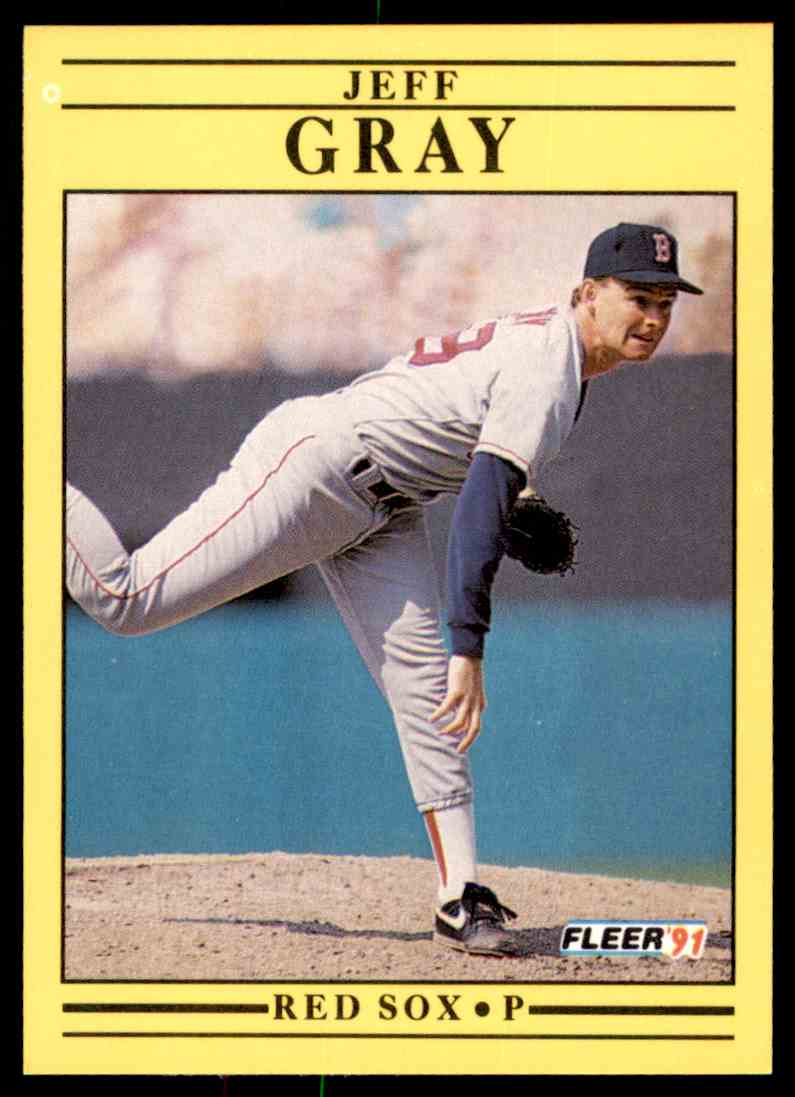
Rich Gedman 1989 Topps, Lee Smith 1990 Topps and Jeff Gray 1991 Fleer

On September 5, 2017 I received these cards from the Baseball Card Bandit (BCB):


On Facebook, I wrote: I've been really lax in my BCB updates. I received three cards in the last few weeks -- all Red Sox. 

The interesting thing is that on the Rich Gedman envelope, the return address was "BCB My Hometown". Gedman is from Worcester, it seems the BCB dropped a hint and that eliminates my first suspect. 

Looks like I'll have to rethink who it is. 

Quick hits:
Gedman: famous for his helicopter swing, two-time All Star that was flummoxed by Charlie Hough's knuckleball, victim of ownership collusion who never got his career back on track. Played 150 games a year because his back up was Marc Sullivan. 

2019: Rich Gedman was the local boy made good. He grew up in Massachusetts and the next thing you know, he's the starting catcher for the local nine. As someone who probably idolized Carlton Fisk, this was a big deal. And he did really well too. For a time.

But for Gedman, his career highs where like Monkey Paw wishes. He played in the 1985 and 86 All-Star Game, but Charlie Hough's knuckleball made Gedman look like a Little Leaguer in 1986. He just couldn't catch the things and they rolled all over the place. He was a laughingstock. Then there was his first World Series where Stanley bounced the ball in front of him and it rolled to the backstop putting Ray Knight in scoring position. After the season ended he was poised to be a big time free agent, only with Collusion rearing its ugly head, he didn't get an offer and due to the weird free agent rules of the day, signed with the Sox but could not report until May 1. 

The same thing happened to Tim Raines but while Raines was still awesome that year, Gedman never got on track and had a horrible 1987. And that snowballed into horrible 1988 and 1989. Gedman was a Walt Hriniak disciple and needed precise timing for his helicopter swing to work. I've always thought that missing 1987 Spring Training screwed up his timing and his lost season turned into a lost career. It also meant that Boston fans had to suffer through a month of Marc Sullivan catching. 

Gedman has had a pretty good post career where he's managed his hometown Worcester Tornados for a bit and is working for the Red Sox now. Gedman wasn't a bad guy, I used to like him a lot, he was just really unlucky. 

Lee Smith: hulking borderline HoFer reliever who pitched well in Boston but GM Lou Gorman couldn't leave well enough alone so he signed Jeff Reardon. Was traded for quarters on the dollar for Tom Brunansky. Said he'd literally sleep through the first five innings of every game before waking up, stretching and getting to the bullpen. 

2019: Since 2017, Smith has turned from a borderline Hall of Famer, to a real Hall of Famer as he was inducted by the Veteran's Committee (or whatever they're calling that now) about two months ago. Gorman's trade to get Smith was brilliant: Calvin Schiraldi and Al Nipper to the Cubs. That was it. But like I said above, he couldn't just leave well enough alone. He had to tinker and futz. Next thing you know, Smith is on his way to St. Louis for Brunansky. 

Smith had some really great years after he left Boston while the Red Sox bullpen was always a question mark. Who knows what could have been?

Look at his card, dude looked hulking. How could you not want him as your closer?

I wrote a bit more about this trade twice, in the Reardon pieces here and here. 

Jeff Gray: decent middle reliever most "famous" for having a stroke in the before a 1991 game. He was actually having a terrific year for the Sox before this injury occurred. He tried to come back but never could do it. According to Wikipedia he and Jody Reed owned a restaurant in Sarasota, FL called Beef O'Gradys. I want to go there.

2019: I still want to go to Beef O'Grady's. It sounds like a magical place. 

Thursday, July 27, 2017

Andre Dawson 1986 Topps


On June 4, 2016, I received the above card from the Baseball Card Bandit. That day, I wrote this on Facebook:

After about a week of hiding, the Baseball Card Bandit reappears with Hall of Famer and subject of an awkward rhyme: Awesome Andre Dawson. (Awesome and Dawson don't rhyme.)
Anyway, what the BBC doesn't know is that I witnessed Dawson's 400th homer in person as a young college lad. The Hawk and I are connected via round numbers.

For a long time, I’m not so sure if it’s true now, the mantra for every comic book writer was something to the effect of, this issue could be someone’s first issue, so you have to explain everything. This is why if you binge read a collection of comics from the 60s, 70s or 80s, it seems incredibly repetitive. Plots are retold, powers and secret identities are re-explained and things don’t seem to really get going until page 5 or 6. They didn’t want to lose readers.

The same mantra should have been uttered by baseball card photographers during those times too. Andre Dawson was an incredibly exciting player who happened to play in baseball Siberia: Montreal. It was dark, dreary and growing up an American League city, I didn’t get to see them play that much because the Expos were rarely on Saturday’s Game of the Week*.

** The wasn’t exactly true. Since there once was a high population of French Canadians that settled in my town, Amesbury’s cable company (this was before there were three or four national cable providers, most towns had their own little mom and pop operation so channels varied widely from town-to-town) had a Montreal station as part of its basic package. The entire channel was in French and not only did they show those terrible old Marvel Comics cartoons from the 1960s dubbed in French, but they also ran Canadiens games and once in a while, Expos games. I would never watch the games though, for some reason seeing the quality of the broadcast combined with the French language, freaked me out. I’d change the channel immediately. Other than that, I do remember in 1987 when the Expos were on NBC’s Saturday Game of the Week. Tim Raines was making his return to the Expos lineup after being held out of games for a month. Back then, if you were a free agent and didn’t sign with your team by mid-January (I think), you weren’t allowed to negotiate with your team until May 1. Which is a fucking insane rule, but with owner collusion (they all decided not to sign free agents) and this rule, Raines wasn’t able to rejoin the Expos until the beginning of May. The day he returned, he destroyed Mets pitching going 4-4 and hitting a grand slam in the top of the tenth inning. He was awesome.

Damn, that was a long detour. Anyway, the point was this baseball card sucks. It’s Dawson, without a hat in a blue practice jersey in front of a blue wall. He looks like a regular dude just sitting around. When I first pulled this card from a pack, I hated it. It’s boring and I never heard of him before, which meant that Andre Dawson must not have been very good. I was incredibly wrong. Dawson didn’t suck, he was actually incredibly good. I just didn’t get it then.

Like Raines, Dawson was part of that 1986-87 free agent class of players who were found by a court to be unlawfully colluded against. Aside from Raines, Red Sox catcher Rich Gedman was in the May 1 situation, and it seemed as if he never bounced back from not having a spring training that year. He was terrible in 1987, worse in 88 and was relegated to a backup for the rest of his career. As a two-time All Star in 1985 and 86, this was an ignominious way to end his career. But unlike Gedman and Raines, Dawson didn’t wait until May 1 to return to the Expos. Unlike fellow free agent, Jack Morris, he didn’t crawl back to his old club and accepted whatever pittance they gave him.

Dawson believed in himself and knew that he was getting screwed, so he did what he felt was best: he went to the Chicago Cubs and basically said, “I need to get off of the turf in Montreal (it completely destroyed his knees) and I want to play for the Cubs. Here is a blank contract, fill it in for what you think I’m worth and then we’ll renegotiate.” The Cubs were over a barrel here, on one hand the team felt that they had to be loyal to the rest of the owners but on the other hand, they were terrible and Dawson was practically giving himself to them. They settled on a $500,000 contract plus bonuses if he played well.

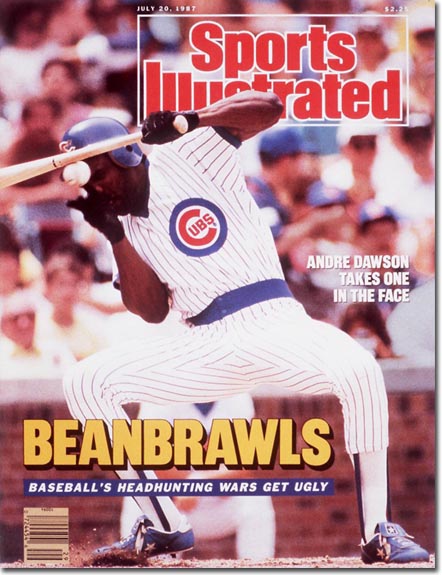
Dawson played out of his mind in 1987.  He led the National League in home runs with 49 and runs batted in with 137 (this is when people gave a shit about RBIs). Writers were so impressed that despite finishing in dead last place, Andre Dawson won the National League’s Most Valuable Player. And he only made $700,000. The following offseason, the Cubs signed him to a much better contract and all was right with the world. Aside from the homers, the one thing that I remember most about Dawson is when he got drilled in the face by Padres pitcher Eric Show. Sports Illustrated captured the picture and put it on that week's cover:


From what I remember Eric Show was a bit of a prick.  He hit Dawson on purpose because the Hawk had hit three homers in five at bats against San Diego. Seems like a good reason to break a guy's cheek bone. But according to Wikipedia, Show was busted using meth a few years later. So, there may have been a reasons for this. 

After his seasons in Chicago, he went to the Red Sox where he played on some truly terrible teams before ending up going home to his native Florida and playing out the string as a Marlin. By the time he played for those two organizations, he was in his late 30s. Age and injuries robbed these fans of seeing the vibrancy of a young Andre Dawson, instead he plodded along occasionally hitting a homer, trying to fight the inevitable one at bat at a time.

Andre Dawson had a fantastic career, he slugged over 400 homers, stole over 300 bases, and had a career OPS+ of 119. He ended up getting the call to the Hall of Fame in 2010 and he’s widely considered one of the all-time great outfielders. But there are always the questions of what if that plague him. What if he didn’t play in Montreal? What if he didn’t play 81 games on the turf of Olympic Stadium?

When he was younger, Andre Dawson was amazing. He could run, he could hit for power and average, he had a plus arm and was a tremendous defender. By playing in Montreal and especially on the “turf” (which seemed to be green-painted concrete) Dawson’s knees were brutalized. He was always hurt, or when he was “healthy” he spent hours icing his knees and legs to make sure that he was ready to go the next day.


Imagine if Dawson played his entire career in a big baseball mecca like New York or Chicago or Los Angeles? More people would know the Hawk and dopey kids in Amesbury, Massachusetts wouldn’t look at his baseball card and immediately assume that he stunk based only on a terrible photo.