Showing posts with label Rich Gedman. Show all posts

Friday, June 30, 2023

Ed Romero 1988 Fleer

Sometime in the last two or three months, I received this card from the Baseball Card Bandit (BCB). By the way, this is a great look at the 75th anniversary patch of Fenway Park  that the Sox wore in 1987:


Even when I was a kid, I knew that not everyone on a baseball team was drafted and brought up through the minor leagues by the team that they now played on. There were agencies to improve teams, like free agent signings and trades.


Trades were always the cooler of the two options, any moron could splash a pile of money in front of a guy and say, “Play for us, you disgusting Hessian here’s your filthy lucre.” And nine times out of ten, that player would take the cash. BTW, there is no judgement or shame in the preceding sentences, every single one of us would (and do) the same things every day in our lives.


Who doesn’t want to get paid?


But trades were a gentlemanly pursuit of excellence, a General Manager needed a bit more deft and cunning to outsmart his cohort. The ability to watch a team other than your own and say, “That chap there looks like he can certainly help our outfit!” and then contact his employer with a proposal to bring him to your team—without sacrificing too much—that takes the steady nerve of riverboat gambler.


The ability to really want something, let someone know you really want something and then not give everything you own to have that something—often in a time of extreme need—is a skill that most people don’t possess. If you’ve played cards with me before, you already know that I don’t have it.


This is a long road to saying that former Red Sox infielder Ed Romero was one of the first players that I remember seeing in the day’s current set of baseball cards (not this one) pictured for his old team while watching him on TV with his new team. I was well aware that the Red Sox got Don Baylor from the Yankees for Mike Easler in a seldom-seen swap between the two franchises Also add in that it was one-for-one position-for-position trade and this was a landmark deal that weighed heavily for Boston.


But Ed Romero? When did we get him? (December 11, 1985) Who did we give up to get him? (Workhorse, but oft maligned, reliever Mark “Big Foot” Clear – I have no idea why they called him that) What is he going to do for us, we already have Marty Barrett and Glen Hoffman plus future shortstop Rey Quinones is rocketing through the minors? Why do we need him? (Because Quinones flopped, Hoffman wasn’t much better when he wasn’t hurt and you need backup infielders because players get tired; though Manager John McNamara might not agree with that last statement)


Romero came over to the Sox from the Milwaukee Brewers, the only franchise he had ever known, and was kinda not great for his three-and-a-half years with the team. His totals were .236/.287/.280 with two home runs and two stolen bases (and four caught stealings). For a guy that played 12 years in the bigs (no small feat) but couldn’t really hit (.247/.298/.302) or run, Romero must’ve been a really good glove man.


I have no recollection of that. But I mean, he must’ve been. Why would you keep Ed Romero around for more than a decade if he couldn’t do at least one thing well? So let’s assume that he was a versatile (he played every defensive position—including DH!—except pitcher and catcher, according to Wikipedia) glove first ball player.


He played on two World Series teams, 1982 with the Brewers (he didn’t play in the Series) and 1986 with the Sox, and lost both of them. I wonder if he thinks about that a lot? I mean it’s cool to say that you were in the World Series, and doubly cool to say that you were in two World Series but the next questions are always: how did your teams do? We lost both. How did you do? I got one at bat in one game and didn’t get a hit.


Maybe it’s not something he brings up too often while at dinner parties.


The one thing that I remember most about Romero was the Gatorade bucket incident. I didn’t recall all of the particulars, but the Athletic did. Apparently the Sox were playing the Yanks in June 1989 and were getting beat 7-2. All of a sudden things started clicking for the good guys and the score was tied. Romero came to the dish with the winning run on first, facing Dale Mohorcic.


The right-handed Mohorcic started the right-handed hitter off with three straight balls when Yankees manager Dallas Green felt like he had seen enough. He summoned another right hander, Scott Nielsen, to try and get the dangerous Romero out. At this point Red Sox Manager Joe Morgan decided it was time to put his genius into action and sent up the left-handed Rich Gedman (who was probably hitting as bad or worse than Romero at the time) to win the ball game!


I mean, this is a move straight from Monty Burns. It’s called playing the percentages! It always works—just like telling Daryl Strawberry to hit a homer. Gedman walked, Jody Reed grounded out and the Yankees won after getting a run in the eighth inning.


But the big incident was Romero going insane and throwing a Gatorade bucket on the field. He was incensed that Morgan would show him up like that. I remember columnists lit into him and whenever TV stations ran sports bloopers, that was always on one of the reels. 


From what I've heard Romero, was a pretty mild-mannered guy, so I wonder what his teammates thought? I know that they called him "Gator" for a bit, which must've made Mike Greenwell mad as that was his weirdo nickname. But I think that they had to have sided with him because that was a bullshit move that Morgan pulled. And I bet Morgan would agree. 


Morgan, who was interviewed for the Athletic piece, said that he understood why Romero would react that way but that he (Morgan) “made crazy move (like that) once in a while”, which would’ve have driven today’s baseball fans insane. Morgan said that Romero paid the $50 fine right after the game and they never spoke about the incident again.


I recall that Romero was released like a week later, but it was a little longer than that. His employment with the Red Sox ended on August 5, 1989. From there he played with the Braves, the Brewers (again) and the Tigers. Finally retiring in 1992.


Romero is a baseball lifer and has been bouncing around various leagues with various jobs, I would assume that he’s retired. But you know who’s not? His son, Eddie. Eddie Romero has been in the Red Sox front office since 2006, currently an executive vice president and assistant general manager.


Not a bad deal at all.

Wednesday, February 13, 2019

Rick Cerone 1990 Fleer

On March 6, 2018 I received this card from the Baseball Card Bandit (BCB):


On Facebook, I wrote: A few weeks ago the BCB sent another card. This is of former Red Sox catcher, Rick Cerone. 

Cerone was a backstop who bounced around — he was on eight different teams. You might remember him from his years as a Yankee — he wore pinstripes three different times. By the time he came to Boston, he was nearing the end of his career. 

2019 Notes: Cerone was a member of (in order) the Indians, Blue Jays, Yankees, Braves, Brewers, Yankees (again), Red Sox, Yankees (one more time), Mets and Expos. For some reason I think it's funny thinking of Rick Cerone trying to navigate the streets of Montreal as very funny. I'm sure he's an erudite and sophisticated dude in real life, but he always looked like a doofus Staten Island longshoreman. "Yeah, hey Frenchy, how the fuck do I get to the fucking Olympic Stadium?I gotta fucking game today, asshole. Fucking speak American, fucko. Jesus fucking Christ, this place sucks. Can't even get good gabbagool here. Fughadaboutit."

He probably never said that, but a boy can dream!

Cerone didn’t hit much but by the end of the 80s, the Sox were kinda screwed when it came to catchers. John Marzano (RIP) never panned out, Rich German forgot how to hit and you’d never find a more text book case of nepotism than Marc Sullivan. 

2019:  you guys, I am really quite bitter towards Marc Sullivan. 

So when a dude gets released by your rival, can hit .240 and plays okay defense, I suppose in this case, you have to sign him. That pretty pathetic production would, unfortunately, help that team. So the Sox did just that. 

Like I said, Cerone didn’t make much of an impression on the field, but he did make an impact off. In a Cleveland (or Detroit, I forget which one exactly) hotel lobby Cerone and Dwight Evans got into a fistfight. I don’t recall why or who won, but fighting Dewey? Seriously? Go back to the Yankees, you jackass. 

And guess what, he did just that in 1990 after the Sox signed Tony Pena in the offseason -- who took his number six (since retired for Johnny Pesky).

2019: I don't believe in those "embedded rivals from another team" stories. They're dumb and they're lazy and they're just not true. People used to say it about former Sox and Yankees reliever Ramiro Mendoza all the time. And I know that it was supposed to be fun, but I think after awhile people began to believe it. "Cashman let Mendoza go so that he could sign with the Red Sox and ruin the team from within. How else can you explain why he sucks so bad?"

So went the logic in the summer of 2004. 

It's not remotely true. Professional athletes are Hessians who play for any team that will pay them and allow them the most playing time. Once you sign your professional contract, those feelings are out the door*.

* It's why when people use "evidence" like, "Here's a picture of player X wearing a Yankees jersey when he was a kid, I just know that he's coming to the Bronx!" Yeah, lots of kids wore Yankees gear when they were kids. If the Houston Astros offered a penny more, they'd be an Astro. No one is going to turn down money because they really, really liked a team when they were 12-years-old. I'm sure that kid used to love Dunkeroos too.

I guess what I'm trying to say is that while there's a lot of lip service, for the most part, athletes see themselves as ballplayers rather than a Ranger or a Laker or a Giant. Yes, there are some very rare exceptions (Tom Brady, Derek Jeter to name a few) but that's just how it goes. No matter what we want to believe, players just don't have the same emotional connection to the team they play for that we as fans do. They just don't. 

Like everything in life, there are exceptions. 

Rick Cerone never looked the part of a Red Sox. With that black mustache and cocky demeanor. he looked as if he just arrived off a commuter boat from Staten Island. He always looked annoyed that he was in a uniform without pinstripes. And while I don't think that many players particularly care which city they find themselves in, Cerone really seemed to. He was born in Newark, NJ, went to Seton Hall and played for the Yankees three different times and the Mets once. He was the team's catcher after Thurman Munson wrecked his plane and even after he retired, settled close to Manhattan, worked for the WPIX and eventually founded the minor league Newark Bears. 

As a Red Sox, he didn't do much. He platooned with Gedman in 1988 and according to Wikipedia, never got into a game in that season's ALCS. That really must have pissed him off -- I know that I'd be mad. He ended up playing for 18 seasons, made it to the World Series once (a 1981 loss to the Dodgers) and spent a bulk of his career with his favorite team. 

I would bet that if you asked 12-year-old Rick Cerone what he wanted out of his life, I bet the answer would be, "I want to fucking play catcher for the fucking New York fucking Yankees." Well, congratulations young Rick, you got your wish. 

Wednesday, February 06, 2019

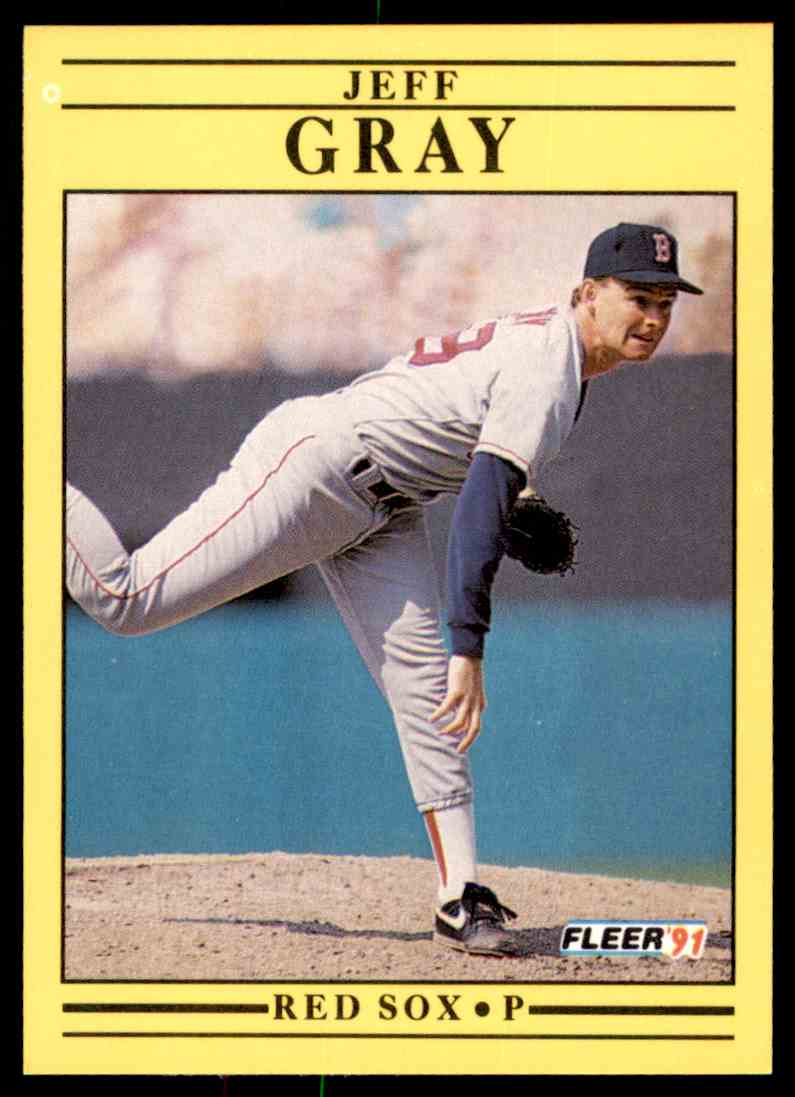
Rich Gedman 1989 Topps, Lee Smith 1990 Topps and Jeff Gray 1991 Fleer

On September 5, 2017 I received these cards from the Baseball Card Bandit (BCB):


On Facebook, I wrote: I've been really lax in my BCB updates. I received three cards in the last few weeks -- all Red Sox. 

The interesting thing is that on the Rich Gedman envelope, the return address was "BCB My Hometown". Gedman is from Worcester, it seems the BCB dropped a hint and that eliminates my first suspect. 

Looks like I'll have to rethink who it is. 

Quick hits:
Gedman: famous for his helicopter swing, two-time All Star that was flummoxed by Charlie Hough's knuckleball, victim of ownership collusion who never got his career back on track. Played 150 games a year because his back up was Marc Sullivan. 

2019: Rich Gedman was the local boy made good. He grew up in Massachusetts and the next thing you know, he's the starting catcher for the local nine. As someone who probably idolized Carlton Fisk, this was a big deal. And he did really well too. For a time.

But for Gedman, his career highs where like Monkey Paw wishes. He played in the 1985 and 86 All-Star Game, but Charlie Hough's knuckleball made Gedman look like a Little Leaguer in 1986. He just couldn't catch the things and they rolled all over the place. He was a laughingstock. Then there was his first World Series where Stanley bounced the ball in front of him and it rolled to the backstop putting Ray Knight in scoring position. After the season ended he was poised to be a big time free agent, only with Collusion rearing its ugly head, he didn't get an offer and due to the weird free agent rules of the day, signed with the Sox but could not report until May 1. 

The same thing happened to Tim Raines but while Raines was still awesome that year, Gedman never got on track and had a horrible 1987. And that snowballed into horrible 1988 and 1989. Gedman was a Walt Hriniak disciple and needed precise timing for his helicopter swing to work. I've always thought that missing 1987 Spring Training screwed up his timing and his lost season turned into a lost career. It also meant that Boston fans had to suffer through a month of Marc Sullivan catching. 

Gedman has had a pretty good post career where he's managed his hometown Worcester Tornados for a bit and is working for the Red Sox now. Gedman wasn't a bad guy, I used to like him a lot, he was just really unlucky. 

Lee Smith: hulking borderline HoFer reliever who pitched well in Boston but GM Lou Gorman couldn't leave well enough alone so he signed Jeff Reardon. Was traded for quarters on the dollar for Tom Brunansky. Said he'd literally sleep through the first five innings of every game before waking up, stretching and getting to the bullpen. 

2019: Since 2017, Smith has turned from a borderline Hall of Famer, to a real Hall of Famer as he was inducted by the Veteran's Committee (or whatever they're calling that now) about two months ago. Gorman's trade to get Smith was brilliant: Calvin Schiraldi and Al Nipper to the Cubs. That was it. But like I said above, he couldn't just leave well enough alone. He had to tinker and futz. Next thing you know, Smith is on his way to St. Louis for Brunansky. 

Smith had some really great years after he left Boston while the Red Sox bullpen was always a question mark. Who knows what could have been?

Look at his card, dude looked hulking. How could you not want him as your closer?

I wrote a bit more about this trade twice, in the Reardon pieces here and here. 

Jeff Gray: decent middle reliever most "famous" for having a stroke in the before a 1991 game. He was actually having a terrific year for the Sox before this injury occurred. He tried to come back but never could do it. According to Wikipedia he and Jody Reed owned a restaurant in Sarasota, FL called Beef O'Gradys. I want to go there.

2019: I still want to go to Beef O'Grady's. It sounds like a magical place. 

Thursday, July 27, 2017

Andre Dawson 1986 Topps


On June 4, 2016, I received the above card from the Baseball Card Bandit. That day, I wrote this on Facebook:

After about a week of hiding, the Baseball Card Bandit reappears with Hall of Famer and subject of an awkward rhyme: Awesome Andre Dawson. (Awesome and Dawson don't rhyme.)
Anyway, what the BBC doesn't know is that I witnessed Dawson's 400th homer in person as a young college lad. The Hawk and I are connected via round numbers.

For a long time, I’m not so sure if it’s true now, the mantra for every comic book writer was something to the effect of, this issue could be someone’s first issue, so you have to explain everything. This is why if you binge read a collection of comics from the 60s, 70s or 80s, it seems incredibly repetitive. Plots are retold, powers and secret identities are re-explained and things don’t seem to really get going until page 5 or 6. They didn’t want to lose readers.

The same mantra should have been uttered by baseball card photographers during those times too. Andre Dawson was an incredibly exciting player who happened to play in baseball Siberia: Montreal. It was dark, dreary and growing up an American League city, I didn’t get to see them play that much because the Expos were rarely on Saturday’s Game of the Week*.

** The wasn’t exactly true. Since there once was a high population of French Canadians that settled in my town, Amesbury’s cable company (this was before there were three or four national cable providers, most towns had their own little mom and pop operation so channels varied widely from town-to-town) had a Montreal station as part of its basic package. The entire channel was in French and not only did they show those terrible old Marvel Comics cartoons from the 1960s dubbed in French, but they also ran Canadiens games and once in a while, Expos games. I would never watch the games though, for some reason seeing the quality of the broadcast combined with the French language, freaked me out. I’d change the channel immediately. Other than that, I do remember in 1987 when the Expos were on NBC’s Saturday Game of the Week. Tim Raines was making his return to the Expos lineup after being held out of games for a month. Back then, if you were a free agent and didn’t sign with your team by mid-January (I think), you weren’t allowed to negotiate with your team until May 1. Which is a fucking insane rule, but with owner collusion (they all decided not to sign free agents) and this rule, Raines wasn’t able to rejoin the Expos until the beginning of May. The day he returned, he destroyed Mets pitching going 4-4 and hitting a grand slam in the top of the tenth inning. He was awesome.

Damn, that was a long detour. Anyway, the point was this baseball card sucks. It’s Dawson, without a hat in a blue practice jersey in front of a blue wall. He looks like a regular dude just sitting around. When I first pulled this card from a pack, I hated it. It’s boring and I never heard of him before, which meant that Andre Dawson must not have been very good. I was incredibly wrong. Dawson didn’t suck, he was actually incredibly good. I just didn’t get it then.

Like Raines, Dawson was part of that 1986-87 free agent class of players who were found by a court to be unlawfully colluded against. Aside from Raines, Red Sox catcher Rich Gedman was in the May 1 situation, and it seemed as if he never bounced back from not having a spring training that year. He was terrible in 1987, worse in 88 and was relegated to a backup for the rest of his career. As a two-time All Star in 1985 and 86, this was an ignominious way to end his career. But unlike Gedman and Raines, Dawson didn’t wait until May 1 to return to the Expos. Unlike fellow free agent, Jack Morris, he didn’t crawl back to his old club and accepted whatever pittance they gave him.

Dawson believed in himself and knew that he was getting screwed, so he did what he felt was best: he went to the Chicago Cubs and basically said, “I need to get off of the turf in Montreal (it completely destroyed his knees) and I want to play for the Cubs. Here is a blank contract, fill it in for what you think I’m worth and then we’ll renegotiate.” The Cubs were over a barrel here, on one hand the team felt that they had to be loyal to the rest of the owners but on the other hand, they were terrible and Dawson was practically giving himself to them. They settled on a $500,000 contract plus bonuses if he played well.

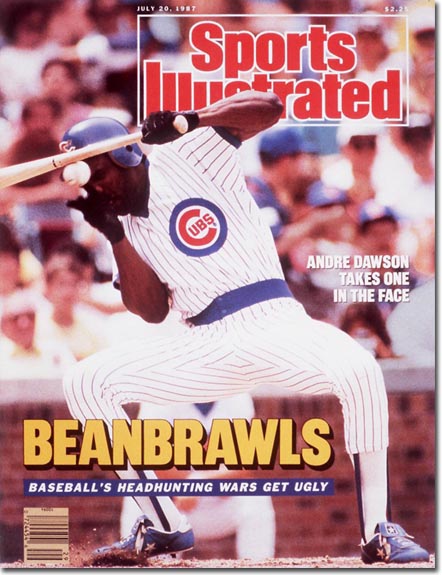
Dawson played out of his mind in 1987.  He led the National League in home runs with 49 and runs batted in with 137 (this is when people gave a shit about RBIs). Writers were so impressed that despite finishing in dead last place, Andre Dawson won the National League’s Most Valuable Player. And he only made $700,000. The following offseason, the Cubs signed him to a much better contract and all was right with the world. Aside from the homers, the one thing that I remember most about Dawson is when he got drilled in the face by Padres pitcher Eric Show. Sports Illustrated captured the picture and put it on that week's cover:


From what I remember Eric Show was a bit of a prick.  He hit Dawson on purpose because the Hawk had hit three homers in five at bats against San Diego. Seems like a good reason to break a guy's cheek bone. But according to Wikipedia, Show was busted using meth a few years later. So, there may have been a reasons for this. 

After his seasons in Chicago, he went to the Red Sox where he played on some truly terrible teams before ending up going home to his native Florida and playing out the string as a Marlin. By the time he played for those two organizations, he was in his late 30s. Age and injuries robbed these fans of seeing the vibrancy of a young Andre Dawson, instead he plodded along occasionally hitting a homer, trying to fight the inevitable one at bat at a time.

Andre Dawson had a fantastic career, he slugged over 400 homers, stole over 300 bases, and had a career OPS+ of 119. He ended up getting the call to the Hall of Fame in 2010 and he’s widely considered one of the all-time great outfielders. But there are always the questions of what if that plague him. What if he didn’t play in Montreal? What if he didn’t play 81 games on the turf of Olympic Stadium?

When he was younger, Andre Dawson was amazing. He could run, he could hit for power and average, he had a plus arm and was a tremendous defender. By playing in Montreal and especially on the “turf” (which seemed to be green-painted concrete) Dawson’s knees were brutalized. He was always hurt, or when he was “healthy” he spent hours icing his knees and legs to make sure that he was ready to go the next day.


Imagine if Dawson played his entire career in a big baseball mecca like New York or Chicago or Los Angeles? More people would know the Hawk and dopey kids in Amesbury, Massachusetts wouldn’t look at his baseball card and immediately assume that he stunk based only on a terrible photo.