Showing posts with label Rickey Henderson. Show all posts

Monday, November 03, 2025

My Favorite Red Sox Players 31-26


31. Rickey Henderson
This year I'm doing a countdown of my all-time Top 31 Favorite Boston Red Sox players. Note: these are players that I consciously remember seeing play. So Ted Williams, Yaz, Luis Tiant, Fred Lynn, Moe Berg aren't on the list.

Kicking off the list is one of my top five favorite baseball players of all time. He didn't contribute a lot to the Boston club, though he did have his moments. He was old, but still funny as hell. And it was awesome just to watch him get into his crouch and hit.

I'm talking about the one and only Rickey Henderson. When I was a kid, my brother and I worshipped Rickey. We thought that he was the absolute pinnacle of speed and power and cool. Having him on the Red Sox, even if he was a shadow of himself, was a dream come true.

Rickey is Rickey is Rickey now matter how old he was.


30. Dennis "Oil Can" Boyd
Number 30 on the list of my All-Time Favorite Red Sox players is one Mr. Dennis "Oil Can" Boyd. He was temperamental, a little crazy but loved to pitched. He kept going well into his 40s in different pro and semi pro leagues.

If he made the All-Star team in 1986 (and he probably should have), could things have been different for him and the Sox that year? Maybe he wouldn't have gotten blasted the night before Game 7 of the World Series and be counted on to pitch instead of Al Nipper? Who knows? But that was the Can.

I have a feeling that if Boyd pitched a generation later, he'd have been something. There was a lot of bullshit that he had to deal with that had he had a more sympathetic front office or supporting system, it may have benefited him greatly. Even in this burst of a career, he shown brightly.


29. Mike Boddicker
Boddicker may no longer be a widely remembered name in Boston but when the Sox got him in 1988 (for minor leaguers Curt Schilling and Brady Anderson) he was the perfect number three starter (behind Clemens and Hurst).

A control pitcher with a dominating hook, Boddicker was quietly component and was the pitcher that you depended on most in the ensuing years. Yes, even more than the combustible Roger Clemens.

I liked watching him pitch because he was thinking out there, seemingly a step or two ahead of the hitter. You could do worse with a staff that had Mike Boddicker at the two or three position. Had the Sox kept Bruce Hurst after the 1988 season and they had a starting staff of Clemens, Hurst and Boddicker; they could have done some stuff during that time. Maybe, just maybe, they could've have slid past the A's one year--provided one of these guys got hot.


28. John Marzano
Number 28 in the list of my favorite Red Sox is a guy who’s every one’s Olympic hero. Yes, I’m talking about John Marzano.

Part of the stacked 1984 Olympic team Marzano was drafted by the Sox, given very opportunity to win a job and ended up as the team’s backup catcher. He had his moments and he was a part of the wave of exciting rookies that made their debuts in 1987.
Marzano was the classic, if he was on a great team, then he must be great too type of players. That 1984 Olympic team was legendary by the time Marzano hit the scene: Barry Larkin, Will Clark, Mark McGwire, BJ Surhoff; if Marzano was on that team, he had to be great, right? It doesn't always work out that way. Marzano made the majors, which is awesome. He hung around for a bunch of years, also awesome. But he was never really a star.

However, for a little while he held the hope of being the next star.

But what I like most about John Marzano is his takes on the Red Sox message board Sons of Sam Horn. Whoever that person is, they know their stuff. This entry is a salute to that guy (or gal)!


27. Lee Smith

The day the Sox got Lee Smith, I was truly shocked. It may have been the first time the Sox have shocked me in a good way. And it was for Calvin Schiraldi and Al Nipper. Smith’s first game was tough, he blew an Opening Day save against the Tigers, but he was nails for 1988 and 89.

For some reason GM Lou Gorman signed Jeff Reardon in the 89 offseason and so the Sox had two really great closers on the roster at once. The idea was that Gorman was going to trade Smith despite the promise that "both men will share the closing duties", which even back then seemed like the biggest pile of shit ever. In May Smith was sent to St. Louis for Tom Brunansky, who was fine. And that was it for Lee Arthur in Boston.

All in all, I'd rather have saved the Reardon money, kept Smith and not had Brunansky. Gorman was so weird because by the early-90s, it seemed that he was trying to recapture the glory of the 1987 Minnesota Twins with Reardon, Brunansky and Frank Viola all on the roster. I mean they did win the World Series, but they really shouldn't have; both the Tigers (and Blue Jays) and Cards were so much better than them.

I never understood why Gorman spent the money on Reardon. No one has ever explained it either other than Gorman like Reardon better. But that was Lou Gorman in a nutshell, sometimes he could make a brilliant move (like getting Lee Smith for nothing) and then he could turn around and make a dumb move (like signing Reardon when Smith is already on your roster).


26. Wade Boggs

He’s number 26 on your scorecard and number 26 on this list. Of course I’m talking about the guy who literally can drink the most beers—and not some fabrication your dumbest friend in college made up—Wade Boggs.

When Boggs was on the Sox I never liked him very much. I mean, I liked that he was on the team and got a ton of hits and peppered the wall with a billion doubles but I focused more on what he didn’t do. Namely hit home runs.

Getting on base, working his ass off to be play a good third base, walking. That was stuff for wimps. I wanted one-dimensional homerun hitters on my team. I wanted guys who were fast and athletic. And when he did decide to hit home runs, like he did in 1987 (a years everyone did, incidentally) I used that against him.

Boggs was a strange dude that I never appreciated but I should have. All he did was hit. And hit. And hit. That’s not easy at all. In fact it’s probably more difficult than swinging from your heals every at bat.

A lot of people hold it against him that he went to the Yankees but the Sox released him and New York offered him a job, what else was he suppose to do? Not only that but Boston let him languish in the minors for years despite him being ready for prime time.

I’d have probably told the Sox to pound sand too.

Wednesday, August 12, 2020

Billy Ball: a Review


I don’t like Billy Martin. I never have, I probably never will. 


I don’t find him charming. Or funny. Or interesting at all. I think that he’s a mean-spirited, drunken bully who has a Napoleon complex. If you like him, you’re probably a Yankees fan and an old one at that. That’s okay, we all root for our laundry; especially the players who wore that laundry when we were kids. 


That being said, if your franchise needed a shot in the arm and wanted to be respectable, you needed Billy Martin to manage your ballclub. Whether it was with the Twins, the Tigers, the Rangers or the Yankees--aside from New York--weren’t very good before Martin took over the corner office. Through force of will and baseball brilliance Martin turned all of these teams around. Then he burnt out and was fired. 


The same was true with the Oakland Athletics. 


Dale Tafoya’s “Billy Ball” is a story about Billy Martin and the Oakland Athletics of the early 1980s. The Athletics of the late 70s were bad. Like really bad. So bad that no one was coming to their games. They were a shadow of their three-time World Series Championship teams of a few years prior and they weren’t drawing flies. 


A’s owner Charles O. Finley was angry that free agency had come into Major League Baseball. Ge was angry that his star players wanted to be paid what they were worth. And he was especially angry that no one told him how great he was every minute of every day. So yeah, Finley was a monumental asshole too. After moving the Athletics from Kansas City to Oakland in the late 1970s, Finley thought that it was time to move again. He set his sights on selling the team to investors from Denver. 


But first he needed to improve the club, while keeping expense down. 


This is the impetus for him to hire the Oakland-bred Martin. By this point in his life, Martin was kind of a persona non grata around baseball due to an offseason fist fight he got into with a travelling marshmallow salesman in a bar. Most baseball people thought that Martin was brilliant, but that he was way too radioactive. 


Finley didn’t care. 


The Oakland Athletics of the early 1980s were a fascinating team. After some awful years, things were starting to look up. They had a terrific outfield with rookie Rickey Henderson in left, Dwayne Murphy in center and Tony Armas in right. Their infield was fine—they prided themselves on not making mental or physical errors and hit well enough. Once Billy was named manager, the whole team played like Martin: they stole bases like crazy (including home a bunch of times), they always took the extra base, they bunted and hit behind runners, were fundamentally sound and just became giant pains in the ass to play against. 


In a sense, they played like their manager’s personality. 


But that wasn’t what was so fascinating. What was unique about the Oakland Athletics of that time was the amount of complete games that Martin’s starters through. Mike Norris, Ray Langford, Steve McCatty, Matt Keough and Brian Kingman threw 93 complete games in 1980,  106 in 1981 before crashing down to Earth with 37 in 1982. This last number was due to a few things: one, 1982 Spring Training was wacky for the A’s with Martin demanding to see every player in the organization at once. This meant that major leaguers were giving up innings and reps to minor leaguers so they never had a chance to fully stretch out and get ready for the season. And two, with two years of blatant overuse the pitching staff’s arms were about to fall off. 


Martin felt that his bullpen sucked and needed to ride his starters for as far as he could until they fell apart. He did that. And then the pitchers fell apart. While it can be argued that it was smart that Martin relied so heavily on his starting staff, they were the only players who could pitch. But it could also be argued that he destroyed the careers of five young pitchers who could have been good throughout most of the 1980s. Instead, they were husks of themselves for the rest of the decade. He bled that resources dry and didn't give a damn about tomorrow.  


Once he gets the story to Oakland, Tafoya does a good job of telling the tale of Martin and his Athletics. He walks through Martin’s hiring, his relationship with his players, the sale of the A’s by Finley to the Walter Haas and his family and the overall triumphs and ultimate crash landing of Martin’s three seasons in Oaktown. While I enjoyed this book a lot, I think that it could have been copy edited a bit better. There were a few mistakes, a lot of repetition and some grammatical syntaxes that sometimes made the narrative hard to follow. For example, I don’t think that Tafoya meant this but when talking about Martin's family tree, he wrote that Martin’s grandfather landed in San Francisco after taking a raft over to the city from Italy. 


Which, if true, I mean Wow, that’s your next book. 


But like a rookie hurler in his first game, the book settles down and the mistakes become less and less. Tafoya definitely did his homework and his research into the club is tremendous, and that’s when I started to enjoy the book more. While I will never be a full-blown Billy Martin fan, I came to respect the guy and can understand why he was always a hot property no matter how many bridges he burnt at his previous job.


So congratulations Dale, because of you I dislike Billy Martin a little bit less than before I started this book. 


I was sent Billy Ball  free to review and comment on. This did not have any effect on my review. 

Friday, May 24, 2019

Now Taking the Field: a Review


It's not as if I didn't enjoy "Now Taking the Field" by Tom Stone, I just thought that I'd enjoy the book a lot more.

That's a dubious opening sentence, but it doesn't exactly encapsulate what I'm trying to say. The elevator pitch of "Now Take the Field" (NTTF) is this: every Major League franchise has its stars. But what if all of those stars were able to come together--regardless of era--and fill out a roster. What would that roster look like? Stone answers that question in this book.

In his forward, Stone said that he had spent about 20 years researching and perfecting the idea of this book. And that shows. There aren't a lot of books (baseball or otherwise) which are as doggedly researched as NTTF. When reading this, it's abundantly clear that Stone did his homework and didn't cheap out by just grabbing the most recognizable name and throwing them in a position. Nor does he move player around too much so that the best team could be assembled.

For example, if a team had two great first basemen and a handful of average third basemen, Stone didn't simply transfer one of the great first sackers across the diamond to make the best team. He stuck to his rules and had two great first basemen and a few mediocre guys at the hot corner.

Unfortunately, what's great about his book is also where it starts to bog down. There was a lot of information and statistics in this book--there had to be--but after awhile all of the numbers, all of the names, all of the teams started to run into each other. Stone kept the same dry format over and over and over, for over 600 pages.

It got to be a little too much.

Not only that but in every chapter were lists from the past of how other publications viewed each franchises' all-time teams. This was a good idea, in theory, it's interesting to see what people in 1950 thought that the Red Sox all-time team looked like. But there were so many examples, and so many of those lists were virtually the same, that it almost became in exercise in typesetting.

There were not a lot of real insights or interesting stories about the players that he selected. Most paragraphs would start out with the player's name, a rehashing of his statistics (which were printed above the paragraph) followed by a line or two of what the player did best. These are the best-of-the-best, so I knew about 95% of the players and while I may not have known every number, I had a pretty good idea of why they would be chosen.

For example, former Boston Braves infielder and Hall of Famer Rabbit Maranville was chosen as one of the backup second basemen for the Braves. Stone said he chose him because while he couldn't hit, he was fast and played good defense. That was pretty much it. These few lines were sort of flat and lacked a bit of life.

I know that it's sacrilege (and almost unfair) to compare a modern baseball write to Bill James, but when Bill James released his Baseball Almanac almost 20 years, he had a top-100 player list at every position. James would cite some stats, but then wouldn't just regurgitate the stats in the paragraph; he'd write something that you may not have known about the player.

For example, when discussing Rickey Henderson, James mentioned that if you took away his stolen bases, Henderson was still a Hall of Famer thanks to his other numbers. If you grew up in the 80s or 90s, there was a school of thought that Rickey was mainly a speed guy. He had some power too, but he was kind of pigeon-holed into a stolen base threat. James changed some of that perception by pointing out that his other numbers were incredible too.

I don't think that Stone really did that. He took a very straight path in explaining why a player deserved to be on the team. Baseball is a game of circuitous routes and rabbit holes, Stone didn't explore those holes. And that's a shame because I think that would have made this a better book. Instead of relying on what the 1959 readers of Sport Magazine thought about who the best all-time White Sox were, it might have been better to explore other areas.

I think that Stone had a great idea for a book, Rob Neyer (a Bill James acolyte) wrote a similar book 15 years ago called the "Big Book of Baseball Lineups" and Stone would quote his all-time teams as comparison to what he thought. Neyer's book was just as regimented, but shorter and filled with more interesting tidbits.

I don't want to dump on this book a lot, because it was a decent read and I was really excited at the premise of the tome because I really do love baseball history. And maybe I should review the book that I read rather than the book that I wished it could be. It's more than apparent that Stone is a huge baseball fan and obviously did a ton of work on his research and he has a gift for turning a phrase. It may not be ideal to read this book from cover to cover, it's probably best to bounce around from team-to-team like I did. To be honest, I found the strongest part of Stone's work is when he was able to use his voice more and pick the rosters of the newer teams like the Mariners or Rockies or Diamondbacks. There he was writing without the net of past all-time teams and he was a little more free with his prose. I likes that a lot.

For a first book, I thought that this was a really good effort. If you're on the beach this summer and need something to peruse, you could do much worse.

I was sent Now Take the Field free to review and comment on. This did not have any effect on my review. 

Thursday, June 01, 2017

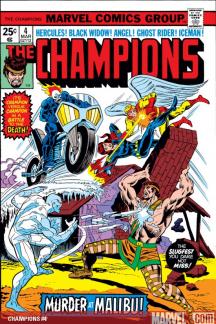
Murder at Malibu!


What makes a team book a fun read? The writing and the art are good places to start. The characters need to be interesting. But the biggest reason is that there needs to be a sense of purpose or an overarching theme behind the group.

The Fantastic Four are essentially a family*, Mr. Fantastic is the husband of the Invisible Girl, brother-in-law of the Human Torch and best friend of the Thing. At its core, there’s a family dynamic. The Avengers are Earth’s Mightiest Heroes. They deal with the stuff that no one else can handle. If you’re an Avenger, you’re the best of the best (at least in theory – I’m looking at you Dr. Druid).

* My theory as to why the FF sucks as a movie: there’s not enough time to establish a family dynamic, figure out how to use their powers and deal with a bad guy. Not in two hours. It would be better as a book. When I say this, people always use “The Incredibles” as a counter argument and that kinda works. But the thing is, “The Incredibles” is about a nuclear family: dad, mom, brother, sister and baby. You already know how that works, that dynamic is practically hardwired into your brain, so you don’t need a lot of time to explain it. The FF isn’t a “traditional” nuclear family and time is needed to establish bonds. Why does Sue love Reed when he’s an obvious asshole? Why are Johnny and Ben so close? Why does Ben defend Reed despite Reed constantly fucking him over? There’s no shorthand to this and it’s not stuff that you can get across in two hours.

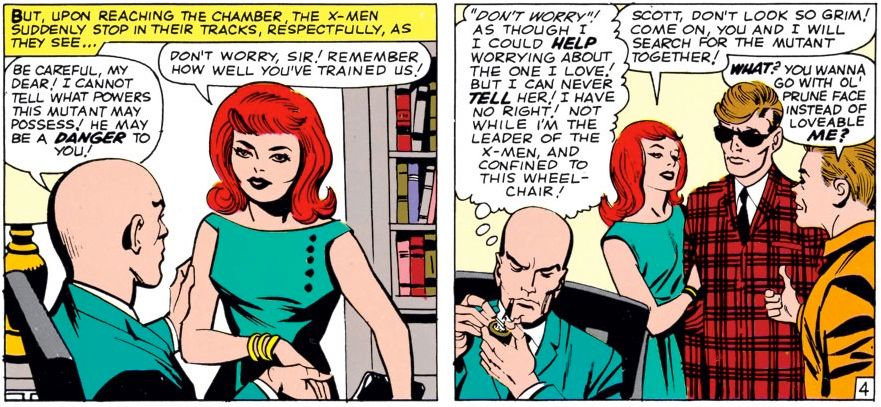
The X-Men are a little different. They’re together because they’re mutants and half the world hates them, the other half fears them. They needed to be brought together to be taught how to use their powers and work for the betterment of mankind. At least that’s what Professor Xavier says, I think he just wanted to look at some young tail.


Yuck.

Even the Defenders had a reason, even if it was an anti-reason: they were a non-team. That meant if the Hulk doesn’t feel like dealing with the villain of the month, he doesn’t have to. The Sub Mariner has things to do in Atlantis, get to it Subby. There were always plenty of heroes hanging around Dr. Strange’s mansion to lend a hand.

Do these teams above bicker with each other? Constantly. But there's that purpose that ties them back. Yes the Thing wants to knock the Human Torch into next week, but he won't because they're practically brothers. Wolverine routinely wants to ram a claw into Cyclops' throat (let's be honest, who doesn't?) but he won't because he believes in Xavier's message.

That brings us to the Champions. It seems that writer Tony Isabella saw that the Marvel method is, "Have teammates argue with each other" and confused it with growth or substance or something and left it at that. We’re in issue four and I still have no idea why they hang around with each other. I mean I get why Angel and Ice Man are pals and everyone probably wants to sleep with Natasha, but the others are just jerks to each other. Bobby has a hair across his ass about Ghost Rider and now Angel does too.

Before I get into that, I need to explain this month's plot a bit: Hercules and Black Widow are walking on the beach when they’re attacked by an old, crazy guy calling himself Billy. He attacks our hero without any provocation and talks about himself in the third-person, which reminds me of Rickey Henderson. Being reminded of Rickey is great.


(My brother had this poster when we were kids, it's so awesome. AND there's a bonus comics pun in there! Who says I don't bring it all home?) 

They kick his ass and are trying to figure out what to do about it when these six goons come around to bring Billy back to where he came from. Hercules isn’t too happy about this because all of a sudden, he likes Billy. The goons shoot him and Widow and the next thing you know they’re at the San Marino State Hospital. I just looked it up and San Marino is 52.3 miles away from Malibu, so I’m not sure what Billy was doing in Malibu anyway and why it took these guys so long to track him down, but comics!

Anyway, Hercules is in cuffs and Widow has a device around her neck that will fry her if either makes the wrong move. It turns out that this scientist is trying to replicate the Super Soldier Serum* and has been testing it on the mentally deranged, the old and the poor. Surprisingly, it hasn’t worked out very well for any of them.

* I love how the SSS only worked for Steve Rogers. It (at least up until I stopped reading comics in the late 80s) never worked well for anyone else. For the most part, after being injected with the SSS, it drove people insane. I think that says a lot for Steve Rogers, that he’s the ultimate American. Not just in terms of mental capacity, but in terms of will and temperament. That’s a nice idea to hold onto, especially if we use him as an avatar for America.
  
This scientist, Dr. Edward Lansing, is planning to try his experiment on both the Widow and Hercules so that they will be his slaves. Their first mission? Destroy the Champions? Why? I don’t know. They just have to, that’s why.

Herc, Nastasha, Dr. Lansing and some more SSSed-up goons attack the Angel, Ice Man and Widow’s friend Ivan. And they’re kind of kicking their asses pretty well, until Ghost Rider shows up. Remember, he’s not only the cavalry, but he’s also the friend and teammate of Angel and Ice Man.

Angel says, “How ‘bout puttin’ your money where your mouth is for once before we all get creamed?” Does the Ghost Rider need this shit? Fuck and no, he doesn’t. If I were Johnny Blaze, I’d turn my bike around and go somewhere else. But Blaze is a better hero than I would be, so he helps the two asshole mutants fight Hercules and it goes okay. Ivan has his hands full with the Black Widow who is literally choking him—like Homer does to Bart*, only less funny.

* The Simpsons are probably my favorite piece of pop culture ever, when they finally leave the airwaves, it's going to be a sad day. But the whole Homer choking Bart “joke” hasn’t really aged well, has it? I guess it’s good that it's a cartoon because seeing a real 38-year-old man choking a real 10-year-old boy would be disturbing.

This act wakes Natasha up and she kicks Dr. Lansing in the face, breaking his control box. The mutates (his words, not mine) end up turning on him and kill him. I guess that once the people under his control kill someone they are then bound to turn into brain dead zombies. Lansing wanted Hercules and Black Widow to kill their fellow Champions so they would be under his control, which seems like a dumb plan. Why don’t you just have them kill a drifter or two? Why take the gamble that they could kill other heroes – even if those heroes are Ice Man and the Angel.

In a rare moment of empathy, Hercules feels bad about these zombies. Are they zombies? I guess they are technically, though they're not dead. It sort of feels like I'm not being sensitive by lumping all brain dead slaves into one big zombie pile. Angel doesn't care for my PC musings (and you know WWIII would vote for Donald Trump and would tell everyone that he did so) and tells the Scion of Zeus not to worry that the cops will take care of them (uh, okay?). Hercules argues that these people were innocents who went to a doctor for help, only to see themselves get experimented on and altered in the worst way.

Does Warren Worthington III take stock in that and feel any empathy? Of course not. He flips the fuck out and says, “All right! There is evil the world Hercules – and Lansing is part of it. But there’s good as well – and we’re a part of that! The question is: do we do anything about it – or do we sit around crying in our beer? #MAGA*”

* He didn't really say the last thing. 

A few things, WWIII:

  1. Hercules wasn’t saying let’s disband the Champions with a murder-suicide pact. He’s just bummed out about what happened to these people.
  2. He didn’t say that you were the cause of this, so just relax.
  3. You have wings, Hercules is one of the strongest people on the planet. He's a demigod. Maybe you should slow your roll a bit.

And that’s what brings me back to my original point: I still have no idea why these people are still together. They don’t seem to like each other too much, they have completely different philosophies for practically everything and aside from mooching off the Angel (he’s rich and underwrites everything that the Champions do and allows him to crash at his place) there’s no symbiotic relationship.

I think that the Champions stories have struggled in these first four issues because the group has struggled to find a purpose. They never answered that one important question: why are the Champions here?

This was a meh issue. The group just sorta defeated literal ancient gods, so fighting a mad scientist is not just a step down, it’s an entire building down. And again, they didn’t really defeat him, Black Widow kicked him and the mutates did the rest of the work (killing him) for them. And BTW, good job Champions of saving Dr. Lansing. No one lifted a finger to help him. At all. 

"Oh? Those screams? Just good old Dr. Lansing being torn apart by a bunch of brain-dead zombies. I wonder if Warren still has that margarita machine? Taco Tuesday y'all!"

You know you're a 90s kid when ... stupid sentence beginning but, every time I read this headline, I sing it to the chorus of the Hole song, "Malibu". I'm sure Courtney Love will be thrilled. 


The George Tuska art was a little better, but the writing lagged. The front cover is boss, so they have a four-issue streak on that. I’d have bought this book if I saw it on a spinner or the magazine rack at Mahoney’s Drug Store in Methuen, MA. I give this issue two vest-wearing Angels out of five.